Police officers carry a cardboard box to a vehicle during a raid in Berlin, Germany, Wednesday, May 24, 2023.
GERMAN authorities raided 15 properties across the country and seized assets in an investigation into the financing of protests by the Last Generation climate activist group, prosecutors said today.
Munich prosecutors said they were investigating seven people on suspicion of forming or supporting a criminal organisation.
They launched the inquiry following numerous criminal complaints they received since mid-2022.
Members of Last Generation have repeatedly blocked roads across Germany in an effort to press the government to take more drastic action against climate change.
In recent weeks, they have brought the traffic to a halt on an almost daily basis in Berlin, glueing themselves to busy intersections and highways.
Over the past year, they have also targeted various artworks and exhibits.
Food prices set to overtake energy bills as cost-of-living crisis ‘epicentre’, report warns
FOOD inflation is up almost 20 per cent on this time last year, new Office for National Statistics showed today.
The consumer prices index (CPI) inflation fell to its lowest level for more than a year last month – but at 8.7 per cent still outstripped average wage increases.
The decline from 10.1 per cent in March was largely down to energy prices stabilising after the sky-high rises from a year ago.
But it was higher than forecast by economists, who had pencilled in a drop to 8.2 per cent in April.
The figures showed food inflation is at 19.3 per cent, down only slightly on March’s 19.6 per cent and remaining close to the highest rate for more than 45 years.
Two billion people, including many Australians, will find themselves living in dangerously hot places this century if global warming reaches 2.7℃, research released today reveals.
The authors calculated how many people would be left outside the “human climate niche” by 2100. The niche is defined as places with an average temperature of about 13℃, or about 27℃ in the tropics. Human population has historically peaked in these areas.
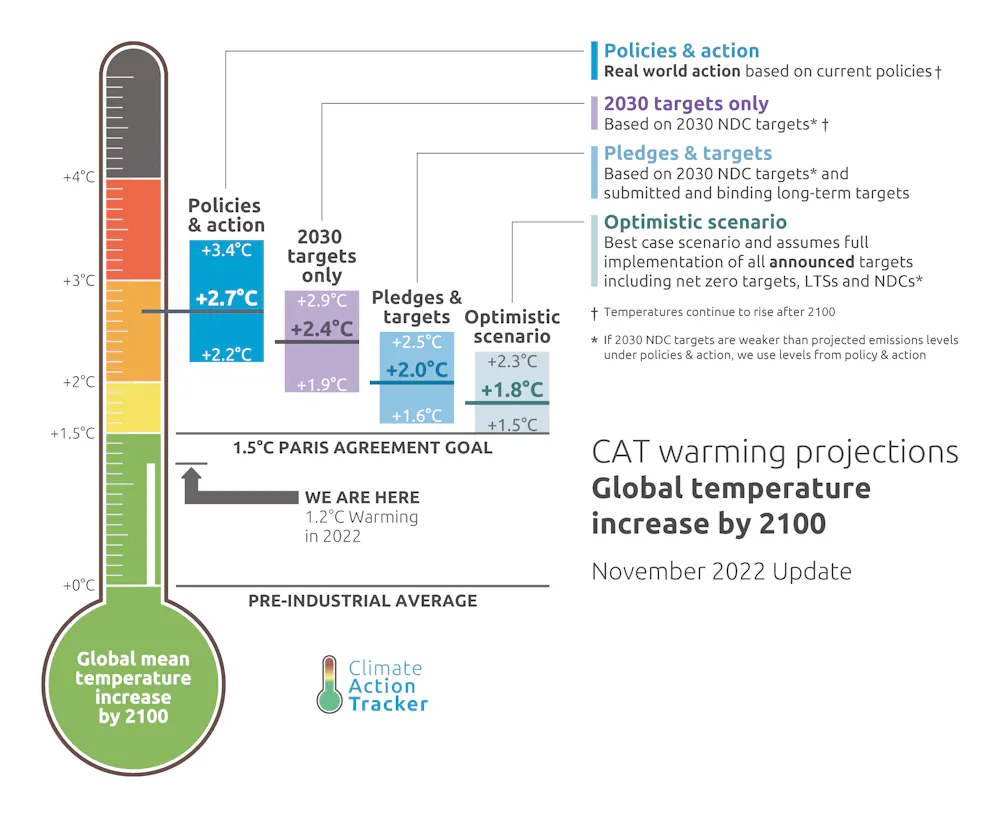
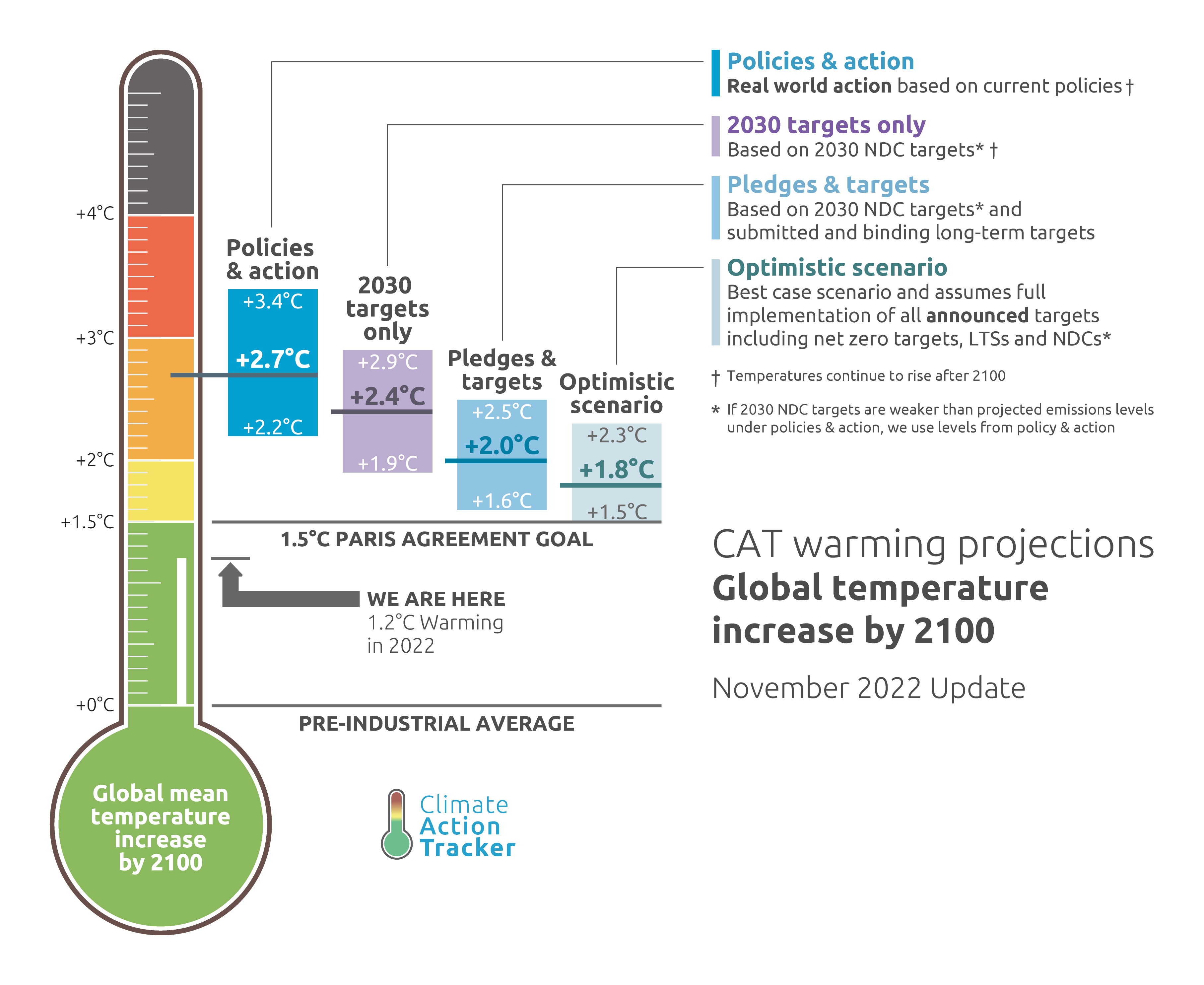
The world is on track for 2.7℃ of warming by 2100. This would push a third of people on Earth outside the human climate niche. This includes people in parts of northwest Australia such as Darwin, Broome and Port Hedland. It also includes parts of Southeast Asia, India, Africa and South America.
Limiting warming to 1.5℃ would substantially reduce the number of people exposed, including most of those affected in northwest Australia.
We were not involved in the research, which was conducted by researchers in the United Kingdom, China, Europe and United States. We are Australian experts in the health implications of global warming. Below, we discuss the broader implications of these globally significant findings.
What is the human cost of global warming?
The research calculated the number of people outside the “human climate niche” under different demographic scenarios and levels of warming. Exposure to unprecedented heat was the main factor pushing people out of the niche.
This includes an average temperature greater than or equal to 29℃, as well as a high number of days with a maximum temperature above 40℃ or in humid places, with a wet-bulb temperature greater than 28℃. The wet-bulb temperature (as opposed to the standard dry-bulb temperature) reflects humidity and is a method used to measure heat stress. That’s because it’s the point at which sweating is no longer effective as a means of cooling.
The study says a wet-bulb temperature of 35 ℃ can be fatal, especially for vulnerable people, because the body can no longer cool itself.
Above the present level of about 1.2 ℃ global warming, the authors found exposure to unprecedented average temperatures increased markedly, along with increased exposure to temperature extremes.
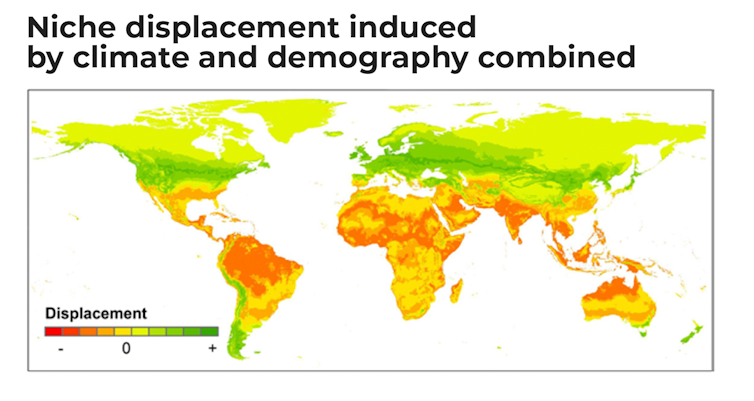
But 2.7 ℃ of warming threatens a third of the world’s population. The below map shows where in the world people will suffer the worst heat. Almost the entire area of some countries, such as Burkina Faso and Mali in West Africa, would be exposed to unprecedented heat.
Just last week, the World Meteorological Organization predicted global surface temperatures would rise to record levels within the next five years. The temperature is also likely to temporarily climb 1.5℃ above pre-industrial levels.
This spells trouble for human health. Even incremental warming increases exposure to health hazards including potentially deadly heatwaves, infectious diseases and diet-related health issues.
Let’s be clear. A 1.5℃ world will result in injury and death, particularly for people in Asia and Africa. Importantly, the people most at risk will be the least capable of protecting themselves: children, the elderly and those with existing health conditions.
While populations closer to the equator are more likely to experience heat-related harm, Australians are by no means immune.
For example, a 2019 study found heat-related health issues in Australia have been grossly underestimated. It found more than 36,000 deaths between 2006 and 2017 were attributable to heat.
And experts predict Darwin could experience an average 265 days a year above 35℃ in a 3℃ warmer world.
The risks to Australia of a 3℃ warmer world (Australian Academy of Science)
To date, the Earth’s average surface temperature has warmed 1.2℃ above pre-industrial levels. We must enact ambitious climate policies now if we are to change our dangerous trajectory.
Historically health has rarely been included in these economic assessments, much less ethical considerations. Emissions reduction policies need to consider health and equity issues, and in doing so can provide governments with a strategic rationale to act.
There are physiological limits to adaptation, particularly to heat. These limits can have negative consequences for labour productivity, especially for outdoor workers, and for health service demand, leading to increased hospital admissions, emergency department visits, and ambulance calls.
Pursuing adaptation measures in an effort to reduce the harmful effects of existing climate change is vital, but to protect the health of all, it is critical that we pursue strong emissions reduction measures.
A commitment to develop and implement a National Health and Climate Strategy and establish a National Sustainability and Climate Unit are promising initiatives. This will help to address our woeful performance in a recent assessment showing how national climate commitments don’t link with health.
Last week, the Victorian Government committed to reducing emissions by 75-80% compared with 2005 levels by 2035. Their analysis indicates it will lead to A$5.7 billion in health benefits from improved air quality between 2035 and 2045.
As today’s new research states, the findings highlight the need for “more decisive policy action to limit the human costs and inequities of climate change”. Australia, in particular, must protect children, the elderly and the broader population from the harms they face in a warmer world.
Annabelle Workman, Research Fellow, Melbourne Climate Futures and Melbourne School of Population and Global Health, The University of Melbourne and Kathryn Bowen, Professor – Environment, Climate and Global Health at Melbourne Climate Futures and Melbourne School of Population and Global Health, University of Melbourne, The University of Melbourne
It’s likely that there will be a diminished service over the next few months because I’m hoping to travel to remote locations with poor connectivity ;) I think that I largely repeat myself and that you’ve probably got the message anyway – assert yourselves, protest, Tories are scum, Starmer’s lot are Tories, Just Stop Oil, it’s the rich that are destroying our beautiful World, etc.
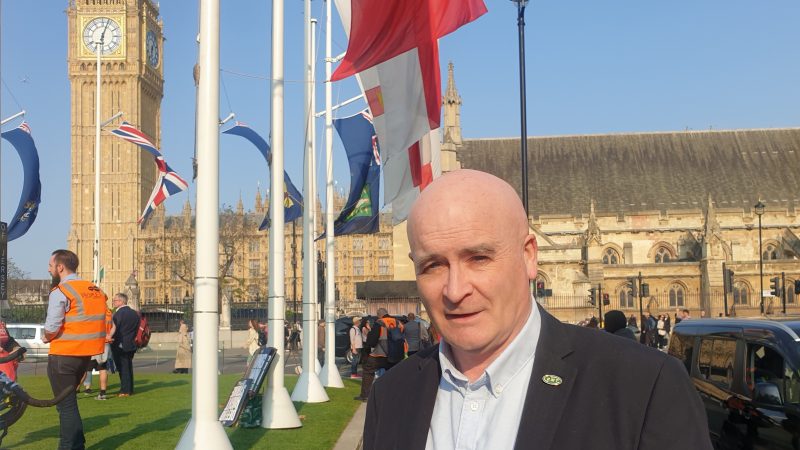
Standing in a sunny Parliament Square surrounded by a colourful mix of trade union flags, Mick Lynch spoke to LFF about the troubling state of democracy in Britain.
The RMT general secretary was a speaker at the emergency protest organised ahead of the final Parliament vote on the anti-strike legislation, Strikes (Minimum Service Levels) Bill.
…
For Lynch, the anti-strike legislation comes under a broader attempt by the Tory government to clamp down on any kind of opposition, warning that a threat to trade union power is a threat to democracy.
“The government has got an attitude towards anything they don’t agree with, any kind of dissent. It could be politically or more broadly socially, where if they don’t agree with people, they try to ban them,” said Lynch.
“We got these police bills and these counter-demonstration bills where people will be stopped from demonstrating or protesting.
“We saw that during the coronation, one of the most passive pieces of civil disobedience if you like, was banned in effect and people were put in jail for the day.
“They’re trying to clamp down on any dissent, and I think that’s a very troubling state, and it’s time for the British people to wake up to that and see that if trade unions, which are an organic part of life and grow in every society, if they’re not allowed to function properly, democracy in this country is in a lot of trouble.
“We’ve got to make sure that people are out opposing that and we’ve got to make sure that people understand the issues.