Protesters from Greenpeace, Stay Grounded, Extinction Rebellion and others chain themselves to aircraft in Geneva
Dozens of climate activists have disrupted Europe’s largest private jet trade fair by chaining themselves to aircraft to protest against the sector’s carbon emissions.
The demonstrators on behalf of Greenpeace, Stay Grounded, Extinction Rebellion and Scientist Rebellion also attached themselves to the entrance gates of the event at Geneva airport in the hope of preventing prospective buyers from entering the annual show.
The activists, who were calling for a global ban on the use of private jets because of their carbon footprint, stuck tobacco-style health warning labels on some of the jets at the European Business Aviation Convention and Exhibition (EBACE) saying private jets “burn our future”, “kill our planet”, and “fuel inequality”.
— Stay Grounded Network (@StayGroundedNet) May 23, 2023
❗HAPPENING NOW❗ More than 100 brave climate activists from @Greenpeace@staygroundednet @extinctionrebellion and @scientistrebellion demand #BanPrivateJets in #EBACE, the biggest private jet sales fair in Europe, an event for private jet users to keep buying and flying in their… pic.twitter.com/JUP7UCZnP2
— Greenpeace International (@Greenpeace) May 23, 2023
… In a tense moment during the meeting, which had already been delayed for nearly an hour, security stepped in to prevent a protester from reaching chairman Sir Andrew Mackenzie and other board members on the stage.
Dozens of protesters were escorted out by members of the security team at London’s Excel conference centre.
“Obviously that last incident went a stage further than we experienced in the first part of today,” Mackenzie said, after protesters had been escorted out.
…
Early in the meeting, a group of protesters sang, “Go to hell Shell and don’t you come back no more, no more, no more, no more,” to the tune of the Ray Charles song Hit the Road Jack.
The first protester to get up shouted: “Welcome to Shell… complicit in the destruction of people’s homes, livelihoods and lives. Welcome to hell.”
…
UPDATE: Climate protesters attempt to storm the stage of Shell AGM!!!
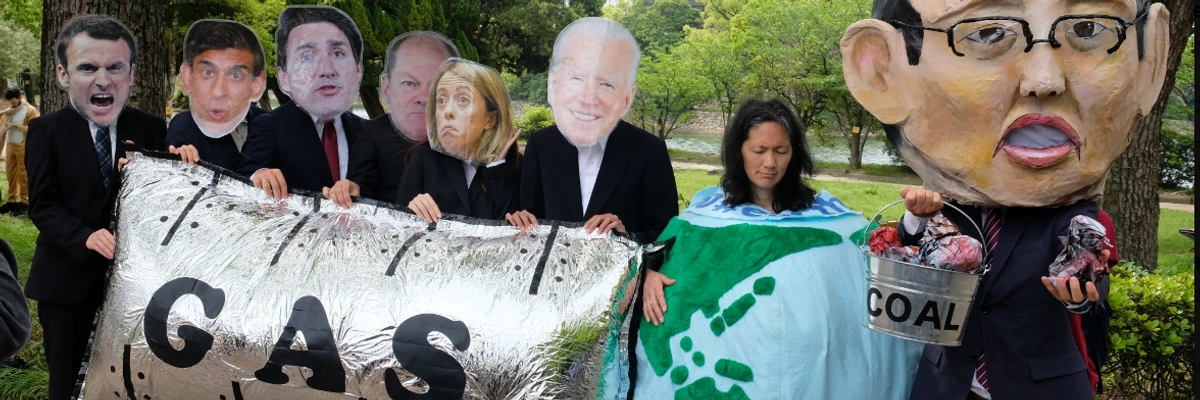
Activists with masks of Group of Seven leaders protest fossil fuels. (Photo: 350.org Japan/Friends of the Earth Japan/Oil Change International)
“Energy security can only be achieved by rapidly and equitably phasing out fossil fuels and transitioning to renewable energy, not locking in deadly fossil fuels and lining the pockets of oil and gas executives,” said one critic.
Since Group of Seven leaders on Saturday put out a wide-ranging communiqué from a Japan-hosted summit in Hiroshima, climate action advocates from G7 countries and beyond have blasted the statement’s support for future investments in planet-heating gas.
The statement comes after G7 climate, energy, and environment ministers were criticized for their communiqué from a meeting in Sapporo last month as well as protests around the world this week pressuring the summit’s attendees to ditch fossil fuels and “deliver a clear and just renewable energy agenda for a peaceful world.”
To meet the 1.5°C goal of the Paris climate agreement, the new statement commits to “accelerate the phaseout of unabated fossil fuels so as to achieve net-zero in energy systems by 2050 at the latest” along with “the elimination of inefficient fossil fuel subsidies by 2025 or sooner.”
“The G7 must stop using fossil fuels immediately—the planet is on fire.”
The statement also highlights that last year, G7 nations—Canada, France, Germany, Italy, Japan, the United Kingdom, and the United States—pledged to end “new direct public support for the international unabated fossil fuel energy sector, except in limited circumstances,” though as recent analysis shows, some are breaking that promise.
The communiqué then endorses liquefied natural gas (LNG) as a solution to “the global impact of Russia’s war on energy supplies, gas prices and inflation, and people’s lives,” referencing the invasion of Ukraine:
In this context, we stress the important role that increased deliveries of LNG can play, and acknowledge that investment in the sector can be appropriate in response to the current crisis and to address potential gas market shortfalls provoked by the crisis. In the exceptional circumstance of accelerating the phaseout of our dependency on Russian energy, publicly supported investment in the gas sector can be appropriate as a temporary response, subject to clearly defined national circumstances, if implemented in a manner consistent with our climate objectives without creating lock-in effects, for example by ensuring that projects are integrated into national strategies for the development of low-carbon and renewable hydrogen.
“The G7 energy outcome correctly diagnoses a short-term need for energy security, then promotes a dangerous and inappropriate lock-in of fossil gas that would do nothing to address this need,” responded Collin Rees, United States program manager at Oil Change International (OCI). “Energy security can only be achieved by rapidly and equitably phasing out fossil fuels and transitioning to renewable energy, not locking in deadly fossil fuels and lining the pockets of oil and gas executives.”
After accusing the summit’s attendees of “using the war as an excuse,” deflecting blame for current conditions, and neglecting Global South countries disproportionately suffering from the climate crisis, Max Lawson, head of inequality policy at Oxfam, declared that “the G7 must stop using fossil fuels immediately—the planet is on fire.”
— Fossil Fuel Non-Proliferation Treaty Initiative (@fossiltreaty) May 20, 2023
Greenpeace International global climate politics expert Tracy Carty also demanded a swift end to fossil fuels, charging that “G7 leaders’ endorsement of new fossil gas is a blunt denial of the climate emergency” which dooms “current and future generations.”
Gerry Arances, executive director of the Philippine Center for Energy, Ecology, and Development, similarly argued that “the endorsement of increased LNG deliveries and investment in gas in the G7 communiqué is no mere backsliding—it is a death sentence being dealt by the G7 to the 1.5°C limit and, in consequence, to the climate survival of vulnerable peoples in the Philippines, Southeast Asia, and across the world.”
“Unless they genuinely put forward the phaseout of all fossil fuels, Japan and all G7 nations spout nothing but lies when they say they have aligned to 1.5°C,” he continued. “They cannot claim to be promoting development while subjecting our people to decades more of pollution and soaring energy prices. We reject this notion of a development powered by fossil fuels.”
Looking to the United Nations Climate Change Conference (COP28) planned for later this year, Arances added that “Japan and G7 leaders should already be warned that civic movements will not tire in pushing back against fossil fuels and false solutions and in demanding a renewable energy transition.”
“Civic movements will not tire in pushing back against fossil fuels and false solutions and in demanding a renewable energy transition.”
Other campaigners also specifically called out the Hiroshima summit’s host—including Ayumi Fukakusa, deputy executive director at Friends of the Earth Japan, who asserted that the country “has used the G7 presidency to derail the global energy transition.”
“Japan has been driving the push to increase gas investments and has been promoting its so-called ‘green transformation’ strategy,” Fukakusa said of a “greenwashing scheme” featuring hydrogen, ammonia, nuclear, and carbon capture and storage technologies.
OCI Asia program manager Susanne Wong agreed that given the nation’s promotion of gas expansion and technologies to prolong the use of coal, “this year’s G7 is revealing Japan’s failure of climate leadership at a global level.”
“Activists mobilized 50 actions across 22 countries this week to demand that Japan end its fossil fuel finance and stop driving the expansion of gas and other fossil-based technologies,” Wong added. “Japan will continue to face intense international scrutiny until it stops fueling the climate crisis.”
Shame on Canada & other #G7 leaders for caving to the narrow financial interests of fossil gas companies
The world is burning and our leaders keep dumping more fuel on the fire https://t.co/j2aPHx24AB
Groups from other G7 countries also called out their political leaders. Petter Lydén, head of international climate policy at Germanwatch, said, “Most likely, the German chancellor, Olaf Scholz, has been a driving force behind the weak language on gas, which is a serious blow to Germany’s international credibility on climate.”
Citing sources familiar with summit negotiations, The New York Timesreported Saturday that “Britain and France fought the German effort” while U.S. President Joe Biden was caught between defending his climate agenda and “aiding other United States allies intent on increasing their access to fossil fuels.”
OCI’s Rees said the that “this betrayal continues a disturbing turn by President Biden and Chancellor Scholz from rhetorically committing to climate leadership to openly boosting fossil fuel expansion. History will not look kindly on world leaders who accelerate the pace of fossil fuel buildout in the face of worsening climate crisis.”
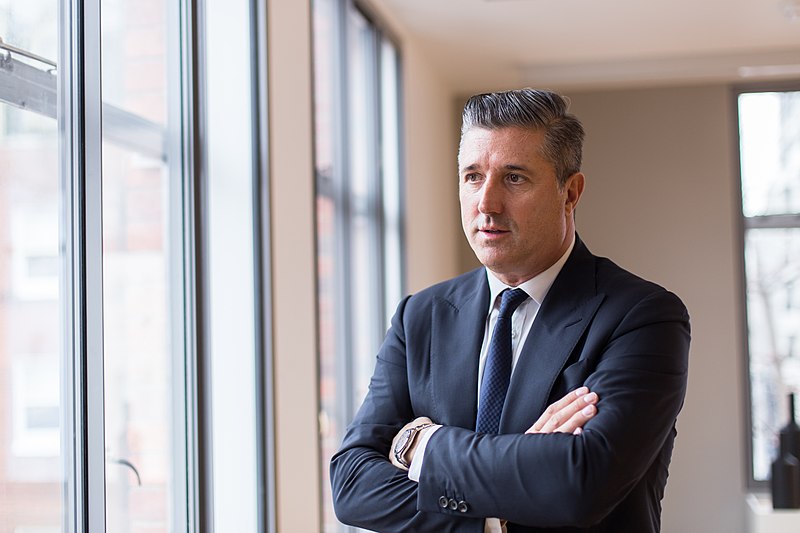
A former ‘playboy’-turned-businessman made a fortune supplying PPE during the pandemic, even though the NHS may be unable to use millions of the gowns his company delivered, openDemocracy can reveal.
Chemical Intelligence Limited was awarded a £126m contract to supply 21 million medical gowns that were desperately needed to protect NHS workers treating Covid patients in May 2020. But data released to openDemocracy through freedom of information law shows the Department of Health and Social Care later deemed 4.5 million of them – worth an estimated total of £27m – “not fit for use” in the NHS.
Lawyers acting on behalf of Robert Gros, the sole owner and CEO of Chemical Intelligence, said Gros could not comment because he “did not recognise these figures or amounts”.
The bumper PPE contract allowed Gros, 51, to turn around his business, which had made losses two years running prior. Chemical Intelligence declared profits of £33m for the year up to September 2020 according to accounts filed on Companies House. It had just two employees, including Gros, when it landed the multi-million pound government contract.
Gros personally splashed out on a £4m country pile just four months after he clinched the PPE deal. In 2021, after his company reported a further £31m in profits, he bought a second £2m country home and asked for planning permission to fit a basement bowling alley in the first.
The businessman then paid himself £7m in dividends in January 2022 – after having already loaned himself £6m the year before. Two months later, he transferred £40m in dividends to a holding company that he entirely owns.
Gros would only answer our questions through his lawyers, who told us that he has paid all the necessary corporation tax and that the £4om would “continue to be reinvested” in his business.
The £126m contract was one of many for which the government apparently paid over the odds as demand for PPE skyrocketed during the pandemic and it did not have enough stockpiled. Gowns cost the government 1,260% more than they did before the pandemic, according to the National Audit Office.
A fifth of gowns supplied by Chemical Intelligence were labelled “not fit for use” because they “failed the technical, clinical or regulatory compliance assessment”, openDemocracy understands. The department would not elaborate on why the gowns failed checks, but according to the data released under FOI their value has been written down to £0.
“The department has processes in place to review the quality of PPE and determine whether products are suitable to be released to the frontline,” said a spokesperson. “Upon receipt, a sample of each product is reviewed by DHSC’s Technical and Regulatory Assurance team.
“A proportion of this stock was classified as ‘do not supply’. Stock in this category has not necessarily fallen short of standards and in many cases these products can be used in other settings.”
Gros’s lawyers insisted that all the PPE the company had supplied was “fit for purpose and use”, suggesting the DHSC may have been mistaken in its record-keeping. The department confirmed that Chemical Intelligence also supplied £35m worth of face masks and disposable surgical aprons under separate contracts also awarded in 2020, none of which was deemed unusable.
Of the £12bn the government spent in total on PPE, £4bn worth cannot be used by the NHS because it doesn’t meet the right standards, according to a 2022 report by the Public Accounts CCommittee of MPs.
Gros’s lawyers said that the sharp rise in profits for Chemical Intelligence was not all down to PPE deals he struck during the pandemic, and threatened openDemocracy with an injunction if we revealed details about his mansions.
The businessman, who had a reputation as a “playboy” in the late 1990s after dating a string of soap stars, appears to have made the most of his new fortune. The Cambridgeshire house he bought a few months after the contract was signed had six bedrooms, four reception rooms, a swimming pool and a gym, all heated by three boilers.
Three months later, he lodged a planning application with Cambridge City Council to more than double the size of the property. The proposed plan included the addition of a basement housing a dance floor, a two-lane bowling alley, a golf simulator, a room for arcade machines and a cinema.
Gros was forced to withdraw the application after it was rejected by planners for being too “modern” in style; neighbours had also raised concerns about the potential noise from the proposed bowling alley and dance floor. He resubmitted a new application in November, which was approved in April.
In June 2021, through another company of which he was the sole owner, Gros bought a second mansion with six bedrooms, three garages and an outdoor pool for £2m in a neighbouring village.
Chemical Intelligence, which Gros founded in 2012, develops medical examination gloves, which have been licensed to and manufactured by Malaysian firm Hartalega since 2017.
Hartalega is one of several Malaysian glove manufacturers that have been accused of using modern slavery. A leaked report by the Home Office in 2019 found there was “strong evidence” to suggest that the majority of Malaysian glove manufacturers that supply the NHS, which include Hartalega, “exhibit forced labour indicators”.
Lawyers acting for Chemical Intelligence said that the company “takes the issue of modern slavery extremely seriously and carried out its own due diligence to seek to satisfy itself that throughout the manufacturing process all of the correct procedures and safeguards are in place”.
Chemical Intelligence was one of 58 suppliers awarded a contract to supply medical gloves to the NHS in January 2022, but no information has been published on whether it has yet done so.
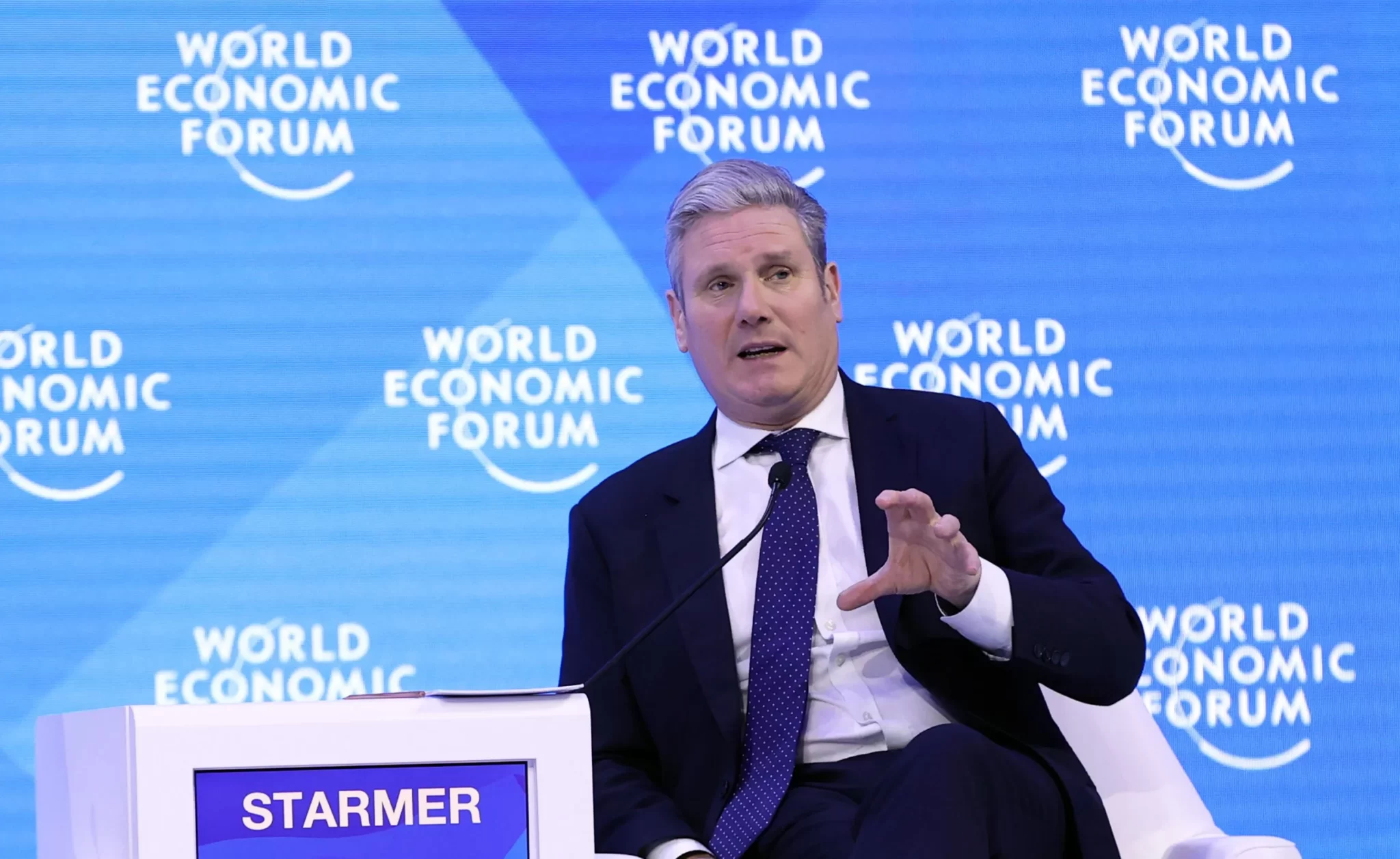
EVERYONE who works in or depends on the NHS should be deeply concerned at Keir Starmer’s vision for the service.
Like so many cheerleaders for public-sector “reform” — which has invariably meant fragmentation and privatisation over the last 40 years — he accuses those calling for higher investment of avoiding the big issues. Yet that is what he is doing.
Starmer dodges questions on NHS pay, despite ongoing disputes involving doctors, nurses, paramedics, porters and domestics.
These disputes have prompted the biggest strikes in NHS history this year — but Labour is “not focused” on pay rises, he says.
That’s not good enough from the leader of a party founded to represent organised labour. Especially since we know from his previous comments that they regard inflation-proofed pay demands as “unaffordable.”
…
Starmer says the NHS cannot cope with more years of Tory government, and he is right. But on a prospectus like this — no promises on investment, no promises on pay, blind faith in “technology” and continued exploitation by the private sector — its agony would continue on his watch, too.