Pro-Coal MP Appointed to Lead Influential Cross-Party Environment Group

Spread the love

Original article by Phoebe Cooke and Sam Bright republished from DeSmog.
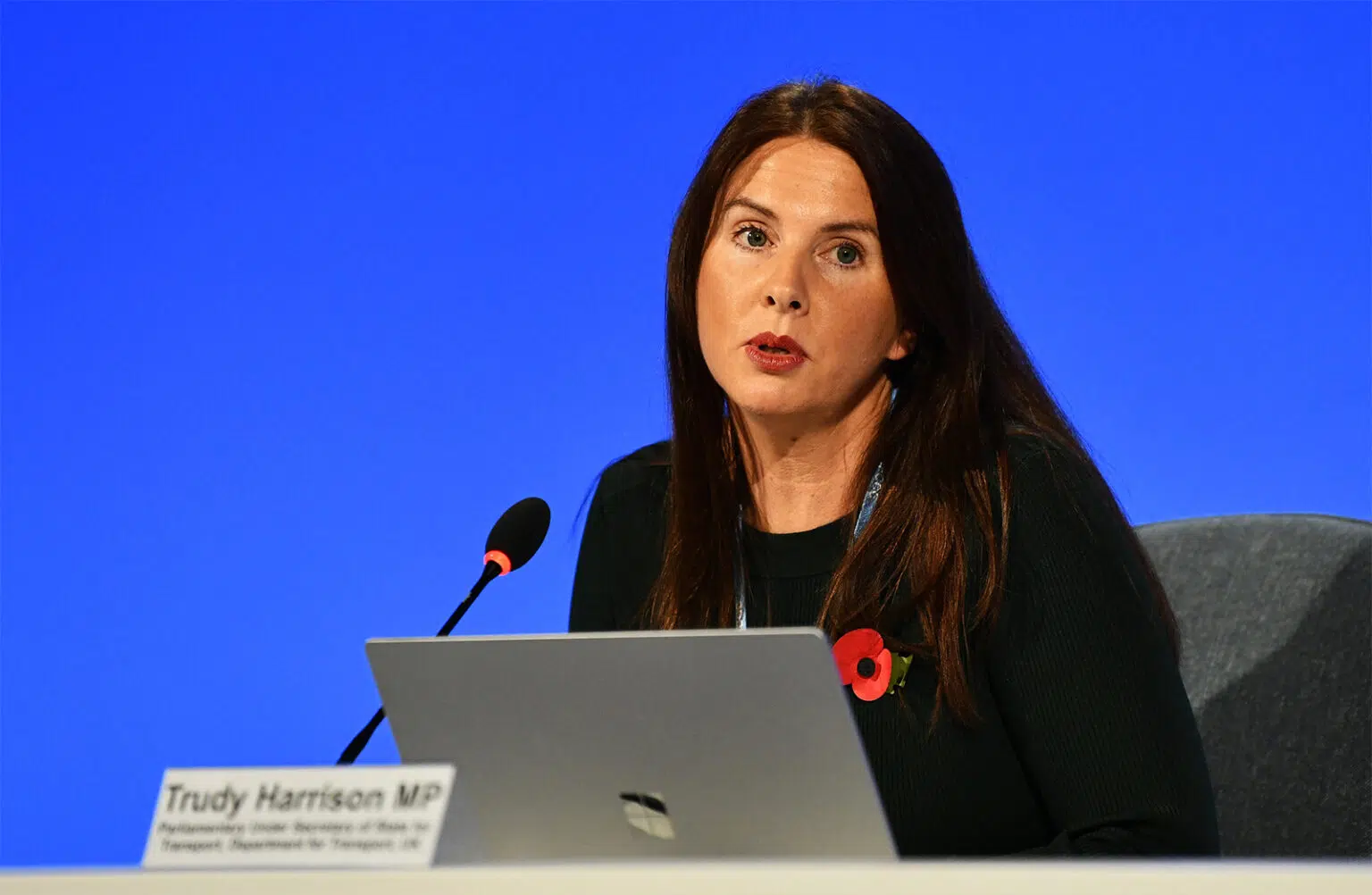
Conservative MP Trudy Harrison. Credit: Justin Goff/UK Government (CC BY-NC-ND 2.0)

Conservatives accused of a “stitch up” as Trudy Harrison replaces Green Tory Chris Skidmore.

A Tory MP who backed the UK’s first new coal mine in over 30 years has been elected to chair the all-party parliamentary group (APPG) on environment.

Desk-banging and jeering were heard in the House of Commons committee room on Wednesday night as lawmakers voted in Trudy Harrison, who represents Copeland in West Cumbria – where the proposed mine in Whitehaven is located. 

Harrison replaces former Conservative MP Chris Skidmore, who resigned from the Commons in January in protest at the government’s move to issue new North Sea Oil and gas licences.

The Copeland MP’s selection was welcomed on social media by the all-party group, which tweeted: “We look forward to working with Trudy as we continue to provide an ambitious, cross-party voice for climate and nature in Parliament.”

Around 40 MPs and peers elected Harrison in the raucous voting session, which was open to all members of the Commons and Lords. 

DeSmog understands that a large number of Conservatives turned out to sway the vote in Harrison’s favour, with several people in the room reporting a frenetic atmosphere. “Hordes of Tories” were said to outnumber Labour MPs, many of whom were running late and barred from entry.

“They clearly felt it a point of principle that they keep control of the chair, regardless who the candidate was – the whole thing was a stitch-up,” a source said, adding: “I think if the public saw how things really work here they would be horrified.”

All-party parliamentary groups have no formal role in Parliament but can often act as an influential forum for debate, and also produce reports, and make policy recommendations. The chair is a pivotal role, tasked with providing direction to the secretariat – the body that formally runs the APPG – as well as leading on the execution of its agenda. 

The appointment of a pro-coal MP in this role comes after a week of shattered climate pledges from both main Westminster parties. On Thursday, the Labour Party announced it would scrap its commitment to spend £28 billion a year on green investments, days after it was reported the Conservatives are poised to ditch a mechanism that could slash emissions from domestic heating.

In January, DeSmog revealed energy secretary Claire Coutinho had accepted thousands of pounds from Michael Hintze, one of the early backers of the UK’s main climate science denial group, the Global Warming Policy Foundation. A member of the group’s board was also appointed to a parliamentary committee on climate change.

“Slowly, slowly, fossil fuel interests are taking over our institutions,” Jolyon Maugham of the Good Law Project told DeSmog. 

Alice Harrison, head of fossil fuels campaigning at Global Witness, said: “it seems the new chair of the All-Party Parliamentary Group on the Environment is also a big fan of coal. The Conservatives want to take us back to the 19th century.”

Coal mine controversy

Harrison, who served as an environment minister until November last year, advocated passionately for the proposed mine in Whitehaven as it became a political flashpoint in discussions over the UK’s commitment to net zero. 

At the 2021 planning inquiry she described the coal as an “environmentally friendly” domestic source for steel. She characterised opposition to the mine as “simply gesture politics”, adding that the coal would help “build the technologies powering us to net zero”.

Levelling up Secretary Michael Gove finally approved plans for the mine in 2022, but it remains deeply controversial. 

Coal is the most polluting fossil fuel, releasing more carbon dioxide than oil or gas when burnt. It also produces toxic elements like mercury, arsenic and soot, which contribute to air pollution. If it went ahead, the mine would emit nine million tonnes of carbon dioxide and 15,000 tonnes of methane a year.

Despite the green light, the mine still only has four percent of the funding required to operate, according to campaigners. A number of legal challenges are also pending.

Scenarios laid out by the Intergovernmental Panel on Climate Change (IPCC) make it clear that global coal use has to collapse to limit global heating to 1.5 degrees and avoid the most devastating impacts of climate change. This week, it was reported that global heating had for the first time  averaged more than this temperature over a 12-month period.

Harrison, like other supporters of the mine in Whitehaven, has argued that the “coking” coal from this mine is suitable for use by the UK steel industry. But industry bosses have said that the Cumbrian coal is too high in sulphur, which rules it out for use  in British and European steelworks. 

West Cumbria Mining, the company behind the project, claims the project will create around 500 jobs. However, Westmorland and Lonsdale Liberal Democrat MP Tim Farron said the government was giving the false hope of jobs for political reasons. The jobs, he said, would be short term because the mine’s business case “didn’t stack up”.

Anne Harris from Coal Action Network told DeSmog: “This appointment makes a mockery of the Environment APPG and shows that this government can never be trusted with this enormous crisis facing humanity.

“In supporting a new coal mine in Cumbria, Harrison is in a minority, and out of touch with the full impacts of climate change and how fossil fuels cause it. It’s a lie to say the proposed coal mine in West Cumbria would be anything other than a climate disaster.”

The all-party parliamentary group exists to “strengthen the influence of parliamentarians on public policy and public debate on the environment, and to assist parliamentarians by improving their access to specialist information.”

Prior to its latest meeting, the Environment APPG had 25 officers (MPs and peers) who participated in its work. These included Green Party MP Caroline Lucas, Shadow Minister for Energy Security Alan Whitehead, Liberal Democrat energy and climate spokesperson Wera Hobhouse, and former Labour environment minister Barry Gardiner. 

Harrison, and the Department for Energy Security and Net Zero did not respond to requests for comment. The APPG for Environment declined to comment.

Original article by Phoebe Cooke and Sam Bright republished from DeSmog.
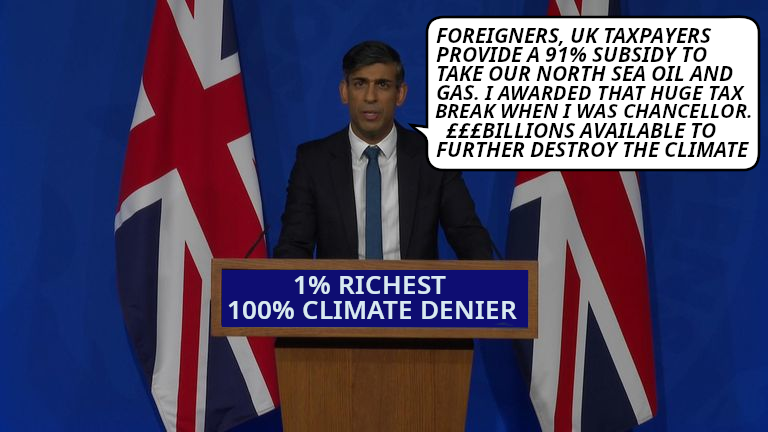
Rishi Sunak offers huge fossil fuel subsidies to develop fossil fuel extraction in UK.
Continue ReadingPro-Coal MP Appointed to Lead Influential Cross-Party Environment Group

‘We will not rest until we put an end to this monstrosity’

Spread the love

https://morningstaronline.co.uk/article/we-will-not-rest-until-we-put-an-end-to-this-monstrosity

People during a pro-Palestine protest in Whitehall, central London, to call for a ceasefire in the conflict between Israel and Hamas, February 12, 2024

Palestine supporters to mobilise worldwide in call for a ceasefire as Israel mounts attack on Gaza’s last refuge

PALESTINE supporters in Britain and worldwide are expected to mobilise in huge numbers in a Global Day of Action on Saturday as Israel mounts its attack on the Gazan people’s last refuge, Rafah.

With 1.4 million people, mainly refugees, crammed into a city which is customarily home to less than 200,000, the feared effects of the Israeli onslaught have provoked mounting anger and increased calls for a ceasefire.

In Parliament next week, a Commons motion from the Scottish National Party calling for a ceasefire is expected to polarise MPs’ opinions and test Sir Keir Starmer’s authority over his own backbenchers.

Israel’s embassy in London will be among the targets for protests on Saturday for the first time since the weekly demonstrations began in October.

Thousands of people are expected to lobby Scottish Labour’s annual conference in Glasgow to demand that the party call for a ceasefire.

The SNP’s Commons motion calling for a ceasefire is expected to be heard on Wednesday, a week before the Rochdale by-election which has seen Labour dump its own candidate over his comments on Israel’s war on Gaza.

The motion “recognises that the only way to stop the slaughter of innocent civilians is to press for a ceasefire now.”

https://morningstaronline.co.uk/article/we-will-not-rest-until-we-put-an-end-to-this-monstrosity

Continue Reading‘We will not rest until we put an end to this monstrosity’

Australian lawmakers call for Julian Assange’s release ahead of extradition appeal

Spread the love

Original article by Tanupriya Singh republished from peoples dispatch under a Creative Commons Attribution-ShareAlike 4.0 (CC BY-SA) license.

The motion in parliament, which was supported by Prime Minister Anthony Albanese, has called for the return of imprisoned WikiLeaks founder Julian Assange to his family in Australia. Assange is days away from a final court hearing in the UK against his extradition to the US.

On February 14, lawmakers in Australia’s parliament voted 86-42 in support of a motion calling on the UK and the US to return arbitrarily imprisoned WikiLeaks founder and journalist, Julian Assange, to his home and family in Australia.

The move, which was also supported by Prime Minister Anthony Albanese, came just days before the High Court of Justice in London will decide if Assange can continue to contest his extradition to the US through the UK’s legal system.

The US has indicted Assange on 18 charges, 17 of which are under the notorious Espionage Act, in relation to the publication of confidential documents on WikiLeaks that exposed the war crimes and atrocities committed by US forces during the invasions of Iraq and Afghanistan. If convicted, Assange would face up to 175 years in a maximum security prison.

The 52-year-old journalist has already been held at the UK’s high security Belmarsh prison for nearly five years, without charge or conviction, amid serious concerns over his mental and physical health.

“Mr. Assange has been deliberately exposed, for a period of several years, to progressively severe forms of cruel, inhuman or degrading treatment or punishment, the cumulative effects of which can only be described as psychological torture.” Nils Melzer, the former UN Special Rapporteur on torture, had said of the journalist’s condition back in 2019.

Addressing a press conference on February 15, Assange’s partner, Stella, stated that his “life is at risk every single day he stays in prison– and if he is extradited he will die”, warning that Assange could be “on a plane within days”.

The public hearings on February 20 and 21 will mark the culmination of a protracted legal battle for Assange. A two-judge bench of the High Court will review a June 6, 2023 decision by Justice Jonathan Swift, in which he had rejected all eight grounds of appeal filed by Assange’s legal team.

If approved, the appeal will challenge the extradition order approved by the UK Home Office in June 2022.

Read more: Assange completes four years in UK jail, struggle against US extradition continues

On Wednesday, independent lawmaker Andrew Wilkie introduced a motion in the Australian parliament, calling on the US and the UK to bring “the matter to a close so that Mr. Assange can return home to his family in Australia”.

“This will be the time for all of us to take a stand, to stand up and to take a stand, and to stand with Julian Assange, stand for the principles of justice, stand for the principles of media freedom and the rights of journalists to do their job…This has gone on too long, that it must be brought to an end.”

Commenting directly on the matter in Parliament on February 15, PM Albanese stated that there was a “common view” that “enough is enough”. “People will have a range of views about Mr. Assange’s conduct… but regardless of where people stand, this thing cannot just go on and on indefinitely.”

He went on to state, “I hope it can be resolved amicably. It’s not up to Australia to interfere in the legal processes of other countries, but it is appropriate for us to put our very strong view that those countries need to take into account the need for this to be concluded.”

The Prime Minister’s ambiguous statements throughout the legal proceedings, including a refusal to outrightly call for a withdrawal of the extradition order, has been criticized by progressive, anti-imperialist forces, with the late renowned journalist John Pilger having called it a “betrayal” in March 2023.

Read more: The betrayers of Julian Assange 

Addressing reporters outside Parliament House on Thursday, Assange’s brother, Gabriel Shipton, warned that his extradition would mean that “all the ties to his family, his lifeline that are keeping him alive inside that prison will be cut off and he’ll be lost into a horrific prison system in the United States”.

He added that the vote in parliament had given the Australian government a “real mandate to advocate very, very strongly for a political solution” to bring Assange home.

“It’s not just about being extradited. Julian should never have been put in prison in the first place,” Stella Assange implored on Thursday, as journalists and activists across the world have warned of the impact Assange’s case could have on the press.

“We are seeing a critical attack on press freedom worldwide. It is like a disease, an anti-press pandemic, creeping up on us that has been incrementally taking shape over the years”, said WikiLeaks editor-in-chief Kristinn Hrafnsson, adding that Assange had been the “canary in the gold mine”.

Read more: Julian Assange case: 4 things that the media doesn’t tell you

Assurances about conditions in US prison are “dubious”, say advocates

This was reiterated by over 35 law professors in the US in a letter sent to the Department of Justice on February 14, stating that Assange’s prosecution posed an “existential threat” to the freedom of speech and press enshrined under the First Amendment.

These “constitutional implications” could “extend beyond the Espionage Act and beyond national security journalism [to] enable prosecution of routine newsgathering under any number of ambiguous laws and untested legal theories.”

Assange’s extradition to the US was approved on the basis of supposed “assurances” given by the US regarding his safety, including the avoidance of what are called “special administrative measures” (SAMs) — a horrific punitive measure that combines “the brutality and isolation of maximum-security units with additional restrictions that deny individuals almost any connection to the human world”.

However, human rights organizations and observers had immediately warned that these “assurances” were unreliable and could be arbitrarily revoked.

“The US assurances cannot be trusted. Dubious assurances that he will be treated well in a US prison ring hollow considering that Assange potentially faces dozens of years of incarceration in a system well known for its abuses, including prolonged solitary confinement and poor health services for inmates,” stated Julia Hall, the international expert on counter-terrorism and criminal justice in Europe at Amnesty International.

If the High Court of Justice in London does not rule in favor of Julian Assange next week, Stella Assange has stated that he will then approach the European Court of Human Rights (ECHR), seeking urgent measures to halt his extradition under Rule 39— granted when there is an “imminent risk of irreparable harm” — pending a full consideration of his case.

The present UN Special Rapporteur Dr. Alice Edwards, has also pointed out that outside of the legal process, the ultimate decision to actually proceed with the extradition will lie with the US Secretary of State. Antony Blinken, for his part, had rebuffed calls by the Australian government last year to drop the prosecution.

“The UK is a party to the UN convention against torture as well as the European convention on human rights, both of them have Article 3 which prohibits states from sending people to where they may face this type of treatment [torture],” Edwards said.

Original article by Tanupriya Singh republished from peoples dispatch under a Creative Commons Attribution-ShareAlike 4.0 (CC BY-SA) license.

Continue ReadingAustralian lawmakers call for Julian Assange’s release ahead of extradition appeal

Petro condemns “institutional rupture” and attacks on Colombian democracy by the right-wing

Spread the love

Original article republished from peoples dispatch under a Creative Commons Attribution-Share Alike 4.0 (CC BY-SA) license.

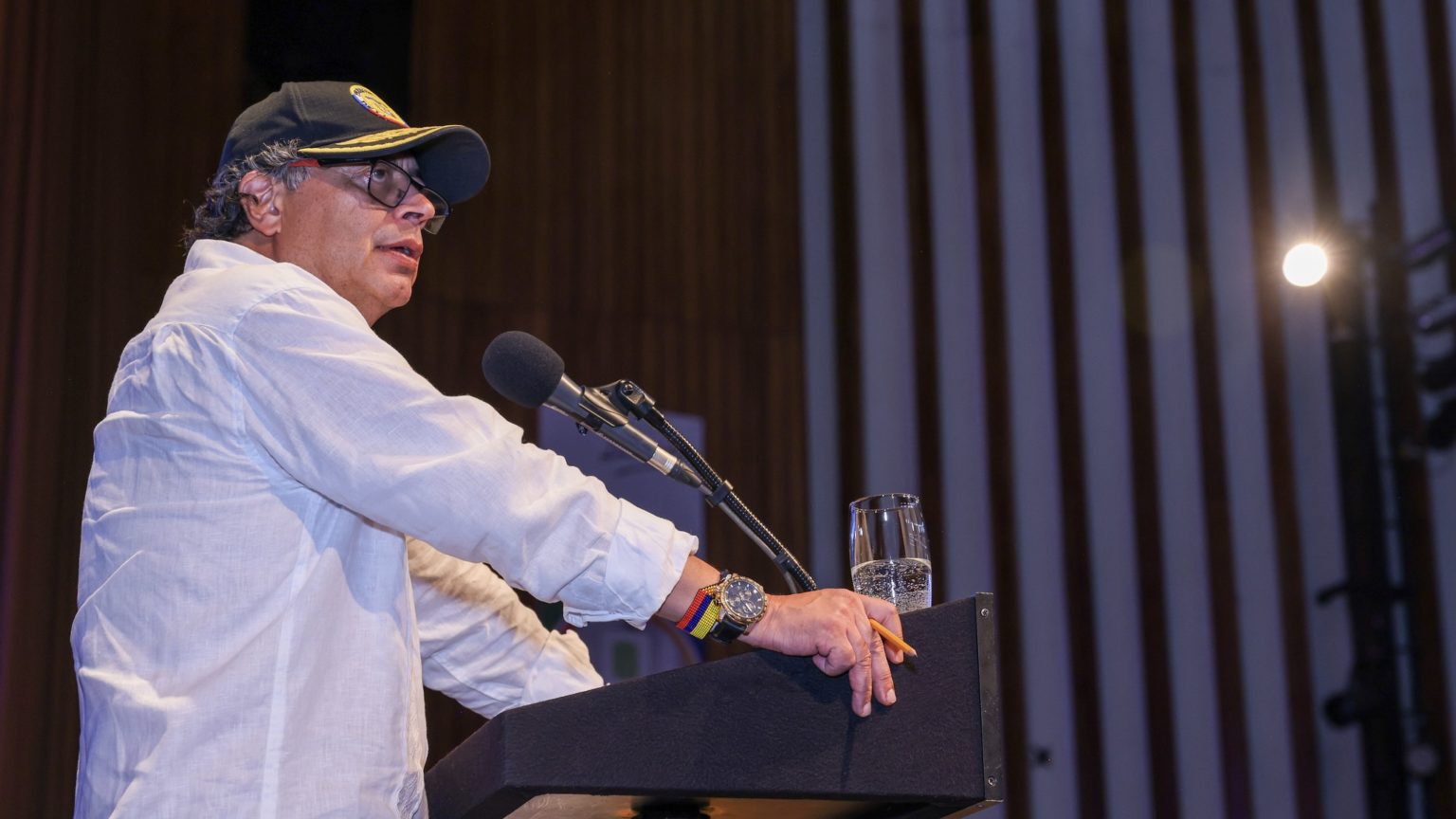
Colombian President Gustavo Petro speaking on February 13 from the Industrial University of Santander in Bucaramanga. Photo: Presidencia Colombia

The delay in the election of the Attorney General at the center of the ongoing tensions with the right, was highlighted by the United Nations Human Rights office and IACHR

Colombia’s Supreme Court will convene on February 22 to elect the country’s Attorney General (AG). The Supreme Court had already convened on two occasions, January 25 and February 8, for the same purpose but was unable, or as some allege, unwilling, to elect one of the three candidates proposed by President Gustavo Petro for the post back in August. The court’s refusal to elect one of Petro’s candidates for the post, has been at the center of what some have termed a “soft coup” or a destabilization campaign against the left-wing president’s government.

Petro himself said on February 2 that the court’s refusal to move forward was “institutional rupture that has reached its most desperate point, because the mafia does not want to control the entire sections of the Attorney General’s office that I have put in danger for having presented a shortlist of decent women.”

The Attorney General in Colombia is part of the judicial branch of power and has the role of investigating and accusing those who are alleged to be responsible for committing crimes.

On Monday February 12, the mandate of former AG Francisco Barbosa expired. Barbosa was appointed by former far-right president Iván Duque who is also his close friend from university. The AG has had open conflict with the current president, telling Blu Radio in May 2023 “I think Gustavo Petro is irresponsible” when Petro had warned of possible foul play in the AG’s investigation of members of Petro’s Historic Pact party.

On January 25, the same day that the Supreme Court was first set to elect his replacement, Barbosa ordered a raid of the Bogotá office of the Federation of Colombian Educators (FECODE) over allegations of improper contributions to Gustavo Petro’s presidential campaign. The move was widely condemned by social movements and trade unions in the country as being politically motivated.

With his term up, Barbosa’s deputy prosecutor and close ally, Martha Mancera, has taken up the post in the interim – until the Court makes its decision. Mancera has been named in different scandals, including an alleged cover up of an agent from the Attorney General’s investigative body who was involved in drug trafficking and arms trafficking.

On Wednesday February 14 at an event in the Industrial University of Santander in Bucaramanga, Petro said, “The government doesn’t agree that the Attorney General should be handed over to people with dubious reputation, that could have links, it seems and according to media investigations, with organized crime.”

International bodies such as the Inter-American Commission on Human Rights (IACHR) also expressed concern over the delay in the Supreme Court’s deliberations. In a statement published on February 13, the body said that a further delay in the selection of an AG, “could weaken the Colombian justice system” and that the Supreme Court must “fulfill its constitutional duty”.

On February 14, the UN Office of Human Rights in Colombia also declared that it was closely following the AG election process. In its statement, it highlighted the role the AG plays in “guaranteeing access to justice, democratic consolidation, and Rule of Law”, and as such, it “encourages the Supreme Court to conclude the process of selection of the AG in the shortest time possible”.

Both statements by the IACHR and the UN alluded to allegations by the right-wing that the citizen protests in dozens of cities across Colombia on February 8 to demand that the Court carry out its constitutional obligation, were an attempt by Petro to subvert rule of law and disrupt the Supreme Court’s process. The allegations are based on a video from a protest in Bogotá which depicts a couple of demonstrators attempting to rush the barricade at the gates of the Court while other protesters are leaving the site. Many analysts have stated that those depicted in the video were seemingly right-wing infiltrators.

Nevertheless, right-wing media has launched full scale attacks on protesters and Petro, and the Attorney General’s office claimed “possible crimes were committed” and opened up a special investigation.

Added to the growing pressure on Petro’s administration, is the direct attack on his foreign minister, Álvaro Leyva, who is under investigation by the Ombudsman and suspended from his position for three months over allegations of irregularities in the bidding process for passport processing. In reality, Leyva had taken steps to confront a private firm, Thomas Gregs and Sons, that had a major contract with the state for processing passports and had control over a significant amount of the population data in the country.

Leyva is one of Petro’s key allies and was central to reactivating the peace talks with ELN in Cuba, advancing normalization of relations with neighboring Venezuela, in addition to helping lead Petro’s recognized diplomatic efforts on the world stage.

Petro had said that renowned jurists called the suspension of the foreign minister unprecedented and he termed it “institutional rupture”.

With growing pressure on the court to fulfill its constitutional mandate, the Supreme Court’s session on February 22 is set to be an important date, while the movements and social organizations that mobilized and campaigned to put Petro’s government of change in office have vowed to defend it at all costs.

Original article republished from peoples dispatch under a Creative Commons Attribution-Share Alike 4.0 (CC BY-SA) license.

Continue ReadingPetro condemns “institutional rupture” and attacks on Colombian democracy by the right-wing

After Biden HQ Arrests, Sunrise Plans 40+ Protests Across US

Spread the love

Original article by JESSICA CORBETT republished from Common Dreams under Creative Commons (CC BY-NC-ND 3.0). 

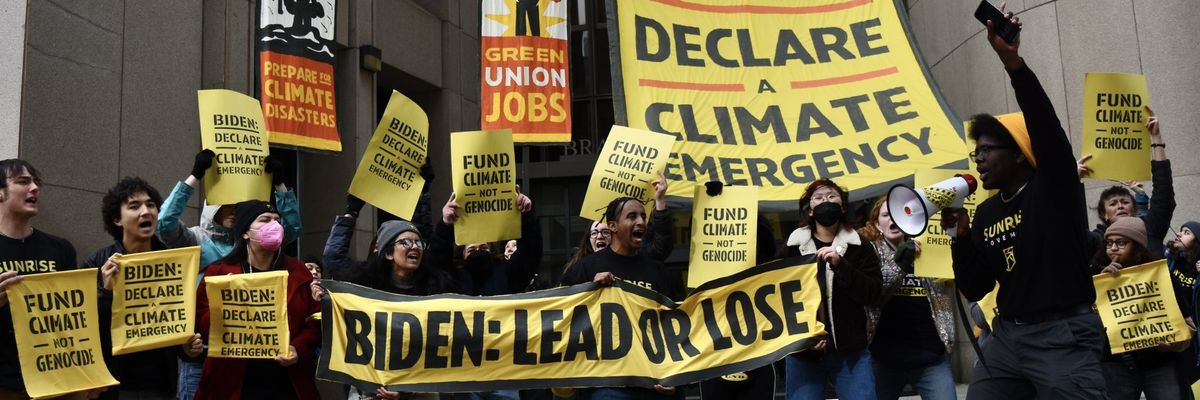
Nearly two dozen campaigners with the Sunrise Movement were arrested after assembling at U.S. President Joe Biden’s 2024 campaign headquarters in Wilmington, Delaware on February 12, 2024. (Photo: Sunrise Movement/X)

“President Biden must declare a climate emergency and go all-out to stop the climate crisis,” said the youth-led movement’s campaign director.

After nearly two dozen Sunrise Movement campaigners were arrested Monday at U.S. President Joe Biden’s 2024 campaign headquarters in Wilmington, Delaware, the youth-led climate group is planning over 40 protests across the country.

Next Monday, movement members plan to demonstrate at local Democratic Party offices and city halls to demand that Biden declare a national climate emergency and use the full extent of his powers to tackle the fossil fuel-driven global crisis.

“Biden can’t build renewables on Monday, approve fossil fuels on Tuesday, and then claim to be climate president. That’s not how science works, and young voters know it,” said Sunrise campaign director Kidus Girma in a statement Thursday. “President Biden must declare a climate emergency and go all-out to stop the climate crisis.”

“He could end the fossil fuel era by refusing to approve a single oil or gas well in this country.”

“There are dozens of things he could sign into law tomorrow if he wanted,” Girma noted. “He could make sure that every time a climate disaster hits, no one gets evicted and everyone has access to free healthcare. He could end the fossil fuel era by refusing to approve a single oil or gas well in this country.”

Sunrise is calling on the Democratic president to reverse the massive rise in U.S. fossil fuel production—rather than approving projects like Willow in Alaska—and to “create green union jobs by unleashing the full power of the Defense Production Act.”

The group’s plans for next week’s protests were announced as nine Democrats joined Republicans in the U.S. House of Representatives to pass a bill intended to reverse Biden’s recent pause on approvals for liquefied natural gas (LNG) exports, and as the Federal Energy Regulatory Commission rubber-stamped the Saguaro Connector Pipeline in Texas.

While Biden has faced intense criticism from campaigners and scientists for various decisions—from backing Willow and Mountain Valley Pipeline to continuing fossil fuel lease sales and skipping last year’s United Nations summit—former President Donald Trump, the Republican front-runner, has been far more hostile toward climate policies.

Young voters like those who belong to the Sunrise Movement were key to Biden’s defeat of Trump in 2020 and to Democrats preventing the predicted “red wave” in 2022. They are expected to play a key role in this November’s elections.

Original article by JESSICA CORBETT republished from Common Dreams under Creative Commons (CC BY-NC-ND 3.0). 

Continue ReadingAfter Biden HQ Arrests, Sunrise Plans 40+ Protests Across US