Chris Packham gives witness testimony at Just Stop Oil crown court case

Spread the love

George Monbiot: “Leave fossil fuels in the ground”

TV presenter and naturalist Chris Packham testified at the crown court trial of Just Stop Oil supporter, Cressie Gethin. 14th February was the eighth day of Cressie’s trial for Public Nuisance. She is appearing at Isleworth Crown Court, appearing before Judge Duncan. Cressie, 22, a music student from Hereford, faces up to ten years in prison if found guilty. 

Cressie climbed a motorway gantry above the M25 on the 20th July 2022, two days after the governments’ net zero strategy was declared unlawful, and one day after the UK recorded it’s highest ever temperature of 40.3 degrees celsius, a milestone that scientists previously thought was impossible.

Cressie Gethin testified: On 20th July 2022, I climbed up onto a gantry over the M25. I hung up two banners – one said ‘Just Stop Oil’ (the campaign in whose name I was taking action) and the other said ‘40 Degrees”’ (this was a day after the 40C heatwave scorched the UK, burnt down houses and left people dead).

The prosecution have said that my intention was clearly to stop the traffic. However, it is under oath that I say I was not expecting the police to close the entire motorway. I thought it was possible they may decide to close one or two lanes, or perhaps slow the speed of the traffic, but I was very surprised when they closed the whole thing. I was surprised because I was conducting a nonviolent, peaceful protest, the intention of which was to gain media attention and create public pressure on the government to stop new oil and gas.

When the police did close the motorway, I did not immediately come down – you saw that in the footage. As I said, my intention was to get media attention and I realised that the road closure would be attracting more press coverage and therefore more pressure on the government to take steps to protect its own citizens.

I will also address the matter of delays at Heathrow. Whilst this may sound unbelievable, I did not realise that the stretch of motorway I was on led to Heathrow – as I say, this may sound ridiculous, but I am telling the truth under oath.

Because I am bound to the truth, I will also say that, despite not being aware of the location at the time, I do not think that near Heathrow was an inappropriate place to conduct this protest, given that it was there that 40.2C was first recorded the day before, and because of the relevance of air travel to the message I was trying to get heard.

The 20th July was deliberately chosen to be when the temperature was less dangerous and the Met Office’s extreme heat warnings had been lifted. This was in order to remove any risks linked to heat and dehydration for myself and for any members of the public who were in their cars for longer than anticipated.

I also took safety precautions that minimised any risk to myself or to drivers on the motorway. I ensured that there was at least one point of attachment between the gantry structure and the banners at all times. I also wore a safety harness so that I was attached to the gantry at all times. This gantry was enclosed and felt safe (it is designed for human access and is essentially a footbridge with enclosed sides) – but I took this precaution to make sure I was being as safe and conscientious as possible.

I want to make it clear that in no way did I feel a sense of glee or “yes, I’ve won” when the police closed the road. I understood that by closing the road the police would be having to manage traffic that would have otherwise come down that stretch of the motorway, and that didn’t and doesn’t sit easy with me. The reason I didn’t come down goes back to my original intention to get the attention of the media and public, and ultimately, to address rather than ignore injustice and suffering.

There was a moral dilemma involved in taking this action. I knew there was a possibility that the action would impact some people – that is the nature of visible and attention-grabbing protest. I had to weigh this, which doesn’t sit easy with me, against my sincere desire to protect lives. As I said at the beginning, my overall intentions were and still are to create pressure on the government to writing [righting?] policies that are killing people around the world.
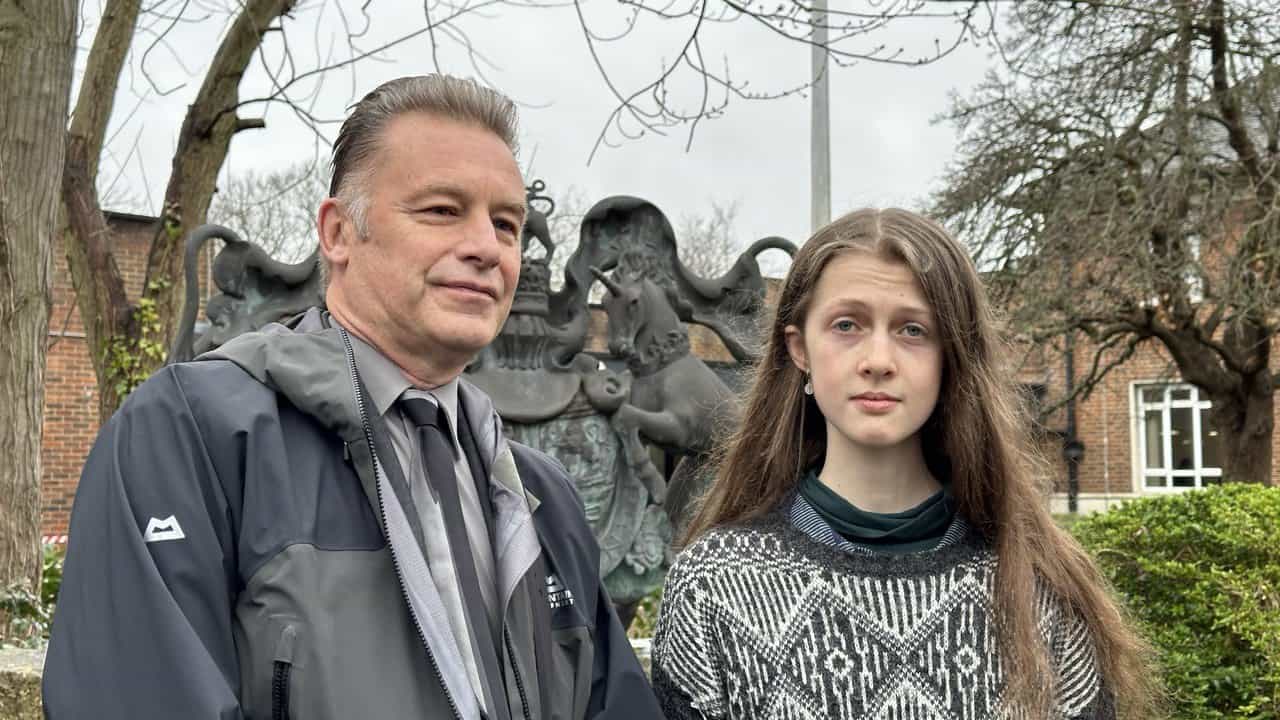
Chris Packham and Cressie Gethin at Iselworth Crown Court. Image: Just Stop Oil

Part of Chris Packham’s testimony:

Prosecution: 26 flights were cancelled.

Chris Packham: As I recall Heathrow was under stress and it had already capped the amount of flights that could leave.

Prosecution: There were over 3000 people impacted, 26 flights delayed and 19 flights cancelled. Do you agree that these people were seriously inconvenienced and seriously annoyed?

Chris Packham: I don’t. It would be difficult for you to apply all of this to Cressie Gethin.

Prosecution: [something about “her” cause]

Chris Packham: It’s not “her” cause – it’s the cause.

Chris Packham: I support the need to raise the alarm on the most serious issue that threatens life and threatens us.

The trial continues.

[sourced from 2 Just Stop Oil press releases]
Continue ReadingChris Packham gives witness testimony at Just Stop Oil crown court case

Global media freedom at risk as Julian Assange back in UK court facing possible extradition to USA

Spread the love

In advance of Julian Assange’s next hearing in the UK courts ahead of his possible extradition to the US, Amnesty International reiterates concerns that Assange faces the risk of serious human rights violations if extradited and warns of a profound ‘chilling effect’ on global media freedom.

“The risk to publishers and investigative journalists around the world hangs in the balance. Should Julian Assange be sent to the US and prosecuted there, global media freedoms will be on trial, too,” said Julia Hall, Amnesty International’s expert on counter-terrorism and criminal justice in Europe.

The US must drop the charges under the espionage act against Assange and bring an end to his arbitrary detention in the UK.

Julia Hall, Amnesty International’s expert on counter-terrorism and criminal justice in Europe

“Assange will suffer personally from these politically-motivated charges and the worldwide media community will be on notice that they too are not safe. The public’s right to information about what their governments are doing in their name will be profoundly undermined. The US must drop the charges under the espionage act against Assange and bring an end to his arbitrary detention in the UK.”  

If Julian Assange loses the permission to appeal, he will be at risk of extradition to the US and prosecution under the Espionage Act of 1917, a wartime law never intended to target the legitimate work of publishers and journalists. He could face up to 175 years in jail. On the less serious charge of computer fraud, he could receive a maximum of five years.

Assange would also be at high risk of prolonged solitary confinement in a maximum security prison. Although the US has offered ‘diplomatic assurances’ to the UK, allegedly guaranteeing his safety if imprisoned, the authorities’ assurances include so many caveats that they cannot be considered reliable.  

“The US assurances cannot be trusted. Dubious assurances that he will be treated well in a US prison ring hollow considering that Assange potentially faces dozens of years of incarceration in a system well known for its abuses, including prolonged solitary confinement and poor health services for inmates. The US simply cannot guarantee his safety and well-being as it has also failed to do for the hundreds of thousands of people currently imprisoned in the US,” said Julia Hall.

Worldwide threat to media freedom

If Julian Assange is extradited, it will establish a dangerous precedent wherein the US government could target for extradition publishers and journalists around the world. Other countries could take the US example and follow suit. 

“Julian Assange’s publication of documents disclosed to him by sources as part of his work with Wikileaks mirrors the work of investigative journalists. They routinely perform the activities outlined in the indictment: speaking with confidential sources, seeking clarification or additional documentation, and receiving and disseminating official and sometimes classified information,” said Julia Hall.

News and publishing outlets often and rightfully publish classified information to inform on matters of utmost public importance. Publishing information that is in the public interest is a cornerstone of media freedom. It’s also protected under international human rights law and should not be criminalized.

“The US’ efforts to intimidate and silence investigative journalists for uncovering governmental misconduct, such as revealing war crimes or other breaches of international law, must be stopped in its tracks.

“Sources such as legitimate whistle blowers who expose governmental wrongdoing to journalists and publishers must also be free to share information in the public interest. They will be far more reluctant to do so if Julian Assange is prosecuted for engaging in legitimate publishing work.

It’s not just Julian Assange in the dock. Silence Assange and others will be gagged

Julia Hall

“This is a test for the US and UK authorities on their commitment to the fundamental tenets of media freedom that underpin the rights to freedom of expression and the public’s right to information. It’s not just Julian Assange in the dock. Silence Assange and others will be gagged,” said Julia Hall.

Background:

The High Court in the UK has confirmed a two-day hearing on 20 and 21 February 2024. The outcome will determine whether Julian Assange will have further opportunities to argue his case before the UK courts or if he will have exhausted all appeals in the UK, leading to the extradition process or an application to the European Court of Human Rights.

sourced from an Amnesty International press release

Continue ReadingGlobal media freedom at risk as Julian Assange back in UK court facing possible extradition to USA

Calls Grow for ‘European Arms Embargo’ on Israel After Dutch F-35 Ruling

Spread the love

Original article by JULIA CONLEY republished from Common Dreams under Creative Commons (CC BY-NC-ND 3.0). 

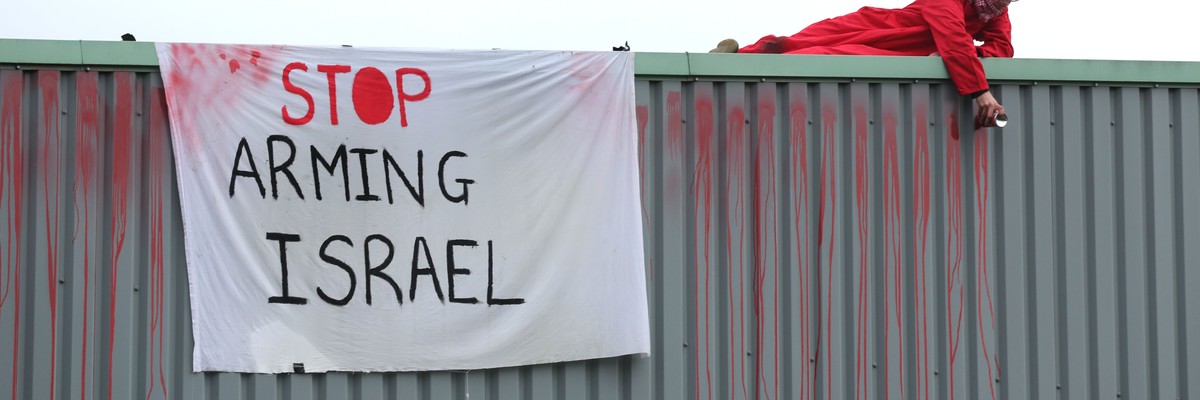
A protester occupies the roof of Howmet Fastening Systems in Leicester, U.K., which makes components for Israeli F-35s, in October 2023.  (Photo: Palestine Action)

“Surely it’s time to stop all arm shipments to Israel,” said one British lawmaker, “and implement targeted sanctions against members of the Israeli leadership.”

While the White House has claimed U.S. President Joe Biden is growing increasingly “frustrated” with Israel’s bombardment of Gaza—largely made possible by U.S. military aid—calls are growing in Europe for governments to halt arms exports to stop their own contributions to the mass killing.

After a Dutch court ordered the Netherlands to stop exporting F-35 fighter jet parts to Israel on Monday, ruling that the country was running a “clear risk” of helping Israel to violate international human rights law, several British lawmakers intensified their demands that the U.K. also halt arms exports.

“Selling arms to Israel for its war on Gaza is incompatible with U.K. and international law,” said Diane Abbott, a Labour Party member in British Parliament. “[Prime Minister Rishi] Sunak should follow suit and ban weapon sales to Israel.”

Natalie Bennett, a member of the Green Party in the British House of Lords, spoke on Tuesday about six-year-old Hind Rajab, whose body was found last week in a car in which her family members had tried to flee Gaza City. The car was riddled with bullet holes, and an ambulance nearby, which paramedics had sent to rescue Hind, had been bombed.

“Is the government challenging the Israeli government about risks to hundreds of thousands of children in Rafah, now in the path of the Israeli offensive?” said Bennett. “Surely it’s time to stop all arm shipments to Israel… and implement targeted sanctions against members of the Israeli leadership.”

The U.K. provides about 15% of the components of Israel’s F-35 bombers—the Israeli Air Force’s “flagship asset,” according to the Royal United Services Institute—and has licensed more than $594 million in military exports to Israel since 2015.

While the U.S. Senate on Tuesday passed a $95 billion foreign aid bill, including $14.1 billion for Israel, some European governments are working to end their complicity in Israel’s mass killing of at least 28,576 Palestinians so far in attacks that have also wounded at least 68,291 and left at least 17,000 children orphaned.

On February 6, the Walloon regional government in Belgium suspended two licenses for the export gunpowder to Israel, citing the International Court of Justice’s (ICJ) interim ruling last month which found that Israel is “plausibly” committing a genocide in Gaza.

Italian Foreign Minister Antonio Tajani said in late January that the government had halted all arms sales to Israel in October, when Israel began its bombardment of Gaza in retaliation for a Hamas-led attack on October 7.

José Albares, Spain’s foreign minister, also said last month that the Spanish government had done the same, but El Diarioreported on Sunday that the country had actually exported $1.1 million in ammunition to Israel in November.

“The suspension of arms transfers to Israel must be comprehensive and permanent, and not just temporary,” said Alberto Estévez, a spokesperson on weapons issues at Amnesty International Spain. “The Spanish government has wanted to be an example in this crisis in the face of other much more complicit governments, but it must be more forceful to promote a European arms embargo on Israel and Hamas and other Palestinian armed groups, in addition to pressuring the United States to stop the supply of arms to Israel and support the imposition of a global embargo on the U.N. Security Council.”

On Wednesday, Spanish Prime Minister Pedro Sánchez joined Irish Prime Minister Leo Varadkar in writing to European Commission President Ursula von der Leyen and demanding an “urgent review” of Israel’s compliance with human rights obligations under its trade deal with the European Union.

“Against the background of the risk of an even greater humanitarian catastrophe posed by the imminent threat of Israeli military operations in Rafah, and given what has occurred, and continues to occur in Gaza since October 2023, including widespread concern about possible breaches of international humanitarian law and international human rights laws by Israel, we ask that the Commission undertake an urgent review of whether Israel is complying with its obligations, including under the E.U./Israel Association Agreement, which makes respect for human rights and democratic principles an essential element of the relationship,” wrote Sánchez and Varadkar.

The two leaders reiterated their call for an immediate humanitarian cease-fire, which was supported by a large majority of countries in a vote at the U.N. General Assembly in December, “including by 17 E.U. member states.”

Varadkar and Sánchez also pointed to the ICJ’s interim ruling in South Africa’s case last month, in which the country accused Israel of genocidal violence against Palestinians.

The orders of the ICJ, which demanded that Israel ensure that humanitarian aid can reach Gaza residents and that its military is not committing acts of genocide, “are binding,” the leaders reminded the European Union.

Original article by JULIA CONLEY republished from Common Dreams under Creative Commons (CC BY-NC-ND 3.0). 

Continue ReadingCalls Grow for ‘European Arms Embargo’ on Israel After Dutch F-35 Ruling

In a flagrant violation of international law, Israel intensifies siege of Nasser Medical Complex

Spread the love

Original article by Ana Vračar republished from peoples dispatch under a Creative Commons Attribution-ShareAlike 4.0 (CC BY-SA) license.

The Nasser Medical Complex has been under siege for several days

After over 20 days of besieging Nasser Medical Complex, Israeli occupation forces attacked thousands of people sheltering inside the hospital

On February 14, the Israeli Occupation Forces (IOF) launched an attack against thousands of civilians seeking shelter at Nasser Medical Complex in Khan Younis, including the hospital’s staff and patients. The complex has endured a siege by the IOF for over 20 days, during which those inside were kept under sniper threat, resulting in the deaths of dozens in the vicinity of the hospital. Among the casualties were children who attempted to fetch water, as well as healthcare personnel.

“Get out, animals! Get out, dogs!” shouted IOF soldiers at the people inside Nasser Hospital during the final stages of the siege. Additionally, soldiers forced a young Palestinian man, whom they had detained, to deliver evacuation orders to the hospital. Reportedly, the man was coerced to return to the IOF after carrying out the task, under threat of the soldiers invading the hospital to find him. The Israeli soldiers then shot the man as he was walking back to them.

Most of the complex became unusable due to Israeli attacks throughout the siege. The IOF demolished the northern wall of Nasser Hospital, leaving only one passage usable—the same one through which they marched people out on Wednesday. Before forcing them to leave, Israeli soldiers reportedly positioned face-recognition technology near the exit. This move, according to observers tracking attacks on healthcare in the Gaza Strip, indicates the declaration of Nasser Hospital as a military target, likely to be followed by mass arrests and abuse of healthcare workers and patients.

Read more: Palestinian health workers kidnapped by Israel subjected to torture and humiliation

Until the evacuation was enforced, Nasser was one of the last major health centers remaining in Gaza. Its capacities seconded only those of Al-Shifa Hospital, the Strip’s largest hospital. According to Ubai Aboudi, Executive Director of Bisan Center for Research and Development, Nasser’s beds accounted for some 12% of the overall capacities in Gaza. 

The attack on the hospital is certain to have a devastating effect on the tens of thousands of people injured in Israeli attacks. While the hospital was besieged, the World Health Organization (WHO) and Doctors Without Borders (MSF) warned that it was crucial to keep the complex operational as IOF attacks south of the Wadi Gaza line intensified. 

Despite all the warnings and pleading, the WHO was last able to deliver supplies to Nasser Hospital at the end of January. After that, attempts to organize medical missions were blocked by Israeli authorities. This meant that health workers had barely anything to work with, especially after an attack on nearby school buildings led to a fire, which then destroyed approximately 80% of the stocks in Nasser’s medical warehouse. As a result of the incessant attacks, the hospital’s emergency department was flooded in sewage water, making it unusable.

“The hospital is barely functioning, but we are trying to work as much as possible to save lives,” Mohammed Harara, a doctor from the hospital, told WHO officials days before the attack. “We are scared that any moment we might lose our lives, and we have no clue about our families.”

Staff from the hospital faces additional threats, as the Israeli forces continue to target health workers in particular. Dozens of nurses, paramedics, and doctors have been disappeared by the IOF. They are still be held  under torture and extreme duress, without any access to legal or humanitarian protection.

The dehumanizing attacks against patients, staff, and displaced people at Nasser Hospital are another step towards making Gaza uninhabitable, according to Aboudi. Little doubt remains that the few health institutions that remain in southern Gaza will meet a similar fate as the Israeli armed forces approach. 

After that, says Aboudi, “there will be no care, simply put.” 

People’s Health Dispatch is a fortnightly bulletin published by the People’s Health Movement and Peoples Dispatch. For more articles and to subscribe to People’s Health Dispatch, click here.

Original article by Ana Vračar republished from peoples dispatch under a Creative Commons Attribution-ShareAlike 4.0 (CC BY-SA) license.

Continue ReadingIn a flagrant violation of international law, Israel intensifies siege of Nasser Medical Complex

Post Office documents containing racist terms describing Horizon victims used as recently as 2013

Spread the love

https://morningstaronline.co.uk/article/post-office-documents-containing-racist-terms-describing-horizon-victims-used-recently

A post office van in Aldwych, central London, January 11, 2024

POST OFFICE documents containing “utterly abhorrent” racist terms to describe wrongfully convicted sub-postmasters were used internally and updated as recently as 2013, according to an internal investigation.

The company launched the probe last year after documents obtained by Horizon scandal campaigners found fraud investigators were asked to group suspects based on racial features.

Between 2000 and 2015, more than 700 sub-postmasters were prosecuted based on information from Fujitsu’s faulty Horizon accounting system used in Post Offices.

A document used by the company’s security team used identity codes, each with language to describe a person’s ethnic origin, for potential suspects.

One description used the term “negroid types.”

Other archaic and offensive terms were used to describe individuals as “Siamese,” “Malaya” and “Chinese/Japanese types.”

https://morningstaronline.co.uk/article/post-office-documents-containing-racist-terms-describing-horizon-victims-used-recently

Continue ReadingPost Office documents containing racist terms describing Horizon victims used as recently as 2013