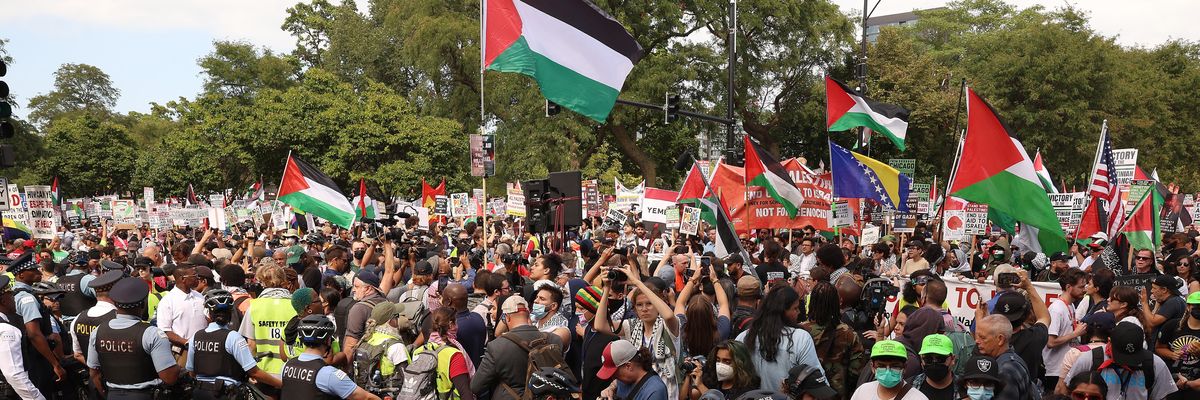
Police and demonstrators are seen at a march during the Democratic National Convention on August 19, 2024 in Chicago. (Photo: Scott Olson/Getty Images)
“For Palestinian Americans, this is a fundamental issue,” said one marcher.
What’s expected to be the biggest protest march during this week’s Democratic National Convention kicked off in Chicago Monday afternoon, with demonstrators demanding that Vice President Kamala Harris support an end to unconditional U.S. military support for Israel amid its assault on Gaza, now in its tenth month.
Thousands gathered in Union Park before beginning their march to the United Center, where the convention is taking place.
Protesters carried signs and banners reading, “End State Violence From Chicago to Gaza” and “Dems’ Silence = Israel’s Violence.”
Organizers—who hoped to see 15,000 people in the streets—have expressed alarm in recent months over the Chicago Police Department’s aggressive response to pro-Palestinian protests, with a legal coalition last week expressing concern about Police Superintendent Larry Snelling’s intimidating comments about arresting protesters and other issues, and city officials have clashed with organizers about the route the march will take.
But threats of arrest did not deter groups including Jewish Voice for Peace from joining the march, with the local chapter saying its members would “make clear our commitment to freedom and safety for all people, from Chicago to Gaza” and as they demanded an “arms embargo now.”
We are here, loud and proud, marching in the streets of Chicago, outside the DNC, to make clear our commitment to freedom and safety for all people, from Chicago to Gaza! We demand an #ArmsEmbargoNow! #MarchOnTheDNCpic.twitter.com/ylwt4LvlzH
Organizers of the Uncommitted movement, which emerged during the Democratic primary season to pressure President Joe Biden to end his support for Israel’s assault on Gaza, continue to press the Harris-Walz campaign to break with the administration’s position.
While Harris initially indicated to the group a willingness to discuss support for an arms embargo earlier this month, a top adviser for the Democratic nominee said soon after that the vice president does not support ending weapons transfers to Israel.
“For Palestinian Americans, this is a fundamental issue,” sociologist Eman Abdelhadi told Democracy Now! at the march. “We have spent 10 months watching our people die every day, and to ask us to simply just wait and hope that some change will happen… It’s just offensive and it’s completely insensitive.”
"We have spent ten months watching our people die every day," says Palestinian American sociologist @emanabdelhadi, who is in Chicago protesting against Israel's assault on Gaza. pic.twitter.com/Vvv3loE9Lk
As the protesters assembled on Monday, journalist Mehdi Hasan warned in a column in The Guardian that Harris should see agreeing to the demand for an immediate cease-fire in Gaza and an arms embargo not as a risk, but as “a moral, geopolitical, and—for the Democrats—electoral no-brainer.”
“Biden may want to continue sending more and more weapons to an Israeli government accused of war crimes at the international criminal court and of genocide at the international court of justice,” wrote Hasan, “but Harris should take a different stance—a bolder stance, a stance that is more in line with her party’s base, as well as with the American public at large.”
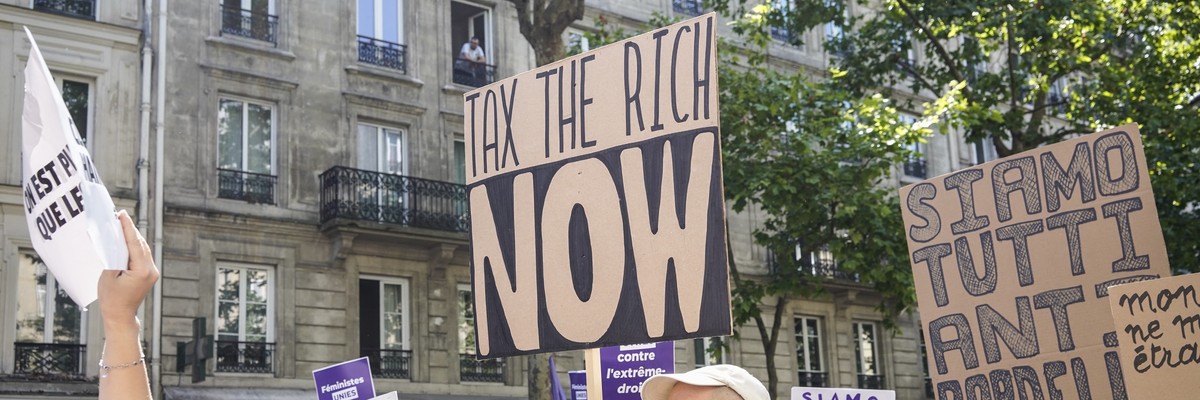
A man holds a sign reading, “Tax the Rich Now” at a protest in Paris on June 23, 2024. (Photo: Laure Boyer/Hans Lucas/AFP via Getty Images)
“To make our economies secure and protect the earner way of life that has defined the modern era, we need wealth taxes that end the two-tier treatment of wealth,” says a new report.
With countries set to focus heavily on climate finance for the Global South at the 2024 United Nations Climate Change Conference in November, the Tax Justice Network on Monday offered a proposal that could raise double the amount of money needed to help developing countries transition to clean energy and adapt to extreme weather—and there’s already proof the idea is effective and politically feasible.
The “featherlight” wealth tax introduced in Spain less than two years ago raised hundreds of millions of euros last year by taxing the net worth of the 0.5% richest households, and the group’s report argued that the law should serve as a model for a global wealth tax like the one increasingly supported by finance ministers in wealthy countries.
Spain’s wealth tax, also called the “solidarity surcharge” by Prime Minister Pedro Sánchez, applied a tax of 1.7% to 3.5% to the richest 0.5% of the country’s households—turning away from the “two-tier treatment of collected wealth and earned wealth” that TJN said is “the root of the problem” of growing inequality.
“Collected wealth—i.e. dividends, capital gains, and rent gained from owning things—is typically taxed at far lower rates than earned wealth—i.e. salaries gained by working,” said TJN. “At the same time, collected wealth typically grows faster than earned wealth. Today, only half of the wealth created around the world each year goes to people who earn for a living—the rest is collected as rent, interest, dividends, and capital gains.”
The two-tier tax system allows billionaires to pay tax rates that are half the rates paid by the rest of society, which has allowed the wealth of the richest 0.0001% people in the world to quadruple since 1987 “to the detriment of economies, societies, and planet,” said TJN.
Because the richest 0.5% of households control, on average, more than 25% of any given society’s wealth, the report states, if countries around the world replicated Spain’s solidarity surcharge, governments could raise $2.1 trillion annually—enough to pay for climate finance as well as other pressing needs.
“By definition, a billionaire owns more wealth than an average U.S. household could spend in 10,000 years. Wealth contributes a lot less to the economy than it can when it’s pharaoh-tombed like this, making economies poorer than the sum of their parts.”
“To guarantee a good life for all citizens and preserve social cohesion despite these challenges, governments around the world need the fiscal space to transform economies in a socio-ecological manner, ensure high-quality education for all, guarantee access to modern health services, and fulfill basic needs like affordable housing, food, and transportation at the same time,” reads the report. “Such measures are only feasible with sufficiently endowed and stable public budgets. A moderate, progressive wealth tax could help countries to raise these urgently needed funds.”
The report shows, said Oxfam International, that “E.U. governments can no longer excuse their ‘lack of funds’ for failing to fight the climate crisis and end poverty. The money they need is in the pockets of the super-rich!”
In each country, half the population holds only about 3% of the wealth—a persistent inequality that is “making economies insecure and is directly linked to people having to spend more than they bring in.”
The current global tax system treats billionaires as though they “earn wealth like everybody else, they’re just better at it,” said Mark Bou Mansour, head of communications for TJN. “This is bogus.”
“It’s impossible to earn a billion dollars,” Bou Mansour said. “The average U.S. worker would have to work for a stretch of time 13 times longer than humans have existed to earn as much as wealth as the world’s richest man has today. Salaries don’t make billionaires, dividends and rent money do. But we tax dividends and rent money much less than we tax salaries, and this is destabilizing the earner model our economies are based on.”
“By definition, a billionaire owns more wealth than an average U.S. household could spend in 10,000 years,” he added. “Wealth contributes a lot less to the economy than it can when it’s pharaoh-tombed like this, making economies poorer than the sum of their parts. To make our economies secure and protect the earner way of life that has defined the modern era, we need wealth taxes that end the two-tier treatment of wealth.”
On the BBC, which featured TJN’s report in a segment on Monday, Bou Mansour debunked the common claim that taxing the richest households would harm countries’ economies by pushing rich people to move away.
“This is an area where public perception has been lagging behind the evidence,” said Bou Mansour. “Recent wealth taxes in Norway, Sweden, and Denmark all resulted in a migration rate of 0.01% among the super-rich who were taxed. So what the data shows is that the super-rich do not leave en masse, and what’s more striking is that the data shows if countries do not implement wealth taxes, that is far more harmful to the economies.”
Countries can raise $2 trillion a year by following the example of Spain’s #WealthTax, our new study shows. But just as important as the amount that wealth taxes can raise, our study talks about how the extreme wealth of the superrich left untaxed makes our economies insecure. pic.twitter.com/eXgluZ24tq
— Tax Justice Network @TaxJusticeNet.bsky.social (@TaxJusticeNet) August 19, 2024
The report notes that concerns about the super-rich simply hiding their wealth in tax havens are valid, and called on countries to ensure that the U.N. tax convention currently being negotiated “delivers robust tax transparency standards.”
“Countries should collaborate to combat tax abuse by the ultra-rich, a challenge addressed in another strand of literature,” reads the report. “A straightforward starting point for combating this form of tax abuse in the context of a wealth tax is the implementation of full beneficial ownership transparency, at least within the country itself.”
While a number of G20 finance ministers have come out in support of a global wealth tax this year, leaders in some wealthy countries including U.S. Treasury Secretary Janet Yellen have refused to back the proposal.
“The vast majority of countries are currently working on what can be the biggest shakeup in history to global tax rules, to end the scourge of global tax abuse by multinational corporations and the superrich. But a minority of rich countries still seem to be holding back from support for a robust framework convention on tax,” said Alison Schultz, research fellow at TJN and co-author of the report. “This needs to change now—the climate can’t wait, and nor can the people of the world.”
Indiscriminate killing: Mourners pray at the funeral for more than 15 people, including several children and women, killed in an Israeli strike, at Al-Aqsa Martyrs Hospital in Deir al-Balah at the weekend
THE number of aid workers killed in conflict zones more than doubled last year, the UN reported today.
Its Office for the Co-ordination of Humanitarian Affairs said that 280 aid workers were killed in 33 countries in 2023, compared to 118 in 2022.
Over half the killings took place in Gaza following Israel’s invasion, which began in October following a Hamas cross-border attack, with the majority of these down to Israeli air strikes, the office said.
Israel’s military has been accused of deliberately murdering aid workers, with the killing of seven working for World Central Kitchen on April 1 causing headlines around the world because they included US, Canadian, British and Australian citizens.
It has also been accused of attempting to starve Gaza by blocking or delaying aid convoys. Its National Security Minister, Itamar Ben-Gvir, caused uproar in June when he told police not to interfere with mobs attacking aid convoys headed for Gaza.
THE number of aid workers killed in conflict zones more than doubled last year, the UN reported today.
Its Office for the Co-ordination of Humanitarian Affairs said that 280 aid workers were killed in 33 countries in 2023, compared to 118 in 2022.
Over half the killings took place in Gaza following Israel’s invasion, which began in October following a Hamas cross-border attack, with the majority of these down to Israeli air strikes, the office said.
Israel’s military has been accused of deliberately murdering aid workers, with the killing of seven working for World Central Kitchen on April 1 causing headlines around the world because they included US, Canadian, British and Australian citizens.
It has also been accused of attempting to starve Gaza by blocking or delaying aid convoys. Its National Security Minister, Itamar Ben-Gvir, caused uproar in June when he told police not to interfere with mobs attacking aid convoys headed for Gaza.
Original article by Ed Siddons , Billie Gay Jackson republished from TBIJ under Creative Commons Attribution-NonCommercial-NoDerivs 4.0.
DLA Piper’s demands from campaigners included £2,500 for a list of its own fees
The UK’s largest law firm sought £1.1m in legal fees from climate campaigners to cover the costs of preventing their protests, the Bureau of Investigative Journalism can reveal.
DLA Piper, a multibillion-pound law firm, tried to recoup eye-watering costs, including fees of £350 per hour for providing legal advice to its clients HS2 and National Highways Limited (NHL) – both publicly owned bodies. Other costs it tried to reclaim included £75,000 for a single hearing and £2,500 to prepare a document listing its own fees.
The firm brought injunctions – court orders prohibiting certain actions – against more than 200 campaigners, primarily from Just Stop Oil and Insulate Britain. Most obeyed the NHL injunction and did not take part in the prohibited protests, but still each faced bills of thousands of pounds.
In two of the cases, judges criticised the firm’s costs as “disproportionate” or “not … reasonable” and significantly reduced the amount it could claim, in one case by more than half.
Barristers told TBIJ that costs incurred by City law firms such as DLA Piper far exceed those incurred by in-house solicitors at public bodies or local authorities, ratcheting up the risk of large costs being foisted onto protestors.
DLA Piper has previously pledged to align its client work with “decisive action” on climate and committed to net zero by 2040.
The firm was hired by NHL and the HS2 rail project in 2021 to provide legal services that included securing injunctions against protesters.
Court files reviewed by TBIJ show that, on behalf of NHL and HS2, the firm sought costs from protesters totalling £1.1m. This figure, and the breakdowns below, include barristers’ fees – money paid to specialist external lawyers selected to argue the case in court.
One woman who broke the injunction told TBIJ that her income meant it would take her eight years to pay off the costs of around £5,000 that had been sought against her.
Another of those targeted was Louise Lancaster, who continued to protest and received a 42-day suspended sentence in 2022 alongside an order to pay £22,000 in costs. Last month, she was jailed for four years for coordinating protests on the M25.
The award of a portion of legal costs to the winning side is standard procedure in civil court cases.
But although the lengthy sentences handed down to a small group of protesters in July made headlines, the combination of criminal charges with civil injunction proceedings and potential costs orders was highlighted as a “grave concern” by the UN special rapporteur on environmental defenders.
Adam Wagner, a barrister at Doughty Street Chambers, said: “You might have a protester who, for the same action, is convicted of a criminal offence, has an injunction taken out against them with the risk of contempt-of-court proceedings if they breach it, and faces huge costs. It’s like triple jeopardy.
“We don’t take that approach to social ills like gang violence or drug dealing – they are dealt with through the criminal courts [alone] … Nobody’s looking at the wider picture and thinking, ‘Could this actually have gone too far?’”
“The threat of costs in injunction proceedings is one of, if not the, biggest chilling effects on protests in Britain at the moment,” said Paul Powlesland, a barrister at Garden Court Chambers and founder of the environmental pressure group Lawyers For Nature.
The use of injunctions has soared in recent years with the rise of civil disobedience groups such as Just Stop Oil and Insulate Britain. Analysis by the BBC found that 1,200 locations across the UK are now subject to injunctions banning protests.
They have also increased in scope. Traditionally, injunctions prevented named individuals from undertaking a course of action, but new “persons unknown” injunctions mean anyone can be punished for breaking them.
Proceedings take place in civil courts, where costs can be huge and initial injunction proceedings do not qualify for legal aid. The majority of campaigners subject to the National Highways injunctions had no legal representation and feared the potential costs. The result is that wealthy people who want to bully peaceful protesters “can do so with impunity,” Powlesland said.
The largest single sum sought by DLA Piper was £727,573.84, which covered multiple claims on behalf of NHL against around 140 protesters who blocked the M25 and surrounding roads. That sum was eventually reduced by a judge to £580,000, and a later settlement offer sought about £3,000 from each campaigner to end the case.
DLA Piper also pursued a further £75,891.84 from protesters who disputed the renewal of the injunction.
Banners at the Bluebell Woods Protection Camp, an anti-HS2 protest site, in Staffordshire in 2021. An injunction later made protest illegal along the length of the HS2 railway line Martin Pope/Getty Images
In separate proceedings, at which NHL pursued 12 protesters for contempt of court after they broke the M25 injunctions, an offence that can mean jail time, DLA Piper listed £229,525.35 in costs, bringing the total to around £1m.
On behalf of Hs2, DLA Piper pursued £70,216 in costs against five defendants, all of whom broke injunctions.
Jodie Beck, policy and campaigns officer at Liberty, said: “Injunctions operate alongside an already expansive web of restrictions and criminal offences introduced in recent years, carrying hefty penalties for making your voice heard.
“When powerful companies and state-owned bodies use opaque legal processes and the threat of financial ruin with eye-watering costs being passed on, our fundamental right to protest is at risk.”
DLA Piper is not the only City law firm to have threatened protesters with costs orders. It is not known how much money it ultimately succeeded in recouping.
As well as its green pledges, the firm has boasted of its role as official provider of legal services to COP26 and highlighted its position as a founding member of the Legal Sustainability Alliance and the Net Zero Lawyers Alliance initiatives.
A DLA Piper spokesperson said: “The firm supports the right to protest lawfully and recognises the need to build a sustainable future. But any change must be brought around in compliance with the law, for the protection of the country and protestors.
The firm is one of the world’s largest legal advisers to the renewable energy industry and is recognised for advising on more renewable energy deals and projects than any other law firm.”
A NHL spokesperson said: “Protesting on motorways and major A-roads is extremely dangerous for both the protesters and motorists … These orders are intended to dissuade people from risking lives, not to prohibit lawful protest. As a government-owned company funded by public money, costs recovery is an important aspect of ensuring public funds are protected.”
A spokesperson for HS2 Ltd said: “We support the right to lawful protest. We have only taken legal action where there has been illegal direct action against HS2. Unlawful action against HS2 has cost taxpayers over £150m and put the lives of protestors, the public and our own workforce in great danger.
“Since the High Court granted a route wide injunction to protect the HS2 project from unlawful activity we have seen a significant decline in illegal activity.”
In June, DLA Piper was awarded a further contract worth more than £650,000 by NHL to provide legal services relating to injunctions against protestors.
Photo: Climate protesters block the M25 as part of a campaign intended to push the UK government to make significant legislative change to start lowering emissions. Credit: Mark Kerrison/Alamy Live News
Reporters: Ed Siddons and Billie Gay Jackson Additional reporting: Simon Lock Deputy editors: Katie Mark and Chrissie Giles Enablers editor: Eleanor Rose Impact producer: Lucy Nash Editor: Franz Wild Production editor: Frankie Goodway Fact checker: Somesh Jha
Our Enablers project is funded by the Hollick Family Foundation, Sigrid Rausing Trust, the Joffe Trust, the Organized Crime and Corruption Reporting Project and TBIJ core funds. None of our funders has any influence over our editorial decisions or output.
Original article by Ed Siddons , Billie Gay Jackson republished from TBIJ under Creative Commons Attribution-NonCommercial-NoDerivs 4.0.
The former business secretary, who is running for Conservative Party leader, has defended net zero U-turns and backed new fossil fuel drilling.
Conservative Party leadership hopeful Kemi Badenoch received £10,000 towards her campaign from the chair of a climate science denial group, DeSmog can reveal.
Based in 55 Tufton Street, Westminster, the GWPF is the UK’s leading climate science denial group. The GWPF’s director Benny Peiser has suggested it would be “extraordinary anyone should think there is a climate crisis”, while the group has also expressed the view that carbon dioxide has been mis-characterised as pollution, when in fact it is a “benefit to the planet”.
Its NZW arm has called for “rapid” new North Sea oil and gas exploration, and for wind and solar power to be “wound down completely”.
Badenoch received £10,000 from Record in July, according to her official register of interests, which said that the donation was “in support of my campaign for the leadership of the Conservative Party”.
The North West Essex MP has previously criticised the UK’s climate targets, calling them “arbitrary” in a 2022 interview. Badenoch has previously suggested that she would be in favour of delaying the UK’s commitment to reach net zero by 2050.
While serving as business secretary in September 2023, Badenoch also defended the decision by then prime minister Rishi Sunak to water down and delay a number of net zero policies, and argued that new fossil fuel licences were compatible with the UK’s climate targets.
“It’s no wonder that the Conservatives don’t want to act on the climate crisis when they are receiving donations from the people running groups like Net Zero Watch,” Adrian Ramsay, co-leader of the Green Party, told DeSmog.
“Just weeks on from the worst electoral defeat in their entire history, you’d hope they would be reflecting on why policies like U-turning on their climate commitments were so unpopular. Instead, it seems they are going to double down on their hostility to net zero and will remain both a threat to the planet and completely out of touch with the British public.”
Polling by More in Common and E3G during the 2024 general election period found that a majority of people in every UK constituency are worried about climate change. Some 61 percent of 2024 Conservative voters said they are worried about climate change, matched by 76 percent of Labour voters, and 65 percent of the country overall.
Last month, which saw world temperatures reach their hottest levels ever measured, Record wrote in The Telegraph that it is “debatable in detail” whether burning fossil fuels increases carbon dioxide (CO2) and causes dangerous global warming.
He went on to claim that achieving net zero by 2050 “will restrict our freedom, and is likely to be eye-wateringly expensive”, and should be replaced with the “realistic promise” for the UK not to contribute more than one percent of global emissions.
The world’s foremost climate science body, the UN’s Intergovernmental Panel on Climate Change (IPCC), has stated that CO2 “is responsible for most of global warming” since the late 19th century, which has increased the “severity and frequency of weather and climate extremes, like heatwaves, heavy rains, and drought”.
The IPCC has also warned that climate action has been delayed by “rhetoric and misinformation that undermines climate science and disregards risk and urgency”.
Record is a “life vice president” of the Institute of Economic Affairs (IEA) think tank, which he chaired until July 2023. The IEA has opposed state-led climate policies and has advocated for more fossil fuel extraction. The think tank received funding from the oil giant BP every year from 1967 to at least 2018. Record has given money to both the IEA and the GWPF.
The GWPF and the IEA are part of the Tufton Street network of think tanks and lobbying groups based in Westminster, all of which campaign for less government regulation, including on climate change.
When questioned previously about his GWPF donations, Record said: “I personally regard the continuing contribution of the GWPF to the climate change debate as very positive in assisting balance and rationality in this contentious area.”
The GWPF and the Tories
A number of other Tory MPs have also recently received donations from funders of the GWPF.
One of the early funders of the GWPF, Lord Michael Hintze, donated £18,000 to a number of Tory MPs from May to August. A hedge fund manager, Conservative peer and major party donor, Lord Hintze has said that he believes “there is climate change” caused “in part due to human activity over the past century”. However, he has said that “all sides must be heard” on the issue “to reach the right conclusion for society as a whole”.
A number of climate consensus studies conducted between 2004 and 2015 found that between 90 percent and 100 percent of experts agree that humans are responsible for climate change. A study published in 2021, which reviewed over 3,000 scientific papers, found that over 99 percent of climate science literature says that global warming is caused by human activity.
Lord Hintze’s recent donations included £2,000 to Claire Coutinho, £5,000 to Iain Duncan Smith, £2,500 to Alison Griffiths, £2,500 to Kit Malthouse, £2,000 to Andrew Murrison, £2,500 to Patrick Spencer, and £2,500 to Nick Timothy.
Former energy and net zero secretary Coutinho – who oversaw the weakening of a number of flagship climate policies – received another £2,000 from Lord Hintze in January.
Lord Hintze is one of the Conservative Party’s most prolific donors in recent years and has given more than £4 million to the party and its candidates since 2002.
Between the 2019 general election and the start of the 2024 campaign, the Conservatives received £8.4 million from fossil fuel interests, highly polluting industries, and climate science deniers.
GWPF donor Lord Jon Moynihan has also given £12,000 to a number of Tory MPs in recent months, including £5,000 to Peter Fortune, £2,000 to Mark Francois, and £5,000 to Thomas Bradley. He has now donated more than £600,000 to the Conservatives and its candidates since 2001.
Lord Moynihan gave £25,000 to the GWPF between 2018 and 2023, and has donated over £300,000 to other “free market” groups in the Tufton Street network in recent years, including the IEA.
Lord Moynihan also has substantial oil and gas investments. The peer’s register of interests shows that he holds shares worth more than £100,000 in each of the oil and gas majors BP, Shell, and TotalEnergies.
The GWPF and NZW have a number of political ties. Labour MP Graham Stringer is a director of the GWFP, having joined its board of trustees in 2015. Lord David Frost, a Tory peer and the UK’s former chief Brexit negotiator, is a trustee of the organisation alongside Telegraph columnist Allison Pearson. Former Tory MP Andrea Jenkyns, who lost her seat in July’s general election, is a director of NZW.
“The government may have changed, but it’s not clear much else has when it comes to climate crisis denialism,” Jolyon Maugham, executive director of the Good Law Project, told DeSmog. “Labour MP Graham Stringer continues to sit on the board of the GWPF and Neil Record, who chairs its subsidiary, is funding the would-be Tory leader Kemi Badenoch.”
Following a review by the Charity Commission into the GWPF’s activities and structure, the group announced that it would soon be ending its formal ownership of NZW.
All the MPs and donors mentioned in this article were approached for comment.