UN Expert Says Impunity for Israel Must End as ‘Genocidal Violence’ Spreads to West Bank

Spread the love

Original article by Jake Johnson republished from Common Dreams under a CC licence.

Israeli forces are pictured moving the body of a Palestinian man during a raid in the West Bank city of Hebron on September 1, 2024. (Photo: Hazem Bader/AFP via Getty Images)

“Apartheid Israel is targeting Gaza and the West Bank simultaneously, as part of an overall process of elimination, replacement, and territorial expansion,” said United Nations special rapporteur Francesca Albanese.


An independent United Nations expert warned Monday that “Israel’s genocidal violence risks leaking out of Gaza and into the occupied Palestinian territory as a whole” as Western governments, corporations, and other institutions keep up their support for the Israeli military, which stands accused of grave war crimes in the Gaza Strip and West Bank.

Francesca Albanese, the U.N. special rapporteur on the human rights situation in the illegally occupied Palestinian territories, said in a statement that “there is mounting evidence that no Palestinian is safe under Israel’s unfettered control.”

“The writing is on the wall, and we cannot continue to ignore it,” said Albanese, who released a detailed report in May concluding that there are “reasonable grounds to believe” Israel is guilty of genocide in Gaza.

Albanese’s new statement came as the Israeli military’s largest assault on the West Bank in decades continued into its second week. At least 29 Palestinians have been killed during the series of military raids, according to Al Jazeera, including at least five children.

“Apartheid Israel is targeting Gaza and the West Bank simultaneously, as part of an overall process of elimination, replacement, and territorial expansion,” Albanese said Tuesday. “The longstanding impunity granted to Israel is enabling the de-Palestinization of the occupied territory, leaving Palestinians at the mercy of the forces pursuing their elimination as a national group.”

“The international community, made of both states and non-state actors, including companies and financial institutions, must do everything it can to immediately end the risk of genocide against the Palestinian people under Israel’s occupation, ensure accountability, and ultimately end Israel’s colonization of Palestinian territory,” Albanese added.

Defense for Children International–Palestine noted Monday that “dozens of Israeli military vehicles” have “stormed” the West Bank city of Jenin over the past week as “Israeli forces deployed across the targeted refugee camps, seizing Palestinian homes to use as military bases and stationing snipers on the roofs of buildings, subjecting their residents to field investigations.”

“The military bulldozers began destroying the civil infrastructure in Jenin city and camp, which led to the destruction of the main water networks and power outage in several neighborhoods in Jenin and surrounding villages,” the group said. “Israeli forces besieged several hospitals in Jenin and impeded the movement of ambulances and paramedics.”

Israeli soldiers and settlers have killed more than 620 people in the occupied West Bank since October 7, on top of the roughly 40,800 killed by the Israeli military in Gaza.

Unlawful Israeli land seizures have also surged in the West Bank as settlers and soldiers wipe out entire Palestinian communities. The BBC reported Monday that, according to its own analysis, there are “currently at least 196 across the West Bank, and 29 were set up last year—more than in any previous year.”

Israel’s multi-day attack on the West Bank that began last week has intensified fears that unless there’s a permanent cease-fire, the assault on Gaza could expand to the rest of the occupied Palestinian territories and throughout the Middle East.

David Hearst, co-founder and editor-in-chief of Middle East Eyewrote Monday that “even with the obvious reluctance of Hezbollah and Iran to get involved, all the ingredients are there for a much larger conflagration.”

“An Israel in the grip of an ultra-nationalist, religious, settler insurgency; a U.S. president who allows his signature policy to be flouted by his chief ally, even at the risk of losing a crucial election; resistance that will not surrender; Palestinians in Gaza who will not flee; Palestinians in the West Bank who are now stepping up to the front line; Jordan, the second country to recognize Israel, feeling under existential threat,” Hearst wrote.

For U.S. President Joe Biden or Democratic nominee Kamala Harris, he added, “the message is so clear, it is flashing in neon lights: The regional costs of not standing up to Netanyahu could rapidly outweigh the domestic benefits of being dragged along by him.”

James Zogby, president of the Arab American Institute, similarly argued Tuesday that “the U.S. must reverse course—and do so dramatically.”

“A long-overdue cut-off of U.S. arms to Israel and recognition of the Palestinian right to self-determination would provide exactly the shock to the system that is needed,” Zogby wrote. “It would force an internal debate in Israel, empowering those who want peace. It might also serve to send a message to the Palestinian people that their plight and rights are understood.”

These actions, especially if followed up with determination and concrete steps, won’t end the conflict tomorrow,” Zogby continued, “but they would surely put the region on a more productive path towards peace than the one it is on now.”

Original article by Jake Johnson republished from Common Dreams under a CC licence.

Zionist Keir Starmer is quoted "I support Zionism without qualification." He's asked whether that means that he supports Zionism under all circumstances, whatever Zionists do.
Zionist Keir Starmer is quoted “I support Zionism without qualification.” He’s asked whether that means that he supports Zionism under all circumstances, whatever Zionists do.
Continue ReadingUN Expert Says Impunity for Israel Must End as ‘Genocidal Violence’ Spreads to West Bank

Israeli forces use diggers to target journalists in the West Bank

Spread the love

Israeli occupation forces use diggers to prevent journalists from covering the destruction in Jenin amid ongoing raids in the occupied West Bank. At least 4 journalists have been injured as they came under direct attacks by Israeli snipers, despite them wearing their press vests.

Continue ReadingIsraeli forces use diggers to target journalists in the West Bank

Campaigners demand Met stop bid to disrupt march for Palestine

Spread the love

https://morningstaronline.co.uk/article/campaigners-demand-met-stop-bid-to-disrupt-march-for-palestine

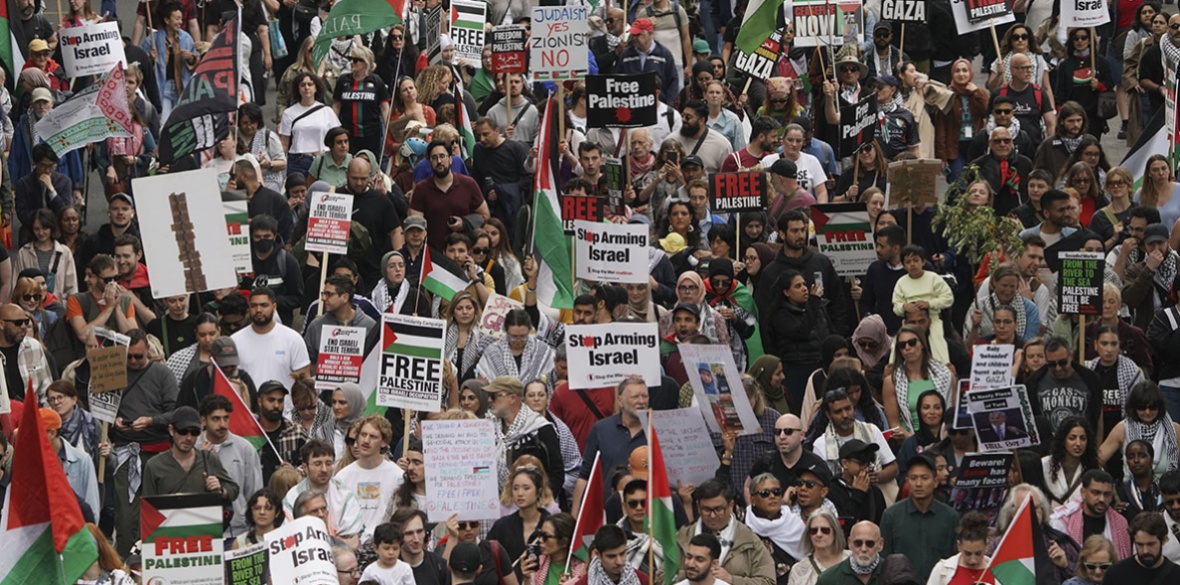
People take part in a national demonstration for Gaza from Russell Square to Whitehall in London, June 8, 2024

SCOTLAND YARD has been urged to abandon plans to impose new orders that would seriously disrupt Saturday’s March for Palestine demonstration in London.

Palestine Solidarity Campaign (PSC), union leaders, MPs, peers and coalition partners expressed concern over the force severely restricting the protest in an open letter today.

The Met was accused of employing tactics “to deter people from attending” the 18th national peaceful demonstration against the Gaza genocide since last October.

On Monday, the Met was accused of refusing to participate in negotiations in a “transparent and accountable” way with the march’s organisers.

Signatories of PSC’s letter raised concerns over the eleventh-hour announcement that the Met wanted the march delayed by nearly two hours “without explanation or rationale” and its refusal to allow Pall Mall as an assembly point.

They added: “We worry that these kind of delays, and late challenges and conditions to the plans of what are entirely peaceful demonstrations, are forming a pattern.”

https://morningstaronline.co.uk/article/campaigners-demand-met-stop-bid-to-disrupt-march-for-palestine

Continue ReadingCampaigners demand Met stop bid to disrupt march for Palestine

Starmer’s hints about the budget suggest UK is set for bleak four years

Spread the love

Original article by Paul Rogers republished from Open Democracy.

https://cdn2.opendemocracy.net/media/images/GettyImages-2159569411.max-760×504.jpg

Introducing a wealth tax would indicate this is a progressive government. But that seems unlikely

Taking as his theme the need to “fix the foundations” after “14 years of rot” under Tory rule, new Labour prime minister Keir Starmer this week delivered a message that should bring discomfort to everyone in the months and perhaps years to come.

Those “14 years of rot” are of no surprise to voters; indeed, they helped ensure a landslide Labour victory in the election in July. But Starmer’s plans to resolve them appear likely to be far harsher than many voters expected.

The chancellor of the Exchequer, Rachel Reeve, has made numerous hints that hard times are ahead. Her October budget will be uncompromising in its commitment to raising revenue to help fill a fiscal hole reckoned to be around £20bn – but much of this money seems likely to be taken from the poorer sections of society, not the rich.

Labour will retain unpopular policies introduced by the Conservatives – the ‘bedroom tax’ and limiting child benefit allowances to the first two children, for example – while introducing its own cost-cutting measures, such as reducing the winter fuel allowances for many pensioners.

These actions contribute to a growing sense that the Starmer government will prove to be decidedly right-of-centre in a country beset with deep divisions of wealth and poverty. Some areas may see an improvement, such as labour rights, but even there, it is a matter of the devil in the detail.

One area where the government does apparently have cash to spash, though, is military spending, which is set to be substantially increased despite the manifest failures in Afghanistan, Iraq and Libya, and the deeply unpopular Israeli wars on Gaza and the West Bank.

Labour’s attitude to Israel is certainly unlikely to change, with the Department for Business and Trade reporting on efforts to strike a new trade deal with the country, saying: “Our teams will be entering negotiating rooms as soon as possible, laser-focused on creating new opportunities for UK firms.” An official from the British Embassy in Israel also recently wrote of the “tremendous opportunity for collaboration between Israeli and British companies”.

A full-scale Strategic Defence Review is also underway, and there are few if any indications that it will start by addressing the grievous failures of the past two decades. If previous experience is anything to go by, it will likely also omit the main challenge to international security: climate breakdown. Without that, the review will not be worth the paper it is written on. Net zero secretary Ed Miliband may be doing his best to maintain the idea of a green transition but the issue would be sidelined by any major increase in government spending.

On the domestic front, less than two months into the new Labour government the contrast between Food Bank Britain and the ludicrous levels of runaway wealth is apparent. It was coincidentally yet powerfully illustrated just four days before Starmer’s pre-budget speech, by a full-page property advertisement from Sotheby’s in the Financial Times.

Of the seven properties on sale, one was a relatively modest three-bedroom apartment in Chelsea, on sale for a mere £5m, while the others included a six-bedroom house in Belgravia offered at £18m and a nine-bedroom/five-bathroom place near Regent’s Park for £20m. Another Regent’s Park number was on sale for £25m million, which at least had 7 bathrooms for the 6 bedrooms. Trumping all was a triplex number in Knightsbridge – £50m with exclusive access to Hans Place Gardens.

While we have to wait for the October budget announcements, we can be reasonably sure that there will be some attempts to raise modest amounts from the wealthier sectors of society, possibly involving changes in capital gains and inheritance taxes. But the best indicator of a changed government would be one willing to bring in wealth taxes, especially those directed at the super-rich.

Onee of Britain’s largest trade unions, Unite, recently proposed a 1% per annum tax on those with net assets of over £4m, which would include property, shares and bank holdings but not mortgaged property. That is estimated to yield £25bn a year but would be bitterly opposed, with the Daily Mail informing us that: “Millionaires are looking to flee the UK in their droves to escape Labour’s tax raids – with a record number of wealthy Britons tipped to leave the country this year.”

As things stand, the budget is expected to include substantial cuts in public spending that could be at least partly avoided by such a wealth tax, and it is worth noting that some European countries such as Switzerland and Spain have already introduced them. At least Britain’s wealthy won’t be fleeing “in their droves” to those countries.

If adopted in October, in even a modest form, a wealth tax would be a reasonable marker for a progressive government. If not, then an opportunity will be missed for placing Labour in a more progressive place in the political spectrum than currently seems at all likely.

Original article by Paul Rogers republished from Open Democracy.

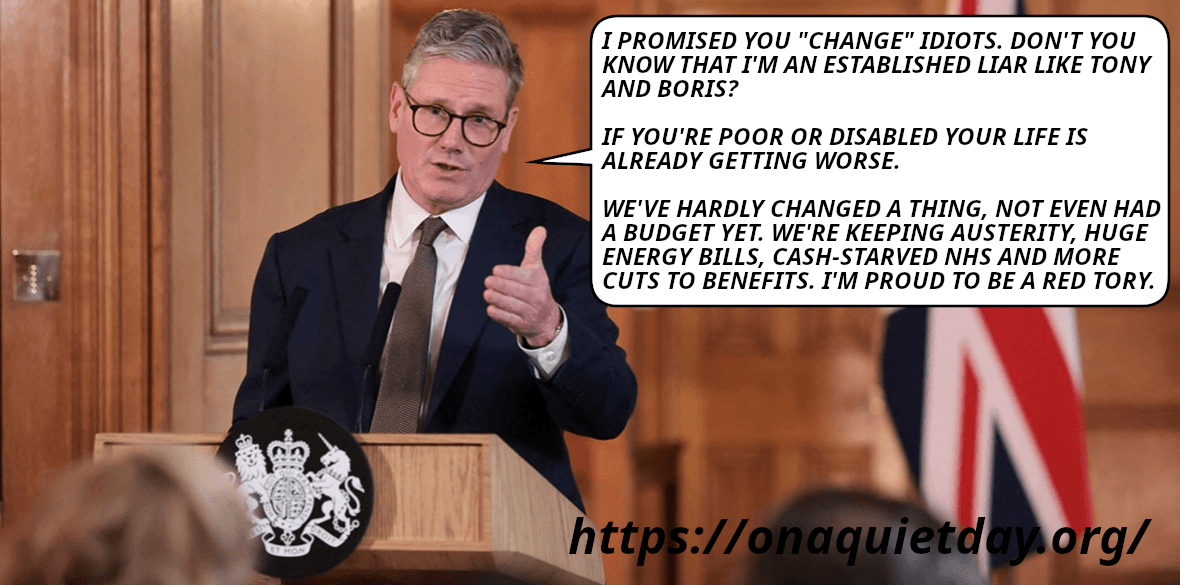
Keir Starmer confirms that he is continuing Tory policies and that he's proud to be a red Tory.
Keir Starmer confirms that he is continuing Tory policies and that he’s proud to be a red Tory.
Keir Starmer says pensioners can freeze to death and poor children can starve and be condemned to failure and misery all their lives.
Continue ReadingStarmer’s hints about the budget suggest UK is set for bleak four years