Zelensky meets Starmer and NATO secretary general Mark Rutte. (Photo: Simon Dawson / No 10 handout)
British aid is being used to open up Ukraine’s wrecked economy to foreign investors and enhance trade with the UK.
Amid the devastating war in Ukraine, British economic aid to the country is focused on promoting pro-private sector reforms and on pressing the government to open up its economy to foreign investors.
Recently-published Foreign Office documents on its flagship aid project in Ukraine, which supports privatisation, note that the war provides “opportunities” for Ukraine delivering on “some hugely important reforms”.
The government in Kyiv has in recent months been responding positively to these calls. Last month, president Volodymyr Zelensky signed a new law expanding the privatisation of state-owned banks in the country.
It follows the Ukrainian government’s announcement in July of its ‘Large-Scale Privatisation 2024’ programme that is intended to drive foreign investment into the country and raise money for Ukraine’s struggling national budget, not least to fight Russia.
Large assets slated for privatisation currently include the country’s biggest producer of titanium ore, a leading producer of concrete products and a mining and processing plant.
Ukraine envisaged privatising the country’s roughly 3,500 state-owned enterprises in a law of 2018, which said foreign citizens and companies could become owners.
The process stalled as a result of coronavirus and then Russia’s invasion in February 2022. But hundreds of smaller-scale enterprises are now being privatised, bringing in revenues of UAH 9.6bn (£181m) in the past two years.
“The resumption of privatisation amid the full-scale war is an important step, which is already yielding results,” Ukraine’s economy minister Yulia Svyrydenko said last month.
Another law enacted in June 2023 allows large-scale assets to be sold to foreigners or Ukrainians during the current martial law regime.
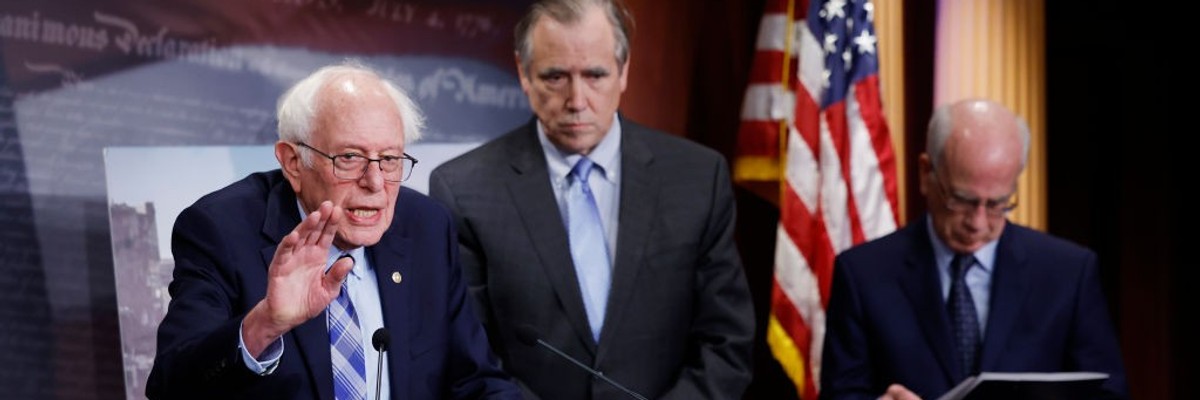
U.S. Sen. Bernie Sanders (I-Vt.), joined by Sen. Jeff Merkley (D-Ore.) and Sen. Peter Welch (D-Vt.), speaks at a news conference on November 19, 2024 in Washington, D.C. (Photo: Kevin Dietsch/Getty Images)
“The United States government is currently in violation of the law, and every member of the U.S. Senate who believes in the rule of law should vote for these resolutions,” said Sen. Bernie Sanders.
A group of U.S. senators led by Bernie Sanders of Vermont held a press conference Tuesday urging their colleagues to support resolutions that would block the sale of tank rounds, bomb kits, and other weaponry to the Israeli government, which has repeatedly used such arms to commit horrific war crimes in the Gaza Strip over the past 13 months.
“The truth of the matter is, from a legal perspective, these resolutions are not complicated; they’re cut and dry,” said Sanders (I-Vt.), who introduced the joint resolutions of disapproval in September alongside several other members of the Senate Democratic caucus.
“The United States government is currently in violation of the law, and every member of the U.S. Senate who believes in the rule of law should vote for these resolutions,” Sanders continued, pointing to U.S. statutes prohibiting the sale of weaponry to countries violating internationally recognized human rights or obstructing American humanitarian aid.
Sanders was joined at Tuesday’s press conference by Sens. Peter Welch (D-Vt.), Jeff Merkley (D-Ore.), and Chris Van Hollen (D-Md.), each of whom made their case to fellow senators ahead of a scheduled floor vote on Wednesday.
“What’s unfolding before our very eyes right now is mass starvation and the spread of disease,” said Welch. “Is the United States and its foreign policy… forced to be blind to the suffering before our very eyes?”
Surrounding the senators as they spoke were photographs of destruction and emaciated children in Gaza, where most of the population is displaced and crowded into small segments of the enclave as Israeli bombs rain down and famine takes hold.
Watch the full press conference:
The resolutions will hit the floor for a vote Wednesday with the backing of a broad coalition that includes Jewish Voice for Peace Action, the Council on American-Islamic Relations, J Street, the Service Employees International Union (SEIU), Oxfam, and other organizations and activists.
“For over a year, the Biden administration has funded the Israeli government’s brutal genocide of Palestinians in Gaza, despite overwhelming opposition from across the country,” said Beth Miller, political director of Jewish Voice for Peace Action, which said it has driven more than 56,200 letters and more than 20,790 phone calls to senators imploring them to support the measures.
“These joint resolutions of disapproval are one of the last chances that Senate Democrats have before Republicans take control in January to uphold human rights, honor the will of the American people, and stand on the right side of history by blocking weapons to the Israeli military,” Miller added.
“It is time to tell the Netanyahu government that they cannot use U.S. taxpayer dollars and American weapons in violation of U.S. and international law, and in violation of our moral values.”
Since the October 2023 Hamas-led attack on Israel, the U.S. has supplied its ally with more than 50,000 tons of weaponry and approved billions of dollars in additional arms and military equipment to be delivered in years to come. U.S. military support has helped Israel carry out a large-scale military assault on Gaza, killing more than 43,000 people so far—a majority of them women and children.
To sustain the flow of American weapons, the Biden administration has contradicted the findings of its own experts and outside analysts by declaring publicly that it has not found Israel to be illegally blocking U.S. humanitarian aid in the Gaza Strip. Meanwhile, aid groups on the ground say humanitarian assistance has plummeted to an all-time low in recent weeks, with an average of just 37 aid trucks entering Gaza per day in October.
During Tuesday’s press conference, Sanders said the “most important point to be made” ahead of Wednesday’s vote is that “the United States of America is complicit in these atrocities.”
“That complicity must end, and that is what these resolutions are about,” said Sanders. “It is time to tell the Netanyahu government that they cannot use U.S. taxpayer dollars and American weapons in violation of U.S. and international law, and in violation of our moral values.”
This post has been updated to correct when Sen. Bernie Sanders introduced the resolutions.
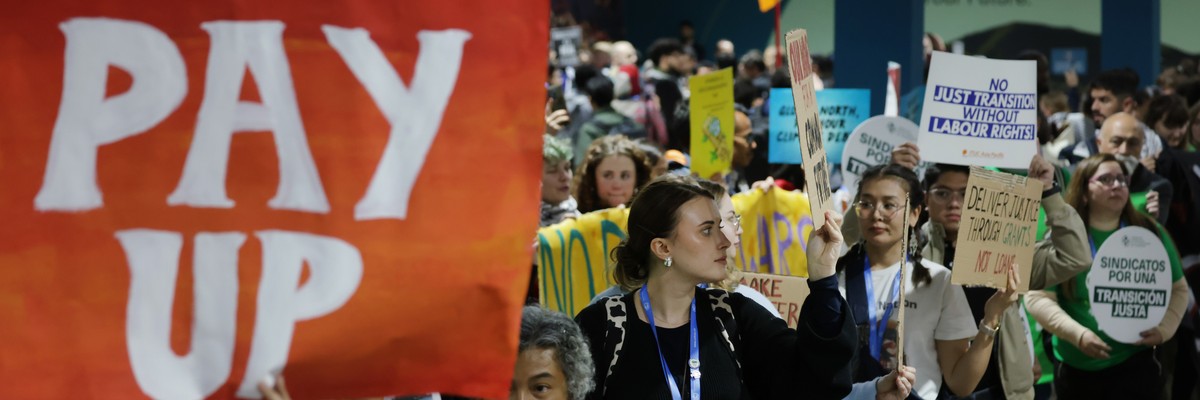
Activists gather with banners, including one that reads: “Pay Up,” outside the plenary halls to voice their demands for a variety of climate-related issues, including labour rights, Indigenous peoples’ rights, loss and damage financing, and the expulsion of fossil fuel lobbyists from the conference on day six at the UNFCCC COP29 Climate Conference on November 16, 2024 in Baku, Azerbaijan. (Photo: Sean Gallup/Getty Images)
A global 2% annual tax on billionaire wealth could raise $250 billion per year from just the world’s 100 richest families.
The world desperately needs to pull the plug on fossil fuels. So agree most of the official delegates from nearly 200 nations who have gathered this month by the Caspian Sea for the 29th annual global “Conference of the Parties” on climate change—COP29 for short—in Azerbaijan’s capital city Baku.
But not all the estimated 70,000 attendees at this year’s COP are practicing what they should be preaching. Private jet arrivals at Baku’s international airport, news reports note, have just doubled.
What makes that such a big deal? Practically nothing symbolizes wanton disregard for our Earth’s environment more dramatically than private jet travel. A corporate executive taking a single long-haul private jet flight, points out the Travel Smart Campaign’s Denise Auclair, “will burn more CO2 than several normal people do in an entire year.”
Instead of taxing the world’s wealthiest at higher levels, rich nations want to give their richest more opportunities to become ever richer.
Researchers at Oxfam have just gone through the flight records of 23 global billionaires. Those airborne souls averaged 184 private jet flights each over a recent single year. They each essentially circumnavigated the globe 10 times over. Their flights averaged 2,074 tons of carbon emissions, an outlay an average person globally would take 300 years to emit.
Extravagances like private jets help explain why global carbon emissions last year expanded by 1.3%. To get climate anywhere near under control, United Nations Secretary-General António Guterres noted on the eve of this month’s COP29 extravaganza, the world’s nations ought to be reducing carbon emissions by at least 9% a year.
“The world is still underestimating climate risks,” Guterres added. “It’s absolutely essential to reduce emissions drastically now.”
And that reducing will only unfold, the U.N. secretary-general emphasized in his COP29 opening remarks, if the world’s nations address the pivotal contribution to climate catastrophe that our world’s wealthiest are making.
“The rich cause the problem,” as Guterres explained, “the poor pay the highest price.”
Observers have tagged this year’s global environmental gathering the “climate finance COP.” The key question before all the official government delegates gathered in Baku: Who will actually pay the bill for addressing the climate change crisis?
Back in 2009, national delegations to that year’s COP gathering pledged to raise an overall annual $100 billion over the next 15 years. The world’s nations have since then met that target only once. Any new annual target for the next 15 years, most researchers and activists agree, needs to run considerably higher, anywhere from $500 billion to $5 trillion higher.
No one can reasonably expect governments alone, COP principals from rich nations counter, to come up with anywhere near that level of support. These rich-nation COP delegations want to encourage private investors to get more involved in financing new climate initiatives.
In other words, instead of taxing the world’s wealthiest at higher levels, rich nations want to give their richest more opportunities to become ever richer.
Nations rich with fossil fuels most heartily agree. The “onus” for financing moves to counter the climate crisis, COP29 President Mukhtar Babayev from Azerbaijan is arguing, “cannot fall entirely on government purses.”
Our globe’s richest nations would also like to expand the trading of “carbon credits,” transactions that let wealthy developed nations delay making costly emissions cuts at home by underwriting much less costly climate actions in poor nations.
But the offset projects that developed nations underwrite, TheGuardiannotes, have regularly overpromised and underdelivered, leaving “wildfires burning through forests that were supposed to be protected and emissions from renewable energy projects being counted on balance books even though they would probably have been built anyway.”
This year’s CO29 conference will wrap up on November 22, and no serious climate change analyst is predicting any consensus that could significantly slow our globe’s ever more perilous progress to climate collapse. Developed nations, Bloomberg’s Mark Gongloff observes, remain “loath to pitch in more than $100 billion a year.”
“Transitioning the world to clean energy alone,” counters Gongloff, could actually cost $215 trillion by 2050.
How could the world make real progress toward those trillions? Guardian environmental editor Fiona Harvey earlier this week ran down some promising options.
Nations could for starters, Harvey notes, put a serious tax bite on the “unprecedented” profit bonanza that fossil fuel companies have enjoyed ever since Russia invaded Ukraine in 2022. Those companies have pocketed well over a quarter-trillion dollars in profits in the two years since.
Nations could also place new taxes on the jet flights our richest so enjoy or move to end the more than $650 billion spent annually in the developing world on subsidies for fossil fuels and polluting industries. Better yet, in a world where our five richest billionaires have more than doubled their wealth since 2020, we could adopt the 2% annual tax on billionaire wealth that Brazilian president Luiz Inácio Lula da Silva has proposed.
A global tax along that line could raise $250 billion per year from just the world’s 100 richest families.
The only sure thing about initiatives like these: No proposals that could make a real climate difference will get any serious attention at COP29, as the prime minister of Albania, Edi Rama, observed in his brief and biting remarks to conference-goers. Rama opened his address to COP29 by noting that he had decided to ditch his prepared remarks after spending some time in the conference’s leaders lounge.
The global notables in that lounge, Rama continued, had all gathered to “eat, drink, meet, and take photos together, while images of voiceless speeches from leaders play on and on and on in the background.”
“To me, this seems exactly like what happens in the real world every day,” he went on to explain. “Life goes on with its old habits, and our speeches, filled with good words about fighting climate change, change nothing.”
Concluded Rama, a former artist and the current chair of his nation’s Socialist Party: “What on Earth are we doing in this gathering, over and over and over, if there is no common political will on the horizon to go beyond words and unite for meaningful action?”
That inaction—in the face of overwhelming global public support for greater pro-climate action—continues to comfort our world’s most fantastically wealthy.
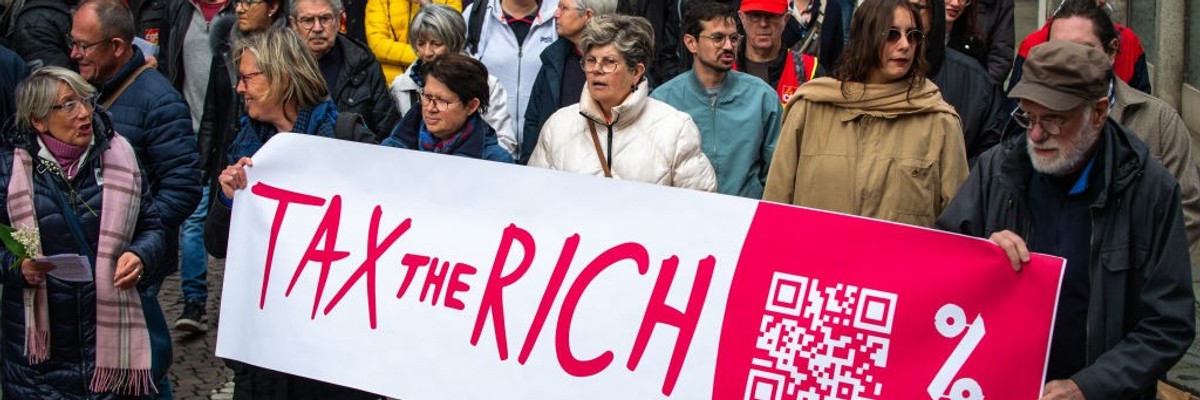
A crowd of demonstrators marches in Saint-Brieuc, France on May 1, 2024. (Photo: Emmanuelle Pays/Hans Lucas/AFP via Getty Images)
“The U.K. and the U.S. are both among the biggest enablers and the biggest losers of this lose-lose tax system,” said the chief executive of the Tax Justice Network.
A study published Tuesday estimates that tax dodging enabled by the United States, the United Kingdom, and other wealthy nations is costing countries around the world nearly half a trillion dollars in revenue each year, underscoring the urgent need for global reforms to prevent rich individuals and large corporations from shirking their obligations.
The new study, conducted by the Tax Justice Network (TJN), finds that “the combined costs of cross-border tax abuse by multinational companies and by individuals with undeclared assets offshore stands at an estimated $492 billion.” Of that total in lost revenue, corporate tax dodging is responsible for more than $347 billion, according to TJN’s calculations.
“For people everywhere, the losses translate into foregone public services, and weakened states at greater risk of falling prey to political extremism,” the study reads. “And in the same way, there is scope for all to benefit from moving tax rule-setting out of the OECD and into a globally inclusive and fully transparent process at the United Nations.”
The analysis estimates that just eight countries—the U.S., Canada, the U.K., Japan, Israel, South Korea, Australia, and New Zealand—are enabling large-scale tax avoidance by opposing popular global reform efforts. Late last year, those same eight countries were the lonely opponents of the United Nations General Assembly’s vote to set in motion the process of establishing a U.N. tax convention.
According to the new TJN study, those eight countries are responsible for roughly half of the $492 billion lost per year globally to tax avoidance by the rich and large multinational corporations, despite being home to just 8% of the world’s population.
“The hurtful eight voted for a world where we all keep losing half a trillion a year to tax-cheating multinational corporations and the super-rich,” Alex Cobham, chief executive of the Tax Justice Network, said in a statement Tuesday. “The U.K. and the U.S. are both among the biggest enablers and the biggest losers of this lose-lose tax system, and their people consistently demand an end to tax abuse, so it’s absurd that the U.S. and U.K. are seeking to preserve it.”
“It’s perhaps harder to understand why the other handful of blockers, like Australia, Canada, and Japan, who don’t play anything like such a damaging role, would be willing to go along with this,” Cobham added.
TJN released its study as G20 nations—a group that includes most of the “hurtful eight”—issued a communiqué pledging to “engage cooperatively to ensure that ultra-high-net-worth individuals are effectively taxed.” Brazil, which hosted the G20 summit, led the push for language calling for taxation of the global super-rich.
The document drew praise from advocacy groups including the Fight Inequality Alliance, which stressed the need to “transform the rhetoric on taxing the rich into global reality.”
The communiqué was released amid concerns that the election of far-right billionaire Donald Trump in the U.S. could derail progress toward a global solution to pervasive and costly tax avoidance.
The new TJN study cites Trump’s pledge to cut the statutory U.S. corporate tax rate from 21% to 15% and warns such a move would accelerate the global “race to the bottom” on corporate taxation.
“People in countries around the world are calling in large majorities on their governments to tax multinational corporations properly,” Liz Nelson, TJN’s director of advocacy and research, said Tuesday. “But governments continue to exercise a policy of appeasement on corporate tax.”
“We now have data from these governments showing that when they asked multinational corporations to pay less tax, the corporations cheated even more,” Nelson added. “It’s time governments found the spines their people deserve from their leaders.”
Māori and allies marched to protest a proposal to dilute Indigenous rights in Wellington, New Zealand on November 19, 2024. (Photo: Sanka Vidanagama /AFP via Getty Images)
The Māori Party co-leader called Parliament’s consideration of a bill that would reinterpret a key treaty “the deepest betrayal that we’ve ever had from a National government.”
An estimated 55,000 people marched outside New Zealand’s Parliament in Wellington on Tuesday to protest legislation that critics argue would dilute Indigenous rights by reinterpreting a treaty signed in 1840 by the British Crown and more than 500 Māori chiefs.
The peaceful demonstration was the culmination of a nine-day march, or hīkoi, that began at Cape Reinga, the northernmost point of New Zealand and the most spiritually significant place in the country for Māori, who are about 20% of the 5.3 million-person population.
Reuters reported that some “dressed in traditional attire with feathered headgear and cloaks and carried traditional Māori weapons, while others wore T-shirts emblazoned with Toitu te Tiriti (Honor the Treaty). Hundreds carried the Māori national flag.”
“We have gathered in our tens of thousands, not just Māori, but others who support an inclusive, diverse, equal partnership that our country has been a world leader in pioneering.”
The Treaty Principles Bill targeting the Treaty of Waitangi, or Te Tiriti o Waitangi, is being pushed by the ACT New Zealand party, a junior partner in the center-right coalition government, which also includes the National Party and New Zealand First (NZF).
Although the National and NZF have said that they are only supporting the legislation for the first of the three readings—meaning it is highly unlikely to pass—Debbie Ngarewa-Packer, co-leader of the Māori Party, or Te Pāti Māori, told the podcast The Front Page that even allowing it to be tabled is a “deep shame.”
“We deserve better than to be used as political pawns,” Ngarewa-Packer argued. “The fact that National has decided that we were tradeable and the mana of the coalition agreement was so much more important than the mana of Te Tiriti and tāngata is the deepest betrayal that we’ve ever had from a National government.”
Pointing to U.S. President-elect Donald Trump, who won earlier this month after being ousted in the previous cycle, Ngarewa-Packer added, “We’re a country that had the first women’s vote, we have always punched above our weight in the anti-nuclear space, the anti-discrimination space, and here we are in 2024 with the sort of Trump-like culture coming into our politics.”
Protestors dressed in traditional Māori attire performed hakas while marching alongside thousands of people through Wellington, New Zealand, in protest of a bill that would reinterpret the Treaty of Waitangi, which underpins Māori people's unique rights. https://t.co/24AHMQGItgpic.twitter.com/Sblei8XFHR
The New York Times noted Tuesday that “a year before American voters’ anger over the cost of living helped Donald J. Trump win the presidency, similar sentiments in New Zealand thrust in the nation’s most conservative government in decades. Now, New Zealand bears little resemblance to the country recently led by Jacinda Ardern, whose brand of compassionate, progressive politics made her a global symbol of anti-Trump liberalism.”
As the newspaper detailed:
The new government—a coalition of the main center-right party and two smaller, more populist ones—has reversed many of Ms. Ardern’s policies. It has rescinded a world-leading ban on smoking for future generations, repealed rules designed to address climate change, and put a former arms industry lobbyist in charge of overhauling the nation’s strict gun laws.
And in a country that has been celebrated for elevating the status of Māori, its Indigenous people, it has challenged their rights and the prominence of their culture and language in public life, driving a wedge into New Zealand society and setting off waves of protests.
Parliament was briefly suspended last Thursday after Maori members staged a traditional dance called a haka to disrupt the first reading. The haka—which garnered global attention—was started by Member of Parliament Hana-Rawhiti Maipi-Clarke, who tore up a copy of the bill.
Speaking to the Wellington crowd on Tuesday, Maipi-Clarke—who at 22 is the country’s youngest MP—said, “We are the sovereign people of this land and the world is watching us here, not because of the system, not because of the rules, but because we haka.”
Other participants in the Tuesday action included the Māori Queen, Ngā Wai Hono i te Pō, and Te Pāti Māori Co-Leader Rawiri Waititi, who led the crowd in a chant to “kill the bill.”
According to The Northern Advocate, ACT Leader David Seymour, “the architect of the Treaty Principles Bill, was booed back inside the Beehive today by the tens of thousands protesting against his controversial bill.”
While Seymour has framed the bill as an effort to end division and ensure equal rights for all, critics like Ella Henry, professor of Māori Entrepreneurship at Auckland University of Technology, warn that it is an effort to roll back New Zealand’s previous progress in terms of relations with Indigenous people.
“So we have gathered in our tens of thousands, not just Māori, but others who support an inclusive, diverse, equal partnership that our country has been a world leader in pioneering,” Henry told SBS News. “Those are the people who are marching.”
Hayley Komene, who is from the Ngāti Kauwhata tribe, similarly toldThe Guardian that there was a “real strength and pride” at the march, and “there are people from lots of different backgrounds here for the same reason—it’s beautiful.”
Komene also slammed the government’s Māori policies as “absolutely ridiculous” and stressed that “Te Tiriti is a constitutional document of our country.”