Amsterdam Media Conspiracy Exposed
I’ve held off from commenting of the violence in Amsterdam because it’s difficult to know what happened without being. This report appears comprehensive.
I’ve held off from commenting of the violence in Amsterdam because it’s difficult to know what happened without being. This report appears comprehensive.

Keir Starmer was having trouble defining genocide at Prime Minister’s Questions yesterday but insisted that Israel was not committing genocide. He should have very little difficulty since he is often described as a human rights lawyer. The rest of us know that Israel is committing genocide. While not a definition, we can see that they are from indiscriminate mass-murder, targeting hospitals, healthcare workers, journalists, aid workers, using starvation and disease as weapons of war, forcible displacements and the statements made by Israeli ministers e.g. Smotrich and Ben-Gvir.
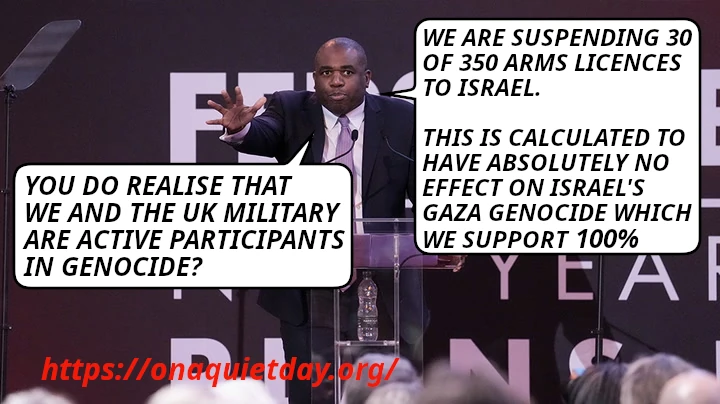
It should be recognised that the UK and US are active participants in Israel’s genocides and that Keir Starmer, David Lammy and others in the UK Labour Party are therefore genocidal war criminals. UK’s military forces are participating in genocide and the cabinet are supposedly held jointly responsible under UK law. [ed: The problem is that t] They need to be held accountable, prosecuted and convicted.


I’m aware that formatting is messed up on the desktop on the first page. Looking for the problem, might not find it, posting this just might fix it. We’ll see.
Original article by Julia Conley republished from Common Dreams under Creative Commons (CC BY-NC-ND 3.0).

As the deadline set by the Biden administration last month for Israel to step up aid deliveries to Gaza passed on Tuesday, human rights groups demanded that the U.S. stick to its commitment to holding the Israeli government accountable for what one advocate called “a campaign of ethnic cleansing.”
But the White House’s refusal over the last 13 months to follow U.S. and international law provoked doubt that it would do so.
U.S. Secretary of State Antony Blinken and Defense Secretary Lloyd Austin wrote a letter to Israeli Prime Minister Benjamin Netanyahu’s government on October 13, giving Israel 30 days to allow at least 350 humanitarian aid trucks per day into Gaza, open a fifth crossing into the enclave, and ensure access to northern Gaza for aid groups, among other specific steps outlined in the letter.
Noncompliance would violate National Security Memorandum 20, which President Joe Biden issued in February to demand credible assurances from Israel that it was acting according to international law, and Section 620I of the Foreign Assistance Act, which prohibits the U.S. from providing military aid to countries that are blocking U.S. humanitarian aid.
Advocates have said for months that Israel and the U.S. have been violating both statutes, as mounting evidence has shown U.S. weapons have been used in Israeli attacks on civilians and United Nations experts have warned Gaza has descended into famine.
Louise Wateridge, a senior emergency officer for the U.N. Relief and Works Agency for Palestine Refugees in the Near East (UNRWA), said Tuesday that the Biden administration’s warning 30 days ago did not improve conditions in Gaza, with aid entering the enclave “at its lowest level in months.”
“Thousands and thousands of people have been killed senselessly. They have been killed because there is lack of aid, because the bombs have continued, and because we have not been able to even reach them under the rubble,” Wateridge said at a press briefing in Geneva. “The average for October was 37 trucks a day into the entire Gaza Strip… That is for 2.2 million people… Children are dying. People are dying every day.”
With the number of daily deliveries since October 13 far below the level stipulated by the Biden administration, Wateridge emphasized that “anything that happens now is already too late.”
As the deadline passed, Israel appeared eager to put new humanitarian aid efforts on display, with the Coordinator of Government Activities in the Territories (COGAT) posting on social media an image of a convoy delivering what it said were “hundreds of food and water packages to the Jabaliya and Beit Hanoun areas in 6n Gaza.”
The military also arranged a photo call on Monday where journalists “were invited to film around eight aid truc ks passing into Gaza,” reported Jon Donnison at the BBC. “They were laden with sacks of flour, rice, and toilet paper, among other things.”
“So, aid is getting into Gaza,” wrote Donnison. “But nowhere near enough.”
Before Israel began its bombardment of Gaza in October 2023, about 500 aid trucks entered the enclave each day.
A spokesperson for COGAT told the BBC Tuesday that “most aspects [of Blinken’s demands] have been met and those which have not are being discussed.”
Sorry, this content could not be embedded.
X
U.N. officials said this week that aid workers have been unable to deliver relief even after the Israel Defense Forces gave approval for deliveries in northern Gaza, which has been cut of from virtually all aid for more than a month. Israeli troops on the ground have restricted aid despite the IDF’s approval.
In southern Gaza, hundreds of trucks containing aid have been sitting on the enclave’s side of the border with Egypt because U.N. workers cannot reach them due to “lawlessness, theft, and Israeli military restrictions,” according to The Associated Press.
As the deadline passed Tuesday, a coalition of human rights groups including Oxfam, Refugees International, and Save the Children released a scorecard assessing Israel’s progress in complying with the conditions set by Blinken and Austin on October 13.
They found “outright failure” by Israel to meet 15 out of 19 measures of compliance, and said the IDF has only partially complied with the remaining four.
Israel has failed to allow 350 aid trucks into Gaza over the last month, said the groups, and has not ended the isolation of northern Gaza or allowed the International Committee of the Red Cross (ICRC) access to Palestinians detained by Israel, among other requirements set last month.
“The U.S. government once again laid out basic measures for how the government of Israel must follow international law and allow for aid delivery in Gaza,” said Oxfam America president and CEO Abby Maxman. “Since then, we have seen Israeli forces accelerate their efforts to bombard, depopulate, deprive, and erase the Palestinian population of the North Gaza governorate. We are witnessing a campaign of ethnic cleansing.”
“Oxfam and partner organizations are unable to provide any support to the remaining civilians in the North Gaza governorate, where people are dying every day,” added Maxman. “jAccess to the rest of Gaza is also severely restricted, with civilians facing starvation and relentless violence. The U.S. must finally make this overdue call to suspend deadly arms sales to Israel or be complicit in the horrific atrocities unfolding before our eyes.”
Michelle Nunn, president and CEO of CARE, said that with the letter sent to Netanyahu’s government last month, the U.S. “created a critical opportunity to respond to the facts on the ground, and to insist upon accountability to our own laws.”
“It is imperative to act now to prevent further loss of innocent life, the deepening of an extraordinary humanitarian crisis, and the continued erosion of U.S. credibility as an upholder of international humanitarian law,” said Nunn.
The analysis, added Refugees International president Jeremy Konyndyk, “demonstrates that the Israeli government is violating its obligations under U.S. and international law to facilitate humanitarian relief for suffering Palestinians in Gaza.”
“With experts again projecting imminent famine in north Gaza, there is no time to lose,” he added. “The United States must impose immediate restrictions on security cooperation with Israel as required under Section 620I of the Foreign Assistance Act.”
Original article by Julia Conley republished from Common Dreams under Creative Commons (CC BY-NC-ND 3.0).
Original article by Jake Johnson republiahed form Common Dreams under Creative Commons (CC BY-NC-ND 3.0).

Climate campaigners didn’t sugarcoat their reactions to a Dutch court decision on Tuesday that overturned a landmark 2021 ruling ordering the oil behemoth Shell to cut its planet-warming emissions nearly in half by the end of this decade.
“We are shocked by today’s judgment,” said Donald Pols, director of Milieudefensie, the Netherlands-based environmental group that originally filed suit against Shell in 2018.
“It is a setback for us, for the climate movement, and for millions of people around the world who worry about their future,” Pols said of Tuesday’s ruling by the Hague Court of Appeal. “But if there’s one thing to know about us, it’s that we don’t give up. This setback will only help us grow stronger. Large polluters are powerful. But united, we as people have the power to change them.”
The original 2021 ruling, as CNBC noted, marked “the first time in history that a company was found to have been legally obliged to align its policies with the Paris Agreement” and “sparked a wave of lawsuits against other fossil fuel companies.”
Despite acknowledging that Shell has “an obligation toward citizens to reduce CO2 emissions,” the appeals court on Tuesday scrapped a legal mandate compelling the company to slash its emissions by 45% by 2030 compared with 2019 levels, saying it was “unable to establish that the social standard of care entails an obligation for Shell to reduce its CO2 emissions by 45%, or some other percentage.”
“It is primarily up to the government to ensure the protection of human rights,” the court added.
Laurie van der Burg of Oil Change International said in response that “while we mourn today’s setback, the ruling establishes a responsibility for Big Oil and Gas to act that future litigation can build on.”
“The court ruled protection against climate change is a human right, and corporations have a responsibility to reduce their emissions,” she added. “As far as we know, this is the first case where a court has acknowledged that new investments in oil and gas are incompatible with international climate goals.”
“Today’s ruling underscores the importance of world leaders now negotiating at the U.N. Climate Summit in Baku taking responsibility.”
Shell, which is responsible for just over 2% of global CO2 emissions, said in a statement that it was “pleased” with the court’s ruling and claimed to be “making good progress in our strategy to deliver more value with less emissions.”
But research by the human rights organization Global Witness has found that Shell has consistently overstated the scale of its investments in green energy—including by characterizing fossil fuels as “renewable.”
“Even as Shell claims to be reducing its oil production, it is planning to grow its gas business by more than 20% over the next few years, leading to significant additional emissions,” Global Witness wrote in a complaint to the U.S. Securities and Exchange Commission last year.
Andy Palmen, the director of Greenpeace Netherlands, said Tuesday that while campaigners working toward a just phaseout of fossil fuel emissions are “disappointed that Shell is being allowed to continue polluting,” they “will not give up the fight.”
“This only motivates us more to take action against major polluters,” said Palmen. “It really gives hope that the court finds that Shell must respect human rights and has a duty to reduce its CO2 emissions.”
“Today’s ruling underscores the importance of world leaders now negotiating at the U.N. Climate Summit in Baku taking responsibility,” Palmen added, referring to the COP29 gathering that kicked off on Monday in Azerbaijan’s capital city. “The summit in Dubai last year marked the end of coal, oil, and gas, now governments must come up with concrete plans to move away from fossil fuels.”
The Dutch appeals court’s ruling came in the wake of new research showing that oil and gas production surged to an all-time high in 2023—the hottest year on record.
“The oil and gas industry is not transitioning,” the environmental group Urgewald and dozens of other NGOs found. “In fact, 95% of the upstream companies on [the Global Oil and Gas Exit List] are still exploring or developing new oil and gas resources. This includes the oil and gas producers TotalEnergies, Shell, BP, Eni, Equinor, OXY, OMV, and Ecopetrol, which all claim to be targeting net zero emissions by 2050.”
Nils Bartsch, head of oil and gas research at Urgewald, said Tuesday that the 2023 oil and gas production record is “deeply concerning.”
“If we do not end fossil fuel expansion and move towards a managed decline of oil and gas production,” said Bartsch, “the 1.5°C goal will be out of reach.”
Original article by Jake Johnson republiahed form Common Dreams under Creative Commons (CC BY-NC-ND 3.0).