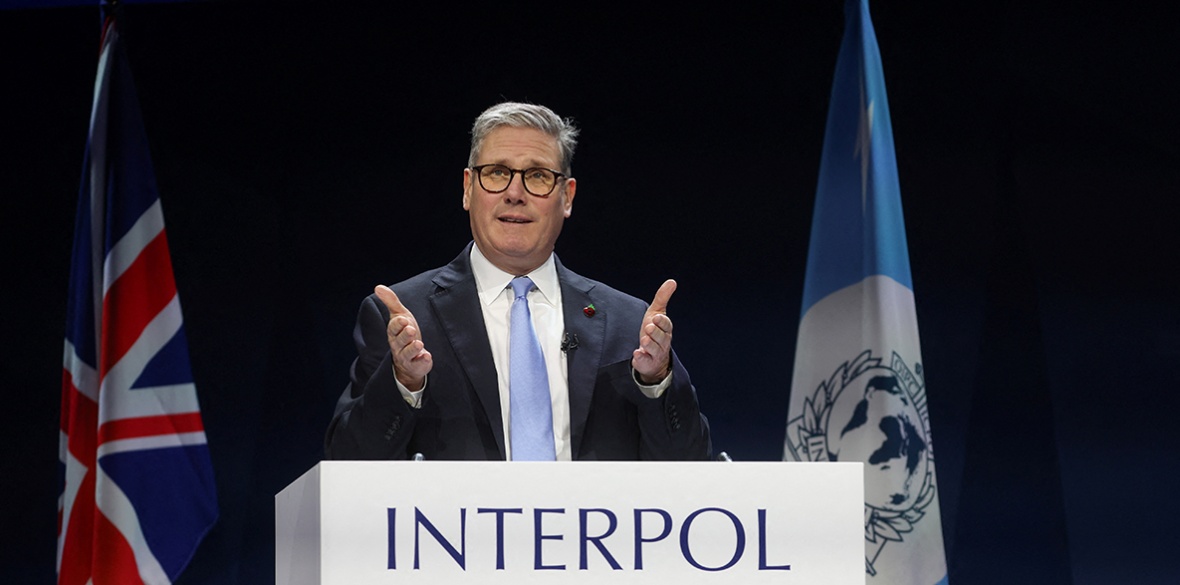
Prime Minister Sir Keir Starmer giving a speech during the Interpol General Assembly, at the Scottish Event Campus (SEC) in Glasgow, November 4, 2024
ILLEGAL migration is a security threat equivalent to terrorism, the Prime Minister said today as he aped Tory rhetoric.
Pouring cash and hardline language at the problem, Sir Keir Starmer announced an extra £75 million to police Britain’s borders.
Speaking at the global policing organisation Interpol’s conference in Glasgow, Sir Keir said that “people smuggling should be viewed as a global security threat similar to terrorism.”
The new Border Security Command Labour is establishing would “treat people smugglers like terrorists,” he pledged.
…
Government presentation of the question appeared inflammatory, as the Downing Street press release for the Prime Minister’s speech headlined “national security threat.”
Public and Commercial Services (PCS) union general secretary Fran Heathcote said: “While we welcome the government’s commitment to tackle people smugglers, the best way to deal with deaths in the Channel is to adopt our Safe Passage policy that would create a safe and legal route for refugees to come to the UK and here begin their asylum claim.”
Small boat crossings are presently on the rise, with more than 27,500 people having made the dangerous passage across the Channel so far this year, more than in the same period in 2023.
Cuba is in the midst of an ongoing humanitarian crisis, and October’s widespread power outages are only adding to the Cuban people’s troubles. For the last six decades, Cuba has been on the receiving end of myriad sanctions by the United States government. This blockade has proved devastating to human life.
Reporting on Cuba’s blackouts have either omitted or paid brief lip-service to the effects of US sanctions on the Cuban economy, and how those sanctions have created the conditions for the crisis. Instead, media have focused on the inefficient and authoritarian Communist government as the cause of the island’s troubles.
Pulping the economy
Michael Galant (The Hill, 1/5/24): “Businesses and financial institutions, including many from outside the United States, often elect to sever all connections to Cuba rather than risk being sanctioned themselves for association with ‘a sponsor of terror.’”
One of President Donald Trump’s final acts in office was to re-designate Cuba as a State Sponsor of Terrorism, after President Barack Obama had removed them from the list in 2015 as a part of his Cuban thaw. Inclusion on the list subjects a country to restrictions on US foreign aid and financing, but, more importantly, the SSoT list encourages third-party over-compliance with sanctions. “Businesses and financial institutions, including many from outside the United States, often elect to sever all connections to Cuba rather than risk being sanctioned themselves,” The Hill (1/5/24) reported.
Trump reportedly added Cuba to the list for harboring members of FARC and ELN, two left-wing Colombian armed movements. However, Colombian President Gustavo Petro later “noted that Colombia itself, in cooperation with the Obama administration, had asked Cuba to host the FARC and ELN members as part of peace talks,” the Intercept (12/14/23) wrote. Indeed, if Cuba deported the dissidents, they would have been in violation of the protocols of the peace talks, which they were bound to by international law (The Nation, 2/24/23).
President Joe Biden has not begun the process of reviewing Cuba’s inclusion on the list, despite his campaign promises to the contrary.
The terror designation, plus the many other sanctions imposed by Trump and continued by Biden, are no small potatoes. Ed Augustin wrote at Drop Site (10/1/24) that
the terror designation, together with more than 200 sanctions enacted against the island since Obama left office, has pulped the Cuban economy by cutting revenue to the struggling Cuban state…. The combined annual cost of the Trump/Biden sanctions, [economists] say, amounts to billions of dollars a year.
Augustin argued that the economic warfare regime is a root cause of the rolling blackouts, water shortages and mass emigration that have plagued Cuba in recent years. Even imports that are ostensibly exempt from sanctions, like medication, are caught in the dragnet as multinational companies scramble to cut ties with the island. Banks are so reluctant to run afoul of US sanctions, Augustin wrote, “that often, even when the state can find the money to buy, and a provider willing to sell, there’s simply no way of making the payment.”
Cuba’s pariah status as a SSoT has put a stranglehold on its economy, and its government’s ability to administer public services. However, US restrictions on Cuba are almost never mentioned in US coverage, and reporting on the recent blackouts is no exception.
Cash-strapped Communists
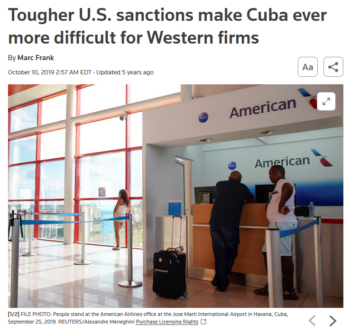
Reuters (10/10/19): “Tougher US sanctions against Cuba have led international banks to avoid transactions involving the island, while prospective overseas investors put plans on hold.”
Coverage has emphasized the inability of Cuba’s government to pay for necessary fuel imports. The New York Times (10/19/24) reported “the strapped Communist government could barely afford” to pay for fuel. Elsewhere, the Times (10/18/24) claimed “a severe economic crisis and the cash crunch it produced made it harder for Cuba to pay for those fuel imports.”
The Washington Post (10/18/24) made broadly similar arguments, chalking the blackouts up to “a shortage of imported oil and the cash-strapped government’s insufficient maintenance of the creaky grid.”
The “cash crunch” referenced by the Times is not just the result of an abstract economic crisis, as is implied. Instead, it is a direct effect of US sanctions on financial institutions. During the Obama administration, European banks, including ING and BNP Paribas, were fined to the tune of over $10 billion for transacting with Cuba (Jacobin, 3/27/22). Even before Cuba was choked further as a result of their SSoT designation, reporting by Reuters (10/10/19) showed the extent to which banks were terminating operations with Cuba and Cuban entities:
Many Western banks have long refused Cuba-related business for fear of running afoul of US sanctions and facing hefty fines.… Panama’s Multibank shut down numerous Cuba-related accounts this year and European banks are restricting clients associated with Cuba to their own nationals, if that.…
Businessmen and diplomats said large French banks, including Societe Generale, no longer want anything to do with Cuba, and some are stopping payments to pensioners living on the Caribbean island.… For the first time in years, the island has had problems financing the upcoming sugar harvest. Various joint venture projects, from golf resorts to alternative energy, are finding it nearly impossible to obtain private credit.
This de-risking by financial institutions manufactures a cash-scarce economy. Cuba’s inability to procure cash for imports is not a function of financial mismanagement, or a lack of credit-worthiness. Instead, it is a deliberate effect of American foreign policy. By omitting the actions of the most powerful government on earth, mainstream coverage allows only that only Cuban failures could be the cause of a shortage of cash.
‘Terrorism’ cuts off tourism
Britain’s ambassador to Cuba told the Telegraph (11/6/23), “Those who come are profoundly shocked at what the SSOT designation is doing to the people here.”
Cuba has historically used tourism as a way of bringing money into the economy, but lately the Cuban tourism industry has been severely depressed. The explanation employed by corporate media for the decline of this industry is to blame the extended effects of the pandemic recession (New York Times, 10/19/24; Washington Post, 10/18/24).
This explanation, however, is incomplete. Cuba has indeed had a lackluster rebound in their tourism industry, but the Times and the Post fail to explain why Cuba has faltered while other Caribbean islands have more than re-achieved their pre-pandemic tourist numbers.
Travelers from Britain, Australia, Japan and 37 other countries do not need to procure a visa for travel to the United States. Instead, they can use ESTA, an electronic visa waiver. This greatly reduces the cost and the annoyance of obtaining permission to visit the US. However, since Cuba’s 2021 listing as a SSoT, any visit to the country by an ESTA passport-holder revokes the visa waiver, for life (Telegraph, 11/6/23). In other words, any Brit (or Kiwi, or Korean, and so on) who visits Cuba must, for the rest of their lives, visit a US embassy and pay $180 before being able to enter the United States. US policy, not a Covid hangover, is hamstringing any possibility of a resurgence in tourism to Cuba.
Blame game
During Cuba’s most recent energy crisis, the New York Times published three stories describing the blackouts. Two of these stories mention the US blockade only as something that the Cuban government blames for the crisis.
The New York Times (10/21/24) presented the idea that the US is punishing Cuba’s economy as a Communist allegation: “The Cuban government blames the power crisis on the US trade embargo, and sanctions that were ramped up by the Trump administration.”
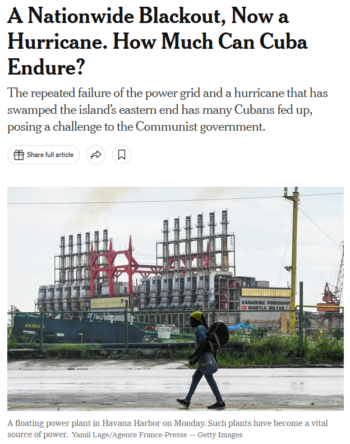
The headline on the Times website (10/21/24) read: “A Nationwide Blackout, Now a Hurricane. How Much Can Cuba Endure?” The paper was right to report on the humanitarian crisis ongoing in Cuba, but it chose to downplay the most important root cause: the decades-long US blockade on Cuba’s economy and its people.
That same story described Cuba as “a Communist country long accustomed to shortages of all kinds and spotty electrical service.” Why is the country so used to shortages? Eleven paragraphs later, the Times gave an explanation, or at least, Cuba’s explanation:
The Cuban government blames the power crisis on the US trade embargo, and sanctions that were ramped up by the Trump administration, which severely restricts the Cuban government’s cash flow. The US Department of the Treasury blocks tankers that have delivered oil to Cuba, which drives up the island’s fuel costs, because Cuba has a limited pool of suppliers available to it.
Earlier coverage by the Times (10/18/24) similarly couched the effects of the blockade as merely a claim by Cuba. The Washington Post (10/22/24) also situated the blockade as something that “the Cuban government and its allies blame” for the ongoing crisis.
To report that Cuban officials blame the US sanctions for the energy crisis is a bit like reporting that fishermen blame the moon for the rising tide. It is of course factual that US trade restrictions–which affect not just US businesses, but also multinational businesses based in other countries–are a blunt weapon, with impact against not just a government, but an entire people.
At the very least, it is incumbent upon journalists to do at least minimal investigation and explanation of the facts concerning the subject of their reporting. None of the coverage in either major paper bothered to investigate whether this was a fair explanation, or even to report generally the effects a 60-year blockade might have on an economy.
Brief—and buried
“Cuban economists and foreign analysts blamed the crisis on several factors,” the New York Times (10/19/24) reported; 18 paragraphs later, the story gets around to mentioning US sanctions.
On October 19, the Times gave its most complete explanation of the relationship between the US sanctions regime and the Cuban blackouts:
Cuba’s economy enjoyed a brief honeymoon with the United States during the Obama administration, which sought to normalize relations after decades of hostility, while keeping a longstanding economic embargo in place. President Donald J. Trump reversed course, leading to renewed restrictions on tourism, visas, remittances, investments and commerce.
This explanation can be found in the 31st paragraph of the 37-paragraph story. Only once the Times has painted a picture of all the ways the Communist government has gone wrong can there be a brief mention of the role of US sanctions. And how brief it is; the Times chose not to detail the extent of blockade against Cuba, nor how Cuba was wrongfully placed on the SSoT list, nor the failure of Biden to reevaluate Cuba’s status as he promised on the campaign trail.
Describing the US starvation of Cuba’s economy in abstract terms like “economic crisis” provides cover for deliberate policy decisions by the US government. By reporting on the embargo only as something that the Cuban government claims, it is easy for readers to dismiss that explanation as simply a Communist excuse. Instead of asking why the United States is choosing to enforce a crippling sanctions regime on another country, outlets like the New York Times find it easier to repeat the line that Cuba’s government has only itself to blame for its problems.
FAIR’s work is sustained by our generous contributors, who allow us to remain independent. Donate today to be a part of this important mission.
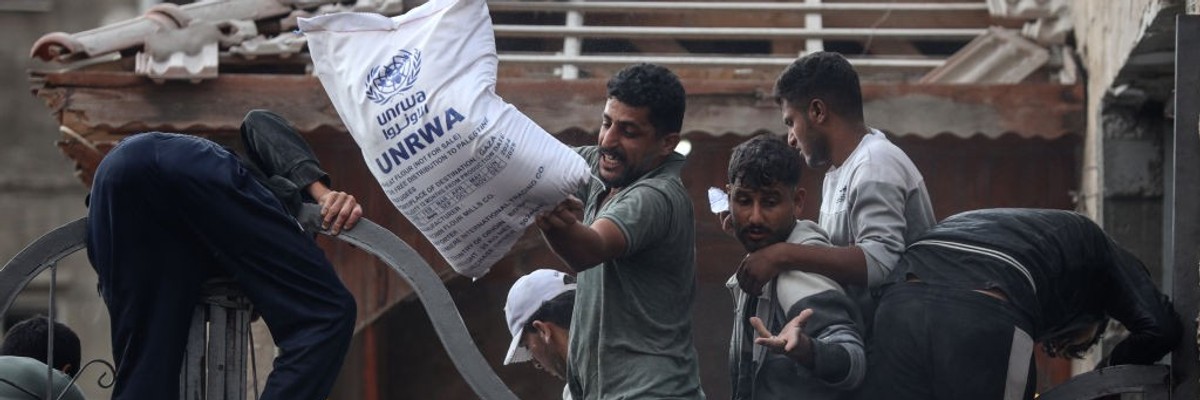
Palestinians scramble to receive sacks of flour at a United Nations Relief and Works Agency aid distribution center in Deir al-Balah, Gaza on November 3, 2024. (Photo: Majdi Fathi/NurPhoto via Getty Images)
“Restricting humanitarian access and at the same time dismantling UNRWA will add an additional layer of suffering to already unspeakable suffering,” said the U.N. agency’s commissioner-general.
Israel’s Foreign Affairs Ministry on Sunday formally notified the United Nations that it has terminated a decades-old legal agreement governing the country’s relations with the U.N. agency for Palestinian refugees, a move that aid workers and advocacy groups say will spell further disaster for Gaza’s besieged and famine-stricken population as winter approaches.
The director-general of the Israeli Foreign Affairs Ministry announced the decision to scrap the 1967 agreement in a letter to the president of the U.N. General Assembly, a message sent roughly a week after Israeli lawmakers approved legislation banning the U.N. Relief and Works Agency for Palestine Refugees in the Near East (UNRWA) from operating or providing services “in the sovereign territory of the state of Israel.”
The new letter states that the legislation “will enter into effect following a three-month period.”
The Washington Post reported Monday that Juliette Touma, UNRWA’s communications director, said that “the agency expected to continue its work coordinating the distribution of aid in Gaza and the West Bank at the operational level.”
But aid groups have warned that Israel’s UNRWA ban could inflict fatal damage to humanitarian operations in Gaza and the West Bank, given Israeli control over access to the illegally occupied territories. The legislation Israeli lawmakers passed last week bars the government from issuing work permits to foreign UNRWA staff and prevents the military from coordinating with the aid agency.
“The human cost of this ban is immeasurable,” Mara Kronenfeld, executive director of UNRWA USA, said in a statement last week. “This Israeli Knesset vote banning UNRWA is not merely an attack on the U.N. agency; it’s an attack on the fundamental rights and dignity due to all human beings. The consequences of this ban could result in the loss of tens of thousands, if not more, precious Palestinian lives. Where is the humanity?”
“You can hear children crying, people screaming, people running for their lives, and it has been nonstop for 24 hours. There’s nowhere to go. People are trapped.”
The U.S., Israel’s main ally and arms supplier, urged the Israeli government last week not to implement the newly passed legislation, even though the U.S. has yet to restore its own funding to UNRWA. The Biden administration suspended U.S. funding for UNRWA in January after Israel accused a small number of agency employees of taking part in the October 7, 2023 Hamas-led attack on Israel.
The U.N. fired nine UNRWA workers after an investigation determined that they “may have been involved” in the attack. UNRWA has roughly 13,000 staffers in the Gaza Strip, and the agency is the most important aid group operating in the enclave.
Dylan Williams, vice president for government affairs at the Center for International Policy, argued that by terminating its agreement with UNRWA, “Israel is also further breaking U.S. law prohibiting the restriction of aid delivery.”
“It’s a definitive rejection of an explicit demand in the Biden administration’s October 13 letter and by law must result in halting U.S. arms and military aid to Israel,” Williams added.
The Israeli Foreign Affairs Ministry’s announcement came as Israel’s military continued its bombing campaign and ground attacks across Gaza. Reuters reported that at least a dozen Palestinians were killed by Israeli airstrikes on Monday, including seven people in an attack on houses in northern Gaza.
“It is absolutely terrifying,” Louise Wateridge, an UNRWA spokesperson, told Al Jazeera on Saturday, referring to conditions on the ground in Gaza. “You can hear children crying, people screaming, people running for their lives, and it has been nonstop for 24 hours. There’s nowhere to go. People are trapped.”
Philippe Lazzarini, UNRWA’s commissioner-general, said Monday that Israeli authorities allowed an average of just 30 aid trucks to enter Gaza per day last month.
Prior to October 7, 2023, around 500 aid trucks were entering the enclave daily.
“This cannot meet the needs of over 2 million people, many of whom are starving, sick, and in desperate conditions,” Lazzarini said Monday. “Restricting humanitarian access and at the same time dismantling UNRWA will add an additional layer of suffering to already unspeakable suffering.”
“Only political will,” he added, “can put an end to a politically made situation.”