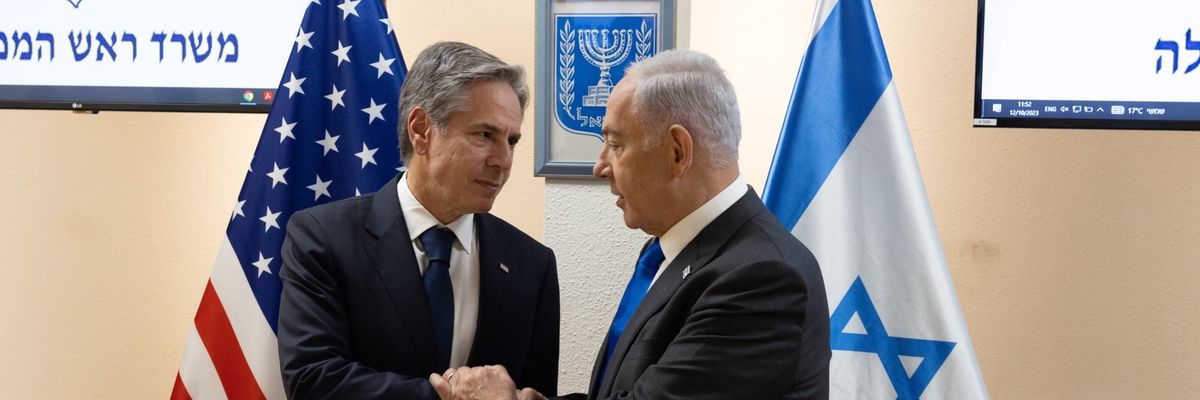
U.S. Secretary of State Antony Blinken. meets with Israeli Prime Minister Benjamin Netanyahu in Tel Aviv on October 12, 2023. (Photo: Eyepress Media Limited/Reuters via Getty Images)
“This lawsuit demands one thing and one thing only: for the State Department to obey the law requiring a ban on assistance to abusive Israeli security forces,” said one advocate.
Palestinians and Palestinian Americans on Tuesday filed a lawsuit accusing the U.S. State Department of creating a “loophole” allowing Israel to skirt federal legislation barring American military aid to foreign militaries that violate human rights law.
The lawsuit, which was filed by five individuals and supported by the group Democracy for the Arab World Now (DAWN), accuses the State Department and Secretary of State Antony Blinken of violating the Leahy Law, legislation passed in two parts in the late 1990s that built on the Foreign Assistance Act of 1961‘s proscription of U.S. military aid to foreign security forces that commit gross human rights violations.
According to DAWN, the suit “documents how the State Department has created unique, insurmountable processes to evade the Leahy Law requirement to sanction abusive Israeli units, despite overwhelming evidence of their human rights violations” including “torture, prolonged detention without charge, forced disappearance, and flagrant denials of the right to life, liberty, and security, such as genocide, indiscriminate and deliberate killings, and deprivation of items essential to survival, including food, water, fuel, and medicine.”
Case plaintiff Ahmed Moor, a Palestinian American from the southern Gazan city of Rafah who has lost numerous relatives in Israeli attacks, toldZeteo‘s Prem Thakker, “I’m hoping, through this action, through this lawsuit, that we can just call out the federal government to begin to enforce American laws.”
The State Department has sparked international outrage by repeatedly finding that Israel is using U.S.-supplied arms in compliance with domestic human rights law, citing the key ally’s right to defend itself and the October 7, 2023 Hamas-led attack. However, Israel’s 438-day retaliation has left more than 162,000 Palestinians dead, wounded, or missing in Gaza and millions more forcibly displaced, starved, or sickened. Thousands more have been killed or maimed in the West Bank.
South Africa is leading a genocide case against Israel at the International Court of Justice. Last month, the International Criminal Court (ICC) issued arrest warrants for Israeli Prime Minister Benjamin Netanyahu and Yoav Gallant, his former defense minister, for alleged war crimes and crimes against humanity.
Both men have been warmly welcomed in Washington, D.C.. Congress and the Biden administration have approved tens of billions of dollars in arms transfers to Israel. U.S.-supplied bombs have been used in some of Israel’s most notorious airstrikes. The U.S. has also vetoed numerous United Nations Security Council resolutions demanding a Gaza cease-fire.
Today, the White House welcomed Yoav Gallant, charged by the ICC with the war crimes of starvation as a method of warfare and intentionally directing an attack against the civilian population, as well as the crimes against humanity of murder, persecution, and other inhumane acts. What a disgrace.
“This lawsuit demands one thing and one thing only: for the State Department to obey the law requiring a ban on assistance to abusive Israeli security forces,” DAWN executive director Sarah Leah Whitson said in a statement on Tuesday. “For too long, the State Department has acted as if there’s an ‘Israel exemption’ from the Leahy Law, despite the fact that Congress required it to apply the law to every country in the world. As a result, millions of Palestinians have suffered unimaginable, horrific abuses by Israeli forces using U.S. weapons.”
Stephen Rickard, a former U.S. official who helped pass the landmark legislation, said that “long-standing concerns that the State Department was not cutting off aid to specific Israel units as required by the Leahy Law… have been given dramatic urgency by the tragic ongoing crisis in Gaza.”
“If the State Department will not comply with the law, then it is time for the courts to vindicate the rule of law and order it to do so,” Rickard added.
The new lawsuit came a day after relatives of Ayşenur Ezgi Eygi—the Turkish American woman who, according to witnesses, was deliberately shot in the head while peacefully protesting the expansion of Israel’s illegal settlements in the occupied West Bank in September—met with Blinken in search of justice and accountability for the activist’s killing.
Referring to another American activist killed by Israeli forces while defending Palestinian homes, Hamid Ali, Eygi’s widower, said that Blinken “was attentive in listening to us, but unfortunately repeated a lot of the same things that we’ve been hearing for the past 20 years, particularly since Rachel Corrie’s killing.”
Ali called Blinken “very deferential to the Israelis,” adding that “it felt like he was saying his hands were tied and they weren’t able to really do much.”
A journalist asked State Department spokesperson Matthew Miller during a Tuesday press conference why the U.S. has not suspended arms transfers to Israel by invoking the Leahy Law and citing the cases of victims like Eygi or Shireen Abu Akleh—the Palestinian American Al Jazeera correspondent who, according to witnesses and several independent probes, was deliberately shot dead by an Israeli sniper in the West Bank in May 2022.
“We have taken those cases extremely seriously,” Miller claimed. Referring to Eygi, he added that he made it clear to Israel that “her death was unacceptable, that it should have been avoided, it should have never happened in the first place, that we want to see the results of their investigation, and we want to see them change their rules of engagement.”
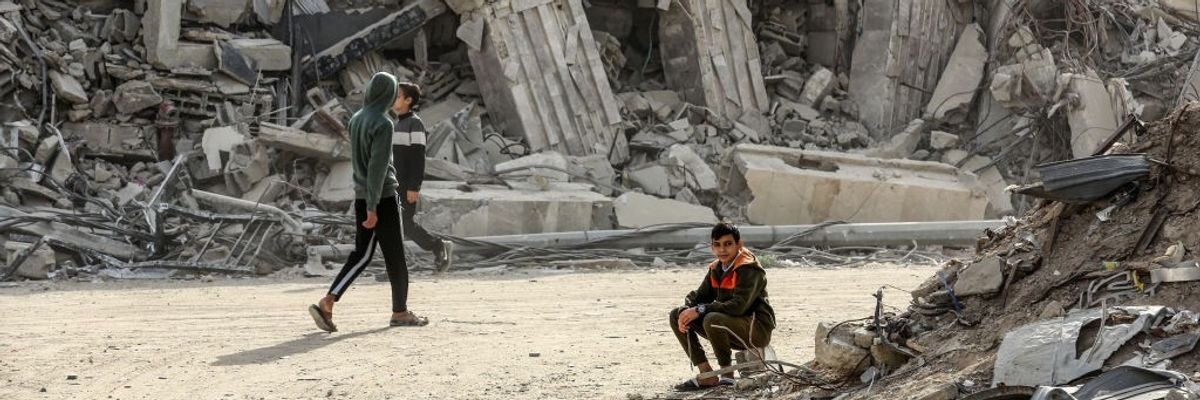
Palestinians are surrounded by buildings destroyed by Israeli attacks in Khan Younis, Gaza on December 10, 2024. (Photo: Abed Rahim Khatib/Anadolu via Getty Images)
“Failure to do so not only risks our leverage in ceasefire negotiations, it undermines our country’s own national security and weakens America’s commitment to human rights as a cornerstone of our foreign policy.”
Twenty progressives in the U.S. House of Representatives on Tuesday wrote to top Biden administration officials arguing that “the United States government must suspend offensive weapons” to Israel over its destruction of the Gaza Strip, citing federal and international law.
Led by Reps. Summer Lee (D-Pa.) and Greg Casar (D-Texas), the incoming Congressional Progressive Caucus chair, the lawmakers began by thanking U.S. Secretary of State Antony Blinken and Secretary of Defense Lloyd Austin for their October 13 letter threatening to cut off weapons to Israeli Prime Minister Benjamin Netanyahu’s government if it did not dramatically improve humanitarian conditions in Gaza.
“However, despite your administration acknowledging that the Netanyahu government did not fully address the United States’ concerns over Gaza and has failed to meet all of the conditions stipulated in this letter, the State Department decided not to take further action, including the suspension of offensive military assistance, to ensure full compliance,” the Democrats wrote.
“We believe continuing to transfer offensive weapons to the Israeli government prolongs the suffering of the Palestinian people and risks our own national security by sending a message to the world that the U.S. will apply its laws, policies, and international law selectively,” they continued. “Furthermore, a failure to act will put Israeli lives in danger by prolonging Netanyahu’s war, isolating Israel on the international stage, and creating further instability in the region.”
The new letter comes just over a month away from President Joe Biden leaving office and follows one from last week signed by 77 House Democrats—including Casar—that demanded “a full assessment of the status of Israel’s compliance with all relevant U.S. policies and laws, including National Security Memorandum 20 (NSM-20) and Section 620I of the Foreign Assistance Act.”
This one goes further, explicitly urging the Biden administration to suspend offensive military transfers and warning that “failure to do so not only risks our leverage in cease-fire negotiations, it undermines our country’s own national security and weakens America’s commitment to human rights as a cornerstone of our foreign policy.”
“We remain committed to saving Palestinian and Israeli lives. This means doing everything possible to prioritize the release of hostages, secure a lasting cease-fire deal, and move toward long-term peace,” the 20 progressives concluded.
In addition to Lee and Casar, Tuesday’s letter was signed by Democratic Reps. Jamaal Bowman (N.Y.), Cori Bush (Mo.), Joaquin Castro (Texas), Lloyd Doggett (Texas), Veronica Escobar (Texas), Jesús “Chuy” García (Ill.), Al Green (Texas), Sara Jacobs (Calif.), Pramila Jayapal (Wash.), Hank Johnson (Ga.), Jim McGovern (Mass.), Alexandria Ocasio-Cortez (N.Y.), Ilhan Omar (Minn.), Mark Pocan (Wis.), Ayanna Pressley (Mass.), Delia C. Ramirez (Ill.), Rashida Tlaib (Mich.), and Bonnie Watson Coleman (N.J.).
It came on the same day as a lawsuit filed by Palestinians and Palestinian Americans accusing the U.S. State Department of creating “unique, insurmountable processes to evade the Leahy Law requirement to sanction abusive Israeli units.”
As of Tuesday, the 14-month Israeli assault on Gaza in retaliation for the Hamas-led October 7, 2023 attack has killed at least 45,059 people and wounded another 107,041, according to local officials. Israel’s slaughter and starvation of Palestinian civilians have led to a genocide case at the International Court of Justice as well as International Criminal Court arrest warrants for Netanyahu and his former defense minister, Yoav Gallant.
Omar el Qataa is a photojournalist operating out of northern Gaza
Facebook has severely restricted the ability of Palestinian news outlets to reach an audience during the Israel-Gaza war, according to BBC research.
In a comprehensive analysis of Facebook data, we found that newsrooms in the Palestinian territories – in Gaza and the West Bank – had suffered a steep drop in audience engagement since October 2023.
The BBC has also seen leaked documents showing that Instagram – another Meta-owned platform – increased its moderation of Palestinian user comments after October 2023.
Meta – the owner of Facebook – says that any implication that it deliberately suppressed particular voices is “unequivocally false”.
…
During a period of war, audience engagement might be expected to rise. However, the data showed a 77% decline after the Hamas attacks on 7 October 2023.
Palestine TV has 5.8 million followers on Facebook. Journalists at the newsroom shared statistics with us showing a 60% drop in the number of people seeing their posts.
“Interaction was completely restricted, and our posts stopped reaching people,” says Tariq Ziad, a journalist at the channel.
Over the past year, Palestinian journalists have raised fears that their online content is being “shadow-banned” by Meta – in other words, restricted in how many people see it.
To test this, we carried out the same data analysis on the Facebook pages of 20 Israeli news organisations such as Yediot Ahronot, Israel Hayom and Channel 13. These pages also posted a large amount of war-related content, but their audience engagement increased by nearly 37%.
Labour have enacted the first piece of anti-LGBT legislation to come from Westminster in 36 years
IN indefinitely extending the ban on puberty blockers for trans young people, Labour have enacted the first piece of anti-LGBT legislation to come from Westminster in 36 years.
And like the ban on teaching of LGBTQ+ identities enacted in 1988, it is grounded in little more than a moral panic that harms young people.
Health Secretary Wes Streeting claims that the decision to extend the Conservative Party’s ban on something which is a reversible and safe means to give young people the time and space to decide what is right for them was taken after receiving expert advice. But the Government’s own consultation process tells another story.
If, as the Government’s proponents are so quick to say, we must take the heat out of the so-called transgender debate, the route to doing so must surely be through expert opinion and by listening to the experiences of young trans people themselves.
Yet skipping through the list of names invited to respond to the Government’s targeted consultation on the indefinite ban, a number of chosen invitees are objectively the last people who should be near such a consultation – anti-trans organisations, conversion therapy advocates and groups with ties to far-right American evangelism.
The list of groups and organisations invited to take part included charity the LGB Alliance, which was labelled by the Global Project Against Hate and Extremism (GPAHE) as a hate group in 2022.
GPAHE – which was formed by two former members of the respected US Southern Poverty Law Center – highlighted the LGB Alliance among other groups such as the Official Proud Boys Ireland and the Iona Institute as setting out to “demean, harass, and inspire violence against people based on their identity traits”.
The Government also invited the Bayswater Support Group to respond – a favourite go-to of the far right that pushes conversion therapy and advocates abuse toward trans youth “for their own good”.
In the immediate wake of the Syrian government’s abrupt collapse, much remains uncertain about the country’s future – including whether it can survive as a unitary state or will splinter into smaller states as did Yugoslavia in the early 1990s, a move that ultimately led to a bloody NATO intervention. Moreover, who or what may take power in Damascus remains an open question. For the time being at least, members of ultra-extremist Hayat Tahrir al-Sham (HTS) appear highly likely to take key positions in whatever administrative structure sprouts from Bashar Assad’s ouster after a decade-and-a-half of grinding Western-sponsored regime change efforts.
As Reuters reported on December 12, HTS is already “stamping its authority on Syria’s state with the same lightning speed that it seized the country, deploying police, installing an interim government and meeting foreign envoys.” Meanwhile, its bureaucrats – “who until last week were running an Islamist administration in a remote corner of Syria’s northwest” – have moved en masse “into government headquarters in Damascus.” Mohammed Bashir, head of HTS’ “regional government” in extremist-occupied Idlib, has been appointed the country’s “caretaker prime minister.”
However, despite the chaos and precariousness of post-Assad Syria, one thing seems assured – the country will be broken open to Western economic exploitation, at long last.
Multiple reports show that HTS has informed local and international business leaders that when in office, it will “adopt a free-market model and integrate the country into the global economy, in a major shift from decades of corrupt state control.”
As Alexander McKay of the Marx Engels Lenin Institute tells MintPress News, state-controlled parts of Syria’s economy may have been under Assad, but corrupt it wasn’t. He believes a striking feature of the ongoing attacks on Syrian infrastructure from forces within and without the country is that economic and industrial sites are a recurrent target. Moreover, the would-be HTS-dominated government has done nothing to counter these broadsides when “securing key economic assets will be vital to societal reconstruction, and therefore a matter of priority”:
We can see clearly what kind of country these ‘moderate rebels’ plan to build. Forces like HTS are allied with U.S. imperialism, and their economic approach will reflect this. Prior to the proxy war, the government pursued an economic approach that mixed public ownership and market elements. State intervention enabled a degree of political independence [that] other nations in the region lack. Assad’s administration understood without an industrial base, being sovereign is impossible. The new ‘free market’ approach will see all of that utterly decimated.”
‘Reconstruction Project’
Syria’s economic independence and strength under Assad’s rule and the benefits reaped by average citizens, as a result, were never acknowledged in the mainstream before or during the decade-long proxy war. Yet, countless reports from major international institutions underline this reality – which has now been brutally vanquished, never to return. For example, an April 2015 World Health Organization document noted how Damascus “had one of the best-developed healthcare systems in the Arab world.”
Per a 2018 U.N. investigation, “universal, free healthcare” was extended to all Syrian citizens, who “enjoyed some of the highest levels of care in the region.” Education was likewise free, and before the conflict, “an estimated 97% of primary school-aged Syrian children were attending class, and Syria’s literacy rates were thought to be at over 90% for both men and women [emphasis added].” By 2016, millions were out of school.
A U.N. Human Rights Council report two years later noted pre-war Syria “was the only country in the Middle East region to be self-sufficient in food production,” its “thriving agricultural sector” contributing “about 21%” to GDP 2006 – 2011. Civilians’ daily caloric intake “was on par with many Western countries,” with prices kept affordable via state subsidy. Meanwhile, the country’s economy was “one of the best performing in the region, with a growth rate averaging 4.6%” annually.
At the time that report was written, Damascus had been reduced to heavy reliance on imports by Western sanctions in many sectors and, even then, was barely able to buy or sell much in the way of anything, as the measures amounted to an effective embargo. Simultaneously, the U.S. military occupation of a resource-rich third of Syria cut off the government’s access to its own oil reserves and wheat. The situation would only worsen with the Caesar Syria Civilian Protection Act’s passing in June 2020.
Under its auspices, a vast volume of goods and services in every conceivable field were and today remain banned from being sold to or traded with any Syrian citizen or entity. The legislation’s terms explicitly state preventing attempts to rebuild Syria was its chief objective. One passage openly outlines “a strategy to deter foreign persons from entering into contracts related to reconstruction.”
Immediately after coming into effect, the Syrian pound’s value collapsed further, sending living costs skyrocketing. In a blink, almost the entire country’s population was left barely able to afford even the bare essentials. Even mainstream sources typically approving of belligerence towards Damascus cautioned of an inevitably impending humanitarian crisis. However, Washington was neither concerned nor deterred by such warnings. James Jeffrey, State Department chief of Syria policy, actively cheered these developments.
Simultaneously, as Jeffrey subsequently admitted to PBS, the U.S. was engaged in frequent, secret communication with HTS and actively assisting the group – albeit “indirectly” due to the faction’s designation as a terrorist entity by the State Department. This followed direct approaches to Washington by its leaders, including Abu Mohammed Jolani, former leader of Al Qaeda affiliate al-Nusra. “We want to be your friend. We’re not terrorists. We’re just fighting Assad,” HTS reportedly said.
Given this contact, it may be no coincidence that in July 2022, Jolani issued a series of communications about HTS’ plans for future Syria, containing multiple passages in which finance and industry loomed large. Directly foreshadowing the group’s recent pledge to “adopt a free-market model,” the extremist mass murderer discussed his desire to “open up local markets to the global economy.” Many passages read as if they were authored by representatives of the International Monetary Fund.
Coincidentally, Syria, since 1984, has refused IMF loans, a key tool by which the U.S. Empire maintains the global capitalist system and dominates the Global South, ensuring ‘poor’ countries remain under its heel. The World Trade Organization, of which Damascus isn’t a member either, plays a similar role. Accession to both would go some way to cementing the “free-market model” advocated by HTS. After over a decade of deliberate, systematic economic ruin, geopolitical risk analyst Firas Modad tells MintPress News:
They have no choice. They need Turkish and Qatari backing, so [they] will need to liberalize. They have no capital whatsoever. The country is in ruins and they desperately need investment. Plus, they hope liberalizing may attract some Saudi, Emirati or Egyptian interest. It’s impossible for Syria to rebuild using its own resources. The civil war might resume. They are acting out of necessity.”
‘Shock Therapy’
In Syria’s protracted political and economic dismantling, there are eerie echoes of the U.S. Empire’s destruction of Yugoslavia throughout the 1990s. During that decade, the multiethnic socialist federation’s breakup produced bitter wars of independence in Bosnia, Croatia and Slovenia – encouraged, financed, armed, and prolonged every step by Western powers. Belgrade’s perceived centrality to these brutal conflicts and purported complicity in and sponsorship of horrendous war crimes led the U.N. Security Council to impose sanctions against what remained of the country in May 1992.
The measures were the harshest ever levied in U.N. history. At one point, producing inflation of 5.578 quintillion percent, drug abuse, alcoholism, preventable deaths and suicides skyrocketed, while shortages of goods – including water – were perpetual. Yugoslavia’s once thriving independent industry was crippled, its ability to manufacture even everyday medicines virtually non-existent. By February 1993, the CIA assessed that the average citizen had “become accustomed to periodical shortages, long lines in stores, cold homes in the winter and restrictions on electricity.”
Surveying the wreckage years later, Foreign Affairs noted that sanctions against Yugoslavia demonstrated how “in a matter of months or years whole economies can be devastated,” and such measures can serve as uniquely lethal “weapons of mass destruction” against civilian populations of target countries. Yet, despite such desolation and misery, throughout this period, Belgrade remained resistant to privatization and foreign ownership of its industry or to the pillaging of its vast resources. The overwhelming majority of Yugoslavia’s economy was state- or worker-owned.
Yugoslavia was not a member of the IMF, World Bank, or WTO, which went some way to insulate the country from economic predation. In 1998, though, authorities began waging a heavy-handed counterinsurgency against the Kosovo Liberation Army, a CIA and MI6-funded and armed al-Qaeda-linked extremist militia. This provided the U.S. Empire with a pretext to, at last, finish the job of neutralizing what remained of the country’s socialist system. As a Clinton administration official later admitted:
It was Yugoslavia’s resistance to the broader trends of political and economic reform [in Eastern Europe] – not the plight of Kosovar Albanians – that best explains NATO’s war.”
From March – June 1999, the military alliance bombed Yugoslavia for 78 straight days. Yet, Belgrade’s army was barely in the firing line at any stage. In all, officially, just 14 Yugoslav tanks were destroyed by NATO, but 372 separate industrial facilities got smashed to smithereens, leaving hundreds of thousands jobless. Markedly, the alliance took guidance from U.S. corporations on which sites to target, and not a single foreign- or privately-owned factory was hit.
NATO’s bombing laid the foundations for Yugoslav leader Slobodan Milosevic’s removal via a C.I.A.- and National Endowment for Democracy-sponsored color revolution in October of the following year. In his place, a doggedly pro-Western government advised by a collective of U.S.-sponsored economists took power. Their explicit mission was to “make an economic environment favorable for private and other investments” in Belgrade. Ravaging “shock therapy” measures were deployed the moment they assumed office, to the further detriment of an already immiserated and impoverished population.
In the decades since successive Western-backed governments across the former Yugoslavia have enforced an endless array of neoliberal “reforms” to ensure an “investor-friendly” environment locally for wealthy Western oligarchs and corporations. In lockstep, low wages and a lack of employment opportunities stubbornly endure or worsen while living costs rise, producing mass depopulation, among other destructive effects. All along, U.S. officials intimately implicated in the country’s breakup have brazenly sought to enrich themselves from the privatization of former state industries.
‘Internal Repression’
Does such a fate await Damascus? For Pawel Wargan, founder of the Green New Deal for Europe, the answer is a resounding “yes.” He believes the country’s story is familiar “to those who study the mechanisms of imperialist expansion.” Once its defenses are fully neutralized, he foresees the country’s industries being “bought-up at bargain sale prices as part of market ‘reforms,’ which transfer yet another chunk of humanity’s wealth to Western corporations”:
We’ve witnessed the well-rehearsed choreography of imperialist regime change: a ‘tyrant’ is overthrown; backers of national sovereignty are systematically and viciously repressed; with tremendous, but hidden, violence, the country’s assets are chopped and diced and sold to the lowest bidder; labor protections are discarded; human lives are cut short. The most predatory forms of capitalism take root in every crevice and pore that emerges in the collapse of the state. This is the agenda of structural adjustment policies enforced by the World Bank and IMF.”
Alexander McKay echoes Wargan’s analysis. Now “free,” Syria will be forcedly made “dependent upon imports from the West” evermore. This not only fattens the Empire’s bottom line but “also severely restricts the freedom of any Syrian government to act with any degree of independence.” He notes similar efforts have been undertaken throughout the post-1989 era of U.S. unipolarity. It was well underway in Russia during the 1990s “until the slow turn around in policy started in the early 2000s under Putin”:
The aim is to reduce Syria to the same status as Lebanon, with an economy controlled by imperial forces, an army used primarily for internal repression, and an economy no longer able to produce anything but merely serve as a market for commodities produced elsewhere, and site of resource extraction. The U.S. and its allies do not want independent development of any nation’s economy. We must hope the Syrian people can resist this latest act of neo-colonialism.”
Kit Klarenberg is an investigative journalist and MintPress News contributor exploring the role of intelligence services in shaping politics and perceptions. His work has previously appeared in The Cradle, Declassified UK, and Grayzone. Follow him on Twitter @KitKlarenberg.