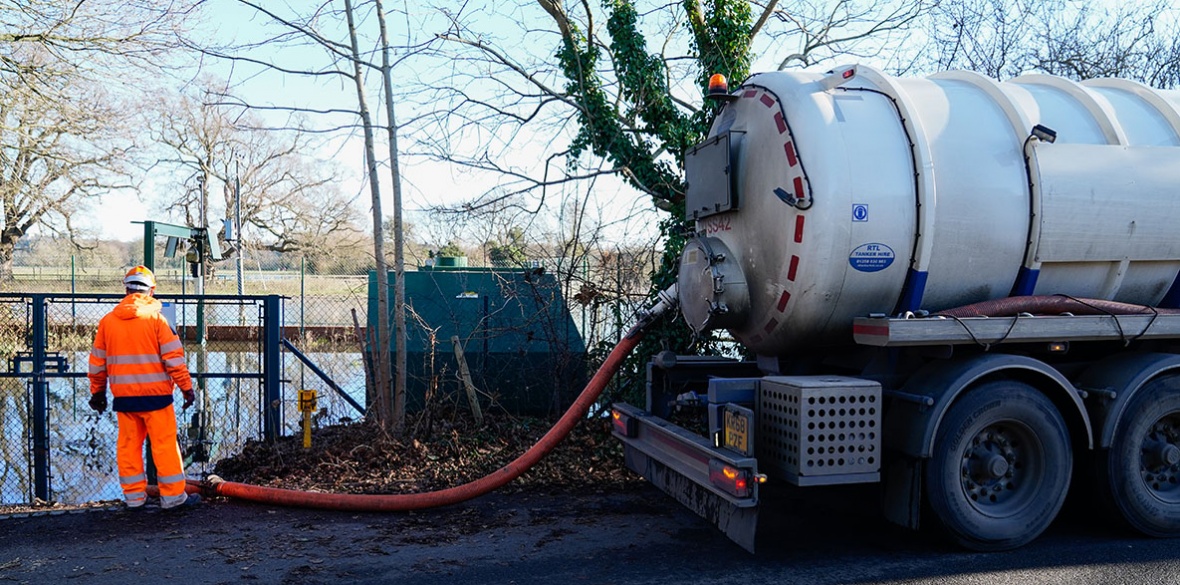
A tanker pumping out excess sewage from the Lightlands Lane sewage pumping station in Cookham, Berskhire which flooded after heavy rainfall, January 10, 2024
WATER COMPANY fat cats are being rewarded for decades of criminal behaviour, a Labour MP said today after the industry regulator announced an average £86 bill hike from April.
Clive Lewis said billpayers are paying for crooks as he called for water firms to be nationalised and Ofwat abolished.
The MP for Norwich South said: “Ofwat is making us pay for decades of criminal behaviour by water companies.
“The regulator turned a blind eye to years of these companies’ widespread illegal sewage dumping.
“Privatisation is a failed experiment. We deserve a public ownership model prioritising people and the environment over profit.”
Ofwat said that the steep rise is part of bill increases in England and Wales over the next five years that will pay for supply upgrades and to reduce sewage discharges.
This is despite water companies doubling their profits since 2019.
European Commission President Ursula von der Leyen during a press conference in Brussels, Belgium on December 18, 2024 [AB Konseyi/Pool/Anadolu Agency]
European Commission President Ursula von der Leyen marked the first anniversary of the Hamas cross-border incursion by saying: “On October 7, 2023, the world awoke to horrifying images of unspeakable savagery, scenes that will remain etched in our minds forever. On this tragic anniversary, I want to honour the memories of the victims. The European Union stands with all the innocent people whose lives have been shattered to the core since that fateful day.”
Since the EU supports Israel’s security narrative, and von der Leyen in particular has been unequivocally blatant in her support of apartheid Israel and its genocide (one now former MEP labelled her “Frau Genocide”), her statement, of course, does not include Palestinian victims of Israel’s brutality over the past 76 years.
The money follows von der Leyen’s rhetoric.
Since 7 October and the start of Israel’s genocide, the settler-colonial entity has been awarded over €238 million under the Horizon programme, with €640,000 going to Israeli Aerospace Industries (IAI). Between 2014 and 2020, Israeli research institutions, many of them with links to the Israeli military, received €1.28 billion in funding from Horizon.
In June this year, the EU Research and Innovation Commissioner Iliana Ivanova determined that “Termination [of such deals] solely on the basis of nationality would be improper and would amount to discrimination prohibited under the Association Agreement.”
Ivanova’s statement was the reply to a letter sent by Flemish universities seeking guidance on how to proceed in research projects involving Israeli institutions, noting that Article 14 of the Horizon Europe grant agreement stipulates, among other ethical considerations, ensuring the rights of minorities, which clearly Israel does not. The letter does not mention genocide, it merely references “the recent binding rulings of the International Court of Justice on the situation in Gaza and the military actions of the Israeli Government.” Nevertheless, the EU was swift to distort a very basic concern regarding ethical considerations into alleged discrimination against Israel on the basis of nationality.
While Israel continues to benefit from the Horizon programme, the EU announced earlier this week that it will be investing €28.3m to stabilise the Palestinian economy across Gaza, Jerusalem and the occupied West Bank. However, it has already been estimated that removing the 42 million tonnes of debris from Gaza alone will cost $700m.
The actual rebuilding of Gaza will require over $80 billion.
Citing the defunct two-state paradigm, EU Representative Alexandre Stutzman commented, “Economic progress and political resolution go hand in hand, and today’s investment is a testament to our belief that fostering stability and growth is an essential part of this vision.”
What vision, exactly? EU funding has not produced a Palestinian state, and the Palestinian Authority has grown considerably weaker, not only because of financial deficit, but because Ramallah thrives, as Israel does, on subjugating the Palestinian people. The two-state hypothesis will not be implemented because there was never any intention for it to be implemented; colonialism does not set aside any space for the emergence of a state. Israel’s genocide in Gaza confirms this, and so does the increasing incitement for the same practices to be executed in the occupied West Bank. Have EU officials yet to hear about Israeli settler leaders’ incitement, despite calls for genocide being reported on Israeli media?
Can the EU explain what €28.3m can achieve in terms of reviving the Palestinian economy, when clearing Gaza of the debris left by Israel is just the first step in establishing the foundations for a semblance of normalcy in a colonial setting? And can the EU note what an absurdly impossible scenario I have just described — a semblance of normalcy in a colonial setting — for lack of a better explanation of what it might allow Gaza to become?
Genocide is so profitable for the EU that it can allocate €28.3m for illusions, and that is without taking into account the entire farce and cost of purported Palestinian state-building. All of this just so that Israel can arrive at a point where genocide has become a security precaution and the slightest ethical concern about its killing and wounding at least 160,000 Palestinian women, children and men is condemned as “improper… discrimination” based on nationality.
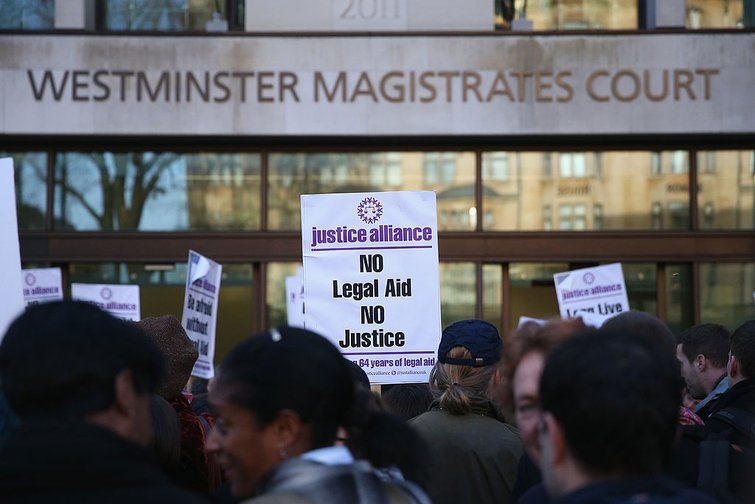
Having an under-funded legal aid system can ruin lives | Oli Scarff/Getty Images
Extra £20m of spending should be celebrated, but it pales in comparison to funding for hostile environment policies
Navigating the UK’s Kafkaesque immigration system is incredibly challenging. One ‘wrong’ turn – a delay in an application, an incorrect form – can quite literally risk a person’s life.
This is deliberate; the system is designed to be hostile. If you’re someone with an immigration or asylum problem, you’ll probably need a lawyer for specialist advice. But what happens if you can’t afford one?
In theory, everyone claiming asylum in this country has the right to access legal aid if they can’t afford it themselves – which is the case for most people seeking asylum, who are not allowed to work. In practice, though, decades of chronic underfunding have left the system in crisis and many people without the necessary legal support. This year only 43% of people claiming asylum had access to a legal aid lawyer, down from an estimated 73% in 2020.
Last month, after years of concerted organising by communities and legal workers, we received a glimmer of hope. Justice secretary Shabana Mahmood announced an extra £20m of funding for the civil legal aid system – the first increase since 1996.
We’ve seen almost 30 years of stagnating salaries for legal workers, legal aid providers shutting down, and more people being forced to face injustices without support. Now, we need to see much bolder action from the new Labour government if we are to get out of the downward spiral that legal aid is in.
How did we get here?
The UK’s legal aid system was created in 1949, on the post-war principle that wherever you are, whatever problems you face and however much money you have, you should be able to have legal advice and representation if you need it.
But while it has never actually been that easy for migrants to access legal aid, the last few years have made it particularly punishing.
In the 2010s, as successive governments’ austerity regimes violently stripped away safety nets for working-class people – migrants and UK citizens alike – legal aid was cut drastically. The appropriately named ‘hostile environment’ policies also meant people whose immigration claims fell through faced losing access to healthcare, housing and jobs.
Legal aid workers, meanwhile, have not just had their salaries slashed, but their public value degraded. Immigration lawyers in particular have been demonised, denigrated by ministers and in the press as ‘lefty lawyers’ – leading to them becoming targets of violent hate crimes.
We are now seeing the predictable and painful impacts of this on the people whom we at Migrants Organise, a charity supporting refugees and migrants, work with every day.
A person seeking asylum who doesn’t have access to legal advice is far less likely to be able to put together the evidence and testimony needed to ‘meet’ the Home Office’s stringent burden of proof.
If their case is refused, they’ll face an even more byzantine appeal system and be expected to represent themselves in front of a judge – still without getting any advice on the regulations that they’re expected to meet. But several large immigration firms have also stopped taking on asylum appeal cases because they don’t get paid enough to do so, forcing many people to tackle gruelling and complex immigration procedures without ever speaking to an adviser.
Then if a person is refused again by the court, because they had a poorly prepared application and no one to advise them, they could be detained and deported to a country where their life is in danger.
Mohammed*, an aspiring barrister and a young migrant advocate at the We Belong charity, has experienced this first-hand. “I waited over five years for a decision on my asylum claim, and then my case got refused and my legal representative dropped me because they’d stopped taking appeals,” he explained. “This was a month into my Masters. It took me almost a year to find another legal aid lawyer, and it was only through the support of community organisations who knew good lawyers and could refer me.
“For people who don’t speak English or have the confidence to seek out support, it’s impossible. Now, after having thought I wouldn’t make it to study anything, I’m able to study law and go into the work that I know will help to fix the problems I myself experienced.”
Pushing back
Having an unsupported legal aid system ruins lives – but it does not need to be this way. Experts, lawyers and the communities who need them have increasingly been speaking out and coming together to document and challenge the impacts of not having access to legal aid.
Organisations and legal aid providers from across the country have been working to have their voices heard. Many contributed to a review of civil legal aid that Sunak’s government launched last year to better understand how well the current system works (or, more to the point, doesn’t). And this year, Young Legal Aid Lawyers and Migrants Organise have run a joint campaign to help those most impacted by the legal aid crisis to educate their MPs on it and demand change.
Researchers such as Jo Wilding, the author of The Legal Aid Market, have also shed light on the extent of the crisis and drawn attention to the expanding ‘legal aid deserts’ where no legal aid is available at all. And legal cases have been brought against the government. Most recently, in June this year, Duncan Lewis Solicitors challenged the government’s violation of its duty to ensure legal aid is available as a result of not increasing fees. The case was settled in September on the basis that the new lord chancellor would decide whether to increase rates in November.
This organised pressure has been impossible for the government to ignore. Finally, the new Labour government has taken heed of the decades of evidence shared, and taken a first step towards positive change by committing new funding.
The additional £20m announced last month, which will be spent over the next four years, is intended to “mark the next step in government plans to rebuild the legal aid sector”. The money will be used to increase legal aid fees for those working in the housing and immigration sectors, with the government saying it is aiming for a 10% uplift in hourly rates, to £65 outside London and £69 in the capital.
Though the final figures have yet to be announced, we at Migrants Organise calculate that the proposed payment fees could increase immigration legal aid work by just over 30%. This, we hope, will open up some capacity amongst legal aid providers to take on cases of people who have been waiting without support.
But in the grand scheme of things, this remains a small injection of cash into two severely neglected areas of legal aid, which will struggle to make any significant indent.
A small uplift in fees isn’t enough to make working in legal aid any more attractive, meaning it won’t address the current crisis in the recruitment and retention of legal aid workers. There is also no sign of a commitment to regularly review funding for legal aid, in order to avoid us ending up in the same position we are now after four more years of inflation.
As successive governments have built a profitable industry out of cruelty, money has been syphoned off to private companies at the expense of public services – housing, transport, legal advice – needed to create better futures for our communities. The hostile environment for migrants remains very much alive, with Labour promising more money for immigration detention centres, increased deportations, and terrorism charges brought against those forced to cross the Channel by boat. Many people still face barriers to accessing justice even with the latest announcement – whether due to language issues, misinformation, or delays.
“Yes, we’re fighting to have more legal aid lawyers. But when will the next increase happen?” asked Mohammed. “We need lawyers now that care, especially when the immigration system is so damaging. Quality work, care and compassion should be the core of legal aid. It’s not just about funding, it’s about the ideology and principle.”
So, whilst we’re celebrating the work that went into this change, we’re under no illusion that for people caught up in the hostile environment – or indeed anyone in the UK in need of a lawyer – life is going to get much easier.
In the short term, we need a legal aid system that is better resourced than the government’s current proposal, for funding to be sustained and raised with inflation (like in many other publicly funded services), and for it to be available to all groups of people who need it.
And ultimately, it is only an end to the hostile environment that will prevent people from being forced into precarious situations in the first place and bring about the dignity and justice that we all deserve.
With renewed hope for change, we need to continue organising with all those impacted by the crisis in legal aid to speak out and call for what’s needed.
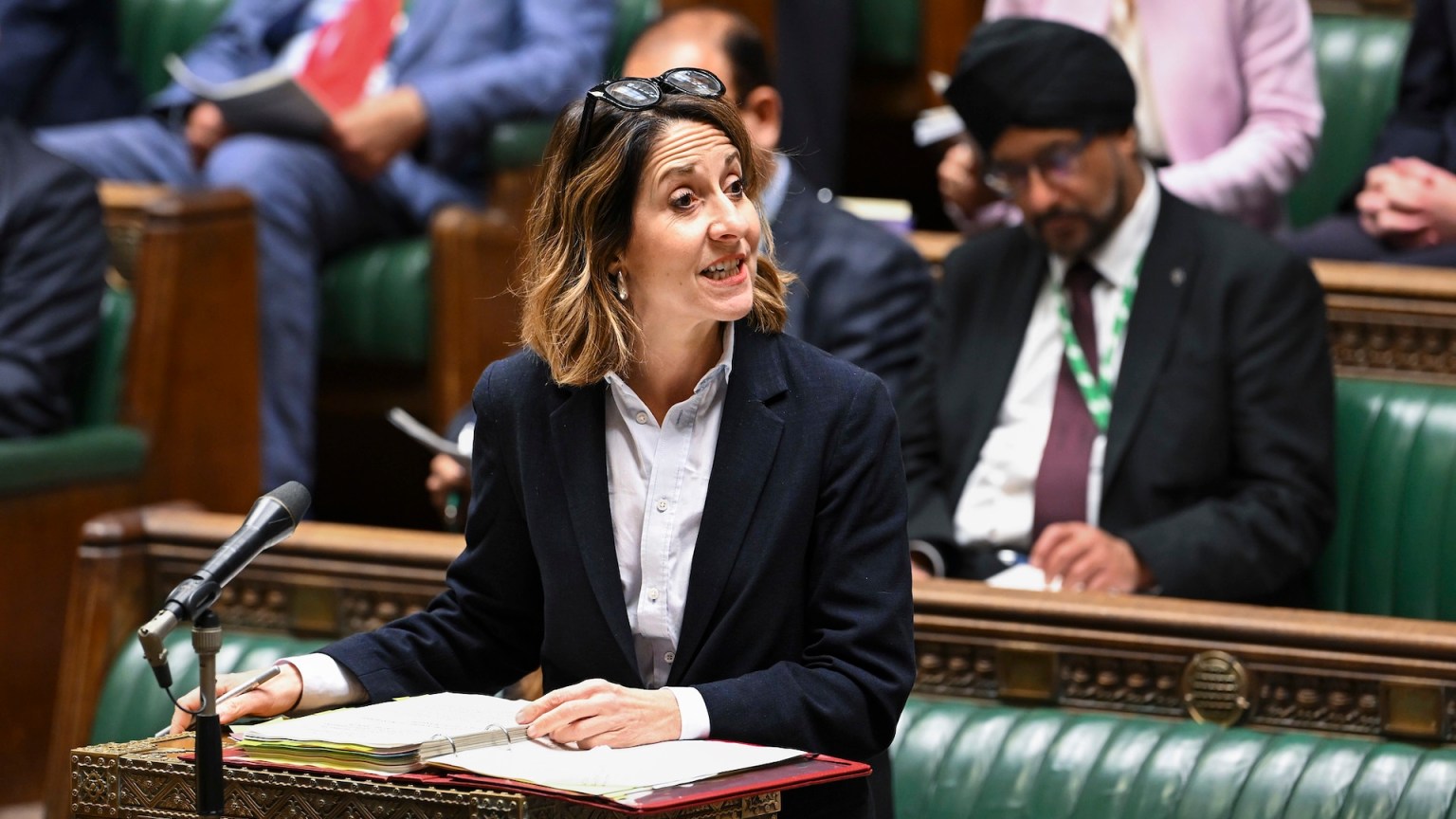
Work and pensions secretary Liz Kendall speaking in parliament. Image: House of Commons/ Flickr
The High Court has heard a legal challenge against a Department for Work and Pensions (DWP) plan to reform disability benefits under the guise of helping people into employment
“We are determined to have a welfare system that encourages and supports people into work, while providing a vital safety net for those who need it most.”
So began the Department for Work and Pensions’ (DWP) consultation into changing disability benefit assessment rules – changes that are predicted to cut the financial support given to around 450,000 disabled people by 2029, but which the consultation presented entirely as helping them.
But contrary to this rose tinting, internal DWP documents revealed at a High Court hearing last week suggest the proposals were at least as much about the Tories’ determination to cut benefits spending as they were about helping disabled people into work.
In fact, DWP officials warned that evidence was needed to justify their line that the measures were about supporting disabled people rather than saving money, while the government rushed the consultation through in time for the savings to be counted in last year’s Autumn Statement.
DWP officials were also aware of the potential mental health impact of cutting benefits to some claimants who would be affected by the measures.
And while an official impact assessment into the plans has still not been published, the court disclosures suggest up to 100,000 disabled people could be pushed into absolute poverty by the changes – although the exact basis of this figure is uncertain.
The revelations came as a result of a judicial review into the legality of the consultation that was heard last week. The case has been brought by disability campaigner Ellen Clifford, a member of Disabled People Against Cuts (DPAC).
And while the consultation took place under the last government, the current Labour government has not dropped the planned cuts – and has fought the judicial review at every step.