20 years of ALBA-TCP

Spread the love

Original article by Pablo Meriguet republished from peoples dispatch under a Creative Commons Attribution-ShareAlike 4.0 (CC BY-SA) license.
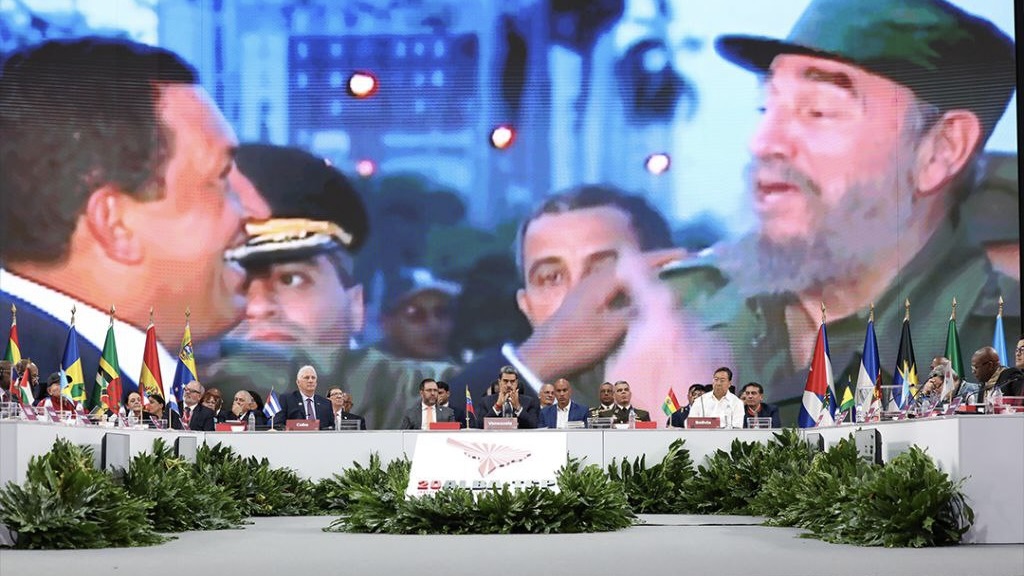
Heads of State Summit of ALBA-TCP in Caracas, Venezuela. Photo: ALBA-TCP

ALBA-TCP was founded in 2004 in an attempt to counter the US proposal of creating a “free trade zone of the Americas

December 14 marked the 20th anniversary of the creation of the Bolivarian Alliance for the Peoples of Our America-People’s-Trade Agreement (ALBA-TCP). ALBA-TCP was created in 2004 as a geopolitical alternative to the devastating advance of neoliberalism in the region.

The project was founded on December 14, 2004, in Havana by Cuban President Fidel Castro and Venezuelan President Hugo Chávez. Currently, the organization has 10 member countries and four countries considered “special guests.” In 2006, Bolivia signed its membership; in 2007, Nicaragua; in 2008, Dominica; in 2009, Antigua and Barbuda and St. Vincent and the Grenadines; in 2014, St. Kitts and Nevis and Grenada; and in 2021, St. Lucia. The special invited countries are Syria, Haiti, Suriname, and now Palestine.

To commemorate the 20 years, social movements, political parties, and heads of state gathered in Caracas, Venezuela for the 24th Heads of State Summit as well as parallel meetings. The event was attended by the host, Venezuelan President Nicolás Maduro; Bolivian President Luis Arce; Cuban President Miguel Díaz-Canel; Nicaraguan President Daniel Ortega; Prime Minister of St. Vincent and the Grenadines, Ralph Gonsalves; Prime Minister of Dominica, Roosevelt Skerrit; and the Prime Minister of Antigua and Barbuda, Gaston Browne.

Independence and solidarity among countries

In their addresses during the Summit on December 14, the heads of state and invited countries stressed the importance of solidarity among countries seeking alternative ways of development and the need for unrestricted solidarity among people struggling against imperialist attacks. They also demonstrated their support for Nicolás Maduro and his victory in the last presidential elections.

Miguel Díaz-Canel said “We reiterate the strongest support for the Bolivarian revolution, led by President Nicolás Maduro…We also call for the elimination of the blockade against Cuba …We cry out for a free Puerto Rico and declare our solidarity with Haiti, our Cuban doctors are there…We reiterate our demand for a ceasefire in Gaza and condemn the attacks perpetrated by Israel against Lebanon, Syria, and Iran.”

The Bolivian President, Luis Arce, highlighted the historical importance of ALBA in its fight against economic projects promoted by the United States such as the FTAA (Free Trade Area of the Americas): “The embrace of Hugo Chávez and Fidel Castro not only marked history but also manifested the defeat of the hegemonic project of the FTAA. ALBA was born, ALBA placed the human being at the center, promoting that a better world is possible. Bolivia reaffirms, once again, its commitment to ALBA-TCP, because it is a resistance that raises its voice against the unjust and criminal blockade against Cuba…ALBA is also a firm voice against the arbitrary and unilateral measures imposed against Venezuela and Nicaragua, which affect the welfare of our peoples.”

Nicolás Maduro said, “We must win the battle of life and truth in the streets, networks, media, and walls, as well as in the conscience and spirituality of the people.” He also added the importance of the struggle of the people to be masters of their destiny without imperial impositions or impositions of any kind. In the same line of discourse, Nicaraguan President Daniel Ortega said “From Nicaragua we reaffirm our commitment to ALBA. We will continue to fight the battle.”

The Prime Minister of Dominica, Roosevelt Skerrit stated “We congratulate the electoral triumph of President Nicolas Maduro on July 28. We wish him all the best…We also want to reaffirm our solidarity with the people of Cuba, a brave people for whom we have our greatest respect and love; we will never cease to lend our voice against the United States to eliminate the blockade against Cuba.”

Ralph Gonsalves, Prime Minister of St. Vincent and the Grenadines, harshly criticized US interference in the development of the past Venezuelan elections “Perhaps [the US government] thinks it is superior,” he said in this regard. He also stressed that the creation of ALBA-TCP was a fundamental invention for the emancipation of the American people, “ALBA is the product of the geniuses of our peoples.”

Inclusion of Palestine to ALBA-TCP

At the current summit, it was announced that Palestine had been included as a “brotherly country” and was included as a “permanent guest”. According to the resolution of the Heads of State, ALBA-TCP condemns the attacks against the Palestinian population and the “illegally occupied territories” and rejects “the merciless and inhuman genocide committed by the State of Israel, the occupying power, as well as its plan of spoliation, invasion, and domination.” Likewise, they denounced the support of several governments currently collaborating with the actions of the Israeli army and called for an “immediate ceasefire…From the heart of the peoples and governments of this alliance, we declare Palestine a brother country of the ALBA-TCP, and reaffirm our commitment to the defense of the Palestinian cause, which is the defense of humanity,” reads the resolution.
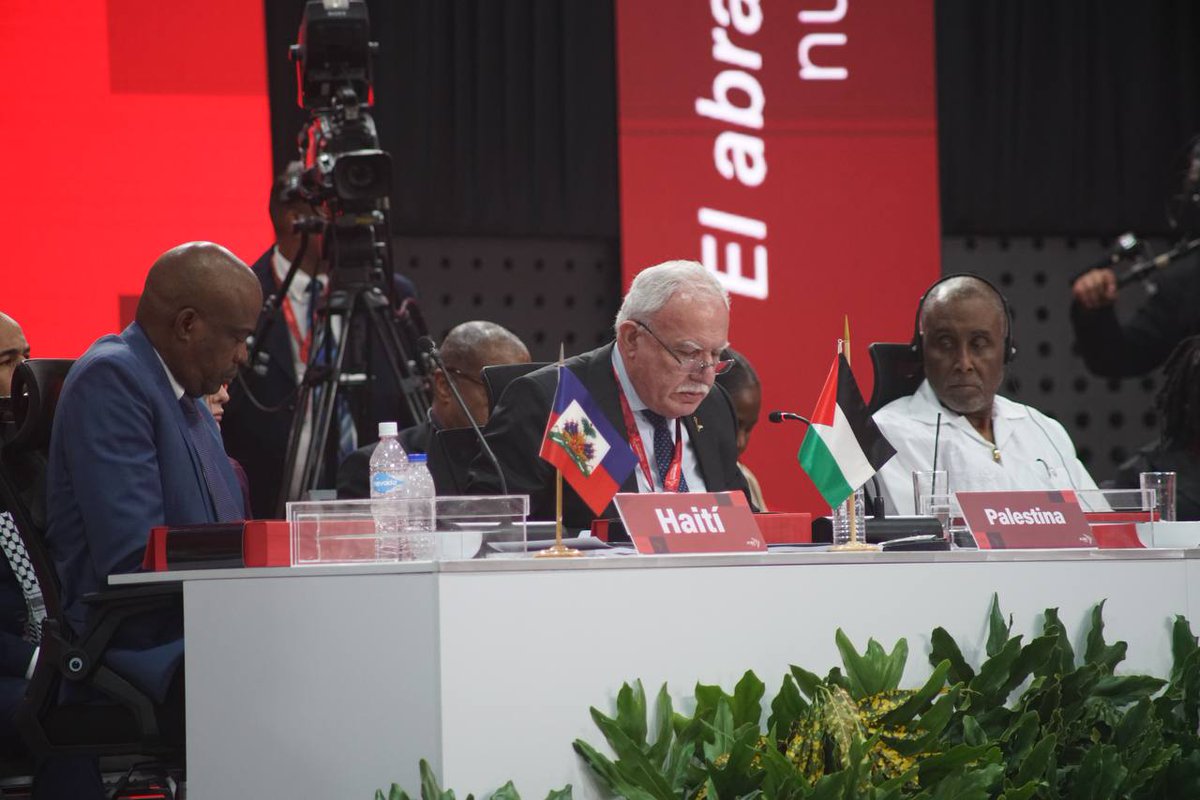
Riyad al-Malki addressing ALBA-TCP Summit. Photo: ALBA-TCP

In this regard, Riyad al-Malki, advisor to the President of State for International Affairs of Palestine said “History will remember those who stood on the side of justice, ALBA’s lasting solidarity with Palestine is a testimony of freedom and collective resistance.” Furthermore, Malki added “This Alliance is a living testimony of collective integration to challenge imperialism and ensure a just world. These values resonate with the Palestinian struggle, an end to the illegal occupation.”

A call for counter-hegemonic struggle

The joint document signed by all the countries highlights the historical importance of ALBA-TCP in the struggle for a more equitable world: “Twenty years after this giant step, we pay homage to the founding leaders, Hugo Chávez Frías and Fidel Castro Ruz, who adopted that December 14, 2004, in Havana, Cuba, the vision of the future embodied in the founding documents of ALBA, which have allowed us to walk united until the present, animated by the ancestral force that led our peoples to be free and that encourages us to continue integrated in this Alliance for Life.”

Similarly, it was stressed that the existence of this multilateral organization operates as a possibility to create a region that resists the impositions of the most developed countries: “Today, we want to ratify before our peoples, the counter-hegemonic, democratic, anti-imperialist and anti-fascist nature of our Alliance and renew our commitment to help and protect each other, to continue building together a future of shared goals under the founding principles of complementarity, cooperation, social justice, defense of our sovereignty and solidarity.”

In this sense, Luis Arce stressed that “In the face of the challenges of a world threatened by fascism and neo-fascism, ALBA is not an option, ALBA is a necessity that must continue with firm steps, reaffirming the founding principles of solidarity, justice, and cooperation…ALBA is not only an alliance, it is a promise for the future, a living resistance, an instrument for the most dispossessed, and a reminder that together, as peoples, we are invincible.”

Objectives and principles of ALBA-TCP

According to ALBA’s official website, the fundamental objective of the project is “to achieve integral development, ensure social equality and contribute to guaranteeing the quality of life, good living, independence, self-determination and identity of the peoples.” For this very reason, the principles of ALBA-TCP propose that political decisions be made horizontally and take into account the economic differences of its members without meaning that the importance of each of the members is underestimated.

The principles shared by the countries are “trade and investment should not be ends in themselves, but instruments to achieve sustainable development; special and differentiated treatment, according to the level of development of the various countries; economic complementarity and cooperation; cooperation and solidarity; the creation of the Social Emergency Fund; the integrative development of communications and transportation; the sustainability of development; energy integration; the promotion of investments of Latin American capital in the region; the defense of Latin American and Caribbean identity and culture; respect for intellectual property; and the agreement of multilateral positions and in negotiations with countries and blocs in other regions.”

Original article by Pablo Meriguet republished from peoples dispatch under a Creative Commons Attribution-ShareAlike 4.0 (CC BY-SA) license.

Continue Reading20 years of ALBA-TCP

Greens say local government reorganisation “steals power away from local people” 

Spread the love
Green Party Co-leader Adrian Ramsay. Wikipedia CC.
Green Party Co-leader Adrian Ramsay MP. Wikipedia CC.

Responding to measures contained within the government’s White Paper on English Devolution, Green Party co-leader Adrian Ramsay MP said: 

“Local democracy is in urgent need of reform but this White Paper does not deliver the real change our local councils need.  

“It steals power away from local people and risks making the real changes required harder to achieve, including building the homes we need, cleaning our rivers, reforming social care and greening our local economies. 

“We should trust local communities to make the right decisions on homes, food, energy, nature and adapting to the climate crisis.  

“Instead, these plans risk moving power away from local councils to huge remote super councils and regional mayors. 

“Devolution must mean real decentralisation of powers and funding so local councils can deliver the improvements to services that their communities need. 

“If we want warmer homes; affordable, reliable accessible public transport, and flood defences that are fit for purpose, we must invest in local democracy. 

“Without power devolved down so that decisions are made closest to where they have the greatest impact, people will grow ever more cynical about politics. 

“Our fragile democracy can’t afford that. 

“We will be pressing for local government to be kept local and made more democratic. 

Continue ReadingGreens say local government reorganisation “steals power away from local people” 

Green Party reaction to government and regulators ‘breaking law’ over sewage spills

Spread the love
Adrian Ramsay MP, Green Party Co-leader. Wikipedia CC.

Reacting to news that government and regulators have broken the law by being too lenient on water companies that spill sewage, and on the day Thames Water seeks a £3bn bailout, Green Party co-leader Adrian Ramsay MP said: 

“For too long billions have been leaking out to shareholders instead of going into fixing our broken water system. But it will be water customers who are expected to bail out this failed model of privatisation through steep hikes to water bills.  

“The way to end this fiasco and ensure government and regulators keep within the law is to put failing water companies into special administration and ultimately to bring water back into public ownership.”  

Continue ReadingGreen Party reaction to government and regulators ‘breaking law’ over sewage spills

Can Britain re-nationalize water services?

Spread the love

Original article by Ana Vračar republished from peoples dispatch under a Creative Commons Attribution-ShareAlike 4.0 (CC BY-SA) license.

Source: We Own It/X

Demands for renationalization of water services in England grows as private London water supplier requests bailout

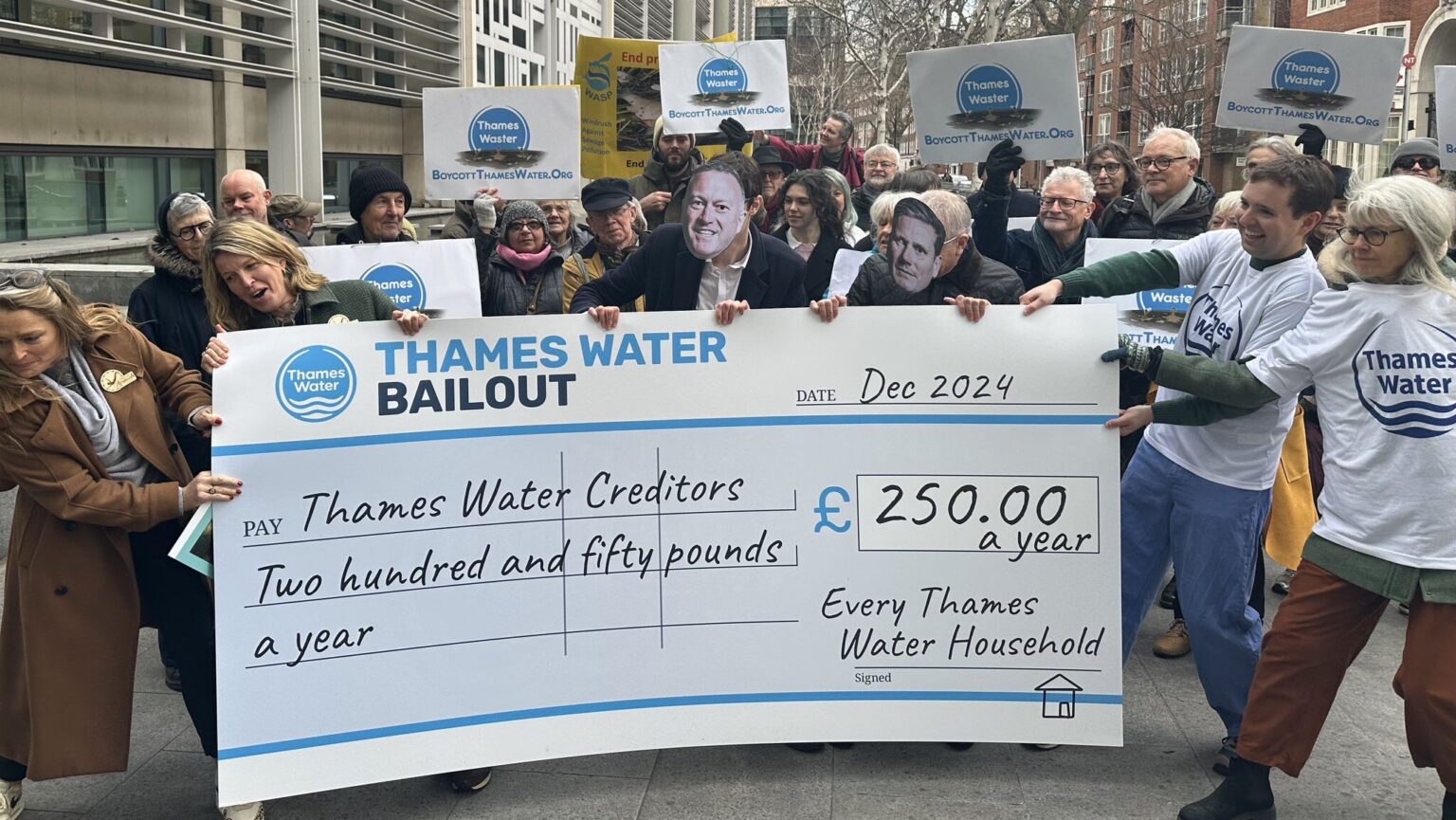
Social justice organizations in Britain are urging judges to reject a bailout request from Thames Water, one of the country’s largest water providers, serving some 16 million people in the greater London area. Campaigners argue that approving the bailout of the private utility provider would allow Thames Water to continue its mismanagement while forcing consumers to shoulder the burden—raising annual water bills by £250 (USD 317) per user.

“This is daylight robbery. There are two people who can stop it, the judge in court today and Steve Reed, the environment secretary. He can protect billpayers from this by withdrawing Thames Water’s license, on the basis of financial insolvency, illegal sewage dumping, or both,” Cat Hobbs, Director of We Own It, told Peoples Dispatch. “Tony Blair’s government defended the public interest when Railtrack went bust, why won’t this government do the same for Thames Water?”

The company warned that without the bailout, it would run out of funds by March next year. However, Thames Water customers predict that they will be unfairly burdened with the costs of the bailout, including the high interest rates that will follow, while company management will face little accountability. The We Own It campaign noted that “it is obvious that the consumer as the sole source of revenue will indirectly fund this amount by way of increases in their water bills.”

While claiming financial difficulties, Thames Water has managed to secure substantial profit margins for its investors—many of whom are based outside Britain and remain unaffected by the declining quality of local water services—while awarding generous bonuses to its management. This pattern is not unique to Thames Water: all water and sewage companies across England have followed a similar path since privatization under Margaret Thatcher’s administration. During this time, these companies have paid out £72 billion (91 billion USD) to shareholders while accumulating £60 billion (76 billion USD) in debt. The result has been a chronic lack of investment in infrastructure, leading to leaks of both water and money.

“The argument for privatization was that there would be more investment, the water would be cheaper, and the service would be more efficient,” independent MP Jeremy Corbyn remarked during a discussion on water services earlier this year. “It’s really worked out well on that, hasn’t it?”

A risk to ecosystem and human health

In addition to financial losses, privatization has led to a significant decline in water safety and quality. Private operators have regularly discharged untreated sewage into rivers and the sea, causing harm to ecosystems and posing a direct threat to human health. Regulators, meanwhile, are unable to enforce compliance with safety standards due to conflicts of interest, low fine thresholds and the fact that the infrastructure itself remains under the companies’ ownership.

Unlike other European countries that experimented with water privatization by outsourcing service provision but mostly retaining ownership of infrastructure, England sold everything. As a result, rather than waiting for contracts to expire and reclaiming control, the government would need to buy back the entire water system from companies like Thames Water. According to We Own It, the initial cost for this process could start around £15 billion (19 billion USD)—an amount the campaign estimates could be repaid within just six years.

Re-nationalizing water services has led to significant successes in other countries, according to Matthew Topham, Lead Campaigner at We Own It. “Paris took back control of its drinking water in 2010 from an outsourced private contract. Bills were immediately lowered, customer satisfaction levels are high, and last year, they were able to reinvest 89 million euros in improving the network,” he explains. He adds that public ownership has also sparked community participation, with cities like Lima, Terrassa, and Paris establishing observatories to give communities, workers, and activists a voice in managing water services.

Campaigners against the Thames Water bailout are calling precisely for a return to public ownership. They argue that this approach would not only lower costs for users but also create space for more investment in infrastructure, improving water quality. This demand resonates with over 80% of the British public, who support the idea of water services being brought back into public hands.

Read more: Labour considers expanding private sector role in NHS, undermining the already fragile public health system

The Labour government, however, does not share this vision. Under Jeremy Corbyn’s leadership, the party’s program included an ambitious plan to renationalize water services. By 2024, Labour’s election program had moved away from this idea, keeping only the possibility of granting “new powers” to regulators to block bonuses for companies proven to pollute watercourses. As many on the left predicted ahead of the July 2024 election, Keir Starmer’s administration has shown a clear inclination toward privatization, not only in water services but also in healthcare and other sectors.

The final decision on Thames Water’s bailout request is expected in early 2025, with campaigners urging the court to consider users’ concerns and reject the proposal, paving the way for better water services.

Original article by Ana Vračar republished from peoples dispatch under a Creative Commons Attribution-ShareAlike 4.0 (CC BY-SA) license.

Continue ReadingCan Britain re-nationalize water services?

Song lampooning Keir Starmer over winter fuel cuts hits number one

Spread the love
Keir Starmer says pensioners can freeze to death and poor children can starve and be condemned to failure and misery all their lives.

https://www.thenational.scot/news/24798711.song-lampooning-keir-starmer-winter-fuel-cuts-hits-number-one

A PARODY song lampooning Keir Starmer’s Labour Government for its cuts to the Winter Fuel Payment has hit number one in the UK charts.

The song Freezing This Christmas – by the artist “Sir Starmer and the Granny Harmers” – hit the top of the Official Big Top 40 chart on December 15.

The song uses the tune of the 1974 Mud classic Lonely This Christmas, which also topped the charts at number one when it was first released.

The parody version goes: “It’ll be freezing this Christmas, without fuel at home, it’ll be freezing this Christmas, while Keir Starmer is warm. It’ll be cold, so cold, without fuel at home, this Christmas.”

The song then uses a clip of Starmer saying: “She told me that she doesn’t get out of bed till midday because she doesn’t want to turn the heating on.”

https://www.thenational.scot/news/24798711.song-lampooning-keir-starmer-winter-fuel-cuts-hits-number-one

Continue ReadingSong lampooning Keir Starmer over winter fuel cuts hits number one