South America on fire

Spread the love

Original article by Pablo Meriguet republished from peoples dispatch under a Creative Commons Attribution-ShareAlike 4.0 (CC BY-SA) license.
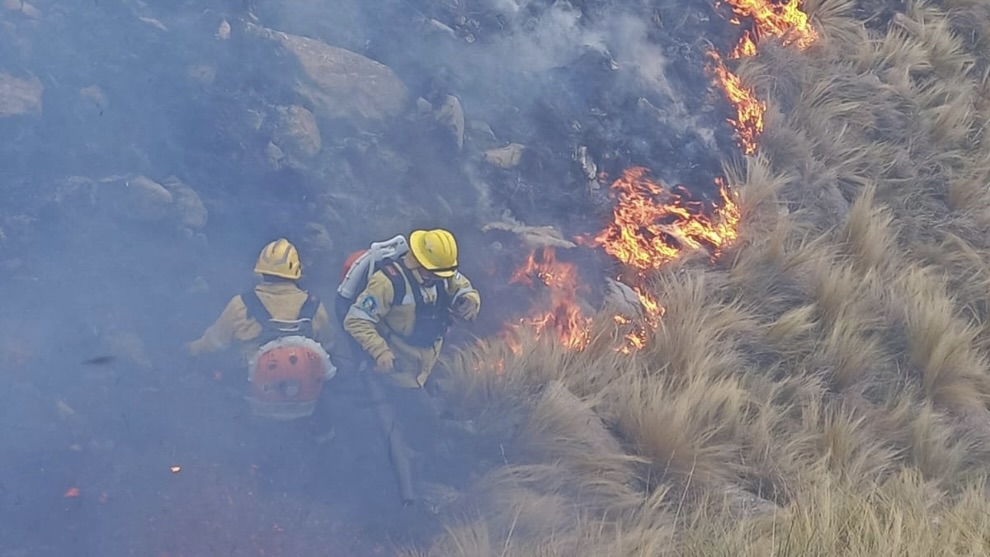
Fires in Córdoba, Argentina have been raging for the past month. Photo: Córdoba Government

More than 300,000 fires have been reported so far in 2024 across South America. The blazes have displaced hundreds and killed several. The causes of this tragedy must be sought in deep geopolitical injustices.

South America is facing one of the most serious environmental crises in recent decades. In the last two months, there has been a dramatic increase in the outbreak of forest fires that have devastated thousands of square kilometers across Colombia, Ecuador, Brazil, Perú, Paraguay, Bolivia, and Argentina. The impacts of the blazes are exponential, not only seen in the direct destruction to the forests and wildlife and surrounding communities, but in many countries the dangerous smoke has traveled far beyond the site of the fire.

The tragedy of fires in South American countries

So far in 2024, more than 300,000 fires have been registered across South America.

In Brazil, the number of fires in southern Brazil (Pantanal and the Amazon) have increased by 92% compared to last year. In the whole country, more than 170,000 have been registered so far and more than 11 million hectares have been lost in this year so far. The fires have required massive state investments in order to alleviate the destruction. In the State of São Paulo alone, more than 15,000 people from the civil guard, firefighters and others have been mobilized to try to put out the fires.

In the El Chaco area, encompassing Bolivia and Paraguay, fires continue to consume thousands of hectares. More than 60,000 fires have been reported in Bolivia this year, with the regions of Rio Blanco and Palestina, in the east of the country, being the most affected and hundreds of people were evacuated. President Luis Arce has declared a national state of emergency to better address the environmental catastrophe. For now, Chile and Venezuela have offered assistance to Bolivia, which has not been able to quell the flames on its own.

In Córdoba, Argentina, fire continues to destroy millions of plants and animals despite the efforts of almost 1,000 firefighters who are trying to extinguish the flames. The strong winds in the central region of the country have made it even more difficult for hundreds of firefighters to extinguish the two large fires. In several cities in Córdoba, hundreds of people were urgently evacuated due to the threat of the flames.

In Colombia, more than 31 forest fires devastated 10,000 hectares of forest. The most affected region is the southwest encompassing the departments of Tolima, Valle del Cauca, and Huila. In these places, Petro’s government ordered the deployment of military troops to help in the rescue tasks and to alleviate the fires. Over a dozen fires are still raging in the country that threaten the lives of hundreds of people.

In Peru, the serious fires have already claimed the lives of over 20 people and experts estimate that it will take about 500 years for Peru’s ecosystems to recover from the latest fires. More than 49 active fires have reported by the National Emergency Operations Center, and are mainly located in Tumbes, Ayacucho, Amazonas, Cuzco, San Martin, and Cajamarca. The army has also been deployed in these areas, which are suffering from the ongoing forest fires.

Some underlying causes of fires 

The eruption of fires across the region and the widespread devastation to the continent’s flora and fauna has once again brought many to ask why these fires are breaking out. In some cases, the fires are literally sparked by “human intervention”, yet even in these cases, they could not have reached large proportions if it were not for the generalized state of drought in the region, as well as the high temperatures.

According to experts, the leading cause behind the fires is the climate change-induced drought in the region. The lack of rainfall is devastating in an ecosystem that especially requires water during certain periods of the year to subsist. Most of the environmental changes that have occurred worldwide due to global warming are due in particular to large companies that devastate ecosystems, and developed countries, which consume most of the world’s goods and generate most of the world’s CO2 emissions and waste.

In this case, the South American region, rich in flora and fauna (and therefore one of the most fragile areas), is one of the most affected by the economic inequality and production imbalance between developed and developing countries, with many countries on the continent producing overwhelmingly raw materials for export.

The production of monoculture crops for agro-export business in many regions of the continent often requires the destruction of native plants to clear land. The vast forests of the continent are also often taken advantage of by large timber companies whose felling of trees also desertifies vast areas of land. The extraction of minerals by multinational mining companies also requires large amounts of water for processing and has severe impacts on the surrounding region also because of the chemicals used in the process.

In addition, it must be taken into account that the fires, already a product of global warming, release thousands of tons of additional CO2 into the environment, which worsens global warming. It is a vicious circle that endangers not only the affected regions but also the existence of all species on Earth.

For now, South American states are quite simply not prepared to face these challenges, especially because many of them have decided to reduce the size of the state, further liberalize the economy by allowing large companies to do whatever they want in rural areas and with their countries’ natural resources, and defund various emergency and rescue groups such as firefighters and forest rangers. The drought is also preventing hydroelectric plants from producing the energy needed to supply its citizens. In addition, wildfire emergencies are not being adequately addressed by firefighting groups that often do not have adequate funding to hire more recruits and acquire better equipment. This is without taking into account the millions of animals (many of them endangered) that are dying every day in the flames, or that have to flee their natural habitat without the certainty that they will be able to survive in a new environment.

Climate change has long ceased to be a theoretical hypothesis. Old speculations about the consequences of a radically unjust world now take the form of flares that can be seen for hundreds of kilometers (only a blind man does not see them); developed countries pollute poor countries and in doing so are destroying the natural wealth of the people, which, in many ways, is all they have. Climate change in South America (this environmental projection of colonialism) is killing people and devastating life and is today a hell that seems to have no end.

Original article by Pablo Meriguet republished from peoples dispatch under a Creative Commons Attribution-ShareAlike 4.0 (CC BY-SA) license.
Continue ReadingSouth America on fire

Unprecedented rains cause floods and landslides in Nepal, killing nearly 200 people

Spread the love

Original article by Abdul Rahman republished from peoples dispatch under a Creative Commons Attribution-ShareAlike 4.0 (CC BY-SA) license.

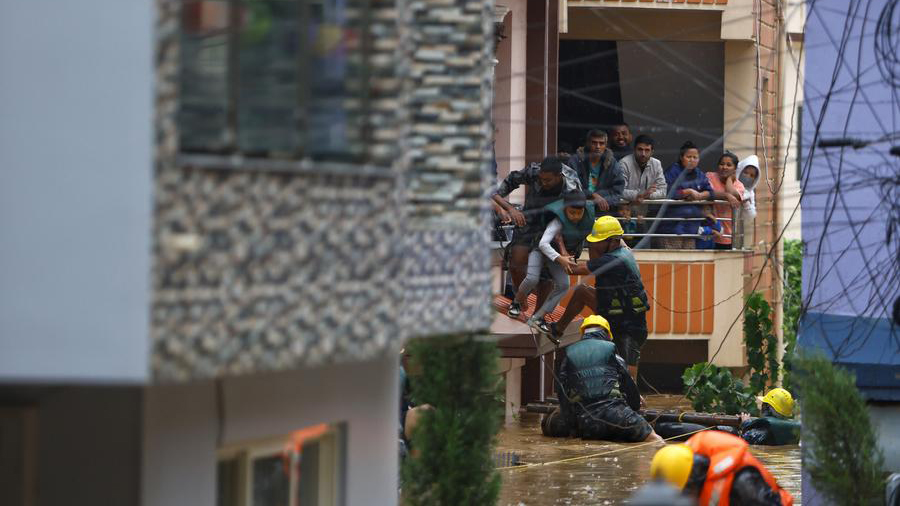
Rescuers evacuate flood victims in Lalitpur, Nepal ((Photo: Sulav Shrestha/Xinhua)

Meteorologists in the Himalayan nation have observed a pattern of change in the local climate in the last few years, with monsoon season lasting longer than usual and erratic rains affecting millions

Over 200 people have been killed or missing in the floods and landslides caused by unprecedented rains lashing Nepal for the last five days. Thousands have been displaced in different parts of the mountainous country.

On Monday, authorities announced the shutting down of all educational institutions. Several school and university buildings have also been damaged after facing the brunt of the torrential rains.

The capital Kathmandu has been one of the most affected regions in the country with a large number of neighborhoods flooded or covered with the mud due to rain water, which has also caused the water levels in the Bagmati river to rise. The flood and landslides have destroyed numerous homes, bridges, roads, and vehicles, leaving a large number of people stranded.

Many flooded areas are localities where poor and working class people live. Their houses have been inundated with water and mud, which may take longer to clear, raising the risk of the breakout of epidemics after the water recedes.

According to Nepal’s Ministry of Transport, 47 out of 80 highways in the country have been affected by the rains and landslides, greatly impacting transportation. Over one hundred flights were canceled due to heavy rains, and the Kathmandu airport stopped operating on Friday and Saturday for several-hour-long periods. It re-started operations again on Sunday morning.

Several power plants have also been damaged due to the flooding and landslides, disrupting the power supply to different parts of the country.

The Communist Party of Nepal (UML) issued a statement earlier asking the government to increase its efforts to relief and rescue work. The party also asked cadres to participate in flood relief efforts.

The heavy rains in Nepal could also have a significant impact in India. In Indian states like Bihar, the flooding was already worsening in the last couple of weeks. Thousands of people have been displaced in several bordering regions in Bihar in the last couple of days, with most of the rivers in the region flowing far above the danger mark.

According to official data, at least 1.6 million people on the Indian side of the border are already severely affected due to the floods. Several schools and other public services have been affected. Local power grids are also shutting down due to flooding, leaving thousands without electricity.

Effects of climate change

Heavy rains during the monsoon season in South Asia are normal. However, in the last few years, local meteorological officials have claimed the severity of rains has increased and the monsoon has been significantly prolonged. The monsoon has shifted its usual duration. Its withdrawal, stretching until the month of October, is quite unusual, resulting in larger repercussions on the region’s agriculture.

From Thursday to Saturday, Kathmandu received 322 mm rainfall against an annual average of around 2,700 mm, causing a sudden rise in the water levels in the region’s rivers. On Saturday alone, some parts of the city received 240 mm rainfall within 24 hours, a record in over two decades.

Several studies indicate that Nepal has emerged as one of the most vulnerable countries in the context of climate change. The rise in the country’s average temperature is much higher than that of the global average (0.056 degrees Celsius against the global average of 0.03 degree Celsius), for example. The rise in temperature has caused the melting of several glaciers in the country, again endangering the local climate as well as the livelihoods of millions of people.

Despite the seriousness of the climate situation in Nepal, most of the developed world has largely been indifferent to its concerns in the climate negotiations so far. Raising the issue, Prime Minister KP Sharma Oli, while speaking during the ongoing UN General Assembly’s 79th session on Thursday said that the world needs to pay attention to the possible effects of climate change in a country such as Nepal which is a “natural climate stabilizer” vital for maintaining balance in the global environment.

Given its significance for global climate concerns, “it is essential that the mountain agenda receive due attention in climate negotiations,” Oli said.

Original article by Abdul Rahman republished from peoples dispatch under a Creative Commons Attribution-ShareAlike 4.0 (CC BY-SA) license.

Continue ReadingUnprecedented rains cause floods and landslides in Nepal, killing nearly 200 people

George Monbiot: As the waters rise, a two-year sentence for throwing soup. That’s the farcical reality of British justice

Spread the love

https://www.theguardian.com/commentisfree/2024/oct/01/prison-uk-justice-system-fossil-fuel-industry

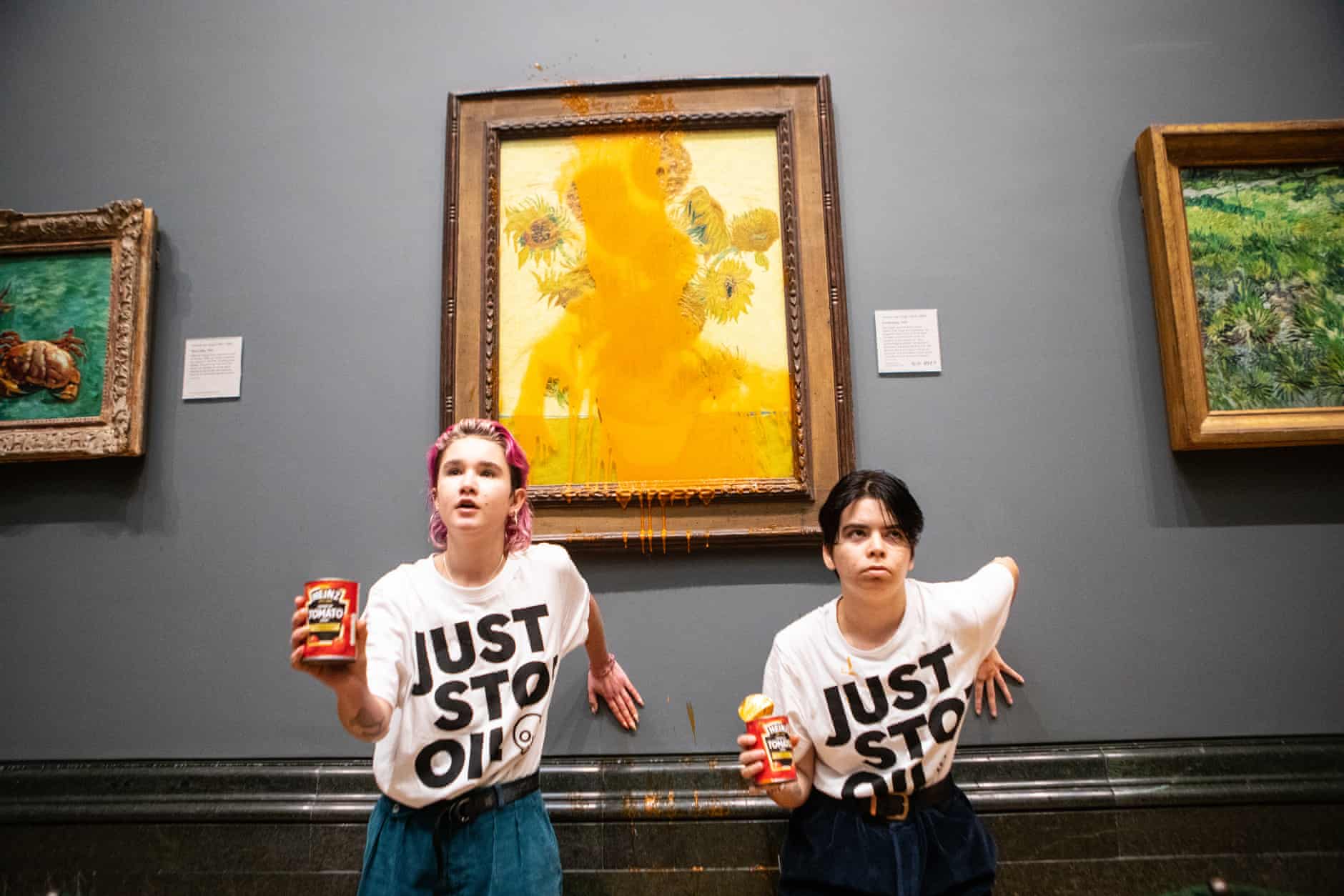
Phoebe Plummer (left) and Anna Holland were sentenced to two years and 20 months, respectively, for throwing soup at the glass protecting Van Gogh’s Sunflowers at the National Gallery in London in 2022. Photograph: Antonio Olmos/the Guardian

Why do the mass killers of the fossil fuel industry walk free while the heroes trying to stop them are imprisoned?

The sentences were handed down just as Hurricane Helene hit North Carolina. As homes were smashed, trucks swept down roads that had turned into rivers and residents were killed, in the placid setting of Southwark crown court two young women from Just Stop Oil, Phoebe Plummer and Anna Holland, were sentenced to two years and 20 months, respectively, for throwing tomato soup at the glass protecting Van Gogh’s Sunflowers. No prison terms have been handed to the people whose companies deliver climate breakdown, causing the deaths of many thousands and destruction valued not at the £10,000 estimated by the court in damage to the painting’s frame but trillions.

Everywhere we see a farcical disproportion. The same judge, Christopher Hehir, presided over the trial of the two sons of one of the richest men in Britain, George and Costas Panayiotou. On a night out, they viciously beat up two off-duty police officers, apparently for the hell of it. One of the officers required major surgery, including the insertion of titanium plates in his cheek and eye socket. One of the brothers, Costas, already had three similar assault convictions. But Hehir gave them both suspended sentences. He also decided that a police officer who had sex in his car with a drunk woman he had “offered to take home” should receive only a suspended sentence. Hehir said he wanted “to bring this sad and sorry tale to its end with a final act of mercy”. The solicitor general referred the case to the court of appeal for being unduly lenient, and the sentence was raised to 11 months in jail.

Hehir also handed a suspended sentence to a man who rammed his car into the gates of Downing Street and was then found by police to have extreme child abuse images on his phone. By contrast, in July Hehir – the Judge Jeffreys of our time – gave five climate protesters who blocked the M25 jail terms of four and five years. It looks to me as if justice itself is suspended in Southwark crown court.

https://www.theguardian.com/commentisfree/2024/oct/01/prison-uk-justice-system-fossil-fuel-industry

Continue ReadingGeorge Monbiot: As the waters rise, a two-year sentence for throwing soup. That’s the farcical reality of British justice

Tory leadership hopeful wants Star of David on every point of entry to UK

Spread the love
Image of Tory idiot Boris Johnson
Former Tory party leader idiot Boris Johnson

https://www.middleeastmonitor.com/20241001-tory-leadership-hopeful-wants-star-of-david-on-every-point-of-entry-to-uk

Two front-runners in the Conservative Party leadership race have attempted to ingratiate themselves with pro-Israel supporters by making statements critics have slammed as demand for a loyalty test on immigrants to support the apartheid state.

Robert Jenrick, speaking at a Conservative Friends of Israel reception, suggested displaying the Star of David at UK border entry points to show support for Israel. He said that “at every airport and point of entry to our great country there is the Star of David.” Jenrick, who last month called for jailing anyone who say “Allahu Akbar,” also pledged to move the British embassy to Jerusalem if he became Prime Minister, adding: “If the Foreign Office or the civil servants don’t want to do it, I will build it myself.”

In a similar vein, Kemi Badenoch, in an article for The Telegraph, raised concerns about the attitudes of immigrants towards Israel. “We cannot be naïve and assume immigrants will automatically abandon ancestral ethnic hostilities at the border, or that all cultures are equally valid. They are not,” wrote Badenoch. “I am struck, for example, by the number of recent immigrants to the UK who hate Israel. That sentiment has no place here.”

When questioned about these comments by Trevor Phillips on Sky News if she meant Muslims, Badenoch clarified: “It is not all Muslim immigrants […] but there are some, those who buy into Islamist ideology, political Islam; they do not like Israel and we need to be able to distinguish between the two,” she added.

Badenoch’s comments have been criticised as dog-whistle racism by some observers. Opposition to Israel is not exclusively a Muslim issue, as she seemed to suggest. Many non-Muslim figures, including the Archbishop of Canterbury and the Pope, have spoken out against Israel’s actions in recent weeks.

https://www.middleeastmonitor.com/20241001-tory-leadership-hopeful-wants-star-of-david-on-every-point-of-entry-to-uk

Lettuce complains about being compared to Liz Truss.
Another one – lettuce complains about being compared to Liz Truss.
Continue ReadingTory leadership hopeful wants Star of David on every point of entry to UK

In First Speech Since Release, Assange Says Imprisonment Set ‘Dangerous Precedent’

Spread the love

Original article by Julia Conley republished from Common Dreams under Creative Commons (CC BY-NC-ND 3.0).

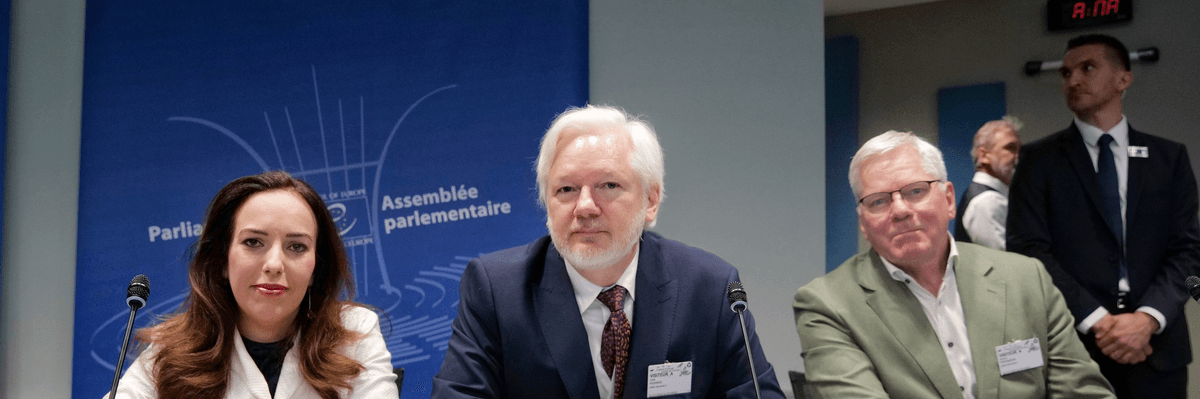
Julian Assange gave a speech to the Committee on Legal Affairs and Human Rights at the Council of Europe on October 1, 2024 in Strasbourg, France.  (Photo: WikiLeaks)

“I am not free today because the system worked,” said Assange. “I am free today because after years of incarceration I pleaded guilty to journalism.”

In his first public statement since being released from prison in June, WikiLeaks founder Julian Assange on Tuesday urged European lawmakers to take action to protect journalists from being prosecuted for their reporting work, warning that his yearslong case is directly tied to self-censorship and the chilling of press freedom.

Assange spoke to the Committee on Legal Affairs and Human Rights (PACE) at the Council of Europe, which includes members from across the continent, in Strasbourg, France, and warned that current legal protections for journalists and whistleblowers “were not effective in any remotely reasonable time,” as evidenced by the 14 years he spent in prison or otherwise in confinement for his work.

“I want to be totally clear,” said Assange. “I am not free today because the system worked. I am free today because after years of incarceration I pleaded guilty to journalism. I pleaded guilty to seeking information from a source.”

Watch Assange’s testimony below:

Assange was released from Belmarsh Prison in London in June after being incarcerated there for five years. His release was secured when he agreed to plead guilty to one felony count of illegally obtaining and disclosing national security materials in a deal with the U.S. government.

He had spent years fighting U.S. efforts to extradite him, threatening him with a sentence of up to 170 years in a federal prison, as punishment for state secrets WikiLeaks published.

The media organization reported on a series of leaks provided by former U.S. Army soldier Chelsea Manning regarding the Army’s killing of unarmed civilians in Iraq, as well as publishing diplomatic cables.

“I was formally convicted by a foreign power for asking for receiving and publishing truthful information about that power, while I was in Europe,” said Assange, who is Australian, on Tuesday. “The fundamental issue is simple: Journalists should not be prosecuted for doing their jobs.”

Assange told PACE members that he had believed that Article 10 of European Convention of Human Rights, which protects the right to freedom of expression and freedom of the media, would protect him from prosecution.

“Similarly, looking at the U.S. First Amendment to its Constitution… No publisher had ever been prosecuted for publishing classified information from the United States,” said Assange. “I expected some kind of harassment legal process. I was pre-prepared to fight for that.”

He continued:

My naiveté was in believing in the law. When push comes to shove, laws are just pieces of paper and they can be reinterpreted for political expediency.

They are the rules made by the ruling class more broadly. And if those rules don’t suit what it wants to do, it reinterprets them or hopefully changes them… In the case of the United States, we angered one of the constituent powers of the United States. The intelligence sector… It was powerful enough to push for a reinterpretation of the U.S. Constitution.

He said he ultimately “chose freedom over unrealizable justice,” as the U.S. was intent on imprisoning him for the rest of his life unless he entered the guilty plea.

Assange added that his case set a “dangerous precedent,” and that since his arrest he has observed “more impunity, more secrecy, more retaliation for telling the truth, and more self-censorship.”

“It is hard not to draw a line from the U.S. government crossing the Rubicon by internationally criminalizing journalism to the chilled climate for freedom of expression now,” said Assange.

His comments echoed the findings of Reporters Without Borders (RSF), which published its annual press freedom index in May. The group found that “in the Americas, the inability of journalists to cover subjects related to organized crime, corruption, or the environment for fear of reprisals poses a major problem.”

The U.S. fell 10 places in the annual ranking, with citing “open antagonism from political officials” such as Republican presidential candidate Donald Trump, “including calls to jail journalists.” RSF also cited the government’s pursuit of Assange’s extradition.

In Europe, said Assange on Tuesday, “the criminalization of news-gathering activities is a threat to investigative journalism everywhere.”

Original article by Julia Conley republished from Common Dreams under Creative Commons (CC BY-NC-ND 3.0).

Continue ReadingIn First Speech Since Release, Assange Says Imprisonment Set ‘Dangerous Precedent’