No flamingos: Loch Lomond, Britain’s largest lake by surface area
THE Scottish government must pull the plug on Flamingo Land’s exclusive rights to build on the banks of Loch Lomond, the Scottish Greens insisted today.
The demand came after the company’s attempt to build a £40 million holiday resort, comprising two hotels, 100 holiday cottages, a waterpark and a monorail, was unanimously rejected for a second time by the board of the Loch Lomond and Trossachs National Park Authority on Monday.
Objections were received from almost 150,000 people, organisations such as the National Trust for Scotland and the Scottish Environment Protection Agency.
SIR KEIR STARMER is facing a possible Labour rebuke over his deeply unpopular plans to cut winter fuel benefits for pensioners.
The party’s largest affiliate, Unite, will try to force a vote on the issue at Labour’s conference, which opens in Liverpool on Sunday.
Unite’s motion also calls for the scrapping of the Treasury’s fiscal rules, which have placed the new government’s spending plans in a strait-jacket.
It urges Labour to borrow more to invest in public services and infrastructure and says that “workers and communities voted for change — a better future, not just better management and not cuts to the winter fuel allowance.”
Calling for a U-turn on the winter fuel cut, the motion added: “We need a vision where pensioners are not the first to face a new wave of cuts and those that profited from decades of deregulation finally help to rebuild Britain.”
The attitude of other affiliated unions will be critical to the success of the motion, which will have to leap procedural hurdles to be debated, something submissions from large unions usually accomplish.
Tensions in the Middle East have reached a new high after thousands of pagers and radios used by members of Hezbollah exploded across various cities in Lebanon and Syria over September 17 and 18. The attacks – which have widely been attributed to Israel, which has not commented – have resulted in at least 30 people killed and more than 3,000 wounded.
Many analysts and politicians are now speculating that the conflict between Israel and Hezbollah, which has been simmering during the 11-month conflict in Gaza, will spiral into open warfare.
Far from taking place in a legal vacuum, the attacks are governed by international humanitarian law (IHL). This is the international legal regime that regulates the conduct of hostilities in situations of armed conflict.
Since the Hamas attacks on October 7 provoked Israel’s ferocious response in Gaza, Israel and Hezbollah have been involved in a series of cross-border hostilities. These qualify as what is called a “non-international armed conflict”, to which IHL applies. This includes the rules set out in, among other instruments, the Geneva conventions.
In pursuing the objective of protecting civilians in wartime, the Geneva conventions rely on the fundamental principles of “distinction” and “proportionality”.
What international law says
The principle of distinction essentially requires belligerents to distinguish at all times between the civilian population and combatants.
Combatants are lawful targets and can be attacked at all times. But intentionally attacking civilians is prohibited and constitutes a war crime under the Rome statute of the International Criminal Court. To this end, military commanders are under an obligation to do everything feasible to verify that the target of an attack is not a civilian.
Even assuming that only Hezbollah members were using the radios and pagers at the moment of the attacks, that does not mean that they shall be presumed to be combatants (and, therefore, lawful targets). Under IHL, a combatant is a “member of the armed forces of a party to the conflict”. This comprises “all organized forces, groups and units which are under a command responsible to that party for the conduct of its subordinates”.
By contrast, whoever is not a member of the armed forces of a party to the conflict is a civilian and subject to the protection of IHL.
There is no doubt that members of the military wings of Hezbollah are “members of the armed forces”, so they qualify as combatants. But those members of Hezbollah’s political wing who are not combatants should be considered as civilians and accordingly, are protected from attack.
Civilians may lose protection from attack for such time as they take a direct part in hostilities. This includes conduct like the intentional killing of civilians and carrying out acts which adversely affect the military capacity of a party to an armed conflict – for example, the planning of attacks against Israel.
The pagers were detonated at 3:30, on September 17 in hundreds of locations in Beirut and other Lebanese cities. Abaca Press / Alamy Stock Photo
What about the attacks against members of Hezbollah’s military wing?
In this case, complying with the principle of distinction does not suffice, since the attack must also respect the principle of proportionality. This requires that the expected “collateral damage” (that is, the incidental killing or wounding of civilians) should not be excessive to the “concreted and direct military advantage” anticipated from the attacks.
Launching an attack with the knowledge that it would cause excessive collateral damage also constitutes a war crime.
Collateral damage
In this case, the attacks killed several civilians. These included the nine-year-old daughter of a Hezbollah member, an 11-year-old boy and at least two health workers. Moreover, the attacks injured thousands more, including Iran’s ambassador to Lebanon.
Although we do not know how many of those killed or injured were civilians, it seems logical that the level of collateral damage to be expected from the attacks would be substantial. After all, the pagers and radios were remotely detonated at the same time, exploding in crowded places such as markets and funerals. In these situations, the likelihood of killing and wounding civilians is extremely high.
These elements suggest that the expected incidental damage is excessive to the military advantage anticipated from the pager attacks – which, at the time of writing, remains unclear.
But it’s important to note that what amounts to “excessive” incidental damage is subject to disagreement. On the one hand there are those who, like the International Committee of the Red Cross, believe that extensive incidental damage is always excessive. Others – including the Israeli government – consider that even extensive incidental damage is allowed if the attack results in a high amount of military advantage.
In my opinion, Israel’s interpretation should be rejected. It turns IHL’s aims of protecting the civilian population on its head and allows for unrestricted warfare.
My conclusion, based on the available information, appears to be that the pager and walkie-talkie attacks purportedly carried out by Israel against Hezbollah members appear to violate the principles of distinction and proportionality. In other words, they could well amount to war crimes.
The U.N. General Assembly approves a resolution calling for an end to Israel’s occupation of Palestinian territories on September 18, 2024. (Photo by Selcuk Acar/Anadolu via Getty Images)
“The vast majority of countries have made it clear: Israel’s occupation of Palestine must end, and all countries have a definite duty not to aid or assist its continuation.”
The United Nations General Assembly on Wednesday passed a resolution demanding that the Israeli government end its occupation of Palestinian territories within 12 months, affirming a recent International Court of Justice opinion that deemed the decadeslong occupation unlawful.
The Palestine-led resolution, co-sponsored by dozens of nations, calls on Israel to swiftly withdraw “all its military forces” from Gaza and the West Bank, including East Jerusalem. The final vote tally was 124 member states in favor and 14 against, with 43 nations abstaining.
Unsurprisingly, Israel and the United States—Israel’s top ally and arms supplier—were among the 14 countries that opposed the resolution, which is not legally binding. The United Kingdom, which recently suspended some arms export licenses for Israel, abstained from Wednesday’s vote, a decision that the advocacy group Global Justice Now (GJN) said shows “complete disregard for the ongoing suffering of Palestinians forced to live under military-enforced racial discrimination.”
“The vast majority of countries have made it clear: Israel’s occupation of Palestine must end, and all countries have a definite duty not to aid or assist its continuation,” said GJN’s Tim Bierley. “To stay on the right side of international law, the U.K.’s dealings with Israel must drastically change, including closing all loopholes in its partial arms ban and revoking any trade or investment relations that might assist the occupation.”
The Palestinian-led Boycott, Divestment, and Sanctions (BDS) Movement welcomed passage of the resolution, noting that the U.N. General Assembly voted “for the first time in 42 years” in favor of “imposing sanctions on Israel.”
The resolution specifically calls on all U.N. member states to “implement sanctions, including travel bans and asset freezes, against natural and legal persons engaged in the maintenance of Israel’s unlawful presence in the occupied Palestinian territory, including in relation to settler violence.”
NEWS: UN General Assembly adopts resolution demanding that Israel brings to an end its unlawful presence in the Occupied Palestinian Territory without delay and within the next 12 months.https://t.co/Vj0Ve1lLBipic.twitter.com/2rKKvDNDqd
The resolution’s passage came nearly two months after the International Court of Justice (ICJ), the U.N.’s highest legal body, handed down an advisory opinion concluding that Israel’s occupation of Palestinian territories is illegal and must end “as rapidly as possible.”
The newly approved resolution states that “respect for the International Court of Justice and its functions… is essential to international law and justice and to an international order based on the rule of law.”
The Biden administration, which is heavily arming the Israeli military as it assails Gaza and the West Bank, criticized the ICJ’s opinion as overly broad.
Nihad Awad, national executive director of the Council on American-Islamic Relations (CAIR), said in a statement Wednesday that “the Biden administration should join the overwhelming majority of nations around the world in condemning these crimes against the Palestinian people, demanding an end to the occupation, and exerting serious pressure on the Israeli government to comply.”
“We welcome this U.N. resolution demanding an end to one of the worst and ongoing crimes against humanity of the past century,” said Awad.
Ahead of Wednesday’s vote, a group of U.N. experts said in a statement that many countries “appear unwilling or unable to take the necessary steps to meet their obligations” in the wake of the ICJ’s opinion.
“Devastating attacks on Palestinians across the occupied Palestinian territory show that by continuing to turn a blind eye to the horrific plight of the Palestinian people, the international community is furthering genocidal violence,” the experts said. “States must act now. They must listen to voices calling on them to take action to stop Israel’s attacks against the Palestinians and end its unlawful occupation. All states have a legal obligation to comply with the ICJ’s ruling and must promote adherence to norms that protect civilians.”
Medical staffers tend to patients at a hospital in Houston, Texas on August 18, 2021. (Photo: Brandon Bell/Getty Images)
“Our private, profit-driven system means that we are paying more for less,” said one progressive activist.
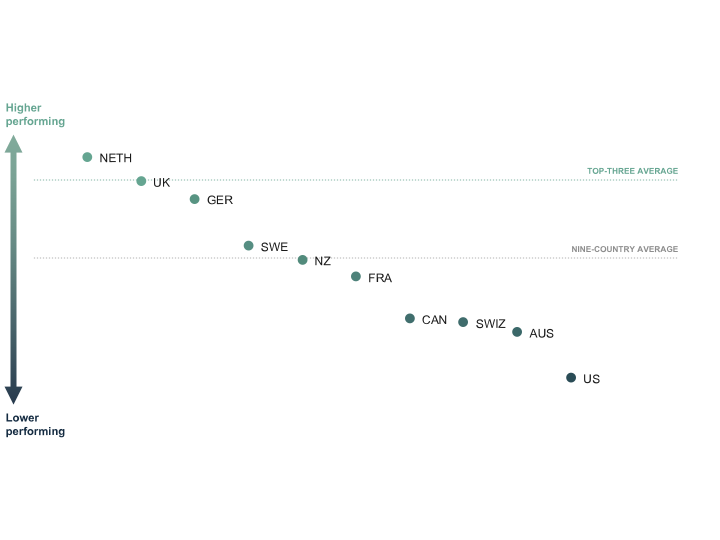
A report out Thursday shows that the United States’ for-profit healthcare system still ranks dead last among peer nations on key metrics, including access to care and health outcomes such as life expectancy at birth.
The new analysis from the Commonwealth Fund is the latest indictment of a corporate-dominated system that leaves tens of millions of people uninsured or underinsured and unable to afford life-saving medications without rationing doses or going into debt.
“Despite spending a lot on healthcare, the United States is not meeting one of the principal obligations of a nation: to protect the health and welfare of its residents,” the report states. “Most of the countries we compared are providing this protection, even though each can learn a good deal from its peers. The U.S., in failing this ultimate test of a successful nation, remains an outlier.”
People in the U.S., which spends roughly twice as much per capita on healthcare as other rich nations, “live the shortest lives and have the most avoidable deaths,” Commonwealth noted, pointing to frequent “denials of services by insurance companies” and other systematic defects of the American system, including massive administrative costs.
Meanwhile, insurance giants and pharmaceutical companies are raking in huge profits, benefiting in particular from the growing privatization of Medicare. More than half of the Medicare-eligible population in the U.S. is currently on a privately run Medicare Advantage plan.
“Our private, profit-driven system means that we are paying more for less,” progressive activist Jonathan Cohn wrote in response to the Commonwealth report.
Americans live the shortest lives and have the most avoidable deaths.
Note: To normalize performance scores across countries, each score is the calculated standard deviation from a nine-country average that excludes the US. See “How We Conducted This Study” for more detail.
Data: Commonwealth Fund analysis.
Source: David Blumenthal et al., Mirror, Mirror 2024: A Portrait of the Failing U.S. Health System — Comparing Performance in 10 Nations (Commonwealth Fund, Sept. 2024). https://doi.org/10.26099/ta0g-zp66
The Commonwealth Fund’s findings bolster progressives’ case for transitioning to a Medicare for All system that would provide comprehensive coverage to everyone in the country for free at the point of service. Studies have repeatedly shown that such a program would cost less than the immensely wasteful for-profit system—which is set to drive national healthcare spending to $7.7 trillion per year by 2032—while saving lives.
Commonwealth observed Thursday that while affordability “is a pervasive problem” in the U.S., Australia “offers free care in all public hospitals, and the nation’s universal Medicare system provides all Australians with coverage for all or part of the cost of [general practitioners] and specialist consultations and diagnostic tests, with additional subsidies available for private hospital care.”
“The U.S. continues to be in a class by itself in the underperformance of its healthcare sector,” the report continues. “While the other nine countries differ in the details of their systems and in their performance on domains, unlike the U.S., they all have found a way to meet their residents’ most basic health care needs, including universal coverage.”
Americans face the most barriers to accessing and affording health care.
Note: To normalize performance scores across countries, each score is the calculated standard deviation from a nine-country average that excludes the US. See “How We Conducted This Study” for more detail.
Data: Commonwealth Fund analysis.
Source: David Blumenthal et al., Mirror, Mirror 2024: A Portrait of the Failing U.S. Health System — Comparing Performance in 10 Nations (Commonwealth Fund, Sept. 2024). https://doi.org/10.26099/ta0g-zp66
With the U.S. presidential election less than two months away, neither 2024 candidate for the two major parties has outlined a detailed healthcare proposal thus far.
Former President Donald Trump, the Republican nominee, said during last week’s debate in Philadelphia that he merely has “the concepts of a plan,” while Harris—who once co-sponsored Medicare for All legislation in the Senate—said she “absolutely” supports “private healthcare options” and wants to “maintain and grow the Affordable Care Act.”
Just days after the debate, Sen. JD Vance (R-Ohio)—Trump’s running mate—said the Republican nominee prefers a system in which “a young American” and a “65-year-old American with a chronic condition” are not placed in “the same risk pools,” suggesting a rollback of the ACA’s protections for people with preexisting conditions.
“You can’t really say people with preexisting conditions are protected if they are in a separate insurance risk pool and can be charged exorbitant premiums,” Larry Levitt, executive vice president for health policy at the research group KFF, wrote in response to Vance’s comments.