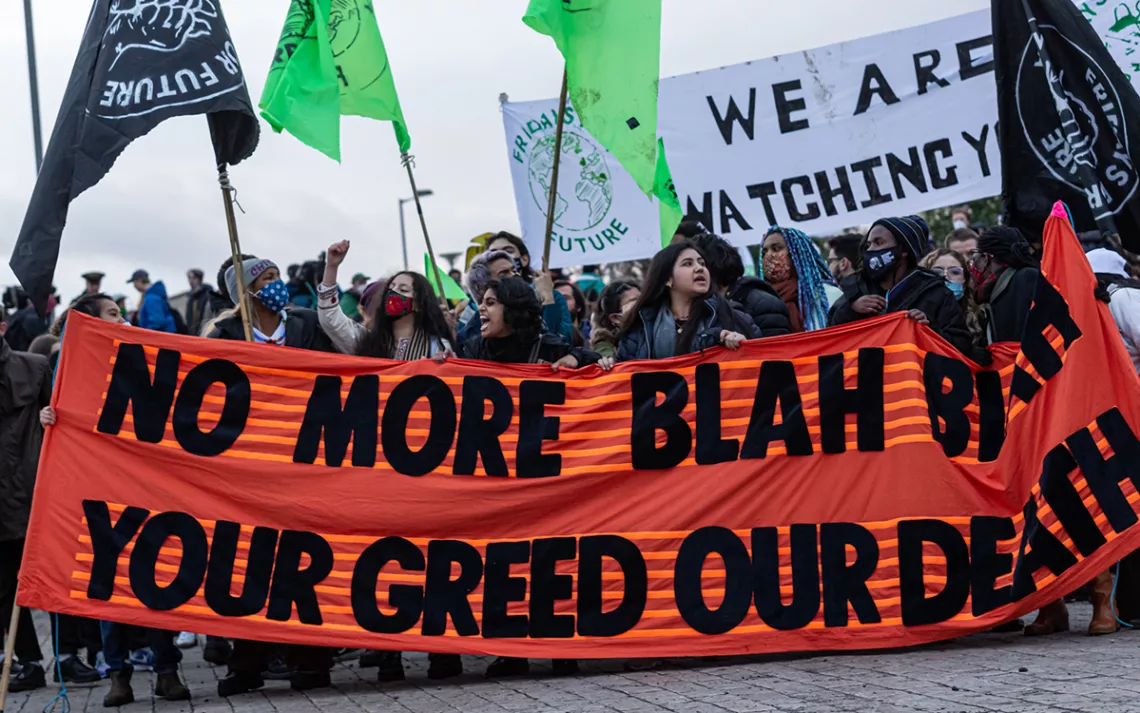
ActionAid says ‘parasitic behaviour’ is fuelling the climate crisis and represents ‘corporate capture’ of public finance
More than $650bn (£494bn) a year in public subsidies goes to fossil fuel companies, intensive agriculture and other harmful industries in the developing world, new data has shown.
The subsidies entrench high greenhouse gas emissions and are fuelling the destruction of the natural world, according to a report from the charity ActionAid.
Developed countries are also actively subsidising such harmful activities. The UK, for instance, devotes about $7.3bn a year to effective subsidies for fossil fuels.
Taken altogether, the sums involved in the developing world would be enough to pay for the education of all children in sub-Saharan Africa three and a half times over, each year.
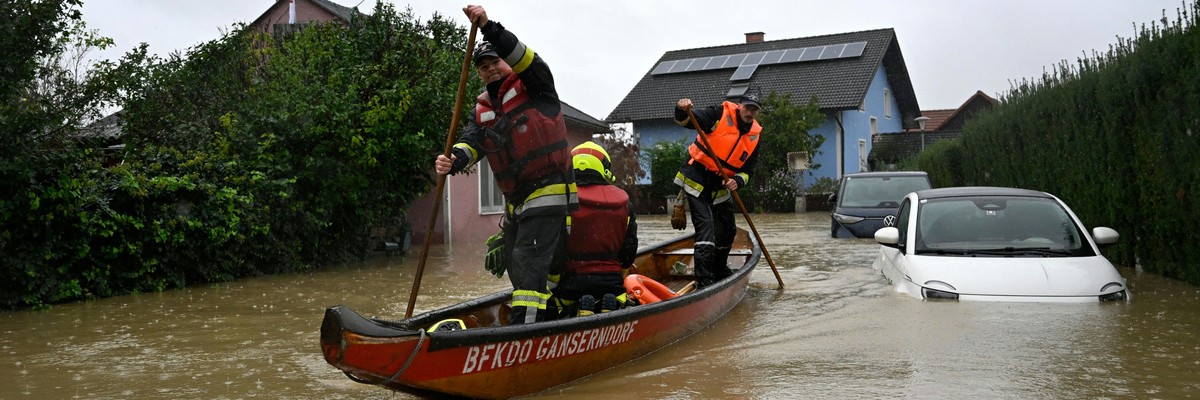
Firefighters in a boat make their way past a car submerged by the floods in Rust im Tullnerfeld, Austria, on September 16, 2024. (Photo: Helmut Fohringer/APA/AFP via Getty Images)
“We are deeply worried such events will get worse until oil and gas giants like Shell, Total, Equinor, Exxon, OMV, and ENI are forced to stop drilling for fossil fuels driving climate change,” said one campaigner.
The international climate group Greenpeace on Friday called on European leaders to “reciprocate” the courage shown by first responders in several countries over the weekend by forcing fossil fuel giants to pay for climate damages.
Calling out leaders including Polish Prime Minister Donald Tusk, Czech Prime Minister Petr Fiala, and Romania Prime Minister Marcel Ciolacu, Greenpeace campaigner Ian Duff said Central and Eastern European countries should end their “support for fossil fuels and [make] climate polluters pay for this disaster,” as emergency workers rescued people from catastrophic flooding.
The death toll on Monday rose to at least 16, with many more people missing and hundreds of thousands of people displaced in countries including Austria, the Czech Republic, Hungary, Romania, and Slovakia after the low-pressure system Storm Boris dumped torrential rains on the region for days starting late last week.
Two men, aged 70 and 80, drowned in their homes in northeastern Lower Austria after being trapped by rising floodwater, and confirmed deaths in Poland rose to six.
About 70% of Litovel, about 140 miles east of the Czech capital of Prague, was underwater Monday, while a power plant servicing the country’s third-largest city was forced to shut down and leave residents without heat and hot water.
“Greenpeace is horrified by damages brought by floods across Central and Eastern Europe, claiming lives, leaving homes without power and farmers with ruined fields, after being already ravaged by drought,” said Duff, head of Greenpeace’s Stop Drilling Start Paying campaign. “We are deeply worried such events will get worse until oil and gas giants like Shell, Total, Equinor, Exxon, OMV, and ENI are forced to stop drilling for fossil fuels driving climate change.”
In the U.S., the notion of big polluters being required to pay for damages caused by the climate crisis has recently gained traction, with lawmakers introducing a bill in Congress last week.
In Europe, a “polluter pays” principle is followed for many kinds of pollution, but advocates have called for it to be applied to planet-heating greenhouse gas emissions.
The flooding in Europe comes, as London-based meteorologist Scott Duncan explained on the social media platform X, after “an exceptional summer for the Mediterranean Sea,” with heat records broken—just as scientists have warned this year that record heat in the North Atlantic and other oceans around the globe would mean “a busy hurricane season.”
“Warmer sea surface temperatures allow more moisture to evaporate, like fuel for a storm. The warmer the water, the greater the evaporation,” said Duncan.
Liz Stephens, science lead for the Red Cross Red Crescent Climate Center, noted that in Central and Eastern Europe, “climate change is known to be playing a role in increasing the risk of flooding,” with the World Weather Attribution saying in 2021 that disastrous flooding that hit Germany and Belgium was tied to “a rapidly warming climate.”
Reports by the Intergovernmental Panel on Climate Change (IPCC), Stephens added, “have indicated that we have already observed an upward trend in heavy rainfall, surface water, and river flooding, and climate models show high confidence of further increases into the future.”
“The flooding looks set to be the worst in the region since 2002,” she said. “Lessons will have been learned from previous big European floods, but forecasts for some locations are for flooding of unprecedented magnitude, and history tells us that people are often surprised by the seemingly unimaginable consequences of such events.”
Journalist and climate advocate George Monbiot pointed out on Al Jazeera that storms previously described as “once-in-1,000-year occurrences [are] happening several times now in the past decade. We’re seeing a massive acceleration and intensification of extreme weather events, and unfortunately this is exactly what climate scientists were predicting.”
.@GeorgeMonbiot: "I've seen what were described as once in a 1,000 year occurrences happening several times now in the past decade. We're seeing a massive acceleration and intensification of extreme weather events" pic.twitter.com/wzgntdDpbq
Climate action group Friends of the Earthechoed Greenpeace’s demand to “leave fossil fuels in the ground and instead invest in a green future,” and Duff emphasized that communities across Central and Eastern Europe are far from the only ones “reeling from deadly floods and torrential rains,” with Typhoon Yagi causing flooding and landslides that killed at least 250 people in Southeast Asia in recent days and heavy rains across West and Central Africa leading to floods that killed more than 1,000 people.
“The fossil fuel industry,” said Duff, “is worsening weather extremes everywhere.”
Former Labour Party leader and now Independent MP Jeremy Corbyn on stage to address a march in central London organised by the Palestine Solidarity Campaign, July 6, 2024
LINDA PENTZ GUNTER reports on speakers highlighting global conflicts, from Gaza to Manipur, as Jeremy Corbyn’s initiative gathers leading lights of the left to grapple with Britain’s progressive political future
EVERY morning, Lubna Masarwa repeats the same task. She views footage and photographs and decides what her news outlet will publish. Except that these are no ordinary images. These are the pictures coming from Gaza and now the West Bank, and, according to Masarwa, they can be summed up in a single word: horrible.
“I have never witnessed such a thing,” said Masarwa, the Jerusalem bureau chief of the news website Middle East Eye, who has been covering Israel’s genocide in Gaza since it began.
The material she is forced to view includes “mothers grieving near Nasser hospital trying to recognise the bodies of their children,” says Masarwa, children who are often only identifiable by the shoes they were wearing that day or even their teeth. “I would say Israel went mad,” she said.
Masarwa was the opening speaker of a day-long conference last Saturday in London, hosted by the Peace and Justice Project (PJP), an initiative launched in December 2020 by Jeremy Corbyn and his wife, Laura Alvarez. The PJP said Corbyn was designed to be “a political home for the politically homeless.”
More than 1.7 million households plan on keeping their heating off this year, survey reveals
LIVES will be lost, campaigners warned today after a survey revealed that more than 1.7 million households do not plan on turning on their heating this year.
The number of those who said they will keep the heating off in polling for Uswitch is nearly double the 972,000 who said they did not heat their homes last year.
Fifty-five per cent of those blamed the continued rise of the cost of living, while 25 per cent of those over 65 said their decision followed the loss of winter fuel payments.
Another one million households will not turn on the heating until December to keep costs down, according to the poll.
About 43 per cent of households said they will only turn the heating on if they are too cold while 31 per cent will only heat some rooms in their home.
Hedge fund Quadrature Capital has given £4m to Keir Starmer’s Labour – the largest donation in the party’s history | Jack Taylor – WPA Pool / Getty Images
Quadrature’s donation is noteworthy not just for being Labour’s largest-ever, but for its timing ahead of election
The Labour Party’s largest-ever donation came from a Cayman Islands-registered hedge fund with shares worth hundreds of millions of pounds in fossil fuels, private health firms, arms manufacturers and asset managers.
While the £4m donation by Quadrature Capital is the sixth-largest in British political history, it is noteworthy not just for its size, but also its timing.
Electoral Commission records suggest Labour received the donation in the one-week window between former prime minister Rishi Sunak announcing the general election and the start of the ‘pre-poll reporting period’ in which all political donations over £11,180 had to be published weekly, rather than the quarterly norm.
This means that despite being made on 28 May, Quadrature’s generous donation was published by the Electoral Commission only last week, more than two months after Labour won the election.
Neither the Labour Party press office nor No 10 responded to openDemocracy’s questions on whether the timing of accepting this donation was intended to minimise scrutiny and critical coverage during the election.
Paul Holden, an investigative journalist and author of The Fraud, a forthcoming book on Starmer’s leadership, told openDemocracy that the donation’s timing fits the Starmer project’s pattern of delaying the disclosure of potentially sensitive or controversial political donations.
Holden said: “Sir Keir Starmer and the organisations close to him have an unfortunate history of reporting donations in controversial ways.
“During his bid to become leader of the Labour Party, Starmer refused to contemporaneously publish details of who had donated to his leadership campaign. His rivals, Rebecca Long-Bailey and Lisa Nandy, agreed to share details of their donors in real-time, which they published. Starmer, however, decided only to declare his donations via his MP’s register of interests, which created a significant lag between when Starmer accepted his donations and when they were made public.
“Labour members, as a result, had no idea at the time of voting that Starmer had been funded with large donations from the likes of wealthy millionaires like Martin Taylor and Sir Trevor Chinn and Baron Waheed Ali; the latter now at the centre of the furore about Starmer’s acceptance of gratuities.”
Holden also referred to a fine issued by the Electoral Commission to Starmerite think tank Labour Together in 2021 for its failure to declare donations worth more than £800,000 – including £730,000 received while it was under the directorship of Starmer’s key adviser and No 10’s director of political strategy, Morgan McSweeney.
openDemocracy has consistently reported on Labour’s increasingly strong ties with the financial sector in recent years.
The party has received more than £8m from businesses or people linked to the financial industry since Starmer became leader in 2020 and now boasts two multi-million-pound donors from the world of hedge funds; Quadrature and Taylor, who has managed several billion-dollar funds over his career.
While Quadrature had not donated to Labour before May, one of its senior employees has contributed significantly to the party under Starmer. Daniel Luhde-Thompson, a strategic adviser at the firm, has given the party more than £500,000 this year, according to the Electoral Commission.
Transparency campaigners have warned Quadrature’s huge donation raises questions about what the financial sector is getting in return.
Rose Whiffen, senior research officer at Transparency International UK told openDemocracy: “When the public see political parties relying on such large sums of money in donations from private sources, it understandably raises questions as to in whose interest politicians are working and can give the impression our democracy is for sale.
“More must be done to take this kind of big money out of politics. The new government should commit to introducing caps on individual donations to tackle this problem [and] restore public trust in how our democracy functions.”
Green Party co-leader Zack Polanski told openDemocracy that the donation shows Labour now “stands for multi-millionaires and billionaires over our working-class communities”.
Polanski said: “Far from being the party in service of working people, Starmer’s Labour Party seems indebted to the bankers and bosses who profit from pillaging our public services and our planet.
“Simply ‘following the rules’ and declaring donations isn’t enough to cast aside the doubts that the main parties have their loyalties tested by big donors. It’s time to implement strict rules on funding political parties, including a cap on how much any individual or business can donate to politics. Elections should be won by the people with the best ideas, not the parties with the biggest donors.”
Registered in the Cayman Islands
Quadrature Capital has a diversified share portfolio worth around $6bn, according to records filed with the US Securities and Exchange Commission (SEC) last month.
After its donation was made public last week, the firm shared a statement on its website.
It said: “In May 2024, we came to the view that a UK government with a commitment to the green transition of the economy would have the ability to drive change that is so urgently needed. Having analysed commitments set out by each party, we donated £4m to The Labour Party, in support of policies that will deliver climate action while also promoting social equity and economic resilience.
“This was a values-based donation, not a political donation, as Quadrature Capital Ltd remains non-partisan and apolitical. Going forward, our private giving will continue to be led by our values, and any further donations to political parties will depend on the parties’ commitments, track record and alignment with our mission for sustainable and equitable growth.”
Last year, the Guardian reported that despite donating to environmental charities through its climate foundation, Quadrature had holdings in fossil fuel companies worth more than $170m. The paper highlighted three holdings in particular with major polluters: ConocoPhillips, Cheniere Energy and Cenovus Energy.
openDemocracy’s analysis of the firm’s latest SEC filings shows that Quadrature has since increased its holdings in Cenovus, which was this year fined millions for an oil spill that released 250,000 litres into the Atlantic Ocean. Quadrature has scaled back its holdings with the other two firms but has taken up a major $67m stake in ExxonMobil, one of the largest oil and gas producers in the world.
Among Quadrature Capital’s other investments, its largest holding is in Apple, valued at $231m, and among its 10 largest holdings are other ‘bluechip’ stocks like Amazon, Shopify and Costco.
Quadrature also maintains significant holdings in the arms manufacturers Northrop Grumman ($31m) and Lockheed Martin ($6m); US private healthcare companies such as UnitedHealth ($31m) and HCA Healthcare ($16m); some of the largest asset management companies like Blackstone ($22m) and KKR ($7m), who potentially stand to benefit significantly from Labour’s plans to utilise private investment for infrastructure; and tech firms, including Palantir ($71m) and Oracle ($8m).
UK accounts filings for the firm show profits before tax of more than £230m in the financial year ending 31 January 2023, but paid corporation tax of only £5.3m. As is noted in the accounts, had the firm paid the standard rate of UK corporation tax of 19% during that period, this would have amounted to more than £43m.
The UK-based fund paid out £343m in wages last year – an average of £3m for each of its 113 employees – while back in 2021 one of its founders was eyeing a luxury central London penthouse valued at around £110m, according to a report by Bloomberg that cited “two people with knowledge of the transaction”.
openDemocracy can reveal that Quadrature was last year acquired by QC Ventures, a company registered in the Cayman Islands, which is now the 100% shareholder in the firm.
The Cayman Islands is a well-known tax haven, and the transparency requirements for companies registered there are much less than in the UK and most other countries.
Documents obtained by openDemocracy show that when QC Ventures was established in the Cayman Islands back in 2018, its directors were three senior directors at Quadrature and a corporate services provider based in Cayman.
Speaking in the Commons in July, Labour’s foreign secretary David Lammy pledged to tackle individuals and companies taking advantage of offshore tax havens “with full vigour”.
He added: “We were concerned that parts of the last government were turning a blind eye to these issues. I hope to come forward with further proposals in the coming weeks.”
When openDemocracy contacted Quadrature to ask about the donation and the acquisition by QC Ventures, a representative of the firm directed us to the statement on the company’s website. They also said the decision to set up a holding company based in the Cayman Islands to acquire Quadrature was not motivated by, or related to, taxation.
Robert Palmer, director of Tax Justice UK, said that “any company moving to a tax haven like the Cayman Islands has questions to answer” as the islands are “notorious for a lack of transparency and for ultra-low taxes”.
“Ultimately governments need to make sure that everyone is paying their fair share in tax, especially when public services are desperately in need of investment and we need to fund the transition to a greener economy,” he said.
Fran Boait, co-executive director at Positive Money, said: “In taking large donations from financial firms registered in tax havens, we have to question what influence the sector is getting in return.
“Labour’s plans to continue the previous government’s deregulation of the City of London are particularly concerning, especially when it has been shown that an oversized financial sector hinders rather than helps the rest of the economy.
“Labour should be looking at how to weaken the power of big finance in our democracy and economy. Right now it seems they are doing the opposite.”