Revealed: Shell Oil Nonprofit Donated to Anti-Climate Groups Behind Project 2025

Spread the love

Original article by Geoff Dembicki republished from DeSmog.

Shell USA Company Foundation has sent hundreds of thousands to Project 2025 advisors. Credit: Marc Rentschler / Unsplash

Foundation says it ‘does not endorse any organizations’ while funneling hundreds of thousands to rightwing causes.

A U.S. foundation associated with oil company Shell has donated hundreds of thousands of dollars to religious right and conservative organizations, many of which deny that climate change is a crisis, tax records reveal.

Fourteen of those groups are on the advisory board of Project 2025, a conservative blueprint proposing radical changes to the federal government, including severely limiting the Environmental Protection Agency.

Shell USA Company Foundation sent $544,010 between 2013 and 2022 to organizations that broadly share an agenda of building conservative power, including advocating against LGBTQ+ rights, restricting access to abortions, creating school lesson plans that downplay climate change and drafting a suite of policies aimed at overhauling the federal government.

Donees include the Heartland Institute, a longtime purveyor of climate disinformation, which published a video on YouTube in May stating incorrectly that “the scientific data continue to show there is no climate crisis.” Other groups that have received donations include the American Family Association, which claims that the “climate change agenda is an attack on God’s creation,” as well as the Heritage Foundation, the lead organization behind Project 2025.

“Shell has every reason to want to maintain close relationships with organizations that wield outsize political influence and just happen to reliably support the interests of the fossil fuel industry,” said Adrian Bardon, a professor of philosophy at Wake Forest University who has studied the religious right and climate denialism.

The Shell USA Company Foundation helps employees boost their charitable giving to nonprofits. A Shell USA spokesperson wrote via email that the company’s workers make the initial decision to donate “to non-profit (tax exempt) organizations of their choice.”

According to the company’s online donation portal, Shell will match individual donations up to $7,500. The spokesperson confirmed that the foundation “matches employee gifts to such qualified 501(c)(3) nonprofit agencies,” but did not respond to specific inquiries about which organizations, if any, received matching donations from the foundation.

Tax records from 2022 show that the president of the foundation was Gretchen Watkins, the current president of Shell USA. But the foundation itself “does not endorse any organizations” and “giving is a personal decision not directed by the company,” the spokesperson added.
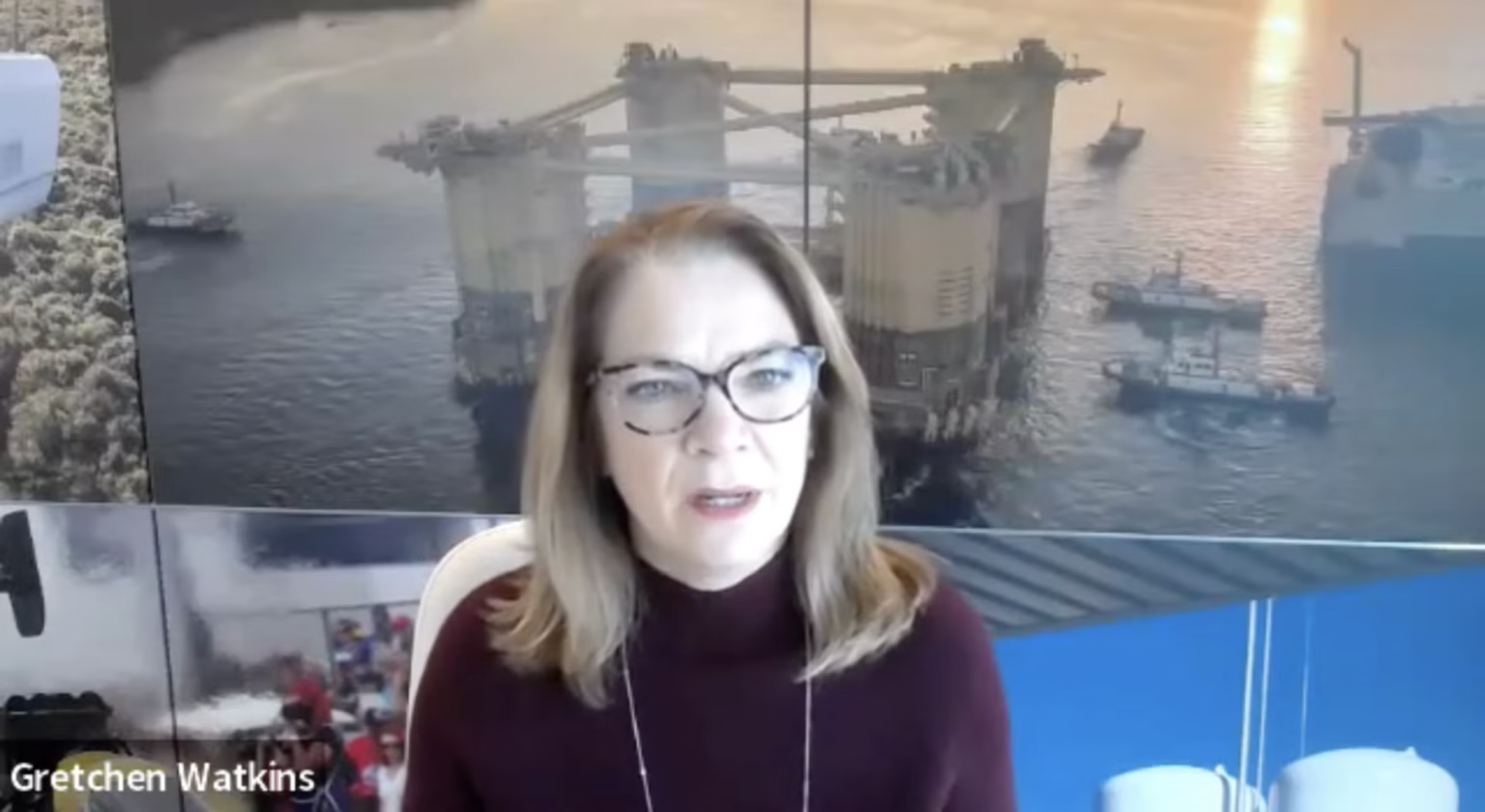
Shell USA president Gretchen Watkins was also president of the foundation, 2022 tax records show. Credit: OurEnergyPolicy.org / YouTube

Shell is a multinational oil and gas producer headquartered in London that last year reported adjusted earnings of $28.25 billion. Its American subsidiary, Shell USA, has for decades operated Shell USA Company Foundation, which makes grants to American non-profits.

Because the foundation itself is a registered non-profit, it must file public returns each year with the IRS, which contain detailed information about the organizations to which it donates. The vast majority of these non-profits have no explicit political focus. They include YMCAs, youth groups, local churches, schools and mainstream charities such as Oxfam and United Way.

But an analysis by the Guardian and DeSmog found at least 21 groups supported by Shell’s foundation that are aggressively opposed to progressive cultural and economic change, including addressing the crisis of global heating.

“They’re all certainly working in the rightwing policy and propaganda space,” said Peter Montgomery, research director at the progressive non-profit organization People for the American Way. “That includes the anti-regulation corporate right and the culture warriors of the religious right.”

Since 2013, the Shell foundation sent $59,264 to the American Family Association, another Project 2025 adviser and an organization designated as a “hate group” by the Southern Poverty Law Center due in part to its long history of aggressive anti-gay activism. In a post from 2022, the conservative Christian organization referred to “the unproven hypothesis of man-made, catastrophic climate change.”

Shell’s foundation contributed $23,321 to the Heritage Foundation, which published the Project 2025 document known as Mandate for Leadership. The conservative thinktank has deep ties to Donald Trump and a long history of attacking the scientific consensus on climate change. Last year, it published a commentary on its website stating that “climate change models are poor predictors of warming.”

Shell’s foundation also donated $58,002 to Alliance Defending Freedom, another Project 2025 adviser. It’s a conservative Christian legal activist group that claims credit for helping overturn Roe v Wade, explaining that its “attorneys and staff were proud to be involved from the very beginning.”

Shell’s foundation also reported donations worth $105,748 to Hillsdale College, a private conservative Christian school in Michigan that’s listed as an advisory board member of Project 2025 and that has hosted prominent climate skeptics.

The American Family Association, the Heritage Foundation, Alliance Defending Freedom and Hillsdale College did not respond to requests for comment.
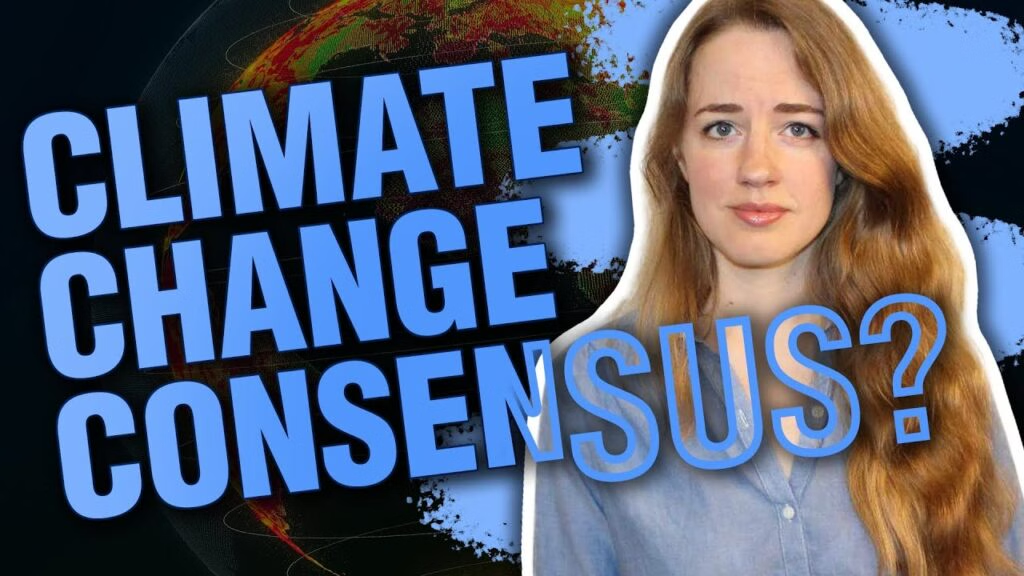
A Heartland Institute video claims ‘the scientific data continue to show there is no climate crisis.’ Credit: Heartland Institute / YouTube

Other donees associated with Project 2025 include the American Center for Law and Justice ($14,321), the Claremont Institute ($1,975), Discovery Institute ($3,300), the Family Research Council ($3,399), First Liberty Institute ($19,100), the Leadership Institute ($7,125), the Media Research Center ($2,528), Students for Life of America ($1,020), the Heartland Institute ($5,000) and the Texas Public Policy Foundation ($8,275).

The Shell USA Foundation also donated to religious right organizations that aren’t directly involved with Project 2025including $79,874 to Focus on the Family, an anti-abortion group that’s called climate change “an unproven theory.” When reached for comment, Gary Schneeberger, a spokesperson for the organization, wrote: “We consider it a best practice for our ministry and, in fact, a promise to our donors that we never share information about their donations with anyone.”

Another anti-abortion group called Texas Right to Life, which has previously argued that climate change is “arguably, nonexistent”, received $65,103 from the foundation. A spokesperson for the group wrote in an email that “the gifts that came from Shell were matched gifts from its employees.”

Shell’s foundation also sent $8,541 to the Prager University Foundation, which is associated with the rightwing media outlet PragerU. Known for producing conservative videos targeting young people with messages downplaying the climate crisis, its content has been approved for classrooms in several states.

Other religious right donees include Judicial Watch ($32,894), the executive committee of the Southern Baptist Convention ($37,420), the Acton Institute for the Study of Religion and Liberty ($2,100) and the Susan B Anthony List ($5,700).

“In the absence of real transparency, one can only speculate on the motives behind these donations,” Bardon said. But the contributions help Shell maintain its place within a broader conservative coalition, he argued. “So if something comes up that bothers me, it’s going to bother you, too, because we’re on the same team,” he said.

This article is co-published with the Guardian.

Original article by Geoff Dembicki republished from DeSmog.

Continue ReadingRevealed: Shell Oil Nonprofit Donated to Anti-Climate Groups Behind Project 2025

Labour urged to act over 9% rise to energy bills

Spread the love

https://morningstaronline.co.uk/article/b/splash-288

ENERGY prices are set to rise by 9 per cent in October, experts revealed today — with the “alarming” increase accompanying winter fuel payment cuts.

A typical household’s energy bills are expected to rise to £1,714 a year, up from £1,568, according to energy consultancy Cornwall Insight.

The group said that while the figure is less than the cap previously predicted, there are also likely to be further “modest increases” in January and more rises early in the year due to “recent tensions in the Russia-Ukraine war.”

End Fuel Poverty Coalition co-ordinator Simon Francis said that instead of offering help, the government has axed winter fuel payments to millions and refuses to confirm if the Household Support Fund will be extended.

“The reality is that bills will go up compared to today and will be around 65 per cent higher than they were before the energy bills crisis started.

https://morningstaronline.co.uk/article/b/splash-288

Continue ReadingLabour urged to act over 9% rise to energy bills

UK: Civil servant who resigned was formerly lead author of arms assessment

Spread the love

https://www.middleeasteye.net/news/uk-civil-servant-who-resigned-formerly-assessed-arms-sales-legality-foreign-office

Mark Smith said he had been the lead author of the central assessment governing the legality of UK arms sales to the Middle East

The British civil servant who resigned over concerns that the government is complicit in Israeli war crimes in Gaza has said he was formerly the lead author of the central assessment governing the legality of UK arms sales in the Foreign Office’s Middle East and North Africa Directorate.

Diplomat Mark Smith’s resignation was first reported when prominent journalist Hind Hassan posted the contents of his resignation letter on X on Friday evening. On Saturday Middle East Eye confirmed the resignation through two sources familiar with the situation.

In a statement issued on Sunday, Smith added that he was the lead author of the central assessment governing the legality of UK arms sales in the Middle East and North Africa Directorate.

He said: “It was my job to gather all relevant information regarding civilian casualties, international law compliance as well as assess the commitment and capabilities of the countries in question.”

“To export arms to any nation, the UK must be satisfied that the recipient nation has in place robust procedures to avoid civilian casualties and to minimize harm to civilian life. It is impossible to argue that Israel is doing that.”

It is unclear when Smith, who appears to have been at the British embassy in Dublin since at least 2022, was in this role.

Smith said he has written to Foreign Secretary David Lammy informing him of his resignation.

“I sincerely hope that he will listen to the concerns of Civil Servants on this issue and make the necessary changes.”

https://www.middleeasteye.net/news/uk-civil-servant-who-resigned-formerly-assessed-arms-sales-legality-foreign-office

UK Labour Party Shadow Foreign Secretary repeatedly heckled at a speech to the Fabian Society over his and the Labour Party's support for and complicity in Israel's genocide of Gaza.
UK Labour Party Shadow Foreign Secretary repeatedly heckled at a speech to the Fabian Society over his and the Labour Party’s support for and complicity in Israel’s genocide of Gaza.
Continue ReadingUK: Civil servant who resigned was formerly lead author of arms assessment

Meeting 1.5C warming limit hinges on governments more than technology, study says

Spread the love

Original article by AYESHA TANDON republished from Carbon Brief under a CC license.

The ability of governments to implement climate policies effectively is the “most important” factor in the feasibility of limiting global warming to 1.5C, a new study says. 

The future warming pathways used by the Intergovernmental Panel on Climate Change (IPCC) suggest that holding warming to 1.5C is unlikely, but still possible, when considering the technological feasibility and project-level economic costs of reaching net-zero emissions.

However, the new study, published in Nature Climate Change, warns that adding in political and institutional constraints on mitigation make limiting warming to 1.5C even more challenging. 

They find that the most ambitious climate mitigation trajectories give the world a 50% chance of limiting peak global warming to below 1.6C above pre-industrial temperatures. However, adding ”feasibility constraints” – particularly those involving the effectiveness of governments – reduces this likelihood to 5-45%.

The study shows that, thanks to advances such as solar, wind or electric vehicles, “the technological feasibility of climate-neutrality is no longer the most crucial issue”, according to an author on the study. 

Instead, he says, “it is much more about how fast climate policy ambition can be ramped up by governments”.

Emissions scenarios

In 2015, almost every country in the world signed the Paris Agreement – with the aim to limit global warming to “well below” 2C above pre-industrial levels, with a preference for keeping warming below 1.5C.

Since then, most countries have set net-zero targets and many are making progress towards achieving them. However, as the planet continues to warm, some scientists are questioning whether it is still possible to limit warming to 1.5C, the new study says.

The IPCC’s special report on 1.5C, published in 2018, included a cross chapter box on the “feasibility” of this temperature limit. The report says there are six components of feasibility that could inhibit the world’s ability to limit warming to 1.5C, as shown in the image below.

The six components of feasibility that could inhibit the world’s ability to limit warming to 1.5C, according to the IPCC”s special report on 1.5C. Source: IPCC SR1.5, cross chapter box 3.

The six components of feasibility that could inhibit the world’s ability to limit warming to 1.5C, according to the IPCC”s special report on 1.5C. Source: IPCC SR1.5, cross chapter box 3.

The IPCC’s working group three report from its sixth assessment cycle explores thousands of different future warming scenarios. These scenarios are mainly generated by integrated assessment models (IAMs) that examine the energy technologies, energy use choices, land-use changes and societal trends that cause – or prevent – greenhouse gas emissions.

Fewer than 100 of these scenarios result in warming of below 1.5C with limited or no overshoot, defined as more than a 50% chance of seeing a peak temperature below 1.6C.  These are known as the “C1 scenarios”. However, these scenarios do not consider all of the feasibility constraints outlined by the IPCC.

(Furthermore, these scenarios – which run from 2019 – assume that rapid decarbonisation began almost immediately. However, in reality, emissions have continued to rise since 2020, eating into the remaining “carbon budget” for warming to be limited to 1.5C more quickly than the models assume.)

The new study investigates five constraints. The first two – geophysical and technological – focus on the constraints presented by technologies, such as the growth of carbon capture and storage, nuclear power and solar generation, and the Earth’s total geological carbon storage capacity. 

For sociocultural constraints, the study explores behavioural changes that can accelerate decarbonisation, such as reduced energy demand. The authors refer to these as “enablers”. And the “economic constraint” focuses on carbon prices.

However, the authors say the “key innovation” of their study is the inclusion of “institutional constraints”, which measure a government’s ability to “effectively implement climate mitigation policies”. 

Policy constraints

All countries have different “institutional capabilities” to enforce policies. Some countries are able to quickly and successfully implement policies, such as taxation changes or environmental regulation. Other countries – which are often less wealthy – have lower levels of governance, making it harder to implement these measures.

Dr Christoph Bertram – an associate research professor at the University of Maryland and guest researcher at the Potsdam Institute for Climate Impact Research (PIK) – is the lead author of the study. He tells Carbon Brief that the paper uses a metric called the “governance indicator” to show how fast countries are expected to decarbonise. 

The indicator is based on the speed and success with which they have achieved their past “environmental goals” – for example, reductions in the sulphur emissions of power plants – he explains. Countries that were successful in achieving these targets in the past are given higher governance scores. 

Dr Marina Andrijevic, a researcher at the International Institute for Applied Systems Analysis (IIASA), led the study introducing these governance indicators, but was not involved in the new paper.

She tells Carbon Brief that the indicator is originally from the Worldwide Governance Indicators published by the World Bank. (See more on the indicators in the guest post Andrijevic and her co-authors wrote for Carbon Brief.)

The graph below, taken from the new study, shows how governance is expected to improve over the 21st century for countries with a population of more than 25 million in 2020, according to this indicator. Each colour indicates a different world region. The grey lines indicate a “pessimistic” scenario in which governance remains frozen at 2020 levels.

Expected increases in governance over the 21st century. Only countries with a population of more than 25 million in 2020 are shown. Each colour indicates a different world region. Source: Bertram et al (2024).


The authors use global average carbon prices as a “proxy” for the overall strength of a country’s climate policy, assuming that countries with higher levels of governance will implement higher carbon prices.

They develop a range of scenarios. In their optimistic scenario, carbon prices vary, but this does not explicitly constrain emissions reductions. In the “default” scenario, both carbon prices and emissions reductions are constrained. 

In the pessimistic scenario, governance indicator values are “frozen” at their 2020 levels, meaning that governments’ ability to implement new climate mitigation policies does not improve over the 21st century. 

Bertram tells Carbon Brief that the measure is “not perfect”, but says that it gives a good approximation of “how fast decarbonisation can happen in different countries”.

Is 1.5C ‘feasible’?

The authors used existing literature to quantify how much each of the five constraints might affect the world’s ability to limit global warming. They then produced a set of different “feasibility scenarios” and assessed their future CO2 emissions using eight IAMs.

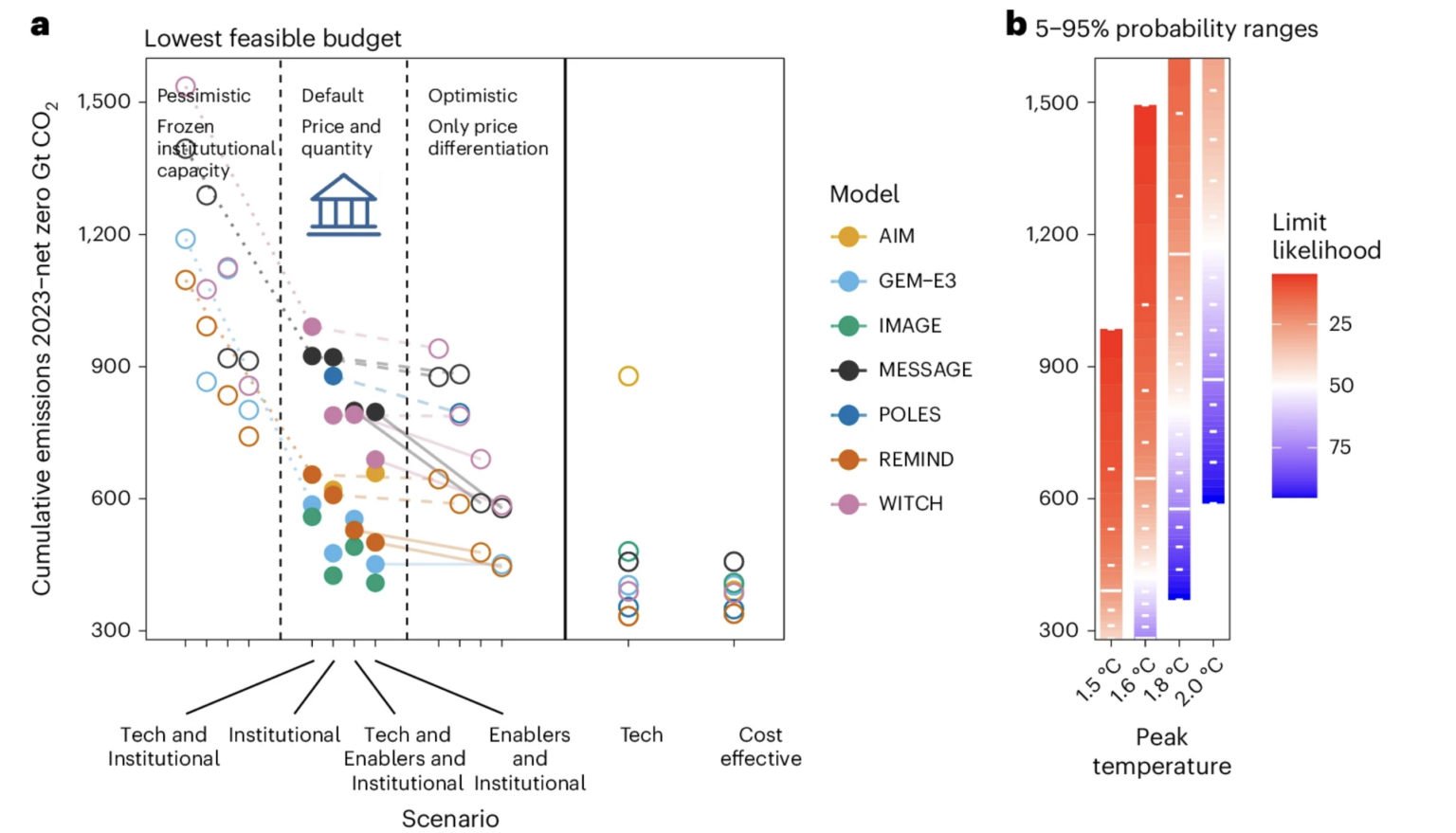
The plot below shows the minimum total global CO2 emissions that could be produced between 2023 and the date that net-zero CO2 is reached for these scenarios. In the panel “a”, on the left, each dot indicates a model result.

The column on the far left is a “pessimistic” institutional feasibility scenario, in which governance indicators do not improve beyond 2020 levels. Cumulative global CO2 emissions before net-zero here are the highest of any scenario explored.

The next column is the “default” assumption of carbon prices and emissions-reduction quantities, under four different combinations of constraints.

From left to right within this column, the combinations cover technological and institutional constraints, only institutional constraints, technological and institutional constraints with enablers and then institutional constraints with enablers.

The enablers include measures such as reduced energy demand in high income countries and increased electrification. This helps to “create more flexibility on the supply side and thus further improve the feasibility of implementation”, according to the paper.

The final column shows “optimistic” scenarios, divided between a scenario with technological constraints (left) and a “cost-effective” scenario, as used in the IPCC (right).

Panel “b” shows the likelihood, based on the 14 feasibility scenarios in panel a, of staying below 1.5C, 1.6C, 1.8C and 2.0C peak temperatures. Each bar indicates a different peak temperature. Red indicates a high likelihood of meeting the temperature target, given the level of emissions, and purple indicates a low likelihood. 

Minimum achievable carbon budget from 2023 until net-zero CO2, across 14 different feasibility scenarios. Source: Bertram et al (2024).

In scenarios without any institutional constraints, nearly all models are able to produce scenarios which line up with the IPCC’s C1 scenarios, which have more than a 50% chance of seeing a peak temperature below 1.6C. 

However, adding institutional constraints reduces this likelihood to 5-45%.

(A peak temperature of 1.6C would not necessarily breach the long-term goal of the Paris agreement, as long as temperatures were brought back down below the 1.5C threshold by the end of the century. However, there are risks associated with overshoot – such as crossing tipping points – and it relies more heavily on large-scale implementation of negative emissions technologies.)

Under the “pessimistic” institutional constraints, the ability of countries to cut emissions is “sharply curtailed”, the authors say, resulting in only a 30-50% chance of limiting warming even to 2C above pre-industrial levels.

The study shows that “technological constraints are not a crucial impediment to a fast transition to net-zero anymore,” Bertran tells Carbon Brief.

“Thanks to the latest advances in low-carbon technology deployment, such as solar, wind or electric vehicles, the technological feasibility of climate-neutrality is no longer the most crucial issue,” Prof Gunnar Luderer – a study author and lead of the energy systems group at the PIK – added in a press release

Instead, he said, “it is much more about how fast climate policy ambition can be ramped up by governments”. 

Future warming

The findings of this study have implications for meeting the Paris Agreement 1.5C limit. “Our study does not imply that the 1.5C target needs to be abandoned,” the study says. However, it adds: 

“The world needs to be prepared for the possibility of an overshoot of the 1.5C limit by at least one and probably multiple tenths of a degree even under the highest possible ambition.”

“The 1.5C target was always something that, while theoretically possible, was very unlikely given the real-world technical, institutional, economic and political setting that determines climate policy,” says Prof Frances Moore from the department of environmental science and policy at UC Davis, who was not involved in the study.

However, she tells Carbon Brief, the finding that humanity could still limit warming to 2C is “a signal of the progress countries have made in committing to climate action”.

Dr Carl-Friedrich Schleussner – a science advisor to Climate Analytics and honorary professor at Humboldt University Berlin – tells Carbon Brief that the paper is “an important contribution to the literature”. 

However, he says the results “need to be interpreted very cautiously”. For example, he notes that the study only considers CO2 emissions and not other greenhouse gases, such as methane.

In addition, he notes that “institutional capacities affect climate action in a myriad of different ways that are not easily representable in the modelling world”. As a result, the study authors had to “settle” on an approach that “may only be partly representative of ‘real world’ dynamics and is very sensitive to modelling assumptions”. 

Moore says this is a “valuable initial study”, but makes a similar point, noting that the “implementation of institutional constraints and demand-side effects is somewhat arbitrary and ad-hoc”, such as using carbon prices as a governance indicator.

Dr William Lamb is a researcher at the Mercator Research Institute and was also not involved in the study. He tells Carbon Brief that the study results are “sobering” and says that “we need to start focusing research, policy and advocacy on the underlying institutions and politics that shape climate action”.

He adds that there are other aspects of feasibility that could be considered:

“We know that incumbent fossil fuel interests are politically powerful in many countries and are able to obstruct the implementation of climate policies, or even reverse those that are already in place. In other words, some governments may be capable, but do not want to implement ambitious climate action.”

Original article by AYESHA TANDON republished from Carbon Brief under a CC license.

Continue ReadingMeeting 1.5C warming limit hinges on governments more than technology, study says

Morning Star Editorial: Cooper’s crackdown on ‘extremism’: don’t trust the British state

Spread the love

https://morningstaronline.co.uk/article/editorial-coopers-crackdown-extremism-dont-trust-british-state

Home Secretary Yvette Cooper during a walk through Lewisham town centre, in south London, as part of a visit to speak about neighbourhood policing and meet with policing teams, July 8, 2024

Cooper cites both far-right and Islamist hate. But political Islam has no profile in Britain at all. She, like Lord Walney, seeks to lump violent fascist riots together with the peaceful Palestine solidarity movement, whose mass demos have been slandered as “hate marches” by the Tories, right-wing media and fascist agitators such as Tommy Robinson.

Where jihadist violence has reached Britain, it has had more to do with our state’s hyper-violent foreign policy than online grooming. The deadliest terror attack of the last decade, that on the Manchester Arena by Salman Abedi in 2017, was carried out by a man our government had helped travel to Libya to fight in a British-backed Islamist revolt against its government, and whose return to Britain was facilitated by MI5.

A state campaign against extremism “across the political spectrum” will reinforce the clampdowns on protest rights and free speech associated with the Conservatives.

That Labour’s current leadership will deploy it to silence left criticism seems predictable given their record: this is the party that banned its branches from discussing the suspension of its former leader Jeremy Corbyn on the ludicrous grounds that this would make Jewish members feel unsafe.

Bans on “fake news” could only be welcomed if we had total confidence in the objectivity and fairness of those sifting the truth from the lies. X, Facebook and indeed the British state are not objective. There is no way such a ban would not simply become a form of political censorship exercised by the ruling class.

https://morningstaronline.co.uk/article/editorial-coopers-crackdown-extremism-dont-trust-british-state

Continue ReadingMorning Star Editorial: Cooper’s crackdown on ‘extremism’: don’t trust the British state