Mark Smith has quit role in FCDO over department’s complicity in ‘unquestionable’ war crimes, cover-ups and refusal to listen to his whistleblowing – UK media silent
Foreign Office (FCDO) diplomat Mark Smith – an expert in arms licensing and sales – has resigned from his role saying he cannot serve in a department he thinks is complicit in ‘unquestionable’ war crimes and which has both covered-up Israel’s unfitness to receive UK weapons and ignored his attempts to blow the whistle on it. Smith wrote:
FCDO complicity in War Crimes
I write to you on my last day in the FCDO with a message I never wanted to send. It is with sadness that I resign after a long career in the diplomatic service, however I can no longer carry out my duties in the knowledge that this Department may be complicit in War Crimes.
As former penholder on the arms exports licensing assessment in MENAD, I am a subject matter expert in the domain of armed sales policy. Each day we witness clear and unquestionable examples of War Crimes and breaches of International Humanitarian Law in Gaza perpetrated by the State of Israel.
Senior members of the Israeli government and military have expressed open genocidal intent, Israeli soldiers take videos, deliberately burning destroying, and looting civilian property and openly admit to the rape and torture of prisoners.
Over half of Gaza’s homes and over 80°/o of commercial properties have been damaged or destroyed. Whole streets and universities have been demolished, humanitarian aid is being blocked and civilians are regularly left with no safe quarter to flee to. Red Crescent ambulances have been attacked, schools and hospitals are regularly targeted. These are War Crimes.
There is no justification for the UK’s continued arms sales to Israel yet somehow it continues. I have raised this at every level in the organisation including through an official whistle blowing investigation and received nothing more than “thank you we have noted your concerns”.
Ministers claim that the UK has one of the most “robust and transparent” arms export licensing regimes in the world, however this is the opposite of the truth. As a fully cleared officer raising serious concerns of illegality in this Department, to be disregarded in this way is deeply troubling.
It is my duty as a public servant to raise this.
I urge you as officers of good conscience to join the many colleagues who have also raised concerns over this issue.
The FCDO has some of the most brilliant, hard-working and good-hearted people I have ever known and I have been proud to work alongside you.
I hope that we can look back on history and be proud.
Best regards,
Mark
Despite the explosive nature of Smith’s resignation, the UK ‘mainstream’ media appear to be ignoring it. A search for news about him reveals no ‘mainstream’ coverage:
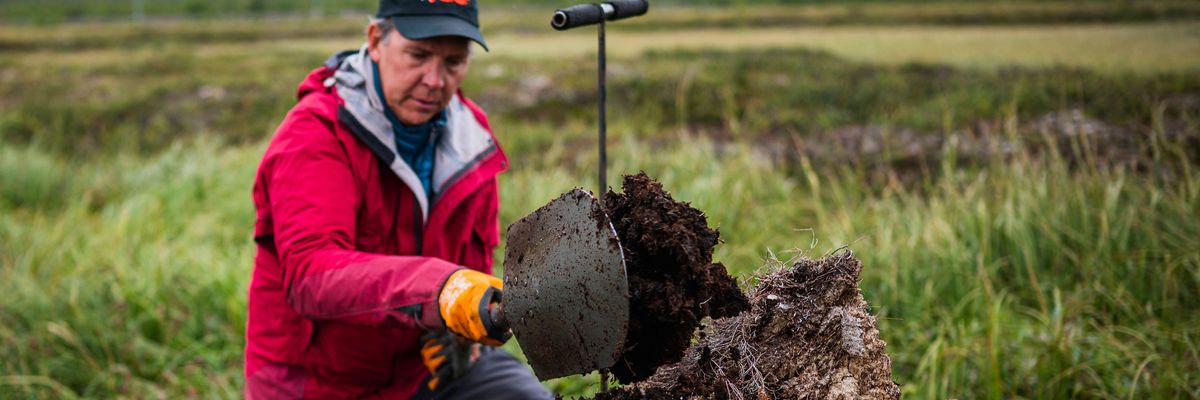
A researcher digs down to permafrost under near the village of Abisko, Sweden on August 24, 2021. (Photo: Jonathan Nackstrand/AFP via Getty Images)
The release of mercury from permafrost “could take a huge toll on the environment and the health of those living in these areas,” said a co-author of the new study.
A study published Thursday in Environmental Research Letters warns that Arctic warming could unleash toxic mercury currently contained in rapidly thawing permafrost, potentially threatening the region’s food supply and water quality.
Researchers from the University of Southern California’s Dornsife College of Letters, Arts, and Sciences noted in the new study that the Arctic is “warming four times faster than the global average, destabilizing permafrost soils that have remained frozen for two or more years and that underlie much of the Arctic.”
Mercury (Hg) deposits in the region’s permafrost have “accumulated over thousands of years,” the study authors noted, “and Hg in the top meter of Arctic soils potentially exceeds the total amount stored in the atmosphere, ocean, and all other soils.”
Josh West, professor of Earth sciences and environmental studies at USC Dornsife and a study co-author, said in a statement that “there could be this giant mercury bomb in the Arctic waiting to explode.”
The study notes that “a range of processes” can release mercury from permafrost, including riverbank erosion.
“The rivers are reburying a considerable amount of the mercury,” West said. “To really get a handle on how much of a threat the mercury poses, we have to understand both the erosion and reburial processes.”
Isabel Smith, a doctoral candidate at USC Dornsife and another study co-author, warned that “decades of exposure” to the toxic element, “especially with increasing levels as more mercury is released, could take a huge toll on the environment and the health of those living in these areas.”
The study was published as parts of the Arctic experienced what The Washington Post‘s Ian Livingston described as “exceptionally high temperatures—up 30 to 40 degrees above normal.”
“And it’s happening as the National Oceanic and Atmospheric Administration just announced July was the 14th successive month with record-high global temperatures,” Livingston wrote earlier this week. “Over the past week, temperatures soared to nearly 100 degrees Fahrenheit in Norman Wells, Canada, just 90 miles south of the Arctic Circle. Locations in Alaska set numerous record highs.”
“Off the coast of Greenland, Longyearbyen, Norway, the northernmost city on Earth with a sizable population, witnessed its warmest August day, with a high of nearly 70,” he added.
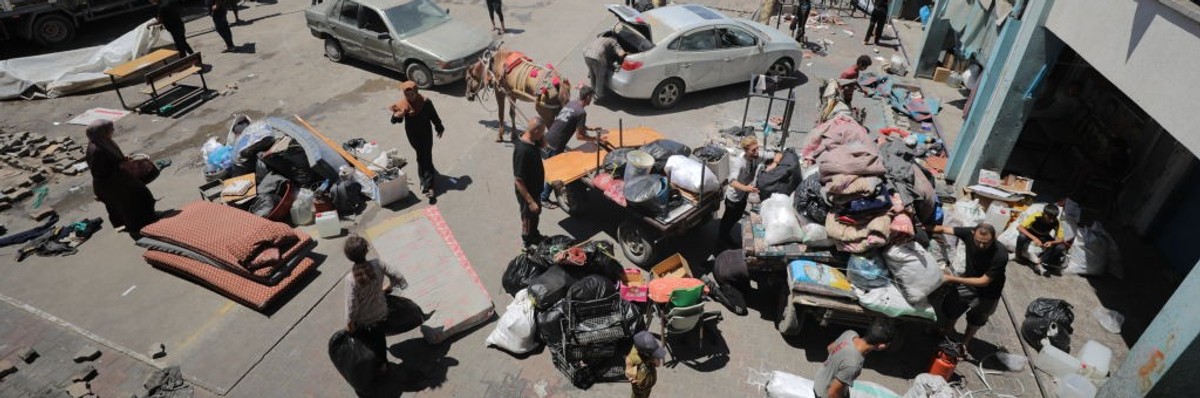
Palestinians, carrying their belongings, migrate towards areas they believe to be safer after the Israeli military issued an evacuation order for the eastern areas of Deir al-Balah in central Gaza on August 16, 2024. (Photo: Hassan Jedi/Anadolu via Getty Images)
“People remain trapped in an endless nightmare of death and destruction on a staggering scale,” the U.N. agency wrote on social media.
Following a series of evacuation orders this week, Israeli forces issued another on Friday for areas in central and southern Gaza, including “safe zones,” leaving Palestinian families gripped with fear and with “nowhere to go,” according to the U.N. Relief and Works Agency for Palestine Refugees in the Near East.
Israel’s Arabic spokesperson announced on social media that people in six neighborhood blocks in various towns, several of which were part of a proclaimed humanitarian zone, must “immediately move,” leading to a scramble of evacuations in those areas.
“Once again, fear spreads as families have nowhere to go,” UNRWA wrote on social media. “People remain trapped in an endless nightmare of death and destruction on a staggering scale.”
#Gaza: New evacuation orders have been issued by Israeli authorities, even inside the so-called “humanitarian zone”.
Once again, fear spreads as families have nowhere to go. People remain trapped in an endless nightmare of death and destruction on a staggering scale. pic.twitter.com/Myi6z6Ix87
Friday’s evacuation orders were for areas in eastern Deir el-Balah, al-Qarara, al-Mawasi, al-Jalaa, Hamad City, and Nasser, Al Jazeerareported.
An Israeli military strike on al-Mawasi, previously a humanitarian zone though long the target of Israeli strikes, killed four Palestinians including three children, the news outlet reported on Friday.
The Israeli army said Hamas had used the areas to fire mortar and rocket attacks, and explained that it had issued warning flyers and text message alerts to reduce the impact on the Palestinian civilian population, according toReuters.
Bombings and evacuations have continued this week—at least 80 Palestinians were killed in a strike on a school-turned-shelter on Sunday—even as peace talks proceeded in Doha, Qatar. A two-day session of talks finished Friday, with the United States, Egypt, and Qatar saying progress was made and they hoped to seal a deal between Israel and Hamas next week. Hamas didn’t directly participate in this week’s talks because the militant Palestinian group said Israel had added new demands to a proposal it had already agreed to in principle.
The death toll of Palestinians during the 10-month war, based on figures from Gaza’s health ministry, reached 40,000 this week—what the U.N. called a “dark milestone.”
“Most of the dead are women and children,” U.N. rights chief Volker Türk said in a statement. “This unimaginable situation is overwhelmingly due to recurring failures by the Israeli Defense Forces to comply with the rules of war.”
“On average, about 130 people have been killed every day in Gaza over the past 10 months,” he added, saying the “scale of the Israeli military’s destruction of homes, hospitals, schools, and places of worship [is] deeply shocking.”
Türk said that both Israel and armed Palestinian groups including Hamas had committed serious violations of international humanitarian law. The armed Palestinian groups killed more than 1,100 Israelis in a shocking and horrifying massacre in southern Israel on October 7 in which they also took some 250 hostages.
Israel’s sustained assault on Gaza over the last 10 months has not only killed a disproportionate number of children but also displaced most of those who’ve survived—and separated many from their families.
A report released Friday by the International Rescue Committee (IRC) documents the scale of the separation crisis and its psychological toll on unaccompanied children. UNICEF estimates that roughly 17,000 Gazan children are unaccompanied, but the IRC warns that the real figure may be much higher.
Unaccompanied youth are at risk of labor exploitation, starvation, and mental health problems that can plague them for the rest of their lives. Gazan children, shocked by the war, are “clinging to others during loud sounds, wetting the bed, having nightmares, and are wanting to sleep under the bed to feel secure,” the report says.
The Associated Pressreported Tuesday that Israeli strikes were leaving “children without parents and parents without children,” and has previously reported that the war has wiped out entire Palestinian extended families.
Israeli violence against Palestinians has not been restricted to Gaza. Israeli settlers attacked the West Bank town of Jit on Thursday night, setting fire to cars and houses, killing one Palestinian man and seriously injuring another. Jack Lew, the U.S. ambassador to Israel, said he was “appalled” by the attack and the perpetrators should be held accountable, but Israeli human rights group B’Tselem responded on social media by saying that the Israeli state and its leadership should be held accountable.
The U.N. Office for the Coordination of Humanitarian Affairs on Wednesday reported that it had recorded about 1,250 settler attacks on Palestinians since October 7. The settlements are illegal under international law, according to the International Court of Justice.
The push for a peace deal is aimed not just at ending the carnage in Gaza and defusing West Bank tensions but also preventing a wider war in the Middle East. Israel is bracing for retaliation from Iran and Hezbollah after it conducted assassinations of Hamas and Hezbollah leaders in Tehran and Beirut in late July.
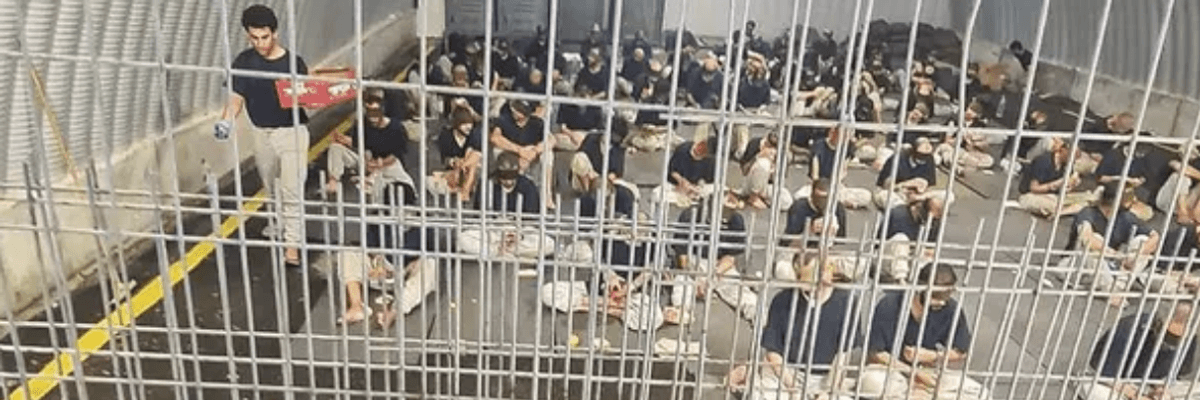
Palestinians imprisoned at Sde Teiman are shackled and blindfolded 24 hours a day and are forced to sit still and silent in painful positions for hours on end. (Photo: Whistleblower)
“Teeth were broken, bones were broken,” said one soldier. “You notice how easy it is to lose your humanity,” said another.
An Israeli newspaper on Friday published interviews with Israel Defense Forces reservists and medical staff who witnessed the “day-to-day torture” of Palestinian prisoners at the notorious Sde Teiman prison in the Negev Desert, where dozens of detainees have died and others were allegedly raped.
The Israelis described seeing torture and abuse of Palestinians detained in Sde Teiman, who included everyone from Hamas fighters to innocent civilians, and ranged in age from children to octogenarians.
“We said, ‘It’s torture.’ But you don’t get into it; you change the subject immediately.”
“What’s happening there is total dehumanization. You don’t really relate to them as if they’re real human beings,” said one public hospital physician who worked at Sde Teiman. “In the end it’s no less than torture. There are ways to administer even poor treatment, or even to torture a person, without crushing cigarettes on them.”
One female former medical staffer said that “the place was totally unimaginable, I had never considered anything like it.”
“My first thought was: What have I done?” she said, describing prisoners being forced to relieve themselves in diapers and take their meals through straws.
“The conditions there were described as torture,” she added. “Maybe. In many senses, yes, I agree with that. Maybe even insane torture.”
Israel cannot prosecute this war—ostensibly against Hamas but actually against all Palestinians in Gaza—without irreparably dehumanising itself and its soldiers, and causing far more harm than good.
This has been clear for months. Sde Teiman should wake up anyone still sleeping.
A 37-year-old male reservist said some of the worst abuse was committed by members of Force 100, the unit of the nine Israelis recently arrested for allegedly gang-raping a Sde Teiman prisoner.
“They took… guys aside and really laid into them,” he said. “I think that each time teeth were broken, bones were broken… And there was also a dog.”
Former Sde Teiman prisoners have described dogs attacking and performing “vile acts” on them.
Another IDF reservist said that “when you come to the camp, the first thing that hits you is the smell… of dozens of people who have been sitting in close quarters for more than a month in the same clothes and in insane heat.”
“They let them shower for a few minutes around twice a week, but I don’t remember ever seeing that they gave them a change of clothes, in any case not on my shifts,” he added.
The Haaretz interviewees said that much of the abuse occurred in the open.
“It wasn’t something that was done in the dark,” the 37-year-old reservist said. “Everyone saw what was going on… It’s not something that was done behind the back of the commander of the camp.”
“Most of the guys were just fine with what was happening,” he continued. “There were some who were a little bothered by it, and there were others who were bothered by it at the start and then they toed the line with the system.”
“There were people who in conversations suddenly mentioned the word ‘torture,'” he added. “And then we said, ‘It’s torture.’ But you don’t get into it; you change the subject immediately.”
Some of those interviewed by Haaretz expressed misgivings about what they did or saw at Sde Teiman.
“When I was there, I wrestled with myself about whether to stay on and try to do the right thing, the best I could as a moral person, or whether I should just get up and declare that I refused to take part in it,” said one male reservist and student. “I came out with a heavy feeling of guilt.”
Another reservist said, “The more distance I have from the place, the more my eyes have opened up.”
“What most disturbed me was to see how easily and how quickly ordinary people can disconnect themselves and not see the reality right in front of their eyes when they’re in the midst of a shocking human situation,” he added.
There were also rare moments of mercy.
“Sometimes the military police gave the minors candy, like in the evening, before sleep,” the 37-year-old reservist said. “One time a detainee started to cry. He was older, 60 years old. So the duty officer tried to speak to him and cheer him up a little.”
But more often, guards were “filled with rage,” said one reservist, who added that “there’s a desire for revenge.”
“What most disturbed me was to see how easily and how quickly ordinary people can disconnect themselves and not see the reality right in front of their eyes.”
One reservist said that “there was a female officer who gave us a briefing on the day we arrived. She said, ‘It will be hard for you. You’ll want to pity them, but it’s forbidden. Remember that they aren’t people.”
“You notice how easy it is to lose your humanity in a second, how easy it is to come up with justifications for treating people as if they’re not people,” he added.
One 27-year-old female reservist said that upon arriving at Sde Teiman—where she was welcomed with popcorn and cotton candy—she was alarmed to find that “good people whom I know talked about being cruel and abusive to people, like they were talking about something routine.”
“The dehumanization frightened me,” she said. “I couldn’t understand how a group of young people who were around me every day underwent such a dangerous process in such a short time.”
Another reservist said that some Sde Teiman staff—especially the volunteers—were “sadists” who “really enjoy beating up Arabs.”
The Haaretz interviews add to a growing body of evidence of torture and other war crimes perpetrated by Israelis against Palestinian prisoners at Sde Teiman and other lockups.
Former Palestinian detainees and Israeli personnel have described beatings, rape and sexual torture by male and female soldiers, routine amputations due to constant shackling, burnings, electrocutions, attacks by dogs, ice-water dousings, denial of food and water, sleep deprivation, constant loud music, and other abuse.
The Israeli military is investigating the deaths of at least 36 Sde Teiman detainees, including one who died after allegedly being sodomized with an electric baton.
On Friday, Alice Jill Edwards, the United Nations special rapporteur on torture, said that “there are no circumstances in which sexual torture or sexualized inhuman and degrading treatment can be justified.”
“I am troubled by recent attempts by Israeli citizens—including reportedly one member of Parliament—to intervene violently after the arrests of soldiers on these abuse charges,” she said of the recent storming of Sde Teiman and another base by a far-right mob in response to the arrests of the alleged rapists.
“Criminal proceedings into all allegations must proceed unhindered,” Edwards added. “No one is above the law. No one is immune from prosecution for torture.”
Indian doctors take part in an August 17, 2024 protest in Guwahati, Assam against the rape and murder of a trainee physician in a Kolkata hospital. (Photo: David Talukdar/Anadolu via Getty Images)
“This is both about the Kolkata doctor who was brutalized and every woman who has faced sexual violence or harassment in the country,” said one protester.
Indian doctors and healthcare workers on Saturday ramped up a nationwide strike in response to the rape and murder of a trainee physician in a state-run hospital in Kolkata, shutting down all hospital services except for emergency care in a bid to force action to protect women from sexual assault.
The August 9th murder of the 31-year-old doctor at R.G. Kar Medical College and Hospital in Kolkata sparked massive demonstrations that began Monday and continued throughout the week. On Wednesday, protesters at a “Reclaim the Night” march attacked the hospital where the woman was killed. Protests also took place in cities including Delhi, Hyderabad, Mumbai, and Pune.
Saturday’s strike, which was organized by the Indian Medical Association, is set to last for 24 hours, during which all treatment in government hospitals and outpatient clinics has been canceled. The IMA condemned the “crime of barbaric scale and the lack of safe spaces for women” in the world’s most populous nation.
“This is both about the Kolkata doctor who was brutalized and every woman who has faced sexual violence or harassment in the country,” one Kolkata protester toldThe Guardian. Other demonstrators in the West Bengal capital shouted slogans including, “We want justice,” “Enough is enough,” and “Hands that heal shouldn’t bleed.”
Hospitals and clinics across India turned away patients except for emergency cases as medical professionals went on strike for 24 hours in protest the rape and murder of a trainee doctor in Kolkata https://t.co/33Ax1GiA93pic.twitter.com/8EQJ2Is7Ye
“We don’t feel safe,” Antara Das, a medical student who joined the Kolkata protest, told Al Jazeera. “If this happened inside a hospital that is second home to us, where are we safe now?”
Indian physicians called for the implementation of the Central Protection Act, a proposed law meant to shield healthcare workers from violence.
“We just want to be safe while we are doing our duty,” Sapna Rani, a 27-year-old female doctor in New Delhi, told Al Jazeera.
One man has been arrested in connection with the doctor’s rape and murder. According to the Indian Express, the suspect’s wife filed multiple complaints with police accusing him of assault, including while she was pregnant. The suspect is reportedly a “civic volunteer” who worked closely with police.
In stark contrast to the nationwide protests, local police and the principal at the victim’s medical college, Dr. Sandip Ghosh, claimed the murdered doctor, who was sleeping in the hospital’s seminar hall when she was attacked, killed herself.
Ghosh then claimed that the victim—who was found bleeding from her eyes, mouth, and genitals, and who had extensive traumatic injuries to her body—was still to blame for her own death.
“It was irresponsible of the girl to go to the seminar hall alone at night,” he said, according to The Wire.
Ghosh was interrogated Saturday by India’s Central Bureau of Investigation. Earlier in the week, he tendered his resignation from R.G. Kar. Instead of accepting his resignation, the government transferred him to serve as principal of Calcutta National Medical College, where students staged a protest against the move.
India Today reported Saturday that the West Bengal government has canceled Ghosh’s transfer.