The Derwentside Immigration Removal Centre since its opening in December 2021 has been a site of regular protests demanding its shut down.
Dozens of human rights activists took part in a monthly demonstration outside the Derwentside Immigration Removal Centre demanding it to be shut down. The Derwentside Immigration Removal Centre, earlier known as Hassockfield, located in north east England is an only women detention center and was opened in December 2021 by former Home Secretary Priti Patel.
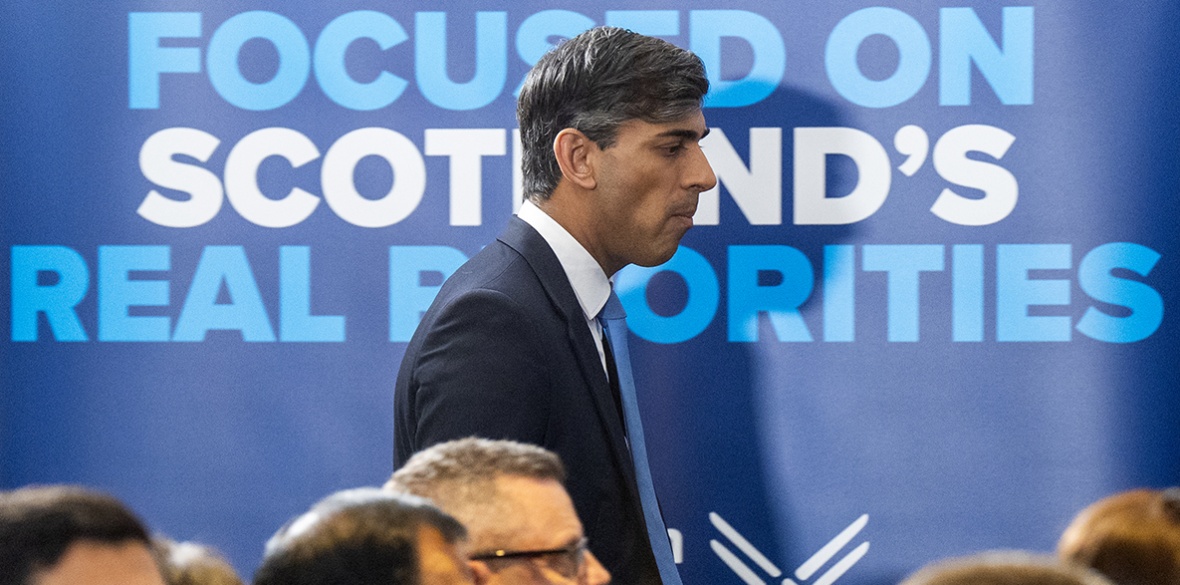
Prime Minister Rishi Sunak at the launch of the Scottish Conservative manifesto at the Apex Grassmarket Hotel in Edinburgh, while on the General Election campaign trail, June 24, 2024
BOTH major parties are looking like busted flushes, Britain’s top polling guru suggested today, as PM Rishi Sunak struggled to contain the Tory gambling row.
BBC elections guru John Curtice said that neither Tories nor Labour were having a “fruitful” campaign, with each having lost 4 per cent in the polls since the election was called a month ago.
That is clearly worse news for the Conservatives than Labour, since it leaves the gap between the two unchanged at 20 per cent, putting Labour leader Sir Keir Starmer’s shrivelling party in Commons landslide territory.
That prospect is reinforced by the scandal over insider betting by Tory candidates and senior officials, which Mr Sunak seems incapable of containing.
Former minister Tobias Ellwood conceded today that the party was certain to lose additional seats — “I have no doubt about it” — because of the controversy, which has seen the Gambling Commission launch a probe into whether four top Tories used prior knowledge of the election date to cash in.
Mr Ellwood, who is standing for re-election, said that the row was overshadowing the Tory election campaign and that “the public wants to see clearer, robust action.”
Original article by Ed Siddons republished from TBIJ under a Creative Commons Attribution-NonCommercial-NoDerivs 3.0 Unported License.
Basic mistake was made in pursuit of fine against man thought to have cost the exchequer £1bn in lost revenue
HMRC squandered the chance to hold a notorious promoter of tax avoidance schemes to account after making a “rudimentary” error at tribunal, new documents reveal.
According to a recently published tax tribunal judgement, the UK tax authority was attempting to bring a £14m penalty against Paul Baxendale-Walker, a former lawyer and tax adviser. HMRC estimates his schemes to have cost the exchequer some £1bn in lost taxes according to a separate court filing.
Baxendale-Walker denied a “false collection of allegations” put to him by TBIJ, and said the £14m penalty was “a fiction … conjured” by HMRC.
The judgement raises questions about HMRC’s handling of the promoters of tax avoidance schemes at a time when tax has become a battleground in the forthcoming general election.
‘There’s a lack of battlefield command within HMRC’
HMRC has enjoyed some substantial victories in recent years, including a £650m windfall and fraud conviction against former F1 mogul Bernie Ecclestone, and a landmark £615m deferred prosecution agreement with the owner of Ladbrokes and Coral. But experts suggest it has failed to adequately hold enablers of tax dodging to account.
“This is screwing it up 101,” said Ray McCann, the former president of the Chartered Institute of Taxation and a senior HMRC investigator of more than 30 years. “I’m completely mystified as to why [HMRC] did what they did [… it appears] there’s a lack of battlefield command within HMRC.”
Baxendale-Walker, 60, gained notoriety after designing a number of tax avoidance schemes in the 1990s and 2000s that were later found not to be legal.
Court documents filed in a separate case in the United States cite HMRC estimates that his schemes cost the tax authority over £1bn in total. Baxendale-Walker disputed this figure to TBIJ, but did not provide evidence to support his claim. “He’s caused carnage,” said McCann.
HMRC was attempting to bring a penalty based on an information notice it obtained at tribunal in 2022, to force Baxendale-Walker to hand over documents to the authority. Baxendale-Walker told TBIJ that he did not have the documents to begin with, and HMRC said it would not comment on individual cases.
HMRC agreed to an extension requested by Baxendale-Walker, but in doing so made one of two mistakes, both of which involved missing a deadline for imposing a penalty.
The Upper Tribunal judge found that it did not matter which mistake HMRC had made, it had invalidated the £14m penalty regardless.
The judge struck out the proposed £14m fine in its entirety in a judgement handed down on 28 July 2023, which was made public this month.
McCann said: “When I was in [HMRC], I would never in a million years have deviated from what a tribunal had authorised because it always goes wrong. […] Now the penalty is history because [HMRC] screwed it up.”
Over the past two decades, Baxendale-Walker has been subject to various civil court cases, professional sanctions and criminal charges.
He was struck off as solicitor in 2006 for conflicts of interest relating to a tax avoidance scheme. In 2012, he was subject to a civil restraint order for filing repeated claims against the Law Society after his dismissal as a lawyer.
Paul Baxendale-Walker pleaded guilty to forgery in 2016Denise Truscello/WireImage via Getty Images
In 2016 he pleaded guilty to forgery after impersonating an investigator contracted by HMRC on a call to the Solicitors Regulatory Authority. Two years later, he was declared bankrupt following a court defeat that found him liable for some £16m on the basis of negligent tax advice.
“HMRC should have approached Paul Baxendale-Walker with extreme care,” said McCann. “Get some people working on his case who really know what they’re doing, don’t take any risks whatsoever, don’t deviate in any way from what the law says.”
‘If HMRC can’t get this guy, it’s hard to see how they can get anyone’
Dan Neidle, the founder of the independent thinktank Tax Policy Associates and former head of tax at global law firm Clifford Chance, said: “If HMRC can’t get this guy, it’s hard to see how they can get anyone.”
Paul Baxendale-Walker told TBIJ that his tax advice was made through a partnership that “paid every due penny of tax” and that he had retired a decade ago. He said HMRC’s £14m penalty was based on a “fictional tax liability” and “randomly chosen multiplier”.
He added: “Every citizen has the right to order their affairs so as to pay the least amount of tax … The evil is accruing a level of taxation which is at a record high since WW2. Not persons who lawfully advise others as to their civil rights and obligations.”
A spokesperson for HMRC said: “We do not comment on identifiable individuals or businesses.”
Original article by Ed Siddons republished from TBIJ under a Creative Commons Attribution-NonCommercial-NoDerivs 3.0 Unported License.
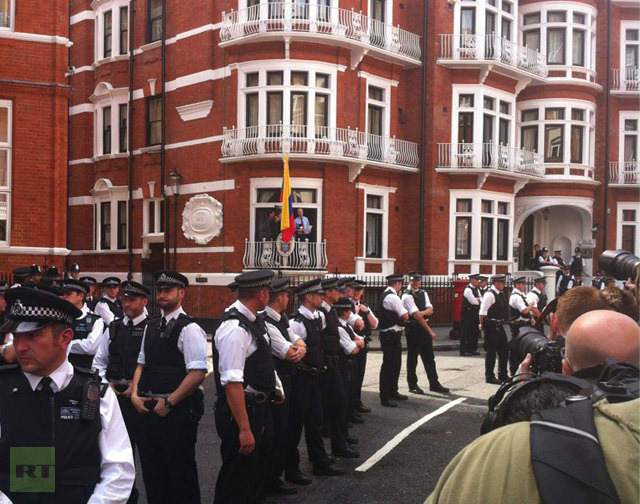
Today, in a surprise development likely weeks in the planning, WikiLeaks founder Julian Assange was able to leave the United Kingdom for the first time in more than a decade after reaching a plea deal with the US government.
In the past several months, momentum has been building towards this moment. There was increasing bipartisan support in both the Australian parliament and the US Congress for the Australian citizen’s release. Australian Prime Minister Anthony Albanese has made repeated statements on his behalf, and in April, US President Joe Biden said he was “considering” a request from Australia to drop its prosecution of Assange.
This all contributed to the sense the matter might be resolved before Assange’s final UK hearing date, previously scheduled for July 9 and 10. The timing of the deal is also a welcome prelude to Albanese’s visit to Washington next week.
Such a resolution, however, was not inevitable. And it is not over yet.
A relentless, years-long pursuit
The United States’ pursuit of Assange has seemingly been relentless since WikiLeaks posted hundreds of thousands of classified military documents in 2010. It wasn’t until 2019 under the then President Donald Trump, however, that he was finally indicted on 17 counts of violating the 1917 Espionage Act.
The charges against Assange were not just considered unprecedented, they raised significant First Amendment concerns.
The apparent desire to punish Assange for the embarrassment caused by the leaks – and to deter others from taking similar action – was apparently so strong the CIA allegedly discussed plans to kidnap and even assassinate Assange during the Trump administration, according to US media reports.
In the UK courts, the US Department of Justice had argued Assange should be subject to US law and extradited to face trial for his actions. However, as a non-citizen, there were questions over whether he could rely on the legal protections afforded by those same laws – particularly the constitutional right to free speech.
The successful extradition of Assange could have set a precedent by which the US could pursue journalists anywhere in the world for publishing information it did not like, while potentially denying them their fundamental First Amendment rights.
In a crucial election year in the US that President Joe Biden is framing as an existential fight for the soul of US democracy, the continued pursuit of Assange was as inconsistent as it was ultimately untenable. Viewed from the outside, it appeared the case was causing the Biden administration international embarrassment.
Biden has been careful to maintain an appropriate distance between the presidency and the Department of Justice. He came into office promising to restore faith in the rule of law following the Trump years, and has meticulously avoided any appearance of interference in the department’s work as it has investigated and indicted his predecessor.
Assange’s case, however, is wholly different to the charges on which Trump has been indicted. It is certainly possible to interpret Biden’s comment that he was “considering” dropping the charges as a gentle public rebuke of the Department of Justice’s pursuit of the case, given its global implications for a free press.
Broader implications for the alliance
The continued pursuit of Assange was also becoming problematic in the context of Australia’s alliance with the US. That relationship is always described as one based on shared democratic values, in contrast to what Biden has repeatedly framed as the coercive and repressive instincts of “authoritarian” powers.
The decision by the US to pursue a citizen of one of its closest allies for the publication of information, while simultaneously condemning authoritarian states for doing much the same, was both hypocritical and damaging to American standing in the world.
In the context of growing concern in Australia about the terms of the AUKUS submarine deal and the Australian government’s willingness to go “all-in” with the US militarily, the continued pursuit of Assange gave the impression that Australia’s most important security ally did not take its concerns seriously. Australia appeared simply to be snapping at America’s heels.
It also added to the sense that the “capital-A Alliance” between the two countries was increasingly dominated by security concerns, often at the expense of democratic accountability.
Because of the international campaign to free Assange and the support it received in both Australian and American democratic institutions, there appears to be have been a reconsideration of this focus on security interests over democratic values.
It should be noted, though, that the US didn’t drop its prosecution in the end; Assange has agreed to plead guilty to a felony charge of violating the Espionage Act, which in itself may set a concerning precedent for press freedom.
And the fact this saga happened at all – and that it has taken more than a decade to get close to resolution – should prompt deep reflection on the values that underpin both Australia’s relationship with its most important security ally and the United States’ role in the world.
Zionist Keir Starmes is quoted “I support Zionism without qualification.” He’s asked whether that means that he supports Zionism under all circumstances, whatever Zionists do.
“Stability is Change!” This seemingly paradoxical, almost Orwellian statement is the principal slogan of the Labour Party’s current parliamentary election campaign. Labour leader Keir Starmer used the slogan at the party’s manifesto launch, and it provides a key prism for understanding the manifesto and its weaknesses.
There is little doubt that the UK electorate is in the mood for change. The widespread, off-stated consensus in the country is that nothing works. The National Health Service is so chronically underfunded that doctor’s appointments are difficult to get and long waiting lists proliferate. The trains are shockingly expensive but utterly unreliable.
The list could go on and on, but the image most frequently used to sum up the situation comes from the failure of the privatized water services. A lack of investment in infrastructure accompanied by the looting of those companies for huge shareholder dividend payouts has led to the near constant release of untreated sewage into the UK’s river system. It flows from there onto our beaches. The British are quite literally swimming in shit!
These problems are identified quite clearly in the Labour Party manifesto, but the diagnosis of their causes and therefore their solutions proves much less convincing. Labour may have a plan to win in July, but how it will govern in the interests of its voters is anybody’s guess.
…
The totality of Labour’s spending pledges amounts to just 0.2 percent of GDP, smaller even than the Conservative pledges of 0.8 percent and dwarfed by the previous two Labour manifestos, which promised 2.1 percent and 3.2 percent respectively. Even the pro-market Institute for Fiscal Studies called Labour’s plans “tiny, going on trivial”.
These policies do not point to stability, not least because they do not address the 18 billion pounds of government spending cuts that the Conservatives have already baked into the government budget going forward. The effects of implementing such cuts on government services — which have already suffered so badly under 14 years of severe austerity — makes it hard to imagine that Labour will stick to this commitment. It seems likely that money will be found to prevent the worst of these cuts through technical changes in accounting between the government and the notionally independent Bank of England.
Beyond this paddling, however, the need for investment in the UK is huge. Both public and private investment in the country has collapsed since 2008. It hasthe lowest business investment in the G7 and ranks just twenty-eighthout of the 31 OECD countries. In the face of this, Labour, hamstrung by self-imposed fiscal rules on bringing down government debt and pledges not to raise the main forms of taxation, are promising so little investment that their plans seem unbelievable.
…
Until last February, Labour was promising to immediately strengthen workers’ rights through a New Deal for Workers, and to spend 28 billion pounds per year to decarbonize the economy through its Green Prosperity Plan. The Labour Party’s current openness to corporate funding and lobbying, including the imposition of over30 parliamentary candidates with corporate lobbying backgrounds, has led to a dramatic watering down of these pledges. The Green Prosperity Plan has been reduced to just 3.5 billion pounds, but the form that spending will take reveals another logic or worldview which may come to the fore as crises mount.
The word “securonomics”, an ugly portmanteau favoured by shadow chancellor Rachel Reeves, makes an appearance in the manifesto, introducing the idea that public investment should support and de-risk private investment in strategically key sectors. The chief vehicle for this will be a National Wealth Fund “capitalised with £7.3 billion over the course of the next parliament”. What precisely this will look like has yet to be determined, but The National Wealth Fund “will have a target of attracting three pounds of private investment for every one pound of public investment”. This is an explicit return to and acceleration of the kind of public-private partnerships that lost legitimacy in the UK during the fallout from the disastrous Public Finance Initiative under New Labour.