UN to Warn Half a Million Gazans Facing ‘Catastrophic’ Food Insecurity

Spread the love

Original article by BRETT WILKINS republished from Common Dreams under Creative Commons (CC BY-NC-ND 3.0).
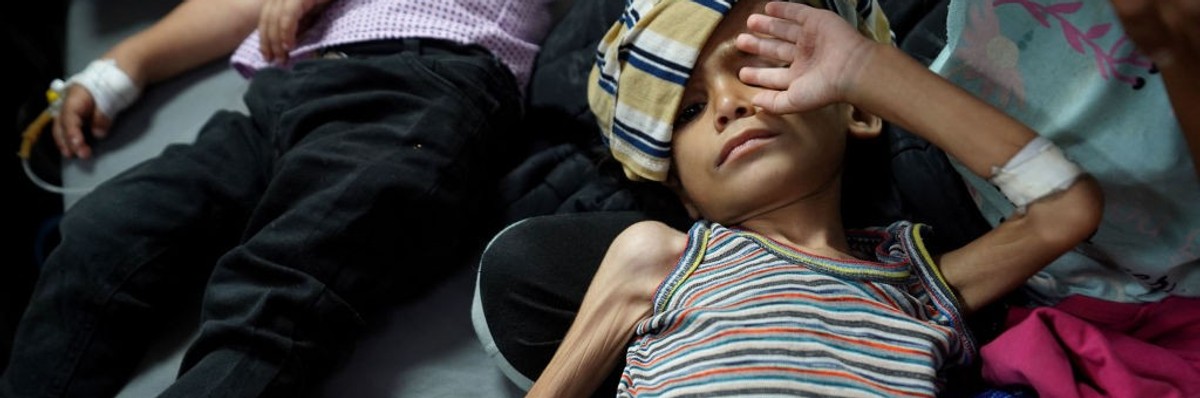
Children receive malnourishment treatment at Al-Aqsa Martyrs Hospital in Deir al-Balah in the central Gaza Strip on May 30, 2024, amid Israel’s ongoing assault on the besieged enclave. (Photo: Bashar Taleb/AFP via Getty Images)

“The international community must apply relentless pressure to achieve a cease-fire and ensure sustained humanitarian access now,” said one advocate.

More than 1 in 5 people in the Gaza Strip are “facing catastrophic levels of food insecurity” amid Israel’s relentless assault and siege against the Palestinian territory, according to a draft report set to be published Tuesday by the United Nations’ hunger monitoring system.

The latest Integrated Food Security Phase Classification (IPC) Acute Food Insecurity Special Snapshot—which was previewed by various news agencies—says that more than 495,000 Gazans—who already face “an extreme lack of food, starvation, and exhaustion”—are expected to suffer the highest level of starvation over the coming months.

The draft report states that while a sharp increase in food aid in northern Gaza in March and April can be credited with “likely averting a famine,” the situation is “deteriorating again following renewed hostilities.”

“A high risk of famine persists across the whole of the Gaza Strip as long as conflict continues and humanitarian access is restricted,” IPC noted.

The IPC draft report also says more than half of all Gaza households had to sell or swap clothing in order to obtain food, and that the majority of Gazan families often “do not have any food to eat in the house, and over 20% go entire days and nights without eating.”

“The population cannot endure these hardships any longer.”

Kate Phillips-Barrasso, vice president of global policy and advocacy at Mercy Corps, an Oregon-based humanitarian NGO, told The Guardian that “people are enduring subhuman conditions resorting to desperate measures like boiling weeds, eating animal feed, and exchanging clothes for money to stave off hunger and keep their children alive.”

“The humanitarian situation is deteriorating rapidly, and the specter of famine continues to hang over Gaza,” she added. “The international community must apply relentless pressure to achieve a cease-fire and ensure sustained humanitarian access now. The population cannot endure these hardships any longer.”

Although the IPC stopped short of the rare step of declaring a famine in Gaza, it warned that “the recent trajectory is negative and highly unstable.”

“Should this continue, the improvements seen in April could be rapidly reversed,” the agency added.

The IPC’s famine review panel previously said there is not enough data to make a determination on whether there is a famine in Gaza since research was being blocked by “conflict and humanitarian access constraints.”

The Geneva-based group Euro-Mediterranean Human Rights Monitor said Monday that “the Famine Review Committee’s inability to declare the current food situation in the Gaza Strip to be a famine does not negate the existence of famine in the strip, as pockets of famine are forming and spreading among different age groups, particularly children, and there is a noticeable increase in deaths from hunger, malnutrition, and related diseases.”

“The committee’s failure to declare the existence of a famine is solely related to its inability to provide certain technical information because of illegal Israeli restrictions and policies that aim to conceal evidence related to the crimes it commits and prevent criminal investigations into them by independent U.N. and international committees, particularly by preventing these committees from entering the strip,” the group added.

U.N. World Food Program Executive Director Cindy McCain said last month that “full-blown famine” had taken hold in Gaza and was spreading south. According to Gaza officials, at least 40 people—mostly children—have died from malnutrition and dehydration during the 262-day Israeli onslaught. Almost all of the victims are from northern Gaza.

Israel began bombing, and later invaded, Gaza after Hamas-led attacks left more than 1,100 Israelis and others dead and over 240 others kidnapped on October 7. At least some of the victims were killed by Israeli forces in so-called “friendly fire” incidents, according to Israeli and international media reports.

Since then, Israeli forces have killed at least 37,626 Palestinians—most of them women and children—in Gaza, while wounding over 86,000 others, according to Palestinian and international agencies. At least 11,000 people, including over 4,000 children, are missing and presumed dead and buried beneath the rubble of hundreds of thousands of bombed-out homes and other buildings.

Michael Fakhri, the United Nations special rapporteur on the right to food and a law professor at the University of Oregon, said in late February that Israel is committing genocide by intentionally starving Gazans. Israel’s siege—and Israeli attacks on humanitarian aid shipments, workers, and recipients—are being reviewed by the International Court of Justice as part of a South Africa-led genocide case backed by over 30 countries and regional blocs.

Original article by BRETT WILKINS republished from Common Dreams under Creative Commons (CC BY-NC-ND 3.0).

Over 20,000 Children Missing in Gaza, With ‘Unknown Number’ in Mass Graves: Report

‘Visible Signs of Wasting’: Heat, Forced Malnutrition Strangle People of Gaza

Biden Continues to Cement a Bloody and Immoral Legacy in Gaza
Continue ReadingUN to Warn Half a Million Gazans Facing ‘Catastrophic’ Food Insecurity

Climate Emergency Causes Extreme Wildfires to Double in Frequency: Study

Spread the love

Original article by JULIA CONLEY republished from Common Dreams under Creative Commons (CC BY-NC-ND 3.0).

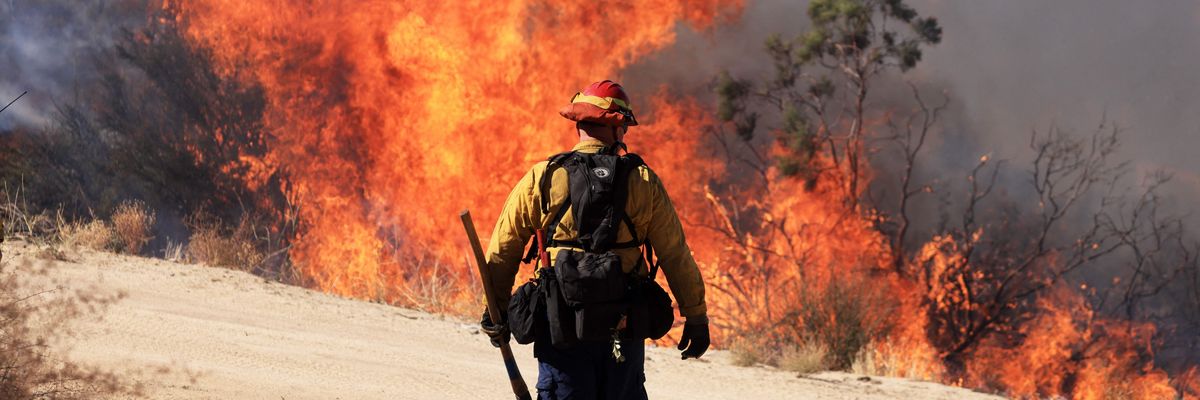
A firefighter walks toward flames as the Highland Fire burns in Aguana, California, on October 31, 2023. 
(Photo: David Swanson/AFP via Getty Images)

“Climate change is not something off in the future,” said one scientist. “It’s happening before our very eyes.”

New findings about the rising frequency of extreme wildfires have “the fingerprints of climate change” all over them, according to an Australian scientist who led a study published on Monday.

Calum Cunningham, a postdoctoral researcher at the University of Tasmania in Australia, told The Washington Post that he was driven to examine current trends in the frequency of wildfires after climate deniers suggested that because the global area being burned in blazes is declining, the idea of a growing wildfire crisis is being overblown by concerned scientists.

While the area destroyed by wildfires is indeed on the decline, analyses that include all fires—the majority of which are small and cause relatively little damage—obscured how the most extreme and destructive wildfires are rapidly growing more frequent.

Cunningham and his team analyzed data from National Aeronautics and Space Administration satellites, collecting four images of wildfires around the world per day over 21 years. They used the images to identify the 0.01% most extreme wildfires—those that release the most smoke and greenhouse gas emissions due to their size and uncontrollable nature.

Out of 30 million fires across the world over two decades, the researchers identified the 2,913 most extreme fire events and found that the frequency and intensity of such wildfires has more than doubled since 2003.

“Climate change is making fire weather more extreme and more frequent in a lot of the world.”

The problem is rapidly getting worse, the team found: The six years with the most extreme wildfires had all occurred since 2017.

Trends were particularly troubling in particular regions, like temperate conifer forests in the western United States and the Mediterranean, where the number of extreme fires rose by more than 10 times in 20 years.

In boreal forests in places like northern Europe and Canada, the frequency of the most intense and hard-to-control blazes increased by seven times.

“It’s absolutely in keeping with what climate change is doing to fire weather around the world,” Cunningham told the Post. “Climate change is making fire weather more extreme and more frequent in a lot of the world.”

The “fire weather” that’s driven the increase includes hotter and drier conditions, with temperatures staying high even overnight when they ordinarily would have have dropped in previous decades, giving firefighters a chance to make headway in putting out blazes.

“Rarely did we have 100,000-acre fires 20 years ago,” veteran firefighter Bobbie Scopa told the Post. “But now, it’s not uncommon.”

The researchers pointed to a “scary” feedback loop created as extreme wildfires create carbon emissions—leading to more planetary heating and even more fires.

“Climate change is not something off in the future,” Cunningham told the Post. “It’s happening before our very eyes. This is the manifestation of the reshaping of the climate we are doing.”

The study was published in Nature Ecology & Evolution days after wildfires scorched more than 14,000 acres in Southern California and more than 24,000 acres in New Mexico, where two people were killed. Last year, climate scientists were stunned by an unprecedented wildfire season in relatively damp Eastern Canada, where wildfires were made twice as likely by the climate emergency according to the World Weather Attribution.

Climate scientist and author Bill McGuire called the findings “terrifying, of course, but just not a surprise,” considering governments in the countries that produce the most fossil fuels are continuing to support and subsidize energy sources that heat the planet.

“This is certifiably insane,” McGuire said.

Original article by JULIA CONLEY republished from Common Dreams under Creative Commons (CC BY-NC-ND 3.0).

Continue ReadingClimate Emergency Causes Extreme Wildfires to Double in Frequency: Study

Julian Assange released from prison, WikiLeaks says, after striking deal with US justice department

Spread the love

News is breaking that Julian Assange associated with the Wikileaks news publishing site has been released.

Julian Assange speaks at London's Ecuadorian Embassy
Julian Assange speaks at London’s Ecuadorian Embassy

https://www.theguardian.com/media/article/2024/jun/25/julian-assange-plea-deal-with-us-free-to-return-australia

WikiLeaks said on X that Assange had left Belmarsh prison on Monday morning, after 1,901 days of captivity there. He had spent the time, the organisation said, “in a 2×3 metre cell, isolated 23 hours a day”.

Assange was set to be reunited with his wife, Stella, who confirmed on X that he was free. She thanked Assange’s supporters, saying “words cannot express our immense gratitude”.

In the WikiLeaks video, Assange, looking healthy dressed in a shirt and jeans with his white hair cut short, is seen climbing the stairs into a plane.

An Australian government spokesperson did not confirm or deny the plea deal but said Canberra was “aware” of the legal proceedings, adding: “prime minister [Anthony] Albanese has been clear – Mr Assange’s case has dragged on for too long and there is nothing to be gained by his continued incarceration.”

Assange’s mother Christine welcomed the developments, saying “I am grateful my son’s ordeal is finally coming to an end.”

The plea agreement comes months after the US president, Joe Biden, said he was considering a request from Australia to drop the US push to prosecute Assange.

WikiLeaks in 2010 released hundreds of thousands of classified US military documents on Washington’s wars in Afghanistan and Iraq – the largest security breaches of their kind in US military history – along with swaths of diplomatic cables.

https://www.theguardian.com/media/article/2024/jun/25/julian-assange-plea-deal-with-us-free-to-return-australia

Continue ReadingJulian Assange released from prison, WikiLeaks says, after striking deal with US justice department

Over 20,000 Children Missing in Gaza, With ‘Unknown Number’ in Mass Graves: Report

Spread the love

Original article by JAKE JOHNSON republished from Common Dreams under Creative Commons (CC BY-NC-ND 3.0).

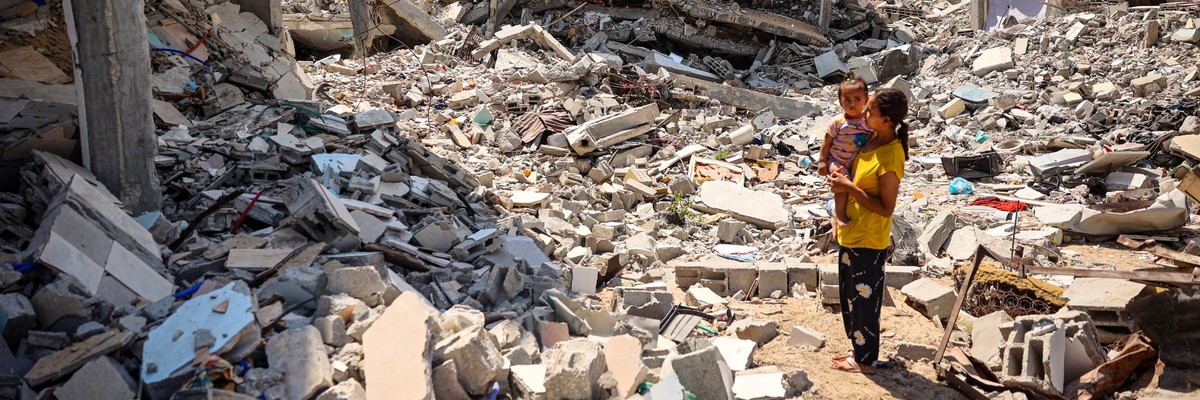
A woman stands holding a child surrounded by the rubble of buildings destroyed by Israeli airstrikes in Khan Younis, Gaza on June 23, 2024.
 (Photo: Eyad Baba/AFP via Getty Images)

“No parent should have to dig through rubble or mass graves to try and find their child’s body,” said the Save the Children’s regional director for the Middle East.

The humanitarian group Save the Children estimated Monday that around 21,000 kids are missing in the Gaza Strip as Israel’s military continues its assault on the enclave, reducing much of the Palestinian territory to rubble.

Roughly 4,000 kids are likely buried under that debris, according to Save the Children, while at least 17,000 are unaccompanied, an “unknown number” are in mass graves, and others have been “detained and forcibly transferred out of Gaza, their whereabouts unknown to their families amidst reports of ill-treatment and torture.”

A child protection specialist with Save the Children said that the group finds more unaccompanied children every day in Gaza, where parents and entire families have been wiped out by Israel’s relentless bombing campaign and ground invasion.

“We work through partners to identify separated and unaccompanied children and trace their families, but there are no safe facilities for them—there is no safe place in Gaza,” said the Save the Children specialist. “Besides, reuniting them with family members is difficult when ongoing hostilities restrict our access to communities, and constantly force families to move.”

“Neighbors and extended family members who have taken in lone children are struggling to meet their basic needs, such as shelter, food, and water,” they added. “Many are with strangers—or completely alone—increasing the risk of violence, abuse exploitation, and neglect.”

“We desperately need a cease-fire to find and support the missing children who have survived, and to prevent more families from being destroyed.”

More than 14,000 children have been killed by Israeli forces in the Gaza Strip since October 7, and many others have experienced devastating psychological and physical trauma, including the loss of limbs. Dozens of children have also been starved to death in recent months as Israel’s blockade hinders the flow of lifesaving humanitarian assistance.

Conditions for children have further deteriorated since Israel’s invasion of Rafah, which has forced roughly a million people to flee the city. Last month, Israeli forces used U.S.-made bombs in an attack on a Rafah camp sheltering displaced people, killing dozens—including women and children. The United Nations Human Rights Office said that infants were “torn apart” in the attack and people were “trapped inside burning plastic tents, leading to a horrific casualty toll.”

Save the Children stressed Monday that its count of Gaza’s missing kids is far from conclusive, given the difficulty of collecting accurate information in areas under near-constant attack. The group noted that “confirming identification of a body by the next of kin is almost impossible when whole families have been wiped out and entry restrictions mean the equipment and experts needed cannot get in.”

Jeremy Stoner, Save the Children’s regional director for the Middle East, said that “families are tortured by the uncertainty of the whereabouts of their loved ones.”

“No parent should have to dig through rubble or mass graves to try and find their child’s body. No child should be alone, unprotected in a war zone. No child should be detained or held hostage,” said Stoner. “Children who are missing but living are vulnerable, face grave protection risks, and must be found. They must be protected and reunited with their families. For the children who have been killed, their deaths must be formally marked, their families informed, burial rites respected, and accountability sought.”

“As many have pointed out, Gaza has become a graveyard for children, with thousands of others missing, their fates unknown,” he added. “There must be an independent investigation and those responsible must be held accountable. We desperately need a cease-fire to find and support the missing children who have survived, and to prevent more families from being destroyed.”

Original article by JAKE JOHNSON republished from Common Dreams under Creative Commons (CC BY-NC-ND 3.0).

Zionist Keir Starmes is quoted "I support Zionism without qualification." He's asked whether that means that he supports Zionism under all circumstances, whatever Zionists do.
Zionist Keir Starmes is quoted “I support Zionism without qualification.” He’s asked whether that means that he supports Zionism under all circumstances, whatever Zionists do.

Continue ReadingOver 20,000 Children Missing in Gaza, With ‘Unknown Number’ in Mass Graves: Report

Sunak and Starmer unite for war

Spread the love

https://morningstaronline.co.uk/article/sunak-and-starmer-unite-war

NATO Secretary General Jens Stoltenberg (left) and Prime Minister Rishi Sunak during a press conference at the Warsaw Armoured Brigade in Warsaw during Rishi Sunak’s visit to Poland and Germany, April 23, 2024

Leaders join forces to condemn Farage for comments on Nato expansionism

RISHI SUNAK and Sir Keir Starmer united in support of their bipartisan war policy as the row spread over Nigel Farage’s remarks blaming Nato and European Union expansion for contributing to the Ukraine conflict.

The two leaders expressed outrage that anyone would make an election issue out of the apparent drive to a wider war in Europe and Britain’s complicity in it.

But anti-war campaigners warned that the conflict could not be swept under the carpet.

Reform Party owner Mr Farage had been the first to break through the wall of silence surrounding British policy towards Russia and Ukraine during the election.

Mr Farage said: “The West’s errors in Ukraine have been catastrophic. I won’t apologise for telling the truth.”

He had told the BBC that “the ever-eastward expansion of Nato and the European Union was giving this man a reason to say to his Russian people, ‘they’re coming for us again’ and to go to war,” referring to Russian President Vladimir Putin.

Making it clear that he did not support Russia’s 2022 invasion of Ukraine, he added: “I am not, and never have been, an apologist or supporter of Putin.

“As a champion of national sovereignty, I believe that Putin was entirely wrong to invade the sovereign nation of Ukraine.

“What I have been saying for the past 10 years is that the West has played into Putin’s hands, giving him the excuse to do what he wanted to do anyway.”

The squabbling Tory Party briefly united to condemn Mr Farage.

Mr Sunak said he had played “into Putin’s hands” and former defence secretary Ben Wallace called him, somewhat irrelevantly, “a pub bore.”

Security minister Tom Tugendhat linked the Reform leader with the left, telling the press: “It doesn’t matter whether you’re Jeremy Corbyn or Nigel Farage — if you parrot the Kremlin’s lies, you cannot be trusted with our national security.”

Not to be outdone, Sir Keir huffed that Farage’s comments were “disgraceful,” adding that Ukraine was basically off-limits as a subject for political debate.

“Anyone who is standing for Parliament ought to be really clear that Russia is the aggressor, Putin bears responsibility, that we stand with Ukraine — as we have done from the beginning of this conflict — and Parliament has spoken with one voice on this since the beginning of the conflict,” the Labour leader said.

Indeed, he threatened a dozen Labour MPs with loss of the whip for expressing concern at Nato policy slightly before the 2022 invasion.

https://morningstaronline.co.uk/article/sunak-and-starmer-unite-war

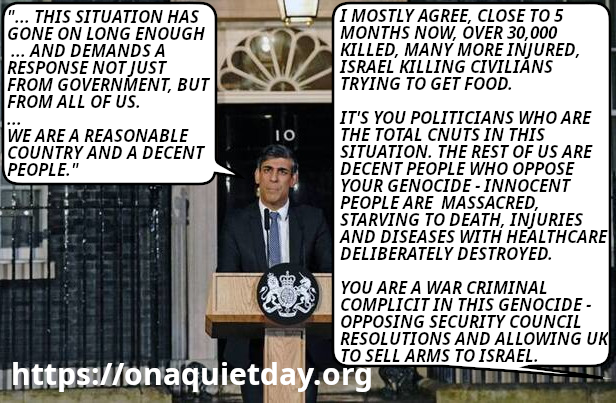
Response to Rishi Sunak's extremism speech at Downing Street 1 March 2024. Second version of this image with text slightly altered.
Response to Rishi Sunak’s extremism speech at Downing Street 1 March 2024. Second version of this image with text slightly altered.
Zionist Keir Starmes is quoted "I support Zionism without qualification." He's asked whether that means that he supports Zionism under all circumstances, whatever Zionists do.
Zionist Keir Starmes is quoted “I support Zionism without qualification.” He’s asked whether that means that he supports Zionism under all circumstances, whatever Zionists do.
Continue ReadingSunak and Starmer unite for war