
Current and former US military personnel build a movement for Palestine within their ranks

Spread the love

Original article by Natalia Marques republished from peoples dispatch under under a Creative Commons Attribution-ShareAlike 4.0 (CC BY-SA) license.

Veterans mobilize in front of the White House on June 8. (Photo: Mandy Wilkens)

Peoples Dispatch speaks to US veterans who are standing against their government’s complicity in genocide and organizing more to do the same

On February 25, US Air Force member Aaron Bushnell became the first active duty US soldier to earn the title of “martyr” among oppressed people worldwide. The 25-year-old set himself on fire in front of the Israeli embassy in Washington DC in protest of the US government’s complicity in the genocide in Gaza, declaring, “this is what our ruling class has decided will be normal,” before self-immolating.

Bushnell’s sacrifice was the most high-profile action by member of the US army in solidarity with Palestine and signaled an enormous sea change among active duty military as well as veterans—who are increasingly taking a bold step to denounce their government’s involvement in genocide. 

According to Mike Prysner, who was an active duty soldier during the Iraq War and has been organizing veterans and active duty military ever since, the momentum among current and former members of the US military “hasn’t been this high since the Bush era.”

Prysner recently authored an article for Empire Files on the dozens of active duty US soldiers quitting the US military over Gaza

“The sector of service members who have turned against the US/Israeli policy in a profound way is undoubtedly much bigger than we can see at the moment—one the Pentagon is no doubt aware of as well,” Prysner wrote.

As Prysner told Peoples Dispatch, although the anti-war veterans movement is not as big as it was during the Iraq invasions, it is significant that veterans are organizing at such a high level today because unlike Iraq, the genocide in Palestine is “not a direct US war.” 

“Most service members haven’t had direct experience with supporting Israel,” Prysner said. “They’re just disgusted by the fact that the military they served in and are serving in is playing a support and a propaganda role.”

However, Prysner notices significant anti-war momentum in the US Air Force in particular, which “does have more of a direct role in the other branches” in Gaza, in terms of “all the logistics that Israel needs” to carry out genocide. “I have noticed the active duty of the Air Force becoming more engaged because of their direct role,” Prysner says, including Bushnell. 

“The potential for there to be unrest within the military is historically something that plays a major impact in adding to the pressure on Washington to end the war,” Prysner told Peoples Dispatch.

Shortly after Bushnell’s self-immolation, Prysner worked with other veterans of the Vietnam, Iraq, and Afghanistan wars to organize an action in Portland in which former US military members burned their uniforms collectively in protest. This type of action was later repeated throughout the country as other veterans and active duty military drew inspiration from the momentum

Veterans in Portland, Oregan also recently organized a massive projection of anti-war imagery on a US Navy warship docked for “Fleet Week”. The images had slogans such as “Stop the US war machine” and “Blood is on your hands”.

Not only do veterans organizing within the anti-war movement inspire active duty military to take further action as well, but they also galvanize the entire anti-imperialist movement, says Prysner. He references the contingent of veterans who attended the recent 100,000-strong protest in front of the White House on June 8. Prysner noticed “a lot of excitement among the attendees” of the protest that veterans had mobilized. 

On June 8, Peoples Dispatch spoke to two of the veterans who attended the mass mobilization in front of the White House to declare a “people’s red line” against genocide. Adrian served in the Air Force from 2002 to 2009, and went to Iraq. He now openly identifies as both an anti-imperialist and Marxist, organizing with the Party for Socialism and Liberation, and credits his time in the military as contributing to his shift in consciousness.

“War is a profit-making business,” US vet declares

“As a person who served in the United States Air Force, I’m very familiar with how the imperialist war machine works. Naturally, this isn’t something that one joins the military knowing. It was part of the whole radicalization process for me, being in the military, realizing that it functions very much like a corporate entity, and that war is a profit-making business,” Adrian told Peoples Dispatch

“It was part of my being a working class person in the military, coming from the background that I came from, going to a foreign country to fight other poor and oppressed people, that created such a cognitive dissonance in me, that I had to address it in some sort of way.” 

Adrian continued, “there are many things that active duty people, reservists and guardsmen can do. They can conscientiously object and thus separate from the military, but they can also organize outside of the military. They can attend rallies. They can organize with professional revolutionary organizations such as our own. They can do many other things to raise consciousness and awareness among their fellow servicemen.”

Chris Stevens, who was an infantryman in the US Army from 2007 and 2013, told Peoples Dispatch what his message is to prospective, current, and former service members who are disgusted by US complicity in genocide. 

“Don’t be seduced in the first place. If you’ve yet to sign a contract, you should turn the other way. Your recruiter’s lying to you about everything, whether it be the job that you can have or the life that you’ll lead, the benefits that they promise you are not cast in stone and they will take anything they can from you,” Stevens said, referencing the predatory US military recruitment process. 

Military recruiters in the US notoriously prey on working class and oppressed youth to lead them into military careers, luring them with promises of free college education. This phenomenon is part of what anti-war activists dub the “poverty draft,” in which poor young people have few opportunities apart from joining the US military, risking life and limb, and participating in the imperialist machine. 

“For those who are already involved, my message is that you don’t have to listen to what they tell you to do,” Stevens continued. “There are significant historical examples from the Vietnam and Iraq wars, where entire units have decided to say no to their orders. As long as it’s not you alone resisting, if you can get a squad or a company together to say, we will not participate in this, there’s not much that the army can do.”

“So if you’re in a position where you are actively supporting this genocide that’s happening in Israel, you don’t have to,” Stevens said. 

The issue of Palestine was particularly galvanizing, as Adrian mentioned: “I don’t want to see children murdered anymore. This is beyond the pale of what can be justified in the name of nationalism, in the name of anything that would be any semblance of what one would call the sovereignty of a so-called nation. The self-determination of the Palestinian people is paramount to humanity. And their fight is our fight.”

Original article by Natalia Marques republished from peoples dispatch under under a Creative Commons Attribution-ShareAlike 4.0 (CC BY-SA) license.

Continue ReadingCurrent and former US military personnel build a movement for Palestine within their ranks

Reform targets Labour ‘red wall’ voters

Spread the love

https://morningstaronline.co.uk/article/-reform-targets-labour-red-wall-voters

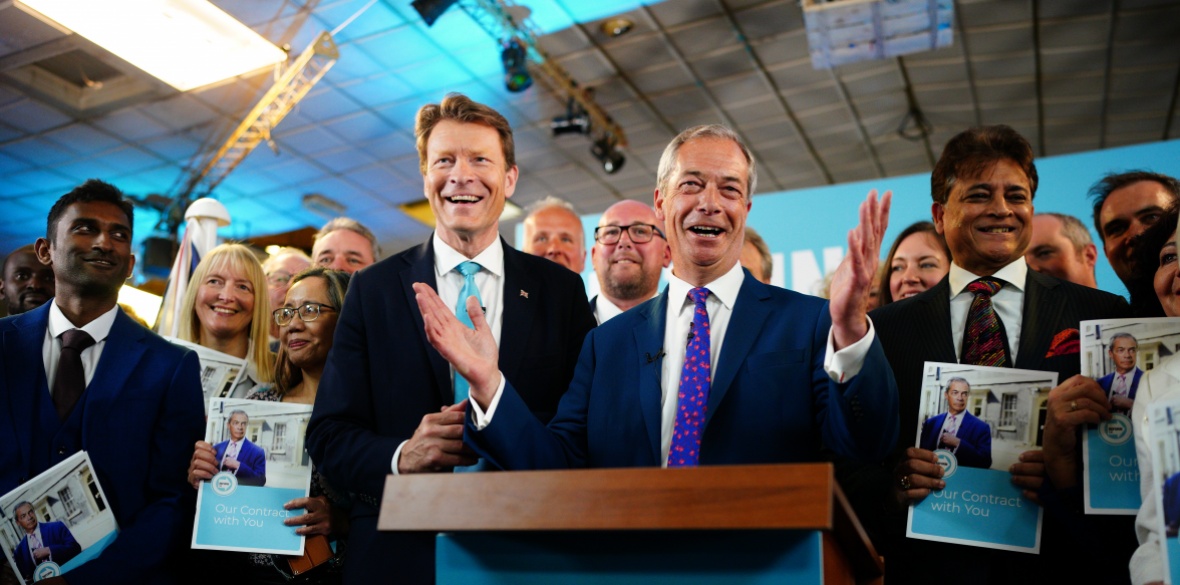
Reform UK chairman Richard Tice (left) and party leader Nigel Farage launch ‘Our Contract with You’ in Merthyr Tydfil while on the General Election campaign trail, June 17, 2024

REFORM started targeting Labour “red wall” voters today as the hard-right party launched its reactionary election manifesto in Wales.

The party’s owner and leader Nigel Farage went to Merthyr Tydfil, once represented by Labour pioneer Keir Hardie, to tell voters that “Labour is not very different to the Conservatives … it is just more incompetent.”

And he restated his aim of being the main challenger to Labour for government by 2029, likely date of the next general election following July 4.

The nationalist party’s platform is anti-migrant, opposed to climate action and supportive of NHS privatisation while cutting foreign aid and leaving the European Court of Human Rights.

It aims to take advantage of muted enthusiasm for Sir Keir Starmer’s Labour in working-class communities by rekindling the Brexit divisions it skilfully exploited in 2019.

Reform’s increasing prominence in the general election comes as the Tory Party’s campaign looks on the verge of expiring.

https://morningstaronline.co.uk/article/-reform-targets-labour-red-wall-voters

Continue ReadingReform targets Labour ‘red wall’ voters

Another election, another round of Nigel Farage hype, with no lessons learned

Spread the love
Image of Nigel Farage

Aurelien Mondon, University of Bath

Nigel Farage, a man who has never been elected to the House of Commons despite years of trying, has again been allowed to set the agenda in the UK.

Ten years after Ukip won the European parliament elections, throwing the Conservative party into turmoil and leading David Cameron to promise a referendum on the UK’s membership of the European Union, Farage is at it again. Or more precisely, he is being allowed to go at it again.

The mainstream elite in the media and in politics who claim to oppose Farage, and who pretend to stand as a bulwark against far-right politics, are again duly buying into the hype he has created for himself.

We could already feel that hype bubbling as Farage took over as leader of Reform. He’d seen the party’s fortunes rising and started to think there could be something in it for him to step into the campaign.

We could see it in the coverage of every move he made thereafter – every milkshake thrown, every inflammatory quip quoted and beer drunk, snapped and plastered all over the news as some kind of morbid excitement set in among the media. Finally, something exciting is happening in this otherwise rather dull campaign, where offers of “change” and pledges to be “bold” are hollow slogans for the sides of battle buses.

To understand how a party which only received 2% of the registered votes in the 2019 general election, failing to get even one MP elected, can get such attention, we must travel back in time.

Ukip was a party created by a eurosceptic elite, for a eurosceptic elite, to put pressure on the Conservatives via the EU elections. It all seemed a rather desperate move at the time, as the issue was marginal at best.

The party received 15.6% of the vote in the 2004 European elections and 16% in 2009. But these are second order elections, prone to low turnout and high protest vote. In these settings, Ukip really only received a mere 6% and 5.6% of the registered vote, once turnout was taken into account. Hardly the voice of the “silent majority”.

The 2005 and 2010 general elections clearly showed the limits of Ukip’s appeal. In 2005, the party received 1.4% of the vote and in 2010, it took 2%.

Ukip’s election vote share

A chart showing the performance of Ukip across general and European elections and what proportion that represented of the overall registered vote.
Ukip results in general elections (GE) and European elections (EU).
A Mondon., CC BY-ND

Still, the first “breakthrough” was in 2014 when Ukip won the EU elections with 26.6%. An “earthquake”, we were told. This was the start of the “left behind” myth which served Farage well as it diverted attention away from his elitist stance. The fantasised “white working class” would come to play a key role in shaping the narrative after the victories of both Donald Trump in the US and Brexit. Proper scrutiny of Ukip’s (and Reform’s) programmes (or Trump’s for that matter) would have also shown that beyond typical far-right measures and other gimmicks, their project was always deeply skewed in favour of the wealthy.

Yet even though Ukip really only received the support of one out of ten registered voters (9.5%) in 2014, in particularly favourable circumstances, the mainstream elite could not get enough of Farage. Finally, the UK had a “populist” contender worthy of the name. They too could feel the same voyeuristic thrills as their European counterparts, watching the “irresistible” rise of the far right (or “populism” to be politically correct, as we would not want to offend the far right, no matter how clear Farage has made his views).

What is striking is that it is this election which set in motion the 2016 referendum, even though Ukip was the only party running on a platform demanding that the UK leave the EU. For all the talk of “taking back control” and “sovereignty”, this reactionary experiment was decided based on the support of less than 10% of voters. Even in terms of votes cast, the referendum was forced onto almost three out of four voters who had decided to vote for parties who were not formally demanding the country leave the EU.
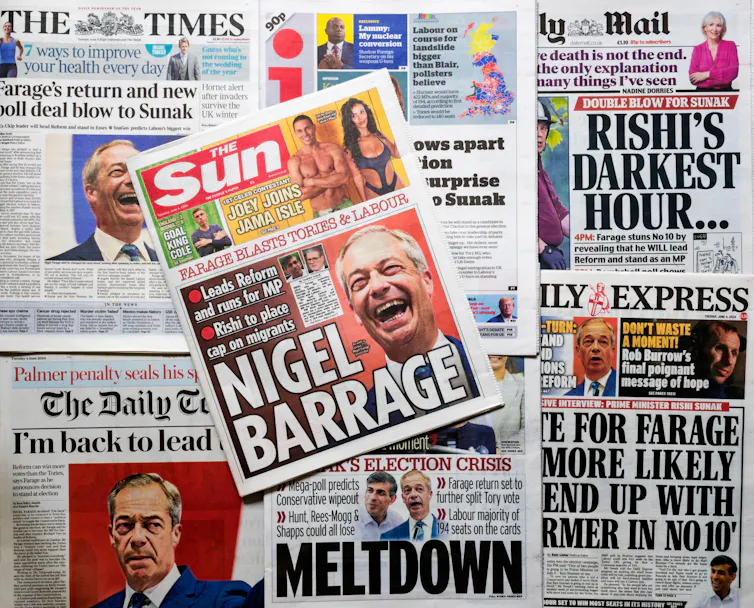
In case you missed it… Alamy/Urban images


All this is to say, Farage has simply never been that popular. This is despite him campaigning in incredibly fertile environments in which parts of the media are dedicated to propping him up, and where even those who seemingly oppose his politics cannot get enough of him – as demonstrated by his record number of appearances on the BBC or the countless articles on “populism” in the Guardian.

Just look at how much coverage a press conference given after one single poll has received, when other parties fail to get issues such as climate change, poverty or social care on the agenda.

And if you think this is because immigration is people’s key concern, think again. Indeed, as I explored with Lancaster university’s Aaron Winter in a report for the Runnymede Trust, the “immigration issue” is one that is clearly constructed in a top-down manner. Unsurprisingly, when people are asked about the key concerns in their personal lives, immigration doesn’t rate. Ironically, the exaggerated focus on immigration could be argued to be elite manipulation rather than the other way around.

So, what’s behind the rise of Farage? Well, the same processes which have been at play across much of Europe: the hyping of far-right politics as a diversion. As has become abundantly clear, there is no mainstreaming or rise of far-right politics without the active involvement of mainstream forces who normalise and platform them.


Want more election coverage from The Conversation’s academic experts? Over the coming weeks, we’ll bring you informed analysis of developments in the campaign and we’ll fact check the claims being made.

Sign up for our new, weekly election newsletter, delivered every Friday throughout the campaign and beyond.


The far right then plays a convenient role, serving to scare the electorate at a time when distrust in governing parties is sky high. The message is: “we are bad but they are worse”.

Yet this strategy is exhausted. Patience has run out and the far right is no longer as repulsive as it once was, now that most mainstream parties mimic its discourse.

The solution is simple. Stop fighting it on its turf. Instead, turn to issues which are not only core to people’s concerns, but far less amenable to far right hijacking. This takes bold actions and real change though – both being in short supply in our mainstream parties.The Conversation

Aurelien Mondon, Senior Lecturer in Politics, University of Bath

This article is republished from The Conversation under a Creative Commons license. Read the original article.

Continue ReadingAnother election, another round of Nigel Farage hype, with no lessons learned

Scrap to the two-child benefit cap urge Greens

Spread the love
Green Party Co-leader Adrian Ramsay. Wikipedia CC.

The IFS (The Institute for Fiscal Studies) have today warned that 250,000 children will be hit by the two-child benefit cap next year, rising to an extra half a million by 2029. Green Party Co-Leader, Adrian Ramsay, responded saying, 

“Greens have unequivocally pledged to scrap the two-child benefit cap in our fully costed manifesto.

“Today I am urging the Labour Party to show real strength and conviction and join us in making this pledge.

“This one decision could lift 250,000 children out of poverty.

“The power to do this will be in Labour’s hands.

“But I want to be very clear.

“If they fail to do this, elected Green MPs will not let this rest.

“We will push them every day of the next parliament demanding that they do what is right.

“That is what a Green vote will enable – voices in parliament to keep Labour honest on these important issues.”

Continue ReadingScrap to the two-child benefit cap urge Greens

Barclays’ billions of ‘sustainable’ finance for fossil fuel industry is greenwash, says investor

Spread the love

Original article by Josephine Moulds Nimra Shahid republished from TBIJ under a Creative Commons Attribution-NonCommercial-NoDerivs 3.0 Unported License.

The bank has funded the companies behind a controversial pipeline and aggressive oil expansion as part of their commitment to fighting climate change

Barclays has been branded “totally dishonest” by one of its investors for calling tens of billions of dollars for fossil fuel companies “sustainable finance”.

The UK high street bank says it is helping to address climate change by raising $1 trillion in sustainable and transition finance by 2030. This includes sustainability-linked loans and bonds, in which a company agrees to meet certain climate-related targets or else face a higher interest rate.

But these targets can be weak and the penalties for failing to meet them paltry. The company can also use the money raised how it sees fit, meaning supposedly sustainable finance could fund polluting activities.

Andrew Harper of Epworth, an investment manager owned by the Methodist church that invests in Barclays, said: “We’re concerned because the bank is making such a substantial claim and the public thinks the climate emergency is being worked towards being solved. Meanwhile, the problem is getting worse and worse. We think it’s totally dishonest.

“If they are calling the financing of any fossil fuel companies sustainable finance, that to me is greenwash.”

Barclays said: “We are committed to being transparent and report separately on the green finance, sustainable finance and the sustainability-linked finance mobilised towards our $1 trillion target, so stakeholders and investors have a clear understanding of what we are reporting.” It said it set out very clear requirements for energy clients’ targets and transition plans in order to access finance.

‘Deeply problematic’ deals

Barclays helped raise $41bn in sustainability-linked finance for fossil fuel companies last year, according to an analysis by the Bureau of Investigative Journalism of data from LSEG, the financial markets group. The $41bn figure covers the total value of the deals Barclays worked on alongside other banks. Barclays itself counts only the funding it is directly responsible for, which it said was $10.9bn across all sectors last year.

Katharina Lindmeier, responsible investments manager at the publicly owned workplace pension scheme Nest, which also invests in Barclays, said TBIJ’s findings were “very concerning”. She added: “We’ll be raising this research with their management team directly at the next opportunity.

“Regulators are looking closely at the issue of greenwashing and if there is any uncertainty, it’s better to be cautious than to mislead customers. Any loans which help companies expand oil and gas infrastructure should not be classed as sustainable.”

The Financial Conduct Authority, the UK regulator, wrote to banks last year highlighting concerns about this type of loan, including weak incentives, potential conflicts of interest, and low ambition. It said that these may lead to accusations of greenwashing.

Anders Schelde, chief investment officer of AkademikerPension, another Barclays investor, said sustainability-linked finance for oil and gas companies is “in most cases deeply problematic”. He said: “We don’t count sustainability-linked bonds and loans as green investments in our own accounting because we know there are so many problems with them. The penalties are low and the targets often insufficient.”

Last year, Barclays helped raise $3bn worth of sustainability-linked loans and bonds for Enbridge, a company that is dramatically expanding oil and gas infrastructure across North America.

Enbridge is behind the construction of a controversial 1,000-mile pipeline that cuts through Indigenous land in the US to pump tar sands oil. It paid US police to crack down on protesters and has been fined millions of dollars for repeated environmental violations.

Barclays classifies the Enbridge debt as sustainable because the company has set a target to cut emissions from its own operations. In part, it intends to do this by using solar power to pump oil through its pipelines.

“The real source of emissions from a company like Enbridge will be from the oil and gas its pipelines help transport,” said Jeanne Martin from responsible investment charity ShareAction. “We do not need greener pipelines, we need to stop the reckless expansion of the fossil fuel industry.

“If the conditions that a bank sets to provide financing to oil and gas transport companies don’t tackle oil and gas, the bank will be accused of greenwashing.”

Barclays also helped raise a $2.8bn sustainability-linked loan for Harbour Energy, the UK’s largest oil and gas producer. Harbour extracted the equivalent of nearly 70m barrels of oil last year, which if burned would produce the equivalent of eight coal-fired power stations’ annual emissions.

Scientists agree that developing any new oil and gas fields will derail climate targets and push global heating beyond 1.5 degrees – which the UN says will threaten lives, food sources and economies worldwide.

It seems that Harbour is aggressively exploring for new oil and gas as it hopes to extract a further 880 million barrels of reserves in the coming decades. It does not appear from Harbour’s public statements that the company has any plans to shift its focus to renewables.

Yet Barclays’ loan to Harbour Energy is called sustainable because the company has committed to reducing emissions from the process of extracting oil and gas. This, however, takes no account of the vast majority of Harbour’s emissions, which are generated from burning the oil and gas itself.

Enbridge paid US police to crack down on protesters opposing its Line 3 pipeline
Nicole Neri/Bloomberg via Getty Images

The notorious oil trader Trafigura also benefited from more than $5.4bn in loans that Barclays called sustainable finance. Counting its supply chain and all the emissions generated by the oil it trades and transports, Trafigura was responsible for more greenhouse gas emissions last year than Spain.

Trafigura’s interest payments are linked to certain sustainability targets, including a pledge to cut emissions – but only from its own operations rather than the burning of the fuels it trades and transports. This accounts for about 1% of the company’s total emissions.

Trafigura said Barclays was one of 54 banks involved in the deal, and said “sustainability-linked loans are an important tool in incentivising reductions in emissions”. It added that its direct emissions were less than 1% of Spain’s. While it reports its indirect emissions, it does not consider all of them “to be within our current sphere of influence”.

Enbridge said it takes climate change seriously and is committed to reducing its greenhouse gas emissions. It said sustainability-linked finance plays an important role in meeting emission-reduction goals and supporting the transition to a lower carbon economy. The company also said that the 1,000-mile Line 3 pipeline had local and tribal approvals and met the strictest environmental standards, and that payments to law enforcement were made and administered via a third party.

Harbour did not respond to a request for comment.

Barclays said: “Sustainability linked loans and bonds are an important sustainable finance tool, incentivising borrowers, particularly in hard to abate sectors, to achieve sustainability objectives over time.”

Net-zero banking

Barclays has committed to cut its emissions – including of the companies it finances – to net zero by 2050. To reach this target, it will have to stop providing money to companies that refuse to shift away from fossil fuels.

Enbridge’s Line 3 project cuts through Indigenous land
Tim Evans/Bloomberg via Getty Images

But a report out today shows that the bank’s funding for fossil fuels increased in 2023 from 2022, which troubled shareholders who have been urging it to reduce lending in line with its climate targets. Barclays was Europe’s top funder of the fossil fuel industry last year, according to the report led by the Rainforest Action Network.

Lindmeier, the Nest investment manager, said: “We want to see Barclays immediately reduce its financing to companies behind new fossil fuel expansion. Any delays could leave the company more exposed to bad loans and potentially cost them millions of pounds.”

Laura Hillis from the Church of England pensions board, another Barclays investor, said: “We are looking for banks to produce a clear climate plan and to see the commitments carry through into lending decisions. Our concern is that these fossil fuel financing figures show that is not happening at the pace we’d like.”

Climate-conscious investors have been putting pressure on Barclays to make good on its net-zero pledge and earlier this year the bank committed to stop providing specific project finance for oil and gas expansion and related infrastructure.

However, less than 2% of Barclays’ funding for oil and gas last year fell under the label of “project finance”. Almost all of it comes in the form of general, unrestricted finance for the companies undertaking those projects.

“Barclays’ new oil and gas policy is an important step forward for the bank but it should have gone so much further,” said Martin from ShareAction, which brought together Barclays shareholders to urge the bank to restrict lending to oil and gas companies.

“Ultimately, the bank has kept the right to finance companies that have plans to massively expand the fossil fuel industry with no strings attached, and that’s a real problem.”

Original article by Josephine Moulds Nimra Shahid republished from TBIJ under a Creative Commons Attribution-NonCommercial-NoDerivs 3.0 Unported License.

Continue ReadingBarclays’ billions of ‘sustainable’ finance for fossil fuel industry is greenwash, says investor