Israeli tanks move near Israel’s border with the southern Gaza Strip on May 25, 2024. (Photo: Amir Levy/Getty Images)
“How much more can the Palestinians survive this?” asked one researcher. “Safe zones targeted, refugees killed with merciless brutality.”
As humanitarians and world leaders condemn an Israel Defense Forces bombing and resulting fire in a Rafah “safe zone” that killed 45 people and wounded hundreds more, the Israeli military on Tuesday killed at least 21 more at another refugee camp in the southern Gaza Strip.
“Four tank shells hit a cluster of tents in Al-Mawasi, a coastal area that Israel had advised civilians in Rafah to move to for safety,” Reuters reported, citing health officials in the Hamas-governed Palestinian enclave. “At least 12 of the dead were women.”
Gaza-based journalist Hind Khoudary said on social media Tuesday: “I have a live hit on Al Jazeera in a bit and all I’m thinking about is how I will report on this massacre again. My heart is pounding so fast. My [fingers] are shaking. I want to cry.”
Journalist Hind Khoudary says Israel's latest attack on a tent encampment, which has killed nearly 22 Palestinians, was in an area that Israel had declared a 'safe zone' and ordered people to move to. pic.twitter.com/rlcLKr8fW1
According to Agence France-Presse, IDF spokesperson Rear Adm. Daniel Hagari told reporters on Tuesday that “I don’t know about this incident. We are putting this incident under investigation, and we will update you in advance.”
Hagari also addressed a probe into the Rafah attack—which Prime Minister Benjamin Netanyahu called a “tragic mistake”—during a Tuesday press briefing, saying that “on Sunday night, we eliminated senior Hamas terrorists in a targeted strike on a compound used by Hamas” and “due to unforeseen circumstances, a fire ignited tragically taking the lives of Gazan civilians nearby.”
“Contrary to reports, we conducted the strike outside the area that we designated as a humanitarian area and called civilians to evacuate to. Our strike was over a kilometer-and-a-half away from the Al-Mawasi humanitarian area. What we call the safer zone,” Hagari said. “Our munition alone could not have ignited a fire of this size… We are looking into all possibilities including the option that weapons stored in a compound next to our target, which we did not know of, may have ignited as a result of the strike.”
The IDF’s claims about the Sunday massacre have not quelled outrage around the world—including from U.S. lawmakers urging President Joe Biden to suspend weapons and diplomatic support for Israel’s war, which has killed over 36,000 Palestinians, injured another 81,000, and left thousands more missing and believed dead beneath the rubble, according to Gaza health officials.
Palestinians who have so far survived the Israeli assault on Gaza for more than seven months are struggling to find food, water, shelter, and medical care. The IDF has destroyed civilian infrastructure—including homes, hospitals, schools, and mosques—across the enclave and severely restricted the delivery of humanitarian aid.
🛑 1 million people forced to flee in search of safety, only in the past 3 weeks. 🛑 Heavy bombardment continued overnight in the area including in Tal Al Sultan where the UN main offices in Gaza are. 🛑Most of our staff could not make it to work. They are… pic.twitter.com/4mkmORe5aZ
Both deadly IDF attacks on displaced Palestinians in and near Rafah came in the wake of the International Court of Justice last week directing Israel to “immediately halt its military offensive or any other action in the Rafah governorate,” which followed the ICJ’s January order that the country “take all measures within its power” to uphold its obligations under the Genocide Convention.
Middle East Eye reported Tuesday that Nabil Abu Rudeineh, a Palestinian presidential spokesperson, “called the new attack a massacre, and called for the implementation of the International Court of Justice decision last week for Israel to halt its offensive on Rafah,” which began earlier this month.
Responding to the Tuesday attack on social media, London-based researcher Naks Bilal said that “without humanitarian intervention it is impossible to see how this does not stop.”
“How much more can the Palestinians survive this? Safe zones targeted, refugees killed with merciless brutality,” Bilal added. “Focus energy on calling for intervention, or there will be no Palestinians.”
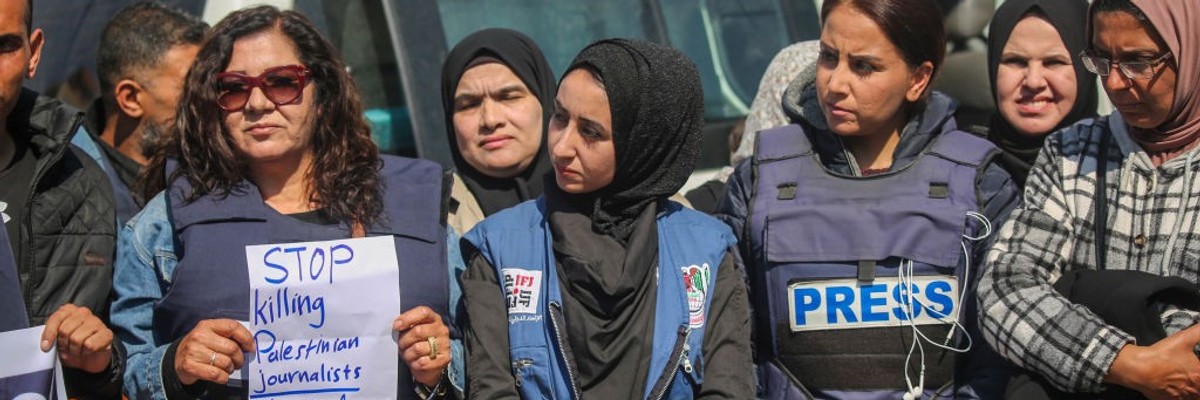
Palestinian journalists stage a protest to draw attention to Palestinian press killed while covering the war in the Gaza Strip on February 26, 2024 in Rafah. (Photo: Ahmad Hasaballah/Getty Images)
Reporters Without Borders says it has “reasonable grounds for thinking that some of these journalists were deliberately killed and that the others were the victims of deliberate IDF attacks against civilians.”
The press freedom group Reporters Without Borders announced Monday that it has filed a third complaint at the International Criminal Court alleging “war crimes against journalists in Gaza,” where over 100 media professionals have been killed by Israeli forces since October 7.
Paris-based Reporters Without Borders (RSF) is asking the ICC to investigate the Israel Defense Forces’ (IDF) killing of eight Palestinian journalists and wounding of another between December 15 and May 20 and, more broadly, the over 100 media workers slain during the course of Israel’s 234-day assault on Gaza.
RSF said it “has reasonable grounds for thinking that some of these journalists were deliberately killed and that the others were the victims of deliberate IDF attacks against civilians” and accused Israel of “an eradication of the Palestinian media.”
“Impunity endangers journalists not only in Palestine but also throughout the world,” RSF advocacy and assistance director Antoine Bernard said in a statement. “Those who kill journalists are attacking the public’s right to information, which is even more essential in times of conflict. They must be held accountable, and RSF will continue to work to this end, in solidarity with Gaza’s reporters.”
#Gaza: RSF files a third complaint with @IntlCrimCourt about war crimes committed by #Israel against journalists. We call on the prosecutor to investigate the cases of more than 100 journalists killed by the Israeli army in Gaza since October 7. 👇https://t.co/rep3ZdIoxt
Journalists in RSF’s latest complaint include Mustapha Thuraya and Hamza al-Dahdouh, freelancers working for Al Jazeera in Rafah when they were killed by a targeted Israeli drone strike on their vehicle on January 7, and Hazem Rajab, who was injured in the strike.
According to RSF:
The complaint also cites the cases of Hadaf News website reporter Ahmed Badir, who was killed by an airstrike at the entrance to Shuhada al-Aqsa Hospital in Deir al-Balah on 10 January; Kan’an News Agency correspondent Yasser Mamdouh, who was killed near Al-Nasser Hospital in Khan Yunis on 11 February; Ayat Khadoura, an independent video blogger killed by an Israeli strike on his home on 20 November shortly after posting a video; Yazan Emad Al-Zwaidi, a cameraman with the Egyptian satellite TV news channel Al Ghad, who was killed on 14 January when an Israeli strike hit the group of civilians he was with in Beit Hanoun; Ahmed Fatima, a journalist with the Al Qahera News TV channel, who was killed during a bombardment in Khan Yunis on 13 November; and Rami Bdeir, a reporter for the Palestinian New Press media outlet, who was killed during an Israeli bombardment in Khan Yunis on 15 December.
Another advocacy group, the Committee to Protect Journalists, previously condemned what it called an “apparent pattern of targeting journalists and their families,” noting cases in which media workers were killed while wearing press insignia and after being threatened by Israeli officials.
Monday marked the ninth anniversary of United Nations Security Council Resolution 2222, which concerns the protection of journalists in conflict zones and “emphasizes the responsibility of states to comply with the relevant obligations under international law to end impunity and to prosecute those responsible for serious violations of international humanitarian law.”
Last month, Francesca Albanese, the U.N. special rapporteur on the occupied Palestinian territories, said: “Killing journalists is a war crime that undermines the most basic human rights. Justice starts with the cessation of injustice.”
There is a 98% chance that one of next five years will be the warmest year on record for the globe.
That is the finding from the World Meteorological Organization’s (WMO) latest report: the Global Annual to Decadal Climate Update published today.
The report, which has been produced by the Met Office for the WMO, also cites there is a two-in-three chance that global average temperature in at least one of the next five years (2023-2027) will temporarily exceed 1.5°C above pre-industrial levels.
Dr Leon Hermanson is one of the Met Office scientists behind the report. He said: “Today’s report shows that the next five years are expected to bring new temperature records.
“These new highs will be fuelled almost completely by the rise of heat-trapping greenhouse gases in the atmosphere, but the anticipated development of the naturally-occurring El Nino event will also release heat from the tropical Pacific.”
Key findings at a glance
There is 66% chance that annual global surface temperature will temporarily exceed 1.5°C above pre-industrial levels for at least one of the next five years
There is a 98% likelihood that at least one of the next five years will be the warmest on record
El Niño and human-induced climate change will likely combine to fuel global temperature increase next year
Arctic heating is predicted to be more than three times higher than the global average
What does this mean for the Paris Agreement?
“This report does not mean that we will permanently exceed the 1.5°C level specified in the Paris Agreement which refers to long-term warming over many years. However, WMO is sounding the alarm that we will breach the 1.5°C level on a temporary basis with increasing frequency,” said WMO Secretary-General Prof. Petteri Taalas.
“Global temperatures are predicted to continue increasing, moving us further and further away from the climate we are used to,” said the Met Office’s Dr Leon Hermanson.
Key points
The average global temperature in 2022 was about 1.15°C above the 1850-1900 average. The cooling influence of La Niña conditions over much of the past three years temporarily reined in the longer-term warming trend. However, La Niña ended in March 2023 and an El Niño is forecast to develop in the coming months. Typically, El Niño increases global temperatures in the year after it develops – in this case this would be 2024.
The annual mean global near-surface temperature for each year between 2023 and 2027 is predicted to be between 1.1°C and 1.8°C higher than the 1850-1900 average. This is used as a baseline to represent pre-industrial temperature before the emission of greenhouse gases from human and industrial activities.
There is a 98% chance of at least one in the next five years beating the temperature record set in 2016, when there was an exceptionally strong El Niño.
The chance of the five-year mean for 2023-2027 being higher than the last five years is also 98%.
Arctic warming is disproportionately high. Compared to the 1991-2020 average, the temperature anomaly is predicted to be more than three times as large as the global mean anomaly when averaged over the next five northern hemisphere extended winters.
Predicted precipitation patterns for the May to September 2023-2027 average, compared to the 1991-2020 average, suggest increased rainfall in the Sahel, northern Europe, Alaska and northern Siberia, and reduced rainfall for this season over the Amazon and parts of Australia.
Heat waves rise near a heat danger warning sign in Death Valley National Park, California. (Photo: David McNew/Getty Images)
“These are not your grandparents’ heatwaves,” said one meteorologist.
Millions of people in the United States are facing the high likelihood of extreme heat in the coming weeks, with northern states that frequently have relatively temperate summers among those where higher-than-average temperatures are expected this summer, according to federal data.
As The Guardian reported Monday, the National Oceanic and Atmospheric Administration’s (NOAA) new predictions for the summer months state that most of New Mexico and Utah have a 60%-70% chance of hotter-than-normal weather, along with parts of Arizona, Texas, and Colorado.
Houston and the surrounding area has already experienced spiking temperatures that were tied to a heat dome that was positioned over Mexico for several weeks. The high atmospheric pressure drove record-breaking heat across Mexico and in Texas, as well as a powerful storm earlier this month that killed at least seven people and left hundreds of thousands of people in the Houston area without power.
NOAA’s Heat Risk tool showed that on Monday, a significant stretch of southern Texas was experiencing an “extreme” level of heat, defined as including “little to no overnight relief” and affecting the health and safety of “anyone without effective cooling and/or adequate hydration.”
The new tool takes into consideration whether the heat is unusual for the time of the year, whether residents get relief with cooler temperatures in the evenings, and whether temperatures pose an elevated risk of health impacts like heat stroke or heat exhaustion.
NOAA found that the entire Northeast, from Maine to New Jersey and Pennsylvania, has a 40%-50% chance of having above-average temperatures from June through August.
Too hot girl summer in a hot climate summer 🥵@noaa released their heat predictions for this summer and, you guessed it, it’s gonna be HOT, hotter than normal, as it has been for the last several years of record-breaking temperatures. #ClimateActionNowpic.twitter.com/NflVEdJINZ
“We can expect another dangerous hot summer season, with daily records already being broken in parts of Texas and Florida,” Kristy Dahl, climate scientist for the Climate and Energy program at the Union of Concerned Scientists, told The Guardian. “As we warm the planet, we are going to see climate disasters pile up and compound against each other because of the lack of resilience in our infrastructure and government systems.”
The predictions come days after the consumer advocacy group Public Citizenreleased a report, Scorched States, about state laws that protect outdoor workers from extreme heat—and those that don’t.
As many as 2,000 U.S. workers die every year from laboring in extreme heat, said Public Citizen, even though “every workplace illness, injury, and fatality caused by heat stress is avoidable, and relatively simple preventative measures—water, shade, and breaks—have proven extremely effective at protecting workers.”
The Occupational Safety and Health Administration’s forthcoming heat standard rules are not expected to be finalized until at least 2026, but states including Washington, Colorado, and Minnesota have issued their own labor laws to protect workers from heat-related injuries.
The Guardian pointed out that the extreme heat expected this summer will likely take hold as the Earth transitions away from El Niño—the natural phenomenon that causes ocean temperatures to rise—and toward La Niña.
“As we transition to La Niña, it still looks to be a potentially record-breaking year. That clearly suggests to me that the anthropogenic signal is there,” James Marshall Shepherd, director of the University of Georgia’s atmospheric sciences program, told The Guardian. “I am also worried about the ocean temperatures, which are very warm, particularly as we approach the Atlantic hurricane season.”
“Attribution studies are pretty decisive that heatwaves will continue to be more intense and frequent” as the planet warms, Shepherd said. “These are not your grandparents’ heatwaves.”
Last year, scientists found that neither the hot and dry conditions that led to destructive wildfires in Canada, nor extreme heatwaves that took hold in Europe and North America, would have been as likely to occur without the planetary heating that’s been linked to continued fossil fuel extraction.
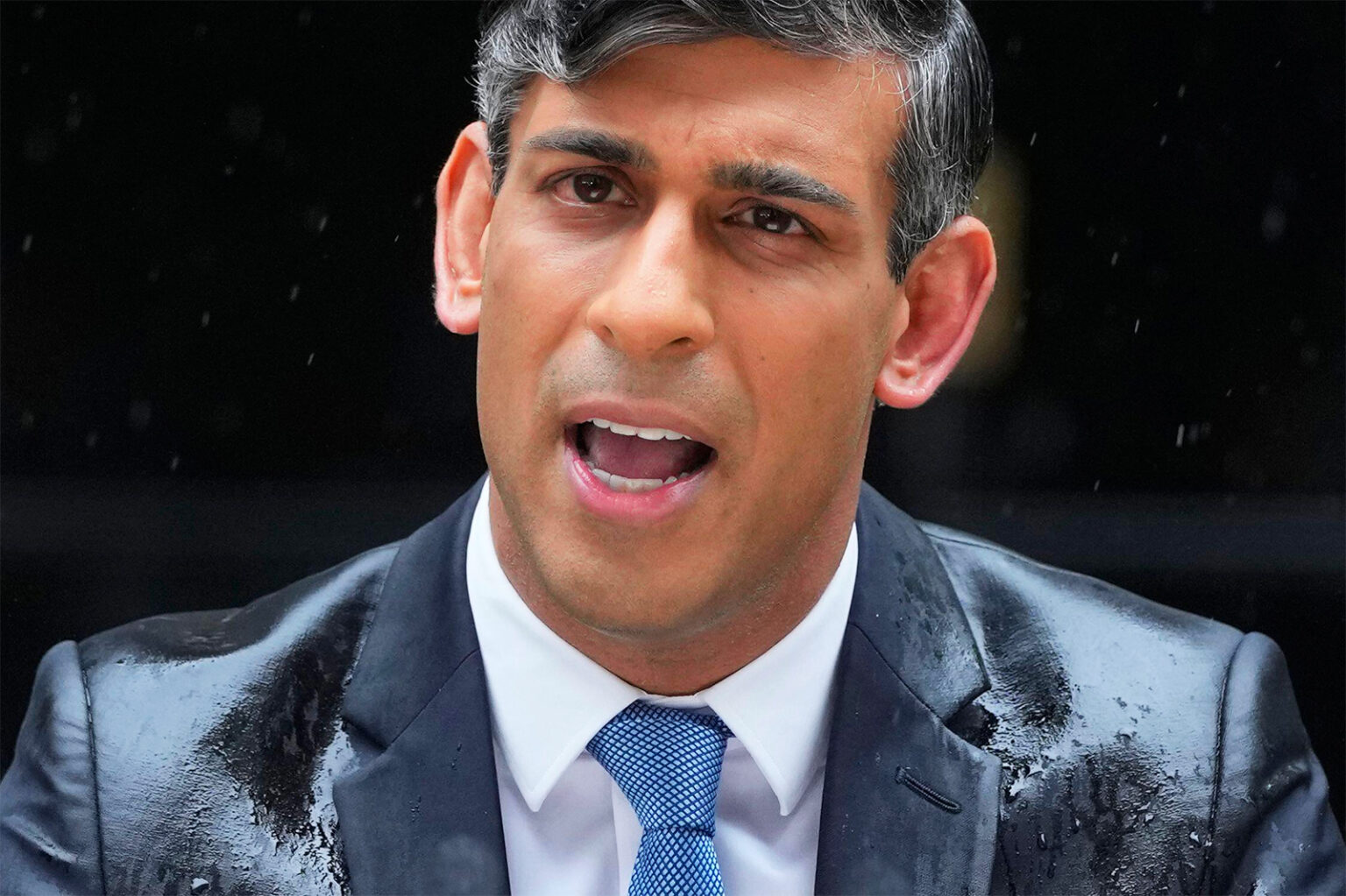
Prime Minister Rishi Sunak. Credit: Associated Press / Alamy
“Outrageous” findings show that the Conservative Party “is clearly in bed with the fossil fuel lobby”, say MPs and campaigners.
The Conservative Party has received £8.4 million since December 2019 from oil and gas interests, highly polluting industries, and individuals who have expressed or supported climate science denial, DeSmog can reveal.
This comes as climate action is increasingly being used as a “wedge” issue to divide voters ahead of the next election, which is due to be held on 4 July.
Over the last year, the governing Conservative Party has watered down its support for the UK’s flagship 2050 net zero emissions target, and has enacted policies to increase fossil fuel extraction. In July, Prime Minister Rishi Sunak confirmed that his government plans to issue hundreds of new oil and gas licences, as well as introducing annual licensing rounds, claiming that he intends to “max out” the UK’s fossil fuel reserves.
Sunak launched the election campaign by claiming that he had “prioritised energy security and your family finances over environmental dogma”.
DeSmog reviewed the donations to every major Westminster party since 12 December 2019 and found that the Conservative Party and its MPs had received 80 times more polluting cash than the Liberal Democrats (£132,600), and 160 times more than Labour (£41,600). The anti-net zero party Reform UK has received more than £2 million in polluting donations since December 2019, accounting for more than 90 percent of its funding.
Since the December 2019 election, the Conservatives have received £2.35 million from fossil fuel interests, £5.7 million from highly polluting industries, and £404,000 from supporters of climate science denial.
“No political party should be taking any money from fossil fuel interests whatsoever,” Caroline Lucas, the Green Party MP for Brighton Pavilion, told DeSmog.
“To have the Conservative party of government in their pocket to the tune of £8.4 million is simply outrageous and unacceptable. Is it any wonder they’ve adopted so many reactionary and dangerous policies to prop up planet-wrecking fossil fuels? He who pays the piper, calls the tune.”
The Conservative Party did not respond to DeSmog’s request for comment.
Fossil Fuel Donations
Since the 2019 general election, the Conservative Party has received more than £2 million from fossil fuel companies, their executives, and those with a financial interest in oil and gas.
These donations have come from some of the party’s highest-ranking figures.
Tory peer Lord Michael Spencer is a former party treasurer who sits on the board of its endowment fund, the Conservative Party Foundation. In a personal capacity and through his family office, IPGL, Spencer has given £548,500 to the party since December 2019.
Spencer currently holds an 18.8 percent (£4.5 million) stake in the oil and gas exploration company Deltic Energy, which has been awarded multiple North Sea licences by the government.
He previously told DeSmog that he believes “it is totally in the best interest of the UK to replace imported oil and gas by energy extracted from our own North Sea.”
He added in a new comment that “using our own oil and gas clearly is a huge benefit to UK balance of payments” – with reference to the amount that the UK exports versus the amount that it imports.
Spencer has a number of oil and gas interests. His House of Lords register of interests shows that he has a stake in Pantheon Resources, a UK company exploring for oil in Alaska, and previously had a stake in Cluff Energy Africa, which is described as an “early stage oil prospecting company seeking licences in Africa (Angola and Sierra Leone)”.
Tory peer Lord Michael Farmer has also donated £317,000 to the party since the last election. Until April 2024, Farmer held shares in the fossil fuel giants Shell and BP, each worth more than £100,000. Farmer still holds shares in BHP Group, which has mining and oil assets. In 2022, BHP’s petroleum business merged with the energy company Woodside, with the new firm being 48 percent owned by BHP shareholders, creating a “global top 10 independent energy company”.
The Conservative Party has also received £75,900 from Amjad Bseisu, the CEO of EnQuest – a company that has been awarded North Sea oil and gas licences, as well as licences to explore CO2 storage under the North Sea. EnQuest declined to comment.
Alasdair Locke, who chairs the UK’s largest independent petrol station operator Motor Fuel Group, has given £280,000 to the Tories since December 2019. Locke is also the non-executive chair of Well-Safe Solutions, a firm that decommissions oil and gas wells, and is the founder and former executive chairman of Abbot Group, a major North Sea oil and gas services company.
Balmoral Holdings, an engineering firm heavily involved in the North Sea industry, has given £335,000 to the party, while more than £100,000 has been donated by Matthew Ferrey, a former senior partner at oil trading firm Vitol.
Donations worth £63,000 have also been given by Nova Venture Holdings, a firm owned by Jacques Tohme, who describes himself as an “energy investor” on LinkedIn and says that he is the co-founder and former director of Tailwind Energy, an oil and gas company.
In 2023, Serica Energy bought Tailwind, reportedly making Serica one of the 10 largest North Sea oil and gas producers.
“This investigation is yet more evidence of the stranglehold the oil and gas industry has on our politics,” Georgia Whitaker, Greenpeace UK’s climate campaigner, told DeSmog. “And it’s bill payers and the climate that will continue to suffer because of it.
“The governing party we’ve had for the last 14 years is clearly in bed with the fossil fuel lobby. We’ve seen rowback after row back on climate policy, as well as highly damaging rhetoric from political leaders. It’s clear that the Conservatives can’t be trusted to make the right decisions about energy policy.
“We already have the solutions to cut bills, increase energy security and cut emissions, but the government has ignored them in favour of pandering to vested interests at the expense of the rest of us. Dirty money from fossil fuels, highly polluting industries, or climate deniers should have no place in our politics.”
Carbon-Intensive Industry
The largest polluting donation to the Conservatives came from Amit Lohia, a petrochemicals executive whose business interests include a Russian textiles plant, as previously revealed by DeSmog. Lohia donated £2 million to the party in March 2023.
The Conservative Party also received more than £1.7 million during this period from the construction giant JCB and its proprietors the Bamford family. JCB sells its products in 150 countries and specialises in heavy machinery. The company, chaired by Tory peer Lord Anthony Bamford, also sells diesel-powered generators.
According to the government’s Environmental Audit Committee, the UK’s built environment is responsible for 25 percent of the UK’s greenhouse gas emissions. The construction industry is responsible for 18 percent of large particle pollution in the UK, a figure that rises to 30 percent in London, according to a report by Impact on Urban Health, and the Centre for Low Emission Construction.
Aviation entrepreneur Christopher Harborne has given more than £1.6 million to the party since the last election. Harborne is the owner of AML Global, an aviation fuel supplier operating in 1,200 locations across the globe with a distribution network that includes “main and regional oil companies”, according to its website. Harborne is also the CEO of Sheriff Global Group, which trades in private jets.
In addition to his Conservative Party donations, since December 2019 Harborne has given £465,000 to Reform UK, the country’s most overtly anti-net zero political party.
Aviation emissions accounted for eight percent of the UK’s annual greenhouse gas emissions before the pandemic, according to the government’s Climate Change Committee (CCC).
In response to DeSmog’s request for comment, Harborne posted a lengthy statement on the AML Global website. He said: “I am not a climate science denier and … I do not seek to influence any government through donations or lobbying regarding their policies on climate change or in favour of corporate interests.”
Harborne added that “there is overwhelming scientific evidence that human activity and in particular the use of hydrocarbons as an energy source is accelerating climate warming due to the greenhouse effect.”
He noted that he supports “aviation industry initiatives to improve fuel efficiency and the use of sustainable aviation fuel” and that he is “financing a business that is creating ambitious and innovative new designs for next generation aircraft that will have a radically lower carbon footprint.”
Climate-Denier Donors
Climate science denial is a growing feature of mainstream British politics. Its proponents dispute the settled consensus around human-caused climate change and the need to reach net zero emissions by 2050, displacing informed debate with divisive conversations that mislead the public.
The Climate Action Against Disinformation global coalition has observed that “climate has become co-opted into the culture wars”, which has widened the potential scope of mis- and disinformation around both the causes of and best solutions to global heating.
Since the 2019 election, the Conservative Party has received hundreds of thousands of pounds from individuals who have funded and promoted climate science denial.
Hedge fund manager Lord Michael Hintze has donated £294,000 to the Tories and a number of its MPs, including energy security and net zero secretary Claire Coutinho in January 2024.
Hintze, a Conservative peer, was one of the early funders of the Global Warming Policy Foundation (GWPF), the UK’s leading climate science denial group, which has claimed that carbon dioxide has been mis-characterised as pollution, when it is a “benefit to the planet”.
Hintze has said that he believes “there is climate change” caused “in part due to human activity over the past century”. However, he has said that “all sides must be heard” on climate change “to reach the right conclusion for society as a whole“.
A number of climate consensus studies conducted between 2004 and 2015 found that between 90 percent and 100 percent of experts agree that humans are responsible for climate change. A study published in 2021, which reviewed over 3,000 scientific papers, found that over 99 percent of climate science literature says that global warming is caused by human activity.
The UN’s Intergovernmental Panel on Climate Change (IPCC), the world’s foremost climate science body, has stated it is “unequivocal that human influence has warmed the atmosphere, ocean and land”.
The party has also received £90,000 from First Corporate Consultants, a firm owned by Terence Mordaunt, a director and former chair of the GWPF. Mordaunt told openDemocracy in 2019 that “no one has proved yet that CO2 is the culprit” of climate change.
The IPCC has stated that carbon dioxide “is responsible for most of global warming” since the late 19th century, which has increased the “severity and frequency of weather and climate extremes, like heat waves, heavy rains, and drought”.
Jolyon Maugham, director of the Good Law Project, told DeSmog: “No one who has seen how the Conservative Party chose Big Oil over families during the cost of living crisis will be surprised by these numbers. But that shouldn’t dull our sense of quite how grim all of this is.”
Other Parties
Last year First Corporate Consultants also donated £200,000 to Tory rivals, the right-wing party Reform UK, which has been the second largest recipient of donations from polluting sources since December 2019.
Of the £2.5 million that Reform UK has received in donations since the 2019 election, around 92 percent (£2.3 million) of that income has been given by fossil fuel interests, polluting industries, or climate science deniers.
Reform UK has received £515,000 from former Tory donor Jeremy Hosking, whose investment firm had more than $134 million (around £108 million) invested in the energy sector at the close of 2021, two thirds of which was in the oil industry, along with millions in coal and gas.
Hosking, who also donated £50,000 to the Conservatives during this period, previously told DeSmog: “I do not have millions in fossil fuels; it is the clients of Hosking Partners who are the beneficiaries of these investments.” He declined to comment further for this article.
Hosking told The Guardian in May that he had ended his donations to Reform UK and is now channelling his political donations to Reclaim, a radical right-wing party led by actor Laurence Fox.
Since December 2019, Reform UK has also received more than £1.1 million from businesses run by its leader Richard Tice, who is a prominent climate science denier. Tice has claimed that “there is no climate crisis”, and has also expressed the view that “CO2 isn’t a poison. It’s plant food”. Reform UK campaigns on an overtly anti-climate platform. It has called for the UK’s 2050 climate target to be scrapped, and has proposed holding a “referendum on net zero”.
Reform UK has also received more than 50 loans collectively worth around £1.4 million from a company called Tisun Investments, which is owned by Tice, since the start of 2020.
A Reform UK spokesman said: “Climate change is real, Reform UK believes we must adapt, rather than foolishly think you can stop it. We are proud to be the only party to understand that economic growth depends on cheap domestic energy and we are proud that we are the only party that are climate science realists, realising you can not stop the power of the sun, volcanoes or sea level oscillation.
“The deniers are those who continually gaslight the public into thinking you can stop these powerful natural forces. We must use the energy under our feet, rather than send our money and jobs abroad.”
The Liberal Democrats and Labour have received much smaller sums from fossil fuel interests, polluters, and climate science deniers since December 2019. DeSmog’s analysis found that the Lib Dems have received £132,600, including £10,000 from energy investor Hosking, and £110,600 from Christopher D. Leach, who runs a private plane chartering and management business.
The Labour Party has received £41,600, including £9,600 from the aviation firm Airbus, and £12,000 from biomass company Drax, which is the UK’s largest single source of carbon emissions. Labour has also received sizeable donations from green technology entrepreneurs, including eco-campaigner Dale Vince.
The Scottish National Party (SNP) did not receive any Westminster donations from fossil fuel interests, polluters, or climate science deniers, according to DeSmog’s research.
Labour and the Liberal Democrats did not respond to DeSmog’s request for comment.