U.S. imperialism’s ‘ironclad’ support for Israel increases fascist danger at home

Spread the love

Original article by C.J. ATKINS republished from peoples world under Attribution-NonCommercial-NoDerivs 3.0 United States.

The Biden administration’s declaration of ‘ironclad support’ for Israel threatens to drive a wedge between the president and progressive voters, a potential electoral gift for Trump. In this photo, a woman walks by an election campaign billboard in Tel Aviv for Israeli Prime Minister Benjamin Netanyahu’s Likud Party that shows the Israeli leader with Donald Trump, Sept 15, 2019. Hebrew on billboard reads: ‘Netanyahu, in another league.’ | Oded Balilty / AP

President Joe Biden declared Saturday that U.S. support for Israel is “ironclad” as more than 300 slow-moving Iranian drones and missiles meandered across the sky toward Israeli military installations. With assistance from the U.S., Britain, France, and Jordan, it’s estimated that 99% of the weapons were destroyed in the air before reaching their targets. There were zero people killed.

As Biden’s declaration was being reported, the Pentagon issued a statement saying that Defense Secretary Lloyd Austin had spoken with his Israeli counterpart “and made clear that Israel could count on full U.S. support.”

On television, Prime Minister Benjamin Netanyahu peddled the image of a besieged Israel fighting for its life. Wearing a stern face, he said, “We will defend ourselves against any threat and will do so level-headedly and with determination.”

Of course, once the cameras were off, the Israeli leader was no doubt smiling. That’s because the pledges from Biden and Austin guaranteed that U.S. weapons will keep flowing his way and that Western leaders’ criticism of his genocidal war in Gaza—which has killed more than 33,000 Palestinians—will be tamped down.

It wasn’t just Netanyahu celebrating this weekend, though. Here in the U.S., ex-President Donald Trump and his allies were also beaming. The militaristic neocons and religious extremists that make up different wings of the Republican coalition were united in cheering for a bigger war and blaming Biden for disaster.

They sense a moment of opportunity to divide anti-MAGA forces, and the policy being pursued by the White House is unfortunately aiding them in their effort. All these developments combine to make the demand for an immediate arms embargo on Israel all the more urgent.
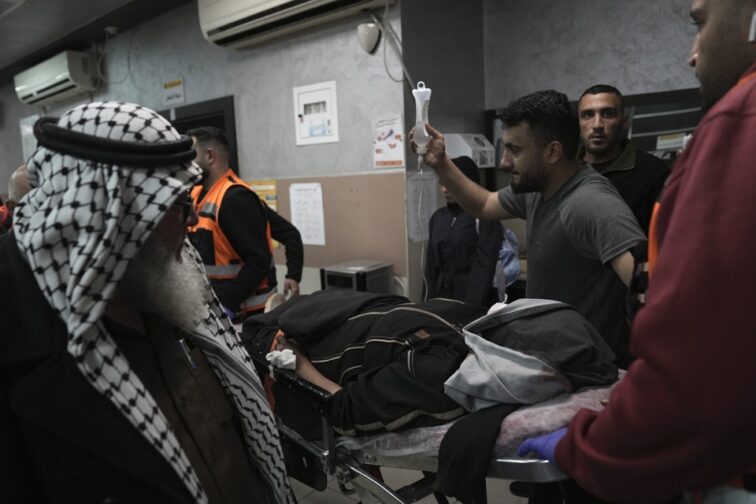
Settler rampage: A Palestinian woman attacked by illegal Israeli settlers arrives at the Palestine Medical Complex in the West Bank city of Ramallah, Friday, April 12, 2024. While the world was consumed with the Iranian attack on Israel, dozens of Israeli settlers rampaged through a Palestinian village, killing Palestinians and destroying property. In Gaza, meanwhile, the genocidal destruction also continued unabated. | Nasser Nasser / AP

Netanyahu’s partial victory

The U.S. response to the Iranian attack was a partial victory for Netanyahu.

The weekend assault by Tehran was the result of Israel’s April 1 bombing of the Iranian Embassy in Damascus, Syria. That last part is worth stating again—the Iranian attack this weekend was not some unprovoked incident; it was retaliation for an Israeli action that killed 13 people at an Iranian diplomatic outpost two weeks ago.

If one were only getting their news from the mainstream corporate media in the U.S. or listening to the words of many political leaders in Washington, they would probably never know that it was Israel that had provoked Iran.

That doesn’t make the latter part of some anti-imperialist alliance nor necessarily a friend of the Palestinians, but it is a context that is inconvenient for the narrative of an innocent Israel alone against aggressive neighbors.

At any rate, Netanyahu managed to prompt Iran to elevate the war danger. That will get him his weapons and temporarily hush the increasingly critical voices of allies skeptical of his execution of the war in Gaza. But the Iran provocation was not quite the complete win he’d hoped for.

The bigger goal was to escalate the war against Gaza into a wider regional war that would include direct U.S. involvement in the fighting. He wants to make U.S. imperialism not just his accomplice but his direct partner in waging war in the Middle East.

Why? The reasons are many.

So far, the Gaza genocide is not achieving many of its declared aims. Hamas has not been smashed. The hostages have not been freed. Gaza has been destroyed and tens of thousands have been killed, but the plan to completely eradicate the Palestinian presence there hasn’t materialized. That’s the case thanks to both Palestinian resistance and the refusal of Israel’s neighboring states to transform themselves into permanent refugee camps.

Meanwhile, the war is increasingly unpopular at home, and hundreds of thousands are demanding elections in Israel—elections which would certainly result in Netanyahu’s removal from office and the resumption of a long-delayed corruption trial that could send him to prison.

Clearly, he needs and wants this war to drag on as long as possible and to become as big and involve as many countries as possible, particularly one country—the United States.

To Netanyahu’s disappointment, however, Biden told him to consider the shootdown of all the Iranian missiles “a win” and close the book for now: Don’t expect U.S. help in any follow-up attacks on Iran.

The coalition for war

But there are other forces coalescing to give Israel the bigger war it wants.

John Bolton—former Trump cabinet member and one of the architects of the U.S. war in Iraq—is rallying neocons in the U.S. to squeeze Biden. Ever since President George W. Bush declared Iran to be part of the “Axis of Evil” over 20 years ago, Bolton and his allies have been angling for a fight with that country.

In January this year, he was already telegraphing the message that the U.S. has “no option but to attack Iran.”  This weekend, he said “passivity…would be a big mistake” and said Biden was “an embarrassment” for urging Israel not to attack Iran (again).

The Evangelical Christian leaders who command major swathes of the Trump MAGA coalition, meanwhile, are revving up their followers for war, as well.

Televangelist Pastor John Hagee, founder of the lobbyist group Christians United for Israel, characterized the Iranian attack as the fulfillment of prophecy, the beginning of the “Gog and Magog war” predicted in the Bible. Demonizing those who advocate a ceasefire in Gaza, Hagee said on Sunday that “the word de-escalate is music to the ears of Hamas and Iran.”

He and other pro-war Christian leaders will be going to Congress “like a bulldozer” in the coming days, he said, ordering lawmakers to “bless Israel” with more U.S. taxpayer-funded weaponry. In the meantime, he urged the faithful to bless the ministry run by him and his son with their hard-earned money.

Then, turning to the 2024 U.S. elections, Hagee indirectly endorsed Donald Trump when he called the Iranian attack on Israel “a tribute to the weak and pathetic leadership of Joe Biden.”

Fascist threat, imperialist strategy

Although Hagee’s remarks are often dismissed as the ravings of a conman cult leader, he illuminates the class and democratic contradictions that define U.S. capitalism and an electoral contest that is forcing voters to choose between two varieties of imperialism.
The absurdity of the moment was perhaps best illustrated when the red-hatted legions at a Trump rally in Pennsylvania on Sunday broke into chants of “Genocide Joe,” and their leader responded, “They’re not wrong!”

Trump paired his apparent acknowledgement that Israel was committing genocide with U.S. complicity with a “God bless Israel” platitude and an affirmation that the Iranian attack wouldn’t have happened if he was president.

Follow the logic (if there is such a thing with Trump), and you get a pledge that he will do an even better job at assisting in genocide and supporting the Israeli military if he is re-elected.

An open fascist who has already tried to overthrow the U.S. government before and is working tirelessly with Republican officials across the country to destroy democracy is openly and cynically attempting to drive a wedge between the Democratic nominee and anti-war voters with a pro-war message.

Does Trump actually expect to win the votes of many pro-Palestinian voters? No, most of them wouldn’t give him the time of day, and he knows it. The goal is to demobilize progressive voters and stoke discontent toward Biden. Trump’s team has done its calculations, and it knows that getting Democratic-leaning voters to stay home in a few key states could be enough for him to win. And the threat extends down-ballot, because it’s not just Biden who’d be in trouble but other progressive candidates running on the Democratic ticket at the state and local levels, as well.

Unfortunately, the imperialist strategy being pursued by the Biden administration is making Trump’s task easier. The unity that’s needed to block fascism at the polls in November is jeopardized every time the president approves another weapons shipment to Israel or reaffirms his “ironclad” support of the government in Tel Aviv.

Ceasefire alone cannot be the demand of the peace movement in our country. A total and complete arms embargo on Israel is an absolute necessity—not just for saving the lives of the Palestinian people and preventing a wider Middle East war, but for saving U.S. democracy from a fascist takeover.

Many organizations and leaders are already making that call, including Jewish Voice for Peace, which on Sunday issued yet another call for the U.S. to end all military funding and weapons sales.

Rep. Cori Bush again reiterated the demand she and other lawmakers have made for an end to the “shameful and unconditional” arming of the Israeli government as it commits war crimes. “The people of our country do not want war,” she said.

There are a million reasons to vote against Trump in November, and almost everyone who is a part of or connected to the mass labor, anti-war, African-American, Latino, immigrant rights, LGBTQ, and other democratic movements know them by heart. But the Democratic National Committee and the Biden campaign cannot simply rely on the bogeyman of Trump to motivate voters. The administration’s Gaza policy must change.

Every dollar for Israel’s war is another crack in the anti-MAGA coalition that’s needed to stop fascism in November.

As with all news-analytical and op-ed articles published by People’s World, this article reflects the views of its author.

We hope you appreciated this article. At People’s World, we believe news and information should be free and accessible to all, but we need your help. Our journalism is free of corporate influence and paywalls because we are totally reader-supported. Only you, our readers and supporters, make this possible. If you enjoy reading People’s World and the stories we bring you, please support our work by donating or becoming a monthly sustainer today. Thank you!

Original article by C.J. ATKINS republished from peoples world under Attribution-NonCommercial-NoDerivs 3.0 United States.
Continue ReadingU.S. imperialism’s ‘ironclad’ support for Israel increases fascist danger at home

Revealed: UK ‘double counting’ £500m of aid for war-torn countries as climate finance

Spread the love

Original article by JOSH GABBATISS republished from Carbon Brief under a CC license.

The UK government has reclassified nearly £500m of aid for war-torn and impoverished countries as “climate finance”, in a bid to meet its international commitments under the Paris Agreement.

This follows reports that the UK’s pledge to spend £11.6bn on climate aid between 2021-22 and 2025-26 is slipping out of reach, due to government cuts.

A freedom-of-information (FOI) request by Carbon Brief reveals how, after the reclassification, money for humanitarian work in nations including Afghanistan, Yemen and Somalia is now being double-counted as climate finance to help the UK hit its goal.  

The projects being double-counted include work to provide food and basic necessities that have no explicit link to climate action, Carbon Brief’s analysis reveals. Some of their internal reports even state clearly that they are not climate-finance projects. 

This is part of a wider revision of climate-finance accounting, introduced by the government in 2023 to ensure the UK achieves its £11.6bn target. 

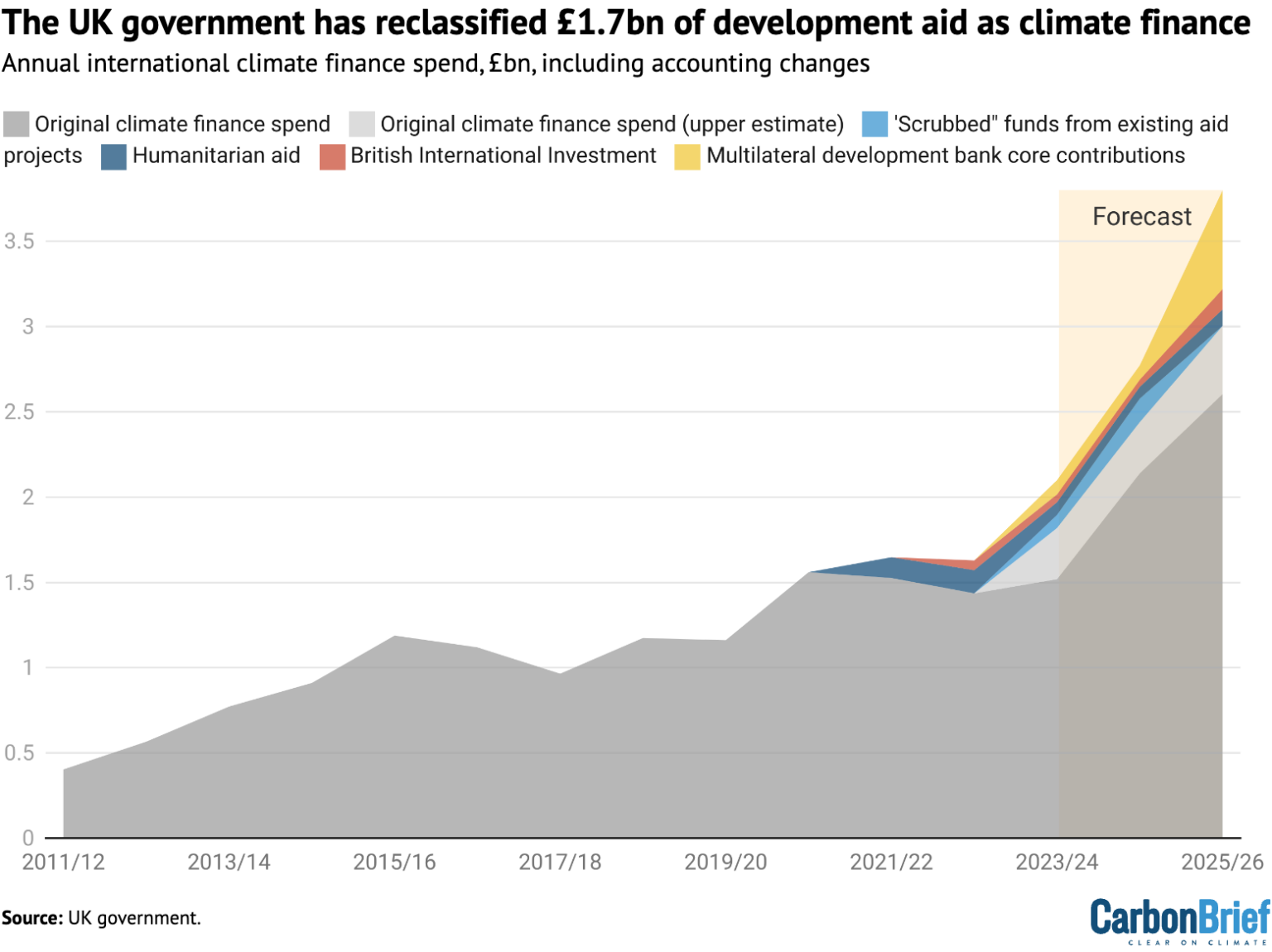
By redefining existing funds pegged for development banks, investment in foreign businesses and humanitarian aid as “climate finance”, the government expects to add £1.72bn to its total.

Experts tell Carbon Brief it is “problematic” and “unjust” to relabel existing funds as climate finance rather than providing new money. One says the UK could meet its target, at least in part, by “double counting development and climate finance”.

The chair of the Least Developed Countries (LDC) group at UN climate talks says the UK’s actions are a “clear deviation from the path to climate justice”.

‘Moving the goalposts’

The UK government has committed to spending £11.6bn on international climate finance (ICF) between 2021-22 and 2025-26. This is the nation’s contribution to climate action in developing countries, which it is obliged to provide under the Paris Agreement

Developed countries, such as the UK, have committed to sending “new and additional” climate finance to developing countries. This is generally interpreted as spending extra money on top of existing foreign aid.

The UK government itself has described the £11.6bn goal as “dedicated ring-fenced funding that is distinguishable from non-climate [aid]”.

However, reports began to emerge in 2023 that the government was not on track to meet its target.

Experts attributed this to the government cutting its overall foreign aid budget. In November 2020, the government suspended a target to give 0.7% of national income as overseas aid – reducing it to 0.5% as a “temporary measure”. 

The government is also spending more of the remaining funds on supporting refugees within the UK. The latest figures show that in 2023, the UK spent more of its aid budget on supporting asylum seekers and refugees in the country than on overseas projects.

In order to remain on track for the £11.6bn goal, development minister Andrew Mitchell announced in October 2023 that the government was changing the way it calculated ICF spending.

This immediately sparked concerns that the government was inflating its climate-finance figures without providing any new aid money for developing countries. Mitchell provided limited details of how the government was getting its target back on track.

More information came in a report released in February by the Independent Commission for Aid Impact (ICAI). It concluded that, by “moving the goalposts”, the government had reclassified £1.72bn of spending as climate finance between 2021-22 and 2025-26.

This figure includes four tranches of funding that had not previously been considered ICF:

  • £746m from assuming that a share of the “core” funding the UK gives to the World Bank and other multilateral development banks (MDBs) will be assigned to climate-related projects.
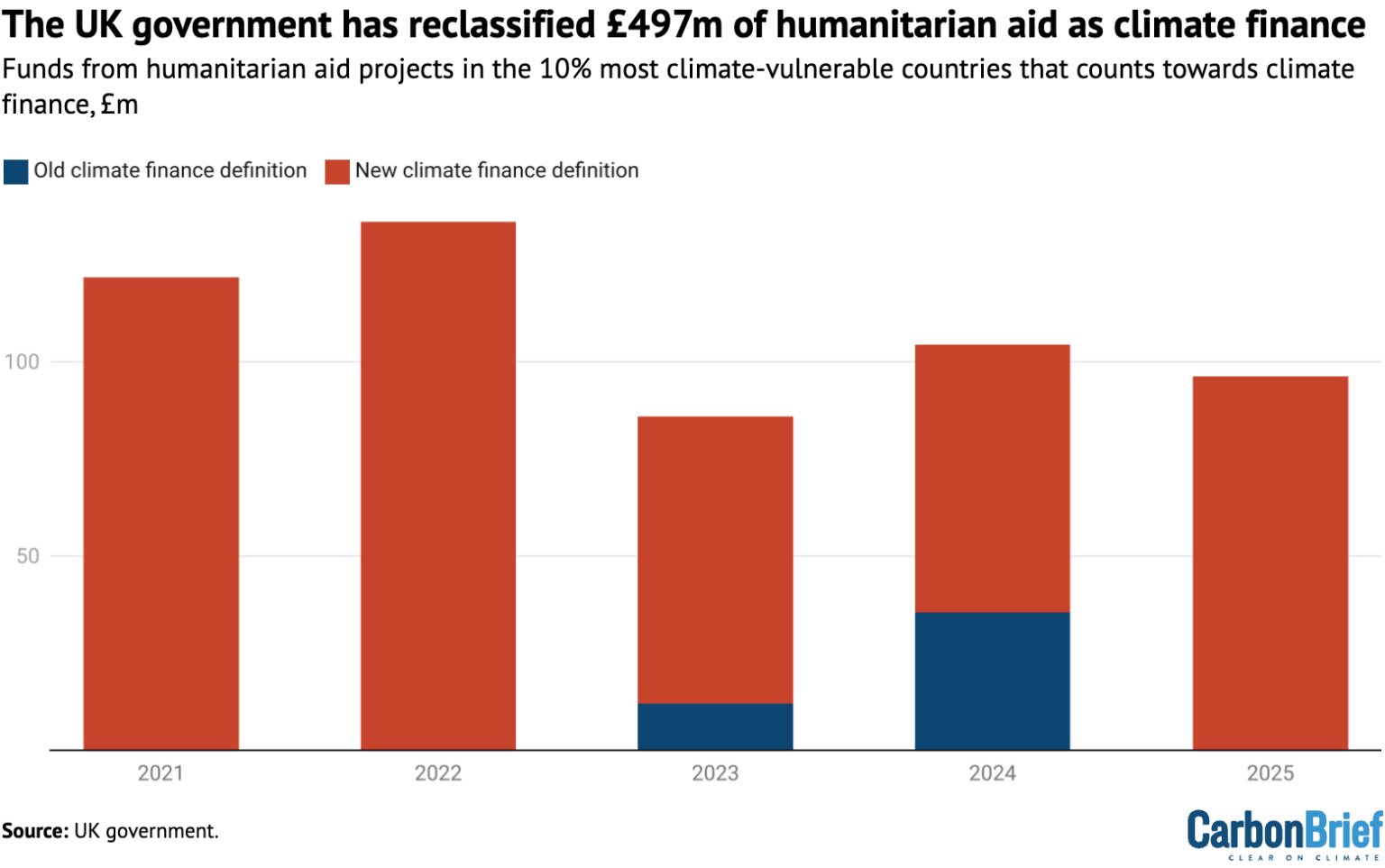
  • £497m from automatically labelling 30% of the humanitarian aid spent in the 10% of countries that are most vulnerable to climate change as ICF.
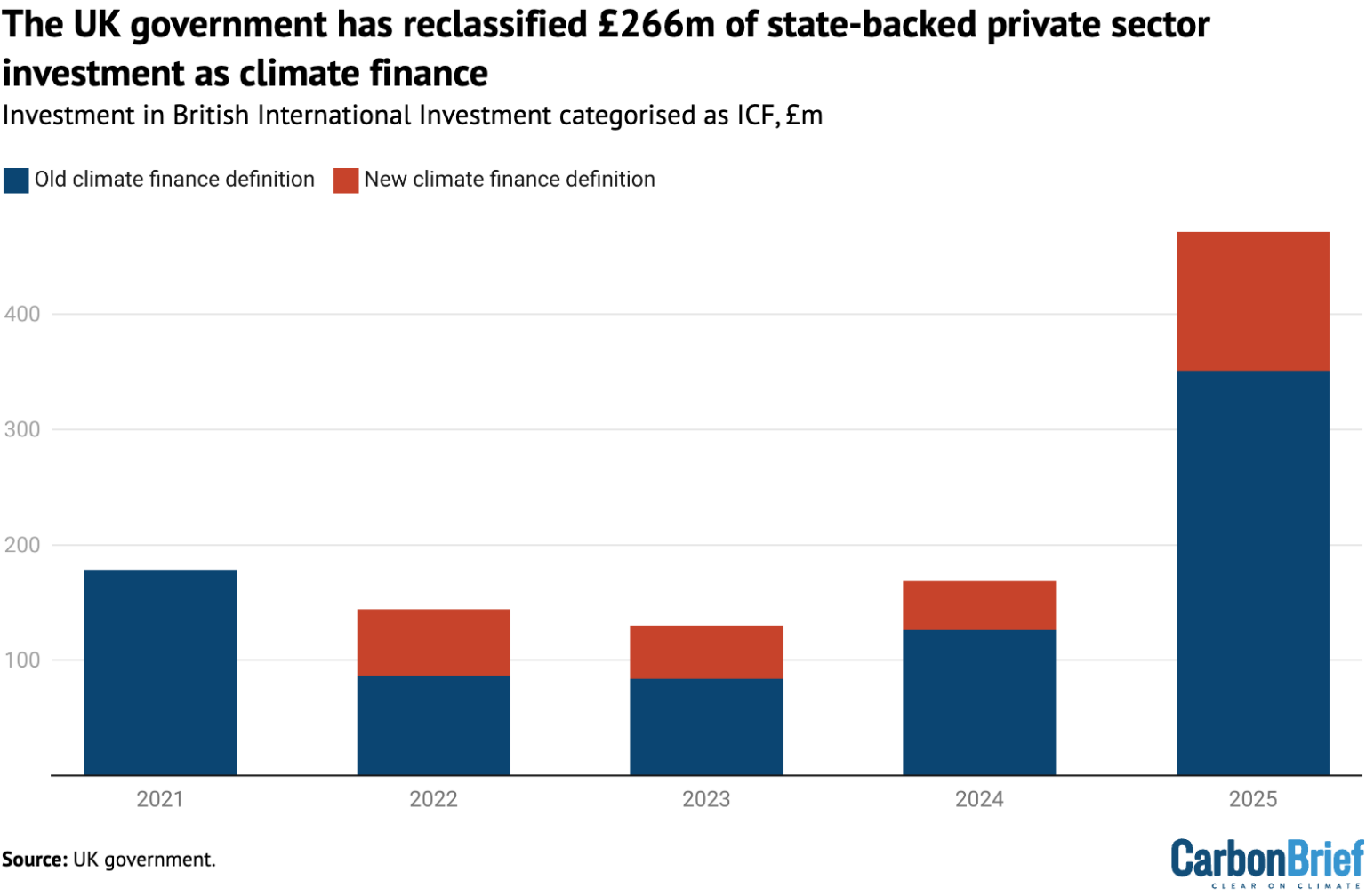
  • An estimated £266m from defining more payments into British International Investment (BII), the UK’s overseas development finance institution, as ICF.
  • £215m from civil servants “scrubbing” the aid portfolio – namely, going back over existing projects and adding any climate-relevant funding they had previously missed.

The figures cited by ICAI are based on unpublished government analysis, which Carbon Brief has now obtained via FOI. 

The analysis includes the annual contributions each of these sources are expected to provide over the period from 2021-22 to 2025-26, which can be seen in the coloured sections of the chart below.

Annual UK ICF spending, £bn, by financial year for the period 2011/12 to 2025/26. The grey area indicates ICF spending under the original accounting methodology used until October 2023. Beyond 2022/23 the figures are forecasts, with the light grey area indicating the upper bound and the darker grey indicating the lower bound. The coloured areas indicate the funding newly reclassified as counting towards ICF, following methodology changes introduced in October 2023. For multilateral development bank contributions, Carbon Brief understands that the UK will pledge £495m to the World Bank in 2025/26, and the remaining contributions that make up the £746m total are spread evenly across the 2011/12-2025/26 period. Source: UK government.

As the chart indicates, even with the methodology changes, the £11.6bn target is still “backloaded”, with a significant uptick in ICF spending required beyond 2023-24 to meet it. 

ICAI notes that, since the government cut its aid spending from the UN-backed benchmark of 0.7% to 0.5% of gross national income (GNI), “serious concerns remain over whether the heavily backloaded spending plan can be delivered”.

Core funding

The largest tranche of redefined ICF – some £740m – comes from the government starting to assume that a share of its “core” MDB funding counts as climate finance.

This is money that the UK government already hands to these organisations to distribute according to their own priorities, primarily through loans. None of this money has previously been counted by the UK government as ICF, even though some went towards climate action.

MDBs, including the World Bank, the African Development Bank (AfDB) and others have placed a growing emphasis on climate change in recent years. The World Bank, for example, has a target of spending 35% of its finance on climate-related projects.

Following the reclassification, the UK government will simply assume that 35% of the money it gives to the World Bank – some £495m of £1.4bn total due in 2025/26 – counts as ICF.

It will use a similar approach for its funding of other MDBs, with these changes adding a total of £740m to the amount of the UK’s aid spending that is classified as ICF.

This move will not result in the UK providing any new funds for climate action, as it was already planning on distributing this money. In fact, the government has cut its spending on MDBs in recent years, due to the overall cut in the UK’s foreign aid budget.

Humanitarian aid

The second-largest tranche of newly reclassified climate finance is from projects in climate-vulnerable countries, an additional £497m of which is being counted as ICF.

The government dataset obtained by Carbon Brief via FOI reveals the 28 humanitarian projects and five more general, country-specific funds that will contribute to this additional £497m. 

The projects are based in some of the poorest and most war-torn countries in the world – Afghanistan, the Democratic Republic of the Congo (DRC), Somalia, Sudan, Uganda, Yemen and Zimbabwe.

They largely focus on essential provisions, such as food and basic infrastructure.

Prior to the recent changes, these programmes would have contributed just £47.5m to ICF, according to the government data released to Carbon Brief.

By automatically counting 30% of their spend as ICF, this figure has now multiplied more than 10 times. The chart below shows, in red, these additional ICF funds.

Annual UK ICF spending, £m, sourced from humanitarian aid projects for the 10% most climate-vulnerable countries, as defined by the Notre Dame Global Adaptation Initiative. Blue columns indicate the ICF spending that was expected from these projects prior to the methodology change, and red columns indicate ICF spending from these projects after the change. Source: UK government.

For the 23 of the 28 projects with documentation available online, Carbon Brief assessed the relevant sections of their “business case and summary” documents for evidence that they were related to climate action.

Many of the project documents reference climate change and say they will provide climate benefits. For example, all four projects in Somalia, a nation that has faced devastating drought and floods in recent years, mention the importance of climate resilience in their work.

However, some of the projects explicitly state that they are not intended to provide climate-finance. 

The summary document for the Assurance and Learning Programme (ALP) in Afghanistan, published in 2021, states: “The programme will not be eligible for ICF nor will it monitor ICF funded programmes.”

Similarly, the Congo Humanitarian, Resilience and Protection (CHRESP) Programme summary document, also published in 2021, notes “we do not anticipate that any of our programming under this programme will be eligible as ICF”.

Another project, titled Yemen: Access, Logistics, Liaison, and Accountability, will provide “few opportunities” to address climate change, according to the summary document. A further four project documents do not contain any reference to climate change. 

Despite this, following the government’s reclassification, these seven projects will collectively contribute £166.9m of UK climate finance in the coming years.

Euan Ritchie, a senior development finance policy advisor at the thinktank Development Initiatives, says blanket approaches to assigning climate finance are “problematic”. He tells Carbon Brief:

“Just because humanitarian aid is going to a country that is vulnerable to climate change doesn’t mean it addresses that vulnerability. And these projects have already been screened for their climate focus.”

He points to one of the projects, the Somalia Humanitarian and Resilience Programme, as an example. Ritchie says, based on International Aid Transparency Initiative data, that officials had already decided around 12% of this programme’s spending was ICF, and asks:

“So what rationale is there for bumping it up to 30%? Were officials wrong the first time?”

Fatuma Hussein, a programme manager at the thinktank Power Shift Africa, tells Carbon Brief such an approach is “unfair and unjust” as it “risks conflating” the “distinct needs” of climate aid and other humanitarian objectives.

In its guidance for categorising what counts as climate finance, the Organisation for Economic Co-operation and Development’s Development Assistance Committee recommends scoring many humanitarian projects “zero”, indicating programmes that “generally do not qualify” as climate aid.

More private investment

The third-largest tranche of reclassified development aid relates to state-backed private sector investment under British International Investment (BII).

The UK government will also now count more of its payments into BII as climate finance, amounting to around an extra £266m by 2025-26. Unlike aid spending, these are investments in the private sector and are expected to yield a financial return for the UK.

Previously, the government counted a fixed 30% of BII spending as climate finance. It now intends to include a higher percentage to reflect a growing focus on climate investments.

The new approach to BII investments assesses the share of each project that should count towards UK climate finance case-by-case, rather than using a blanket 30% share.

It will record 100% of investments in a programme covering the Philippines, Indonesia and other parts of south-east Asia as ICF, as part of the government’s “Indo-Pacific tilt”. Investments in other regions also contribute a higher share of ICF – rising as high as 46% in 2022-23.

The chart below shows the extra BII investment money (red) that now counts as ICF.

Annual UK ICF spending, £m, from British International Investment (BII) contributions. Blue columns indicate the ICF spending that was expected from BII prior to the methodology change and red columns indicate ICF spending from BII after the change. Source: UK government.

The figure above shows that the government expects private sector investment via BII to play an increasingly large role in its climate finance in the future.

Many observers have expressed concerns about the government leaning more on private investment through BII to boost its ICF spending. 

report last year by the parliamentary international development committee criticised BII’s investment in, among other things, fossil fuels and “high-net-worth individuals”.

BII prioritises loans and projects in middle-income nations where there is money to be made, rather than the nations that are most in need of climate finance. 

ICAI highlighted this in its review of the UK’s climate finance commitments earlier this year, stating that private investment “is not always the most appropriate, realistic or preferred form of climate finance in the poorest and most fragile contexts”.

Not new, not additional

Developing countries will require trillions of dollars of investment in the coming years to meet their climate goals. 

To help achieve this, developed countries, such as the UK, are expected to provide finance under the UN climate system that is “new and additional”. Discussions around a new climate finance goal will take centre stage this year at the COP29 climate summit in Baku.

Experts tell Carbon Brief that the UK government’s changes to its ICF undermine the notion that it is providing new, “ring-fenced” funding. Regarding the “arbitrary” labelling of humanitarian funds as ICF, Ritchie says:

“If the UK is counting a fixed share of projects as ICF it can no longer claim that ICF is distinguishable from non-climate [aid].” 

Gideon Rabinowitz, director of policy and advocacy at the international development network Bond, tells Carbon Brief:

“The change of definition means they will be able to reach the target by spending less money than they would have done otherwise through double counting development and climate finance.”

Development NGOs say the best way for the UK to scale up its climate finance would be to return its foreign aid budget to 0.7% of GNI. However, with an election looming, neither the ruling Conservatives nor their Labour challengers have indicated a willingness to do this.

There will be considerable pressure on developed countries in the coming months to commit to providing plentiful, high-quality climate finance in the run up to COP29. 

Evans Njewa, the chair of the LDC group, to which nearly all of the UK’s humanitarian aid ICF recipients belong, tells Carbon Brief:

“Reclassifying existing donor aid as climate finance is a clear deviation from the path to climate justice, and closing the finance gap cannot be achieved this way.” 

Climate-finance reporting has been described as a “wild west”, with countries announcing figures based on vastly different definitions. This has led to nations counting money for coal, hotels and films in their totals, as there is no binding international standard to guide them.

The UK government noted last year that its changes are in line with other countries’ methods. But experts point out that the UK was previously viewed as setting a high standard for other countries to reach. 

In contrast, the new approach “risks breeding cynicism and mistrust because you are going to find programmes that have very little to do with climate change, but end up being reported in the pot as climate finance”, Rabinowitz says.

Hussein agrees, telling Carbon Brief:

“This not only highlights the disparity between western countries’ rhetoric on climate finance and their actual financial commitments to developing countries but also risks undermining trust that underpins global climate action.”

She argues that nations should agree on common definitions and accounting methodologies for climate finance to ensure that governments cannot backslide as the UK has.

Responding to Carbon Brief’s questions about the government’s methodology changes, a spokesperson from the Foreign, Commonwealth and Development Office (FCDO) said:

“Since 2011, UK funding has helped more than 100 million people cope with the effects of climate change, given 70 million people access to clean energy and reduced or avoided over 86m tonnes of greenhouse gas emissions.

“The UK remains on track to meet the £11.6bn international climate finance commitment.”

Original article by JOSH GABBATISS republished from Carbon Brief under a CC license.

Continue ReadingRevealed: UK ‘double counting’ £500m of aid for war-torn countries as climate finance

Calls for De-Escalation Mount as Israel Plans to ‘Exact a Price From Iran’

Spread the love

Original article by JESSICA CORBETT republished from Common Dreams under Creative Commons (CC BY-NC-ND 3.0).

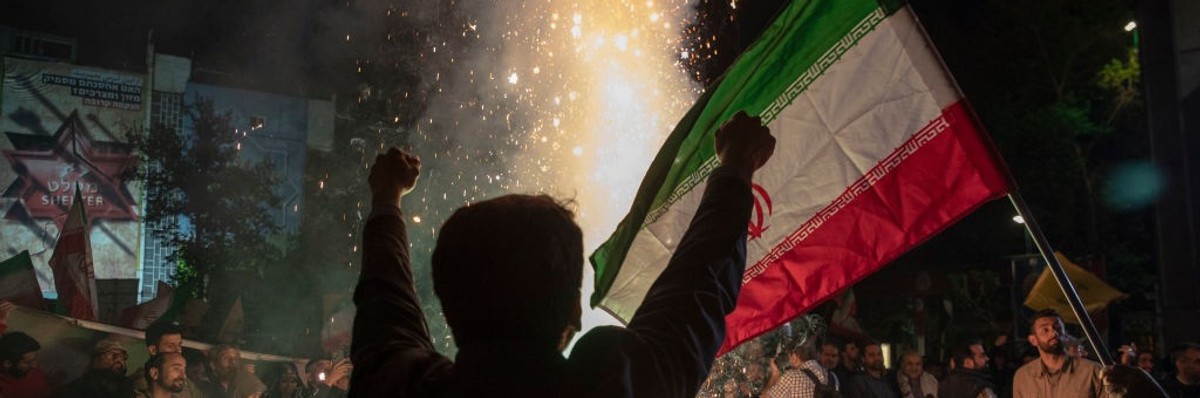
Iranians gather in support of the Islamic Revolutionary Guard Corps’ retaliatory attack on Israel on April 14, 2024 in Tehran.
 (Photo: Majid Saeedi/Getty Images)

“Now is the time for restraint and diplomacy, not more unconditional support for military escalation,” said one advocate.

Since Iran on Saturday sent hundreds of drones and missiles—which were mostly shot down—toward Israel to retaliate for an Israeli bombing of the Iranian consulate in Syria, anti-war voices around the world have called for de-escalation efforts.

“We are deeply concerned that Iranian retaliatory strikes following Israel’s April 1 attack on its diplomatic compound in Damascus will move the region even further from the path to peace and security,” said Jamal Abdi, president of the National Iranian American Council. “The launch of a significant attack on Israeli territory from Iran is without recent precedent and, unless there is a serious effort towards deconfliction, may confirm that Iran, Israel, and the United States are in the midst of the regional war that so many have feared.”

“We call on the Biden administration to exercise the United States’ considerable diplomatic leverage to restrain Israel and Iran to ensure this conflict does not spiral further out of control,” he continued. “Far too many innocents have already suffered in the war that began October 7, and the cycle of violence and inhumanity must be broken.”

“What’s at stake is nothing less than stopping a regionwide war in the Middle East, which the United States would surely be drawn into.”

Israeli Prime Minister Benjamin Netanyahu responded to the Hamas-led October 7 attack on Israel with an assault of the Gaza Strip called plausibly genocidal by the International Court of Justice. Israeli forces have killed at least 33,729 people, wounded 76,371 more, and obliterated civilian infrastructure, displacing most of the 2.3 million Palestinians who live in the besieged enclave.

Blasting Iran’s Saturday attack on Israel as “another unacceptable turn in a dangerous escalation spiral,” Win Without War executive director Sara Haghdoosti said that and U.S. President Joe Biden and senior administration officials “must use all their diplomatic heft and leverage to prevent further violence.”

“What’s at stake is nothing less than stopping a regionwide war in the Middle East, which the United States would surely be drawn into. There are no military solutions to this crisis—only diplomatic ones,” she stressed. “The Israeli government’s destructive and failing campaign in Gaza has driven violent instability throughout the Middle East, which was further exacerbated by Prime Minister Netanyahu’s reckless attack on the Iranian embassy in Damascus. And the Iranian government’s own inexcusable retaliation, which we utterly condemn, has put the lives of people across the region—including communities in Israel, Palestine, Lebanon, Syria, and Iran—at terrible risk.”

While repeatedly urging the the Israel Defense Forces to more precisely target militants in Gaza over the past six months, the Biden administration has also opposed multiple United Nations cease-fire resolution and sent more weapons to Israeli troops while pushing for a support package worth more than $14 billion—on top of the $3.8 billion in annual military aid that the United States gives to Netanyahu’s government.

“Preventing a regional war must be the top imperative and this may mean that Joe Biden must finally say ‘no’ to Israel and Netanyahu,” argued Abdi. “Biden’s bearhug approach towards Israel has completely failed and has put the U.S. at the risk of entering a war of choice—Netanyahu’s choice. Israel launched a military attack on a diplomatic compound, violating international law and all but guaranteeing an Iranian response.”

“Netanyahu appears eager to extend and expand the disastrous war in Gaza and draw the U.S. into a regional war and, by continually abetting the war and enabling Israel’s worst instincts, Biden may have granted Netanyahu’s wish,” he said. “Now is the time for restraint and diplomacy, not more unconditional support for military escalation. President Biden must put his foot down to do what’s necessary to prevent further military engagement between Israel and Iran and to demand a cease-fire to end the humanitarian tragedy in Gaza.”

Israel this weekend fended off most of the Iranian drones and missiles with help from Jordan, the United Kingdom, and the United States. Benny Gantz—a member of the Israeli War Cabinet with Netanyahu and Defense Minister Yoav Gallant—said Sunday that his nation now intends to “build a regional coalition and exact a price from Iran, in a way and at a time that suits us.”

Biden publicly reaffirmed “America’s ironclad commitment to the security of Israel” but a White House official also confirmed to Reuters that during a call with Netanyahu, the president made clear the U.S. will not join any military offensives against Iran.

Denouncing the Iranian Islamic Revolutionary Guard Corps’ retaliation against Israel, Center for International Policy president and CEO Nancy Okail said Sunday that “escalatory actions by both countries threaten to fan the flames of conflict throughout the region, endangering the lives of millions.”

“We appreciate the apparent advance diplomatic efforts by the United States and others behind the scenes—as well U.S., U.K., and Jordanian participation in air defense measures—to minimize the impact of Iran’s attack,” she continued. “Prioritizing civilian protection and de-escalation was clearly the right approach and should continue to serve as the international community’s objectives in the critical days and weeks ahead.”

Okail emphasized that “achieving those goals requires not only arresting the escalation of violence between Israel and Iran, but securing a cease-fire in Gaza that halts the killing of civilians, releases the hostages, allows vital humanitarian aid to actually reach those who need it, and lowers tensions in the region. The continued unconditional supply to the Netanyahu government of the arms it is using in Gaza undermines those objectives, as well as U.S. and international law.”

“Netanyahu’s repeated disregard of U.S. red lines in Gaza, moves to deepen permanent occupation in the Palestinian territory, and escalation with Iran are destabilizing the entire region,” she added. “With American forces already drawn into hostilities with the Iranian-backed Houthis and actively engaging Iranian missiles and drones, President Biden cannot afford to let the extremist prime minister continue to have a harmful, undue influence on the course of events. Hopefully, the president’s efforts have averted a wider regional war with Iran; we urge him to bring that same level of effort to save the people of Gaza.”

Trita Parsi, an expert on Iran and the Middle East and EVP at the Quincy Institute for Responsible Statecraft, said that “if you give Biden (deservingly) credit for having helped prevent the region from falling off the cliff last night, you must also give him credit for helping bring the region to the edge of the cliff in the first place by refusing to restrain Israel and blocking a cease-fire.”

Original article by JESSICA CORBETT republished from Common Dreams under Creative Commons (CC BY-NC-ND 3.0).

Continue ReadingCalls for De-Escalation Mount as Israel Plans to ‘Exact a Price From Iran’

Greepeace future under threat following legal action by oil giants

Spread the love

https://morningstaronline.co.uk/article/greepeace-future-under-threat-following-legal-action-oil-giants

A Shell logo at a petrol station

ENVIRONMENTAL campaign group Greenpeace has warned that its future is under financial threat because of legal action by oil giant Shell.

It says its work in Britain and internationally will be in jeopardy if it loses a court case in which the company is demanding $1 million (£803,000) in damages after activists occupied a drilling platform being towed in the Atlantic last year.

The occupation attracted international attention.

The case is due to go to trial in July.

Greenpeace says it is facing similar legal action by “Big Oil” companies in the United States and Italy and has launched an appeal for donations to help it fight in court.

Ian Duff, who heads Greenpeace’s “Stop Drilling, Start Paying” campaign, said: “Greenpeace is under attack globally like never before.

“Right now, our colleagues in Italy, the USA, and here in the UK are all targets of intimidation lawsuits from oil giants, strategically deployed with one aim: silence anyone brave enough to stand up to their planet-wrecking business.”

“Let’s be clear — it’s not about the money,” he said. “Shell makes the $1 million it is suing us for every half an hour.

https://morningstaronline.co.uk/article/greepeace-future-under-threat-following-legal-action-oil-giants

Continue ReadingGreepeace future under threat following legal action by oil giants

Government drags Britain a step closer to war in the Middle East

Spread the love

https://morningstaronline.co.uk/article/government-drags-britain-a-step-closer-to-war-in-the-middle-east

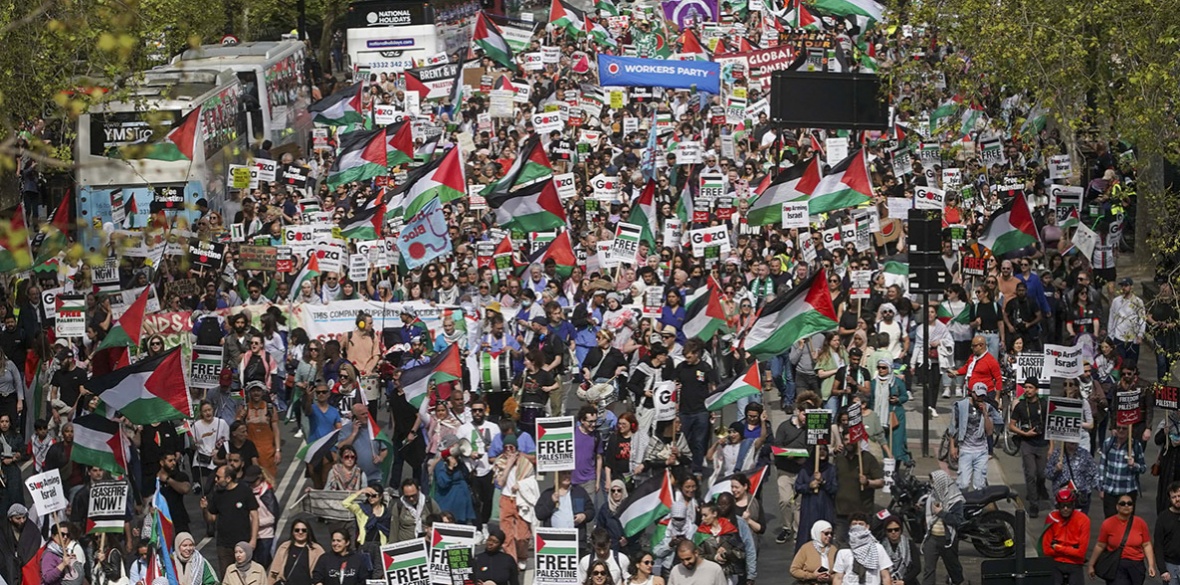
People take part in a pro-Palestine march in central London organised by the Palestine Solidarity Campaign, April 13, 2024

THE British government dragged the nation a step closer to war in the Middle East after the Prime Minister admitted today it had sent RAF fighter jets to shoot down Iranian drones and missiles.

The escalation of the Iranian and Israeli tensions over the weekend prompted calls for “a halt to this terrifying slide to wider conflict” in addition to the continuing demands by tens of thousands of protesters for a ceasefire in Gaza.

But Labour leader Sir Keir Starmer said that while supporting “all measures designed to restore calm” and prevent a wider regional war, “we continue to stand up for Israel’s security and that of our other partners in the region.”

And shadow home secretary Yvette Cooper supported the government’s decision to involve the RAF.

https://morningstaronline.co.uk/article/government-drags-britain-a-step-closer-to-war-in-the-middle-east

Continue ReadingGovernment drags Britain a step closer to war in the Middle East