Prospective GB News Board Member is Fossil Fuel Investor

Spread the love

Original article by Adam Barnett and Sam Bright republished from DeSmog.

Conservative peer and prospective GB News board member Lord Theodore Agnew. Credit: GB News / YouTube

Lord Agnew is a shareholder in Equinor, the Norwegian oil and gas firm behind the ‘carbon bomb’ Rosebank oil field.

A Conservative peer who is expected to join the board of broadcaster GB News has shares in Equinor, the oil and gas multinational behind the Rosebank oil field in the North Sea. 

According to his parliamentary register of interests, Lord Theodore Agnew has shares of at least £100,000 in Equinor, the Norwegian state-owned energy producer. Equinor has a majority stake in the Rosebank North Sea oil field, which has been dubbed a “carbon bomb” by environmental law charity ClientEarth. 

Agnew is set to replace hedge fund millionaire Paul Marshall on the board of GB News’s parent company All Perspectives Ltd, according to Sky News. 

Marshall is one of the key backers of GB News, holding a 45 percent stake in the company. He is reportedly planning to step back from GB News in order to launch a bid for the Telegraph Media Group, which includes The Telegraph newspaper and The Spectator magazine. 

His withdrawal could potentially throw GB News into turmoil. The startup broadcaster has lost £76 million since its launch in 2021 and relies on the resources of Marshall and its other big stakeholder, UAE-based investment firm Legatum, to survive. Sky News reported that GB News is now preparing to make job cuts as part of a “corporate reorganisation”.

This may have implications for how climate change is covered in the UK. An investigation by DeSmog found that one in three GB News presenters had spread climate science denial on air in 2022, while more than half had attacked climate action.

“It comes as no surprise that members of the GB News board have ties to the oil and gas industry, given the way its presenters have championed continued oil and gas expansion,” said Tessa Khan, director of environmental non-profit Uplift. 

Agnew, a former Cabinet Office minister under Boris Johnson, was in October appointed chair of UnHerd Ventures, another Marshall media vehicle. The company runs UnHerd, a publication founded in 2017 to give a platform to marginalised views.

Agnew also has shares in Carbon Plus Capital, a private investment company which specialises in carbon offsetting “based on the protection of forests”. This involves companies paying to plant trees to “offset” their greenhouse gas emissions. 

Carbon offsetting is a controversial idea that has been criticised by climate campaigners as a form of greenwashing. An investigation published last year by newspapers The Guardian, Die Zeit and non-profit SourceMaterial found that 90 percent of rainforest carbon offsets approved by the world’s largest certifier Verra were “largely worthless” and could actually increase global heating. 

Carbon Plus Capital partner Robin Warwick Edwards is a trustee of the Institute of Economic Affairs (IEA) think tank and the chair of its advisory council. The IEA, a free market group that has advocated for more fossil fuel extraction, received funding from BP for at least 50 years. 

Agnew and Edwards declined to comment. GB News did not respond. 

“Climate denial and investment in the fossil fuel industry go hand in hand”, said Carys Boughton of campaign group Fossil Free Parliament. 

“It makes complete sense that an expected new board member of GB News – a channel absolutely committed to attacking climate science and policy at every turn – is invested in Equinor, a company that, according to research by Oil Change International, ranks eighth worst in the world for its commitment to expanding oil and gas production.”

She added: “By spreading disinformation about the climate crisis, GB News is feeding into the fossil fuel industry’s licence to operate and thus helping to line the pockets of the industry’s shareholders.”

GB News in Turmoil

GB News hosts regularly attack climate policies and the science behind them. 

Numerous GB News presenters have also been vocal about their support for policies that would maintain and even extend the UK’s reliance on oil and gas. 

On 9 December 2022, host Mark Dolan praised West Cumbria Mining’s plan to open a new coal mine in Cumbria. He said the UK should “drill, baby, drill” for coal, oil and gas,  adding: “I think the push for net zero here is another element of liberal progressivism which is infecting the West.”

DeSmog revealed in October that Marshall Wace, the hedge fund run by Paul Marshall, had £1.8 billion invested in fossil fuel companies as of June 2023. This included Chevron, Shell, Equinor, and 109 other fossil fuel companies. 

Marshall reportedly invested £10 million in GB News when it first launched two years ago and, in August 2022, joined the Dubai-based investment firm Legatum Group in a £60 million capital injection and buyout of GB News’s other major investor, Discovery. 

If he joins the All Perspectives board, Agnew would become the latest Conservative politician to be adopted by the right-wing broadcaster. GB News hosts include Jacob Rees-Mogg, who was business and energy secretary under Liz TrussLee Anderson, a former Tory deputy chair who defected to anti-net zero party Reform UK last month, as well as Conservative MPs Esther McVey and Philip Davies.  

The All Perspectives board also includes Tory peer Baroness Helena Morrissey and George Farmer, a Reform UK donor and the son of Conservative peer Lord Michael Farmer. 

GB News reported losses of £42 million in the year to May 2023, and £76 million since its launch in 2021. This comes as rival populist channel TalkTV is closing its TV operation and switching to YouTube, having suffered losses of £90 million since it launched in 2022. 

Agnew’s appointment has not been confirmed by Marshall, Agnew or the company. 

“With advertisers steering clear, GB News is haemorrhaging cash – yet they continue to push misleading messages on climate change,” said Richard Wilson, director of the Stop Funding Heat campaign.  

“In the last month alone, GB News commentators have claimed climate change is a ‘social mania’, dismissed climate harms as ‘hypothetical’, and attacked United Nations warnings about the need for urgent climate action as ‘hysteria’.

“Now we learn that a prospective GB News board member has fossil fuel investments”.

He added: “Britain urgently needs a media that supports the public interest – not the interests of a toxic industry that is putting all of our futures at risk”.

Fossil Fuel Projects

Equinor claims it supplies 27 percent of the UK’s energy from oil and gas, and is currently investing $6 billion (£4.8 billion) a year in fossil fuel exploration and drilling. It also says that it powers one million homes in Europe via renewable offshore wind. 

Rosebank is the UK’s largest undeveloped oil and gas field, and could produce around 300 million barrels of oil over its lifetime, emitting 200 million tonnes of carbon dioxide. 

In October, DeSmog revealed that Equinor urged the UK government to help promote the oil and gas industry, and was one of several companies which lobbied to water down the windfall tax on oil and gas company profits following Russia’s invasion of Ukraine. 

The UK government controversially approved the Rosebank project in September, despite the International Energy Agency stating that new oil and gas exploration is incompatible with the ambition to reach net zero emissions by 2050. Green Party MP Caroline Lucas labelled the decision “morally obscene”.

Prime Minister Rishi Sunak used his address at the COP28 climate summit in December to claim that “climate politics is close to breaking point”, while stating that the UK will meet its net zero targets, “but we’ll do it in a more pragmatic way, which doesn’t burden working people”.

However, a 2023 court case found that the government’s plans only added up to 95 percent of the reductions needed to meet its net zero targets. The Conservative government has said it plans to “max out” the UK’s North Sea oil and gas reserves.

Tessa Khan added: “Those pushing for new oil and gas drilling, whether that’s the UK government, GB News or Equinor, are making things worse for the millions struggling with high energy bills and for those now struggling to cope with the impacts of climate change such as UK farmers – and all just to make a few oil and gas companies and their shareholders even richer.”

DeSmog has previously revealed that the Conservative Party received £3.5 million in donations from fossil fuel interests and climate science deniers in 2022, while two-thirds of the directors in charge of the party’s multi-million-pound endowment fund have a financial interest in oil, gas, and highly polluting industries.

Original article by Adam Barnett and Sam Bright republished from DeSmog.

Image of InBedWithBigOil by Not Here To Be Liked + Hex Prints from Just Stop Oil's You May Find Yourself... art auction. Featuring Rishi Sunak, Fossil Fuels and Rupert Murdoch.
Image of InBedWithBigOil by Not Here To Be Liked + Hex Prints from Just Stop Oil’s You May Find Yourself… art auction. Featuring Rishi Sunak, Fossil Fuels and Rupert Murdoch.
Continue ReadingProspective GB News Board Member is Fossil Fuel Investor

Welsh UKIP general election candidate calls Angela Rayner a ‘slag from Bolton’

Spread the love

https://nation.cymru/news/welsh-ukip-general-election-candidate-calls-angela-rayner-a-slag-from-bolton/

Stan Robinson (left) and Dan Morgan (right). Image: Voice of Wales

A foul-mouthed fascist who will be UKIP’s Westminster candidate for Llanelli at the next general election has been condemned for referring to Labour’s deputy leader Angela Rayner as a “common oik” and a “slag from Bolton”.

Stan Robinson made the comments during a vlog he presented with his fellow “Voice of Wales” activist Dan Morgan, a convicted fraudster who was given a suspended prison sentence for his role in a multi-million-pound insurance scam that saw people duped into paying up-front fees with the promise of refunds that never materialised.

During a rant about Richard Tice, the leader of Reform UK, which is polling far higher than UKIP, Robinson refers to former Tory deputy chairman Lee Anderson, who recently defected to Reform, saying: “They’re so inextricably tied together, it’s like Sir Keir Starmer and Angela Rayner, a common oik. In order to personify [sic – presumably he means pacify] the working class, they have to have the slag from Bolton on.”

Ineptitude

Robinson’s rudeness is matched by his geographical ineptitude. Ms Rayner doesn’t come from Bolton. She was born in Stockport, on the other side of Manchester, and is the MP for nearby Ashton-under-Lyne.

In the vlog, Robinson also makes a fool of himself by confusing the Sussex constituency of Lewes with the Scottish island of Lewis.

https://nation.cymru/news/welsh-ukip-general-election-candidate-calls-angela-rayner-a-slag-from-bolton/

Continue ReadingWelsh UKIP general election candidate calls Angela Rayner a ‘slag from Bolton’

Sevim Dağdelen: the double standards of the West are on full display at the ICJ

Spread the love

Original article by Sevim Dağdelen republished from peoples dispatch under a Creative Commons Attribution-ShareAlike 4.0 (CC BY-SA) license.

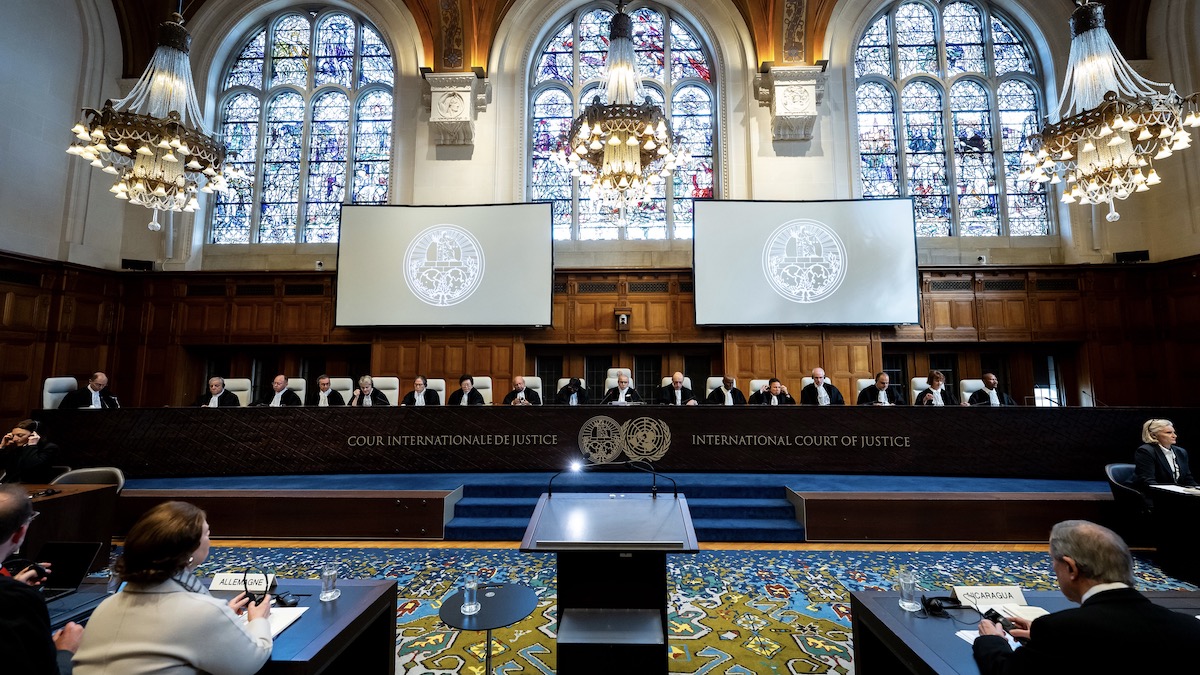
Public ICJ hearing on Nicaragua’s case against Germany. Photo: ICJ

The German MP writes that the response of Germany to Nicaragua’s charges of aiding and abetting genocide in Gaza has been to downplay its role in supplying arms and question the premise that genocide is already taking place

The German government’s appearance before the International Court of Justice in the proceedings for aiding and abetting genocide and violations of international humanitarian law in Gaza is a lesson in Western double standards. On April 8 and 9, Germany sat in the dock in The Hague after Nicaragua filed a case at the highest UN judicial body.

The 43-page document accuses Germany of failing to fulfill its obligations under the Genocide Convention to prevent genocide. Essentially, Germany is accused of aiding and abetting genocide and violating international humanitarian law with its political, financial, and military support for Israel as well as by ceasing to fund the United Nations Relief and Works Agency for Palestine Refugees (UNRWA). In view of the urgency of the situation, Nicaragua requested five interim measures to prevent the facilitation of genocide. These include the demand that Germany stop supplying arms to Israel and resume payments to UNRWA to ensure sufficient humanitarian aid for the Palestinian population.

Does arming a state committing genocide make you an accomplice?

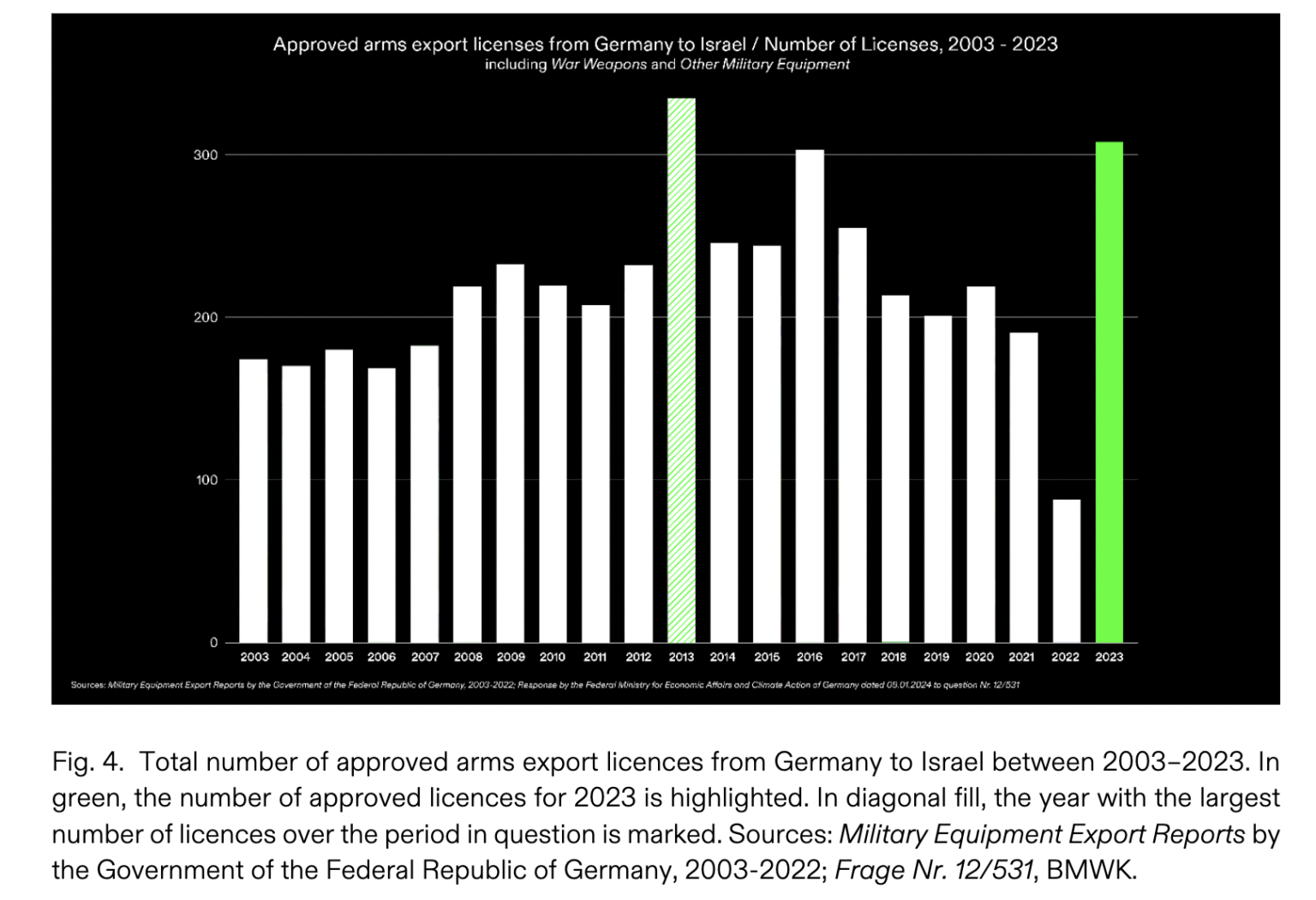
The arguments put forward by the German government in its defense were unconvincing. With a flood of PowerPoint slides, the German representation initially tried to play down the significance of Germany’s arms deliveries to Israel. It argued that the majority of the arms export licenses issued after October 7 were for so-called “other military equipment” (“sonstige Rüstungsgüter”) and only a relatively small proportion for so-called “weapons of war” (“Kriegswaffen”). This was an attempt to deceive the court and the public. For what the German defense failed to mention was the fact that this invented distinction between “other military equipment” and “weapons of war” is a specific feature of German arms export control. Contrary to what the terminology suggests, the category of “other military equipment” can also include weapons that can be used for warfare.

Germany is Israel’s second largest arms supplier after the USA. According to data from the Stockholm International Peace Research Institute (SIPRI), German weapons have accounted for 30% of Israeli arms imports in the last five years. Licenses for new arms exports also increased in 2023. In total, the German government approved the export of weapons to Israel worth EUR 326.5 million – a tenfold increase compared to the previous year. These licenses, most of which were issued after October 7, 2023, include war weapons worth 20 million euros. While the German government tried to justify the approval of 500,000 rounds of ammunition for machine guns with the difficult-to-verify claim that they had been supplied for training purposes, it could not deny the possible use of the approved 3,000 portable anti-tank weapons in war.

Instead, the German government attempted to justify this by arguing that these and the majority of other export licenses had been issued in October 2023, before the war and the humanitarian catastrophe in Gaza had come to a head. This argument ignores the fact that it must have been clear to the world public – and therefore also to the German government – just a few days after October 7 that the partially far-right Israeli government under Prime Minister Netanyahu would use the horrific attack by Hamas as an opportunity to wage a ruthless war against the Palestinian civilian population, committing numerous war crimes that go far beyond any right to self-defense.

It’s not genocide, yet

It was striking that the German government did not even attempt to dispute Nicaragua’s presentation of facts about the extensive violations of international humanitarian law by Israel. Apparently, it also realized that the terrible humanitarian catastrophe caused by Israel’s war, which has killed more than 33,000 people, including more than 13,000 children, can hardly be denied.

The German defense therefore focused on the formalistic argument that the existence of genocide had not yet been established and that Germany could therefore not be found guilty of aiding and abetting genocide. In doing so, however, the German government fails to recognize the central obligation under international law that arises from the Genocide Convention – namely to prevent genocide. This is all the more significant as the ICJ issued protection orders in the case of South Africa against Israel in order to prevent the danger of genocide, which the court considered plausible. Even Israel’s blatant disregard of these orders to protect the Palestinian civilian population has not led to the German government abandoning its unconditional support for Israel.

This shows the absurdity and hypocrisy of the actions of the German government as well as the governments of numerous other NATO states: On the one hand, they ignore all the findings of the most important bodies of the United Nations about Israel’s most serious war crimes and the danger of genocide and, regardless of this, continue to provide unconditional support for Israel’s war. On the other hand, the German government and other Western donor states decided to stop funding UNRWA solely on the basis of unverifiable insinuations by the Israeli government about the alleged involvement of individual UNRWA employees in the Hamas attack on October 7, 2023. The requirements for subjecting 2.2 million people in the Gaza Strip, who depend on UNRWA aid for their daily survival, to collective punishment are apparently lower than for stopping the supply of weapons that could be used to commit genocide. This can hardly be surpassed in terms of cynicism.

Against this backdrop, the German government’s attempt to defend itself before the ICJ by claiming that it had warned Israel of a military offensive on Rafah is hardly credible. In this sense, the German Foreign Minister Annalena Baerbock boasted to the German Parliament just a few days ago that she had already traveled to the region seven times and called on the Israeli government to respect the humanitarian needs of the Palestinian civilian population.

I asked the Federal Foreign Minister in the plenary session of the German Bundestag whether the Federal Government would consequently now declare a ceasefire on Israel, as the UN Human Rights Council recently called for in a resolution, due to Israel’s blatant disregard for these calls and in view of the announcement of a ground offensive in Rafah and the bloodbath to be expected as a result. The German government representative’s verbose answer can be summarized in one word: No.

Like the Foreign Minister, the German legal representation in The Hague gave the impression that the German raison d’état of unconditionally defending Israel was above international law. Threats from Berlin against the most important judicial body of the United Nations that it would no longer be credible if it ruled against Germany fit into this picture. If the German government only accepts international law when it appears to be advantageous for its own government action, it has finally reached the level of the leading NATO member, the US, which has long understood international law only as an instrument of interest-driven politics.

Regardless of how the court decides, Germany and the West must finally fulfill their obligation to prevent genocide and war crimes in order to lend weight to the demand for an immediate ceasefire in Gaza. The consequences of Western double standards, which seem to have reached a temporary climax in the Gaza war, are fatal. Not only does it lead to the West losing its last remnants of credibility in the eyes of the world. Above all, it promotes the erosion of international law, diplomacy and the United Nations as civilizational achievements for the protection of human life and the preservation of peace.

Sevim Dağdelen is a member of the German Bundestag and foreign policy spokesperson for the group “Alliance Sahra Wagenknecht”. She was the only parliamentary observer at the hearings in Nicaragua’s lawsuit against Germany before the ICJ.

Original article by Sevim Dağdelen republished from peoples dispatch under a Creative Commons Attribution-ShareAlike 4.0 (CC BY-SA) license.

Continue ReadingSevim Dağdelen: the double standards of the West are on full display at the ICJ

‘Genocidal Actions’ Persist in Gaza as Israel Blocks Aid and US Weapons Flow

Spread the love

Original article by JULIA CONLEY republished from Common Dreams under Creative Commons (CC BY-NC-ND 3.0). 

Palestinian children, holding banners and empty bowls, gather to protest the food shortages in the city due to Israel’s attacks and blockade on humanitarian aid on March 12, 2024 in Gaza City, Gaza. (Photo: Omar Qattaa/Anadolu via Getty Images)

“President Joe Biden must act now to make famine prevention a top priority and be prepared to deploy meaningful U.S. leverage—including pausing arms sales,” said two humanitarian aid group leaders.

A week after Israeli officials promised the Biden administration they would open a border crossing and a port to allow humanitarian aid into Gaza, relief organizations and the United Nations reported Friday that life-saving supplies are still being blocked, and warned that the White House must take more decisive action to force Israel to stop starving Palestinians.

The U.N. reported that just 212 aid trucks entered Gaza on Tuesday, far lower than the 467 reported by Israeli Defense Minister Yoav Gallant, who promised to “flood Gaza with aid” after a tense phone call between Prime Minister Benjamin Netanyahu and U.S. President Joe Biden last Thursday.

The phone call came in response to Israel’s bombing of a World Central Kitchen aid convoy that killed seven aid workers. On the call, Biden reportedly threatened to halt weapons deliveries unless a surge in humanitarian aid was allowed into Gaza.

But as The Guardian reported Friday, the Ashdod port has not been opened yet, and instead of opening the Erez crossing last Sunday as promised, Israel has opened another crossing into northern Gaza but has not yet allowed U.N. agencies to use it.

“Netanyahu scammed Biden again: A week after he promised to open the Erez crossing and Ashdod port to increase aid to Gaza, the [Israel Defense Forces] & port authorities say they NEVER received any instructions of this nature,” said Muhammad Shehada, communications chief for Euro-Med Human Rights Monitor, citing reporting from Israel’s N12 channel.

The Guardianreports that Israel has set an ultimate target of 500 aid trucks per day to enter Gaza—the same amount that delivered relief to residents before the Israeli bombardment rendered the enclave’s food system, healthcare facilities, and other public services inoperable.

“The call for 500 trucks, with a combination of commercial and humanitarian shipments, is the absolute minimum,” Juliette Touma, communications director for the U.N. Relief and Works Agency for Palestine Refugees in the Near East (UNRWA) toldThe Guardian. “Probably what Gaza needs is at least 1,000 trucks a day.”

The U.N. found that just 141 aid trucks entered the enclave on Wednesday. The Washington Postreported that Israeli authorities have blocked aid deliveries containing items such as chocolate croissants, maternity kits, sleeping bags, stone fruits, and oxygen cylinders.

Jamie McGoldrick, the U.N. humanitarian coordinator, said Friday that “very limited” aid deliveries have continued to contribute to low birth weights in babies who have been born in northern Gaza in recent weeks.

“It’s very easy for Israel to say, ‘We’ve sent you 1,000 trucks so please deliver them inside Gaza,'” McGoldrick said, noting that Israel has held trucks up at checkpoints “for hours” and that many roads are not open to deliveries.

“At no point in time in the last month and more have we had three or even two of those roads working at the same time simultaneously,” said McGoldrick.

The news that Israel has not allowed a “flood” of aid into Gaza since Biden threatened Netanyahu with an end to weapons transfers came days after Samantha Power, administrator of the U.S. Agency for International Development (USAID), admitted to U.S. Rep. Joaquin Castro (D-Texas) that reports of famine in parts of Gaza are now “credible.”

Save the Children confirmed on April 2 that at least 27 children have died of starvation and disease as a result of Israel’s blockade, and U.N. agencies said in February that 5% of children under age 2 were acutely malnourished.

At least 33,634 Palestinians in Gaza have been killed by Israeli forces since October, with U.S. weapons used in much of the bombardment.

At Foreign Affairs on Friday, Refugees International’s president, Jeremy Konyndyk, and vice president for programs and policy, Hardin Lang, wrote that “as negotiations about a econd cease-fire and hostages-for-prisoners swap gain steam, the United States has a crucial opportunity to press Israel to change course and allow a major famine-prevention effort.”

Namely, they said, Biden must make good on his threat to cut off Israel’s military aid—of which the U.S. is the largest international provider.

“The United States is likely the only outside power that can ensure a famine is avoided, given the leverage it has with its ally Israel,” they wrote. “U.S. President Joe Biden must act now to make famine prevention a top priority and be prepared to deploy meaningful U.S. leverage—including pausing arms sales—if the Israeli government does not comply. Famine would not only constitute a humanitarian cataclysm; it would also represent a geopolitical failure that would damage U.S. credibility in the Middle East for years to come.”

Konyndyk and Lang’s call was echoed by the Council on American-Islamic Relations (CAIR), which said Power’s comments must push the president to take action.

“Inducing a famine by besieging an entire population and slaughtering innocent civilians are acts which no one can ignore, let alone justify,” said CAIR national executive director Nihad Awad. “President Biden and his administration are enabling this famine and the deliberate cruelty targeting the Palestinian people in Gaza. He must take action to prevent further atrocities by demanding an immediate cease-fire, securing full access to humanitarian aid, ending all weapons transfers and other funding for Israel, and holding the war criminals in the Netanyahu government accountable for their genocidal actions.”

Also on Friday, a U.S. coalition of groups including the Working Families Party, the Service Employees International Union, and the National Education Association wrote to Biden and urged him to enforce the Foreign Assistance Act, which bars the government from providing military support to countries that restrict humanitarian aid deliveries.

Ending arms transfers “will send a clear message that the Netanyahu government is not above the law and that the U.S. will not stand by while the war kills innocent Palestinians and continues to drive escalation throughout the region,” reads the letter. “U.S. law is unequivocal: Countries that obstruct U.S. humanitarian aid cannot receive U.S. military aid under the Foreign Assistance Act or the Arms Export Control Act.”

Original article by JULIA CONLEY republished from Common Dreams under Creative Commons (CC BY-NC-ND 3.0). 

Continue Reading‘Genocidal Actions’ Persist in Gaza as Israel Blocks Aid and US Weapons Flow

Save our seabed – the bottom of the ocean needs to become a top priority, and the UN agrees

Spread the love


Seagrass meadows are a hugely important store of blue carbon – and so is the rest of the ocean sea floor.
Philip Schubert/Shutterstock

William Austin, University of St Andrews

“The science we need for the ocean we want” – this is the tagline for the UN Ocean Decade (2021-2030), which has just held its first conference in Barcelona, Spain. Marine scientists from around the world, including me, gathered alongside global leaders to chart the progress of this ten-year mission to improve ocean health and marine biodiversity. That includes finding ways to better protect the seabed which we still know relatively little about.

Some areas of sediment on the sea floor hold large stores of carbon. Without greater protection, disturbance from bottom-trawling fishing practices for example, could release some of that stored carbon back into the atmosphere.

I joined discussions in Barcelona that have led to the launch of a new sustainable ocean planning initiative, to be coordinated by Julian Barbière, global coordinator of the Ocean Decade. This aims to encourage commitment to sustainable management of 100% of sea area under a nation’s jurisdiction.

With this in place, there’s scope to reimagine the role of the ocean in our wider climate system and recognise that all marine natural systems sequester and store carbon in their soils and sediments.

I’m here on behalf of the global ocean decade programme for blue carbon – that’s any carbon that is stored in the ocean. This project is one of the UN’s 50 programmes aimed at delivering transformative ocean science solutions for sustainable development, connecting people and our ocean. That’s a big ask.

My work focuses on the extraordinary ability of coastal ecosystems – such as mangroves, salt marshes and seagrass – to sequester or store organic carbon in unusually high densities. Our blue carbon team of international research scientists from more than 20 countries is beginning to define emerging blue carbon ecosystems such as kelp forest and sub-tidal sediments as solutions to manage the climate and biodiversity crises.

The 360 million sq kilometres of ocean and sea floor, from coastal seagrass meadows to the sediment that slowly accumulates within the deepest trenches, are massively overlooked as a precious carbon store. Oceans hold vast stores of carbon – the top metre of the ocean holds an estimated 2.3 trillion metric tonnes.

The seafloor is not a resource to be relentlessly exploited, but a vulnerable repository of global biodiversity and carbon that needs protecting. These highly productive, yet vulnerable, ecosystems have been greatly affected by habitat loss and destructive practices such as deforestation of mangroves for shrimp aquaculture in the relentless development of the world’s coastal zones.

Blue carbon has huge potential to provide ocean-based solutions to help mitigate climate change, and thankfully, at the global scale at least, these losses have slowed in recent years.

The potential for blue carbon to reduce greenhouse gas emissions is relatively modest, but healthy, restored ecosystems have the potential to store an extra 2.96 million tonnes of carbon annually. Certain countries, such as Indonesia, offer huge potential as blue carbon hotspots where the protection and restoration of nature are an opportunity, for both the environment and local communities.

Carbon credits, the means by which additional carbon can become a source of investment income in that community, are gaining much interest. Off the coast of Kenya, the community-based Miko Pamojo project enhances direct benefits to local people from mangrove restoration.

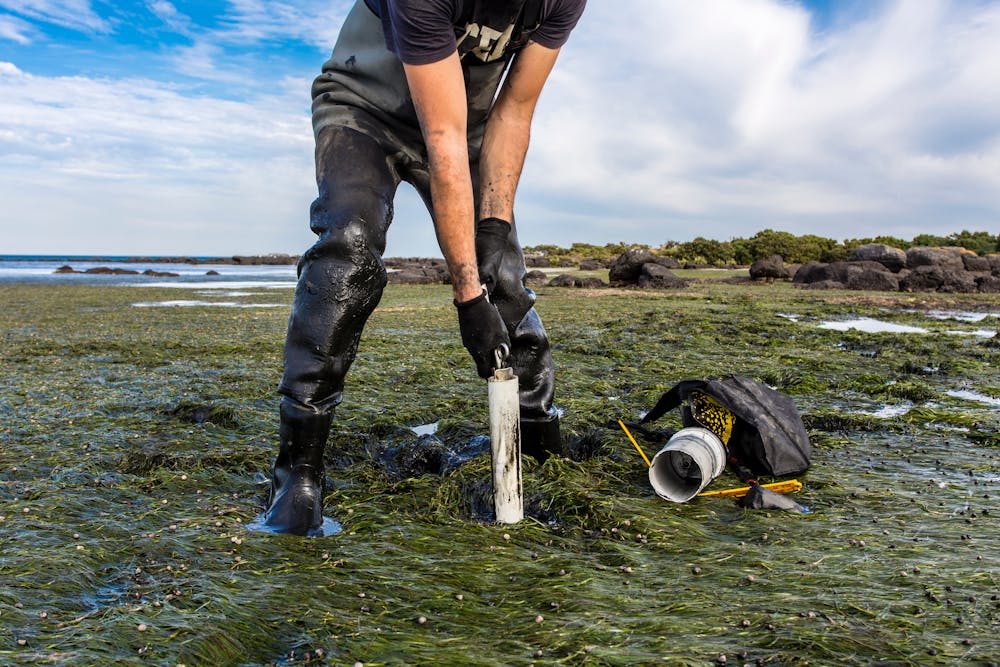
green foreshore, man in wellies with gloves placing white sampling equipment into seabed
Collecting a sediment core to assess carbon sequestration rates in the sediment of a tidal seagrass bed.
I. Noyan Yilmaz/Shutterstock

Blue carbon ecosystems can help countries meet their climate obligations and have been attracting considerable interest. However, if nations want these ecosystems to continue to provide a whole range of services our governments must protect them and, where possible, restore lost habitats.

Most governments have been stubbornly slow to prioritise ocean-based solutions high up on the agenda of global climate negotiations. At this conference, I’ve heard more people, including Unesco’s director general Audrey Azoulay, driving home the need to protect and effectively manage our ocean resources.

Members from the traditional owners of the Great Barrier Reef spoke of “country” from a perspective of a long and sustained human relationship with nature and are intimately connected to the ocean. There is a growing recognition and respect for this indigenous knowledge and our need to integrate that into a sustainable ocean future.

Reimagining the ocean’s role

It makes sense to start by protecting these natural systems that already hold vulnerable stores of carbon – this is sensible risk management.

As nations continue to exploit the marine environment for fishing, fossil fuels and even precious metals which are now being mined from the sea floor in certain places, it is time to rethink the value of these vast natural stores of ocean carbon.

Space science gets way more funding than our oceans, yet vast areas of the global deep ocean remain largely unmapped. “Life below water” is by far the least funded of the UN’s 17 Sustainable Development Goals. That needs to change through a sustained and increased investment in ocean science and greater recognition for the value of our blue economy – defined by the UN as the sustainable use of the ocean’s resources for economic growth, improved livelihoods and jobs.

Stepping back to pause and preserve what already exists in the ocean can help the planet, and us, build resilience and create a healthier and more sustainable marine environment. The seabed forms the foundation for an interconnected ocean ecosystem and acts as an important long-term global sink for carbon that involves the whole ocean and its exchanges with the atmosphere and wider Earth system.

While plans are finally moving in the right direction, there are huge challenges ahead. To paraphrase Cynthia Barzuna, director of ocean action 2030 at the World Resources Institute, “there is no wealthy ocean without a healthy ocean”. The biggest takeaway from the Barcelona conference is that a sustainable ocean future depends on a shared vision that works for all of us and marine life too.The Conversation

William Austin, Professor, University of St Andrews

This article is republished from The Conversation under a Creative Commons license. Read the original article.

Continue ReadingSave our seabed – the bottom of the ocean needs to become a top priority, and the UN agrees