Record-breaking rain over the past few months has left fields of crops under water and livestock’s health at risk, adding to pressures on food producers.
The flooding and extreme weather linked to climate change will undermine UK food production unless farmers get more help, the National Farmers Union said.
The NFU is calling on the government to do more to compensate flooded farmers and support domestic food production.
The government said it was looking to expand a new compensation scheme.
The NFU has warned of “substantially reduced output” and “potential hits” to the quality of crops in this year’s harvest thanks to weeks of rain since the autumn.
NFU vice president Rachel Hallos said UK farmers were “on the front line of climate change – one of the biggest threats to UK food security”.
“These extremes could soon become the norm,” she told the BBC. “We need a clear plan from government to prepare, adapt and recover from our changing climate in the short and long term so that we can continue to produce food and care for the countryside.”
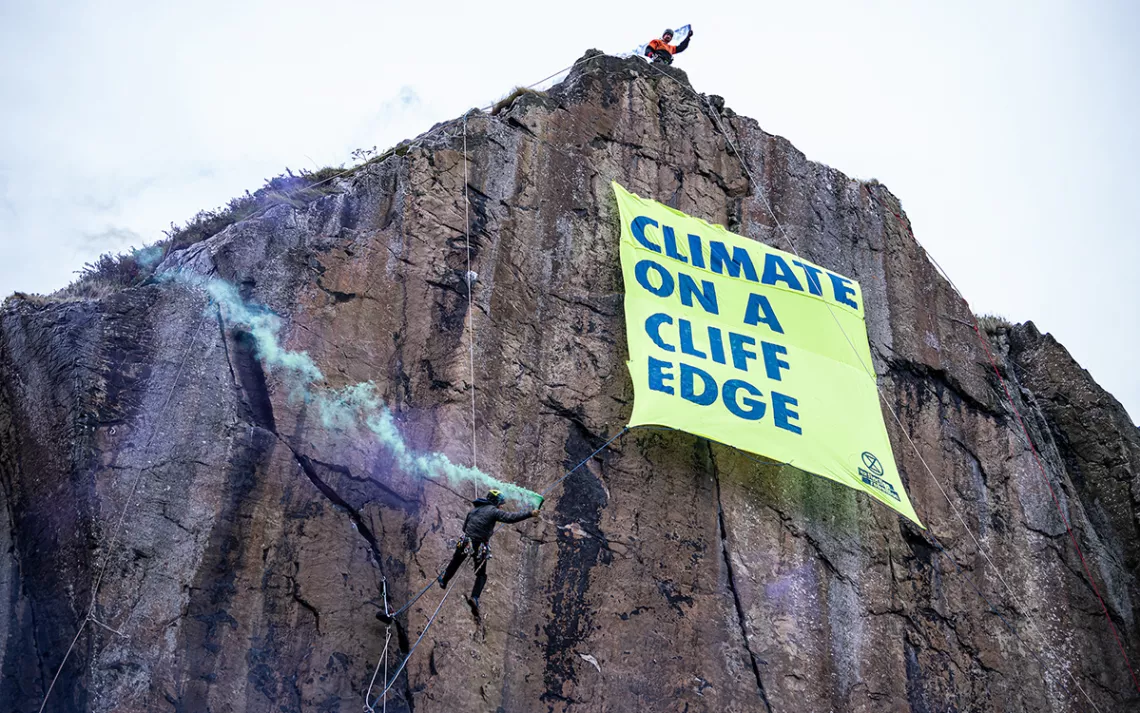
Experienced climbers scale a rock face near the historic Dumbarton castle in Glasgow, releasing a banner that reads “Climate on a Cliff Edge.” One activist, dressed as a globe, symbolically looms near the edge, while another plays the bagpipes on the shores below. | Photo courtesy of Extinction Rebellion and Mark Richards
Over the last year, our oceans have been hotter than any time ever recorded. Our instrumental record covers the last 150 years. But based on proxy observations, we can say our oceans are now hotter than well before the rise of human civilisation, very likely for at least 100,000 years.
This isn’t wholly unexpected. Ocean temperatures have been steadily rising due to human-caused global warming, which in turn means record hottest years have become increasingly common. The last time ocean temperature records were broken was 2016 and before that it was 2015. The last year we experienced a record cold year was way back at the start of the 20th century.
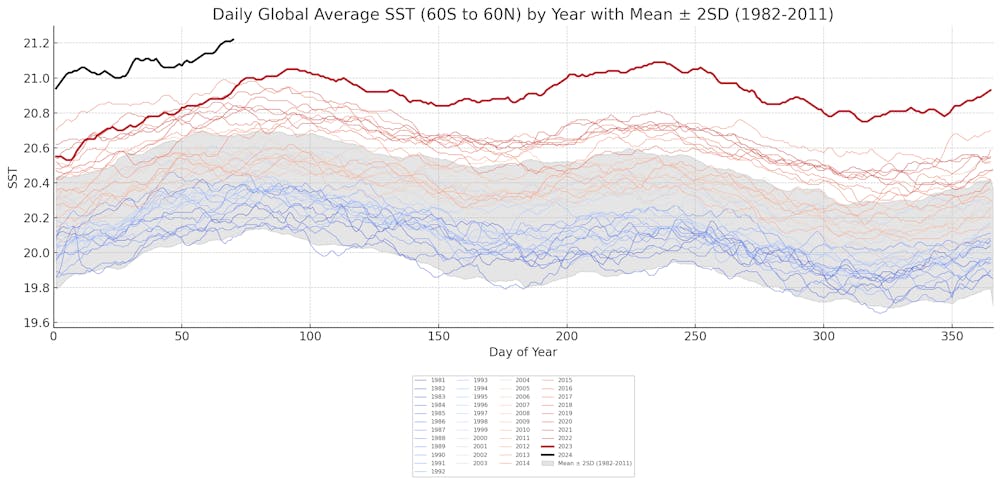
But what is remarkable about the past year is the huge ongoing spike in global ocean temperature which began in April last year. Last year was hotter than the previous record year by a whopping 0.25°C. In contrast the margins of other previous record years were all less than 0.1°C.
Why? Global warming is the main reason. But it doesn’t explain why the heat spike has been so large. Climate drivers such as El Niño likely play a role, as do the random alignment of certain weather events and possibly the reduction in sulfur emissions from shipping. Researchers around the world are trying to understand what’s going on.
Averaged ocean surface temperatures between 60 degrees south and 60 degrees north of the equator, inspired by ClimateReanalyzer.org. Each coloured line represents the temperature of a single year. Author provided, CC BY
The trend is clear to see. Earlier years (in blue) are typically cooler than later years (in red), reflecting the relentless march of global warming. But even with this trend, there are outliers. In 2023 and 2024, you can see a huge jump above previous years.
These record temperatures have been widespread, with the oceans of the southern hemisphere, northern hemisphere and the tropics all reaching record temperatures.
What’s behind the surge?
We don’t yet have a complete explanation for this record burst of warming. But it’s likely several factors are involved.
First, and most obvious, is global warming. Year on year the ocean is gaining heat through the enhanced greenhouse effect – indeed over 90% of the heat associated with human-caused global warming has gone into the oceans.
The extra heat pouring into the oceans results in a gradual rise in temperature, with the trend possibly accelerating. But this alone doesn’t explain why we have experienced such a big jump in the last year.
Then there are the natural drivers. The El Niño event developing in June last year has certainly played a substantial role.
El Niño and its partner, La Niña, are opposite ends of a natural oscillation, the El Niño Southern Oscillation, which plays out in the tropical Pacific ocean. This cycle moves heat vertically between the ocean’s deeper waters and the surface. When El Niño arrives, warmer water comes up to the surface. During La Niña, the opposite occurs.
You can see the impact of an El Niño on short term temperature spikes clearly, even against a backdrop of strong long-term warming.
But even climate change and El Niño combined aren’t enough to explain it.
Other natural heat-transferring oscillations, such as the Indian Ocean Dipole or the North Atlantic Oscillation, may play a role.
It may also be that our successful efforts to cut aerosol pollution from the dirty fuel shipping relies on has had an unwanted side effect: more warming. With less reflective aerosols in the atmosphere, more of the Sun’s energy can reach the surface.
But there’s probably also a level of random chance. Chaotic weather systems over the ocean can reduce cloud cover, which can let in more solar radiation. Or these weather systems could weaken winds, reducing cooling evaporation.
Why is this important?
To us, a warmer ocean might feel pleasant. But the extra heat manifests underwater as an unprecedented series of major marine heatwaves. The ocean’s organisms are picky about their preferred temperature range. If the heat spikes too much and for too long, they have to move or die.
Marine heatwaves can lead to mass death or mass migration for marine mammals, seabirds, fish and invertebrates. They can cause vital kelp forests and seagrass meadows to die, leaving the animals depending on them without shelter or food. And they can disrupt species important for fisheries and tourism.
This year’s heat stress has caused widespread coral bleaching around the world. Bleaching has been seen on reefs in the Caribbean, Florida, Egypt, and the Great Barrier Reef.
In the cooler waters of Tasmania, extraordinary conservation efforts have been put in place to try and protect endangered fish species such as the red handfish from the heat, while in the Canary Islands, small scale commercial fisheries have popped up for species not normally found there.
Last year, Peru’s anchovy fishery – the country’s largest – was closed for long periods, leading to export losses estimated at A$2.1 billion.
What’s going to happen next?
Given the record temperatures stem from a combination of human-induced climate change and natural sources, it’s very likely ocean temperatures will drop back to more “normal” temperatures. Normal now is, of course, much warmer than in previous decades.
If this eventuates, we might see slightly cooler temperatures than the new normal, but it’s still too early to know for sure.
One thing is certain though. As we struggle to rein in greenhouse gas emissions, the steady march of global warming will keep adding more heat to the oceans. And another spike in global ocean warming won’t be too far away.
Prime Minister Rishi Sunak departs 10 Downing Street, London, to attend Prime Minister’s Questions at the Houses of Parliament, March 20, 2024
‘Morally bankrupt’ Sunak doubles down on Israel arms sales
THE GOVERNMENT is “making a mockery” of international law, campaigners charged after Rishi Sunak doubled down on continuing arms sales to Israel.
Mr Sunak was ridiculed today after he said that Israeli Prime Minister Benjamin Netanyahu “needs to do more” to alleviate suffering in Gaza while dodging calls to suspend arms sales to Israel.
Speaking to LBC, the British Prime Minister admitted that the humanitarian situation in Palestine is “dire” but that there had been “no change” in continuing arms sales.
When asked if the government had received fresh advice on arming Israel, after air strikes murdered three British aid workers earlier this month, Mr Sunak said assessments had been “carried out periodically.”
Lindsey German from Stop the War Coalition said that the decision to continue the exports while providing “weak criticism of Israel” demonstrates nothing but “moral bankruptcy and cowardice.”
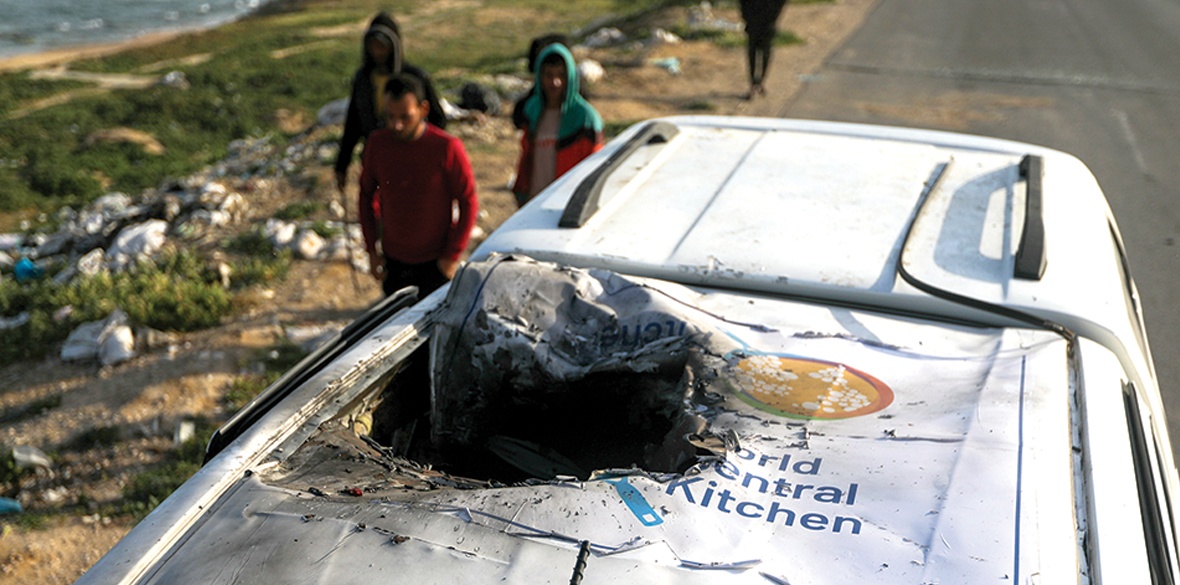
TARGETING AID: World Central Kitchen vehicle hit in an Israeli airstrike in Deir al Balah, Gaza Strip, on Tuesday, April 2 2024
RAMZY BAROUD explains that Israel isn’t making mistakes, even due to callous carelessness — killing aid workers is part of a wider plan to make life in northern Gaza impossible, to facilitate ethnic cleansing
ISRAEL described its clearly deliberate killing of seven humanitarian aid workers on April 1 as a “grave mistake,” a “tragic event” that “happens in war.”
Israel is, obviously, lying. This entire so-called war — actually genocide — in Gaza has been based on a series of lies, some of which Israel continues to peddle.
For some, in the mainstream media, it took months to accept the obvious fact that Israel has been lying about the events that led to the war and the military objectives of its constant targeting of hospitals, schools, shelters and other civilian facilities.
So, it was only logical for Israel to lie about killing the six internationals, and their Palestinian driver, of the World Central Kitchen (WCK). Notwithstanding an event as atrocious as this, it is implausible for Israel to start telling the truth now.
Luckily, few seem to believe Israel’s version regarding WCK, or its continued massacres elsewhere in Gaza. Israel “cannot credibly investigate its own failure in Gaza,” the US-based NGO said in a statement on April 5.
The issue of targeting these internationals, however, has to be placed within a larger context.
Israel was hardly secretive about its intention to deny Palestinians even the most basic necessities of survival in Gaza, epitomised in the words of Israeli Minister of Defence Yoav Gallant on October 9: “There will be no electricity, no food, no fuel, everything is closed.”
Initially, this statement, and many others, were understood at the time to be an outcome of Israel’s desire to punish Palestinians for the October 7 al-Aqsa Flood operation, by resorting to its typical tactic of collective punishment.
With time, however, and based on statements made by other Israeli officials, it became clear that Israel wanted to ethnically cleanse Palestinians altogether.
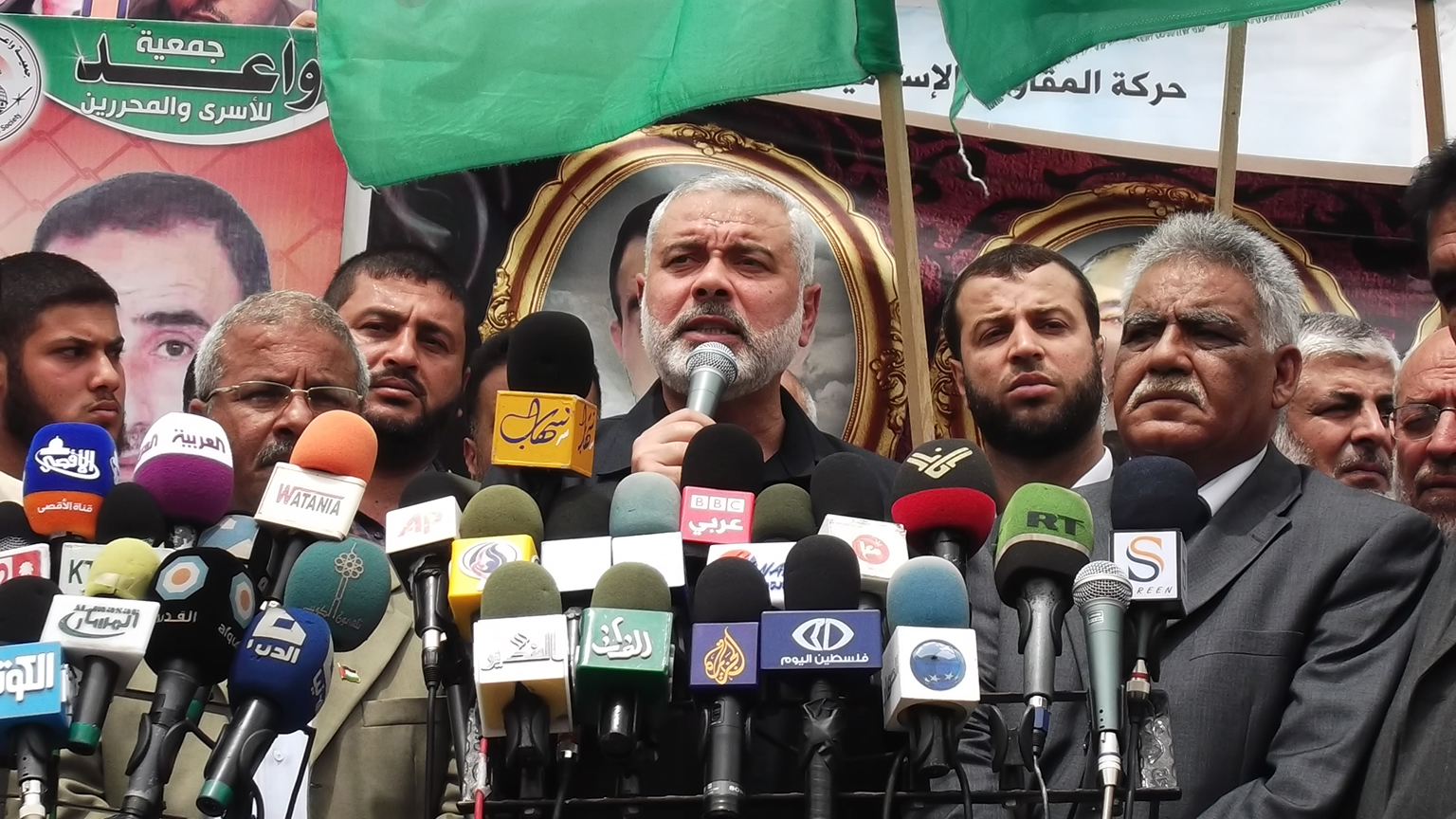
Ismail Haniyeh speaks in Gaza in 2012 (Photo: Joe Catron/CC)
Israel continues to carry out targeted assassinations against non-combatants, this time murdering three sons and four grandchildren of Hamas leader Ismail Haniyeh
On April 10, Hamas leader Ismail Haniyeh announced that Israel murdered three of his sons in a targeted airstrike. The killing of Haniyeh’s children coincides with the Muslim Holy Day of Eid al-Fitr.
Hamas, as well as various other Palestinian resistance groups, released statements decrying the killings of Hazem, Amir, and Mohammad, as well as four of Haniyeh’s grandchildren who were also killed in the attack. Haniyeh’s three sons and three grandchildren were making family visits in Gaza City for Eid, when Israel bombed the car they were traveling in.
These killings took place as Haniyeh and other Hamas leaders are involved in pushing Israel for a ceasefire at the negotiating table. Haniyeh himself is among the chief negotiators on the side of the resistance. According to a Hamas statement from April 8, “While Hamas appreciates the significant efforts made by the mediators, and while the movement is keen to reach an agreement that ends the aggression against our people, the Israeli position remains obstinate and has not responded to any of the demands of our people and our resistance.”
An unnamed Palestinian official who spoke to the Lebanese Al Mayadeen news network said that all attempts and efforts by mediators to reach an agreement have encountered Israeli inflexibility and at present, there is no progress in negotiations. The official stated that any progress will be announced through official channels and emphasized that Hamas adheres to its demands, which include a ceasefire, Israeli withdrawal from the Gaza Strip, the entry of aid, the return of displaced Gazans, and a prisoner exchange.
Aljazeera is reporting that the genocidal Zionist enemy has murdered three of the sons and a number of the grandchildren of Ismail Haniyeh, the politburo chief of Hamas. This cowardly Nazi enemy, whose days usurping Palestine are numbered, always takes it revenge on children. https://t.co/gBeu3uYZS0
“The blood of my sons is not more precious than the blood of our martyred people in Gaza, for they are all my sons.,” said Haniyeh. “The occupation’s threats to invade Rafah do not frighten our people or our resistance. We will not submit to the blackmail practiced by the occupation, for those who surrender will not be spared. We will not compromise and we will not neglect, no matter how great our sacrifices are.”
The murders of Ismail Haniyeh's children and grandchildren in targeted strikes in Gaza is part of a pattern of the IDF sabotaging negotiations.
In the last Gaza war, Israel struck apartment buildings housing 3 PIJ commanders who were to go to ceasefire talks *that morning*. pic.twitter.com/HmB94aPtEZ
Condemnations were issued by various Axis of Resistance forces, including the Palestinian Islamic Jihad, the Mujahideen Movement, and Ansar Allah.
“We extend our condolences to the head of the Political Bureau of Hamas for the martyrdom of three of his sons and several of his grandchildren due to an aggressive Israeli airstrike that reveals the extent of the Israeli failure in the field,” said Ansar Allah, which has been waging a struggle in solidarity with the Palestinian people through its Red Sea blockade. “These great sacrifices, alongside the rest of the sons of Gaza and the occupied West Bank, indeed strengthen the steadfastness of the Palestinian people in the face of this Israeli arrogance.”
“We condemn, in the strongest terms, the barbaric massacre committed by the criminal Nazi entity, which targeted a number of the children of the head of the Political Bureau of the Islamic Resistance Movement (Hamas), the fighter brother Ismail Haniyeh, and his grandchildren,” stated the Palestinian Islamic Jihad, which has been fighting Israeli forces in Gaza alongside Hamas. “We come forth from the sons of our Palestinian people everywhere, from the brothers in the Hamas Movement, and from the fighter brother Ismail Haniyeh, with the highest blessings for this martyrdom, asking Allah to cover the martyrs with His vast mercy.”