Year: 2024
UN Security Council’s Gaza Cease-Fire Resolution Is Not Enough—But It’s a Start
Original article by PHYLLIS BENNIS republished from Common Dreams under Creative Commons (CC BY-NC-ND 3.0).

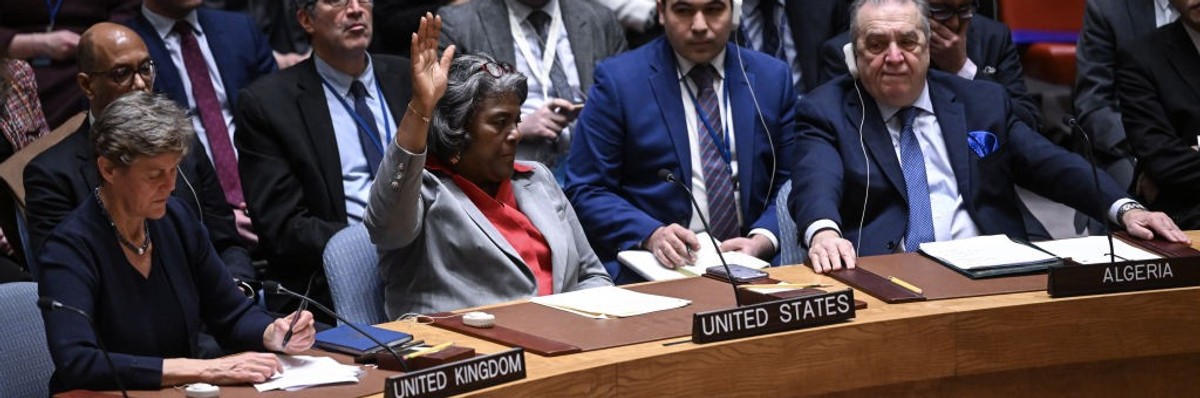
US Ambassador to the United Nations Linda Thomas-Greenfield raises her hand during the UN Security Council meeting which adopted a resolution demanding an immediate cease-fire in Gaza Strip for the month of Ramada on March 25, 2024. As many as 14 countries voted in favor of the resolution, presented by 10 elected members of the Council, while the US abstained from voting. (Photo by Fatih Aktas/Anadolu via Getty Images Despite weaknesses and false U.S. claims that the resolution is nonbinding, it demands an end to the bombing and a massive influx of humanitarian aid. And that means the possibility of saving lives.
Five and half months into Israel’s genocidal assault on Gaza with more than 32,000 Palestinians already killed, six weeks after the International Court of Justice found Israel plausibly committing genocide and ordered it to stop, and after four earlier tries, the UN Security Council on Monday finally passed a resolution submitted by all ten elected members aiming to stop the slaughter. The resolution has lots of weaknesses and shows the effects of U.S. pressure—but it demands an end to the bombing and a massive influx of food and medicine. And that means the possibility of saving lives.
The resolution demanded an immediate ceasefire leading to a lasting and sustainable ceasefire, the release of all hostages, and compliance with international law in treatment of all those detained. The Council also demanded “the lifting of all barriers to the provision of humanitarian assistance at scale,” reminding the world of the need for massive expansion of that aid and for protection of Palestinian civilians across the entire Gaza Strip.
The resolution’s passage was uncertain until the very last moment. An hour before the vote, U.S. diplomats won a final concession—replacing the original demand for a “permanent” ceasefire” to the squishier, less clear “lasting.” And there are significant other weaknesses in the resolution.
When U.S. Ambassador Linda Thomas-Greenfield claimed that the Council vote was “nonbinding,” she was setting the stage for the U.S. government to violate the UN Charter by refusing to be bound by the resolution’s terms.
The most important flaw in the Council’s text is that it calls for a ceasefire only “for the month of Ramadan.” This most important of Muslim holidays began on March 11, so the demand for a ceasefire is only for about two weeks. And while it does demand that the immediate halt lead to a lasting ceasefire, two weeks is still a much too-short time.
Other problems reflect deliberate obfuscation of language. The demand that all parties treat “all persons they detain” in compliance with international law clearly refers to the thousands of Palestinian detainees Israel is holding, many in administration detention without even the pretense of legitimate legal procedures, whom international law requires to be immediately released. Their detention violates a host of those laws, but by not naming them directly, diplomatic wrangling always threatens to deny them their rights.
And in the paragraph focusing on the catastrophic humanitarian situation across Gaza, the Council’s demand for “lifting all barriers to provision of humanitarian aid at scale” should be a clear and straightforward message to Israel that it must open the gates, end its rejection of goods on the spurious grounds of potential “dual use,” replace its deliberately complex and time-consuming inspection processes and more. But that reference to “lifting all barriers” is hidden in a long sentence within a reference to an earlier resolution. The first part of the sentence merely “emphasizes” the need for more humanitarian aid and protection for Palestinian civilians. And in UN diplo-speak, especially in the Security Council that actually has the right to enforce its resolutions, “emphasizing” something ain’t even close to “demanding” that it happen.
Israel was still not pleased, of course. Prime Minister Benjamin Netanyahu immediately announced his delegation, expected in Washington tomorrow to discuss Tel Aviv’s planned escalation against Rafah, will stay home instead.
But even if the resolution is not all it should be, its passage (14 in favor, the U.S. abstained) still represents a powerful global rejection of the U.S.-backed Israeli assault against Palestinians in Gaza, and an important expression of support for the South African-led intervention at the International Court of Justice designed to prevent or stop Israeli genocide and to hold Israel accountable for its crimes. Importantly, and despite U.S. Ambassador Linda Thomas-Greenfield’s false claim following the vote, all decisions of the Council, as stated in Article 25 of the UN Charter, are binding on Member States.
That puts a big obligation on the U.S. and global movements for ceasefire, massive escalation of humanitarian aid, and resumption of funding UNRWA. Left to its own devices, the Council will almost never move to enforce its own decisions. That responsibility, that obligation, lies with our movements—and, in the UN context, with the General Assembly. The legacy of the South Africa anti-apartheid movement, especially through the 1970s and 80s, and into the early 1990s, shows that model. The U.S. and Britain over and over again vetoed resolutions in the Security Council for sanctions against apartheid South Africa. Over and over again the General Assembly passed the resolutions—for banking, trade, and other sanctions, for arms embargoes and much more. Eventually, public pressure against Washington and London forced a pull-back, and eventually, reluctantly and grudgingly, those governments gave in, stopped vetoing the Council resolutions and started abiding by the calls of the Assembly. It all played a huge role in ending South African apartheid.
Left to its own devices, the Council will almost never move to enforce its own decisions. That responsibility, that obligation, lies with our movements—and, in the UN context, with the General Assembly.
When U.S. Ambassador Linda Thomas-Greenfield claimed that the Council vote was “nonbinding,” she was setting the stage for the U.S. government to violate the UN Charter by refusing to be bound by the resolution’s terms. But enforcement of Council decisions can take shape in many forms—protest movements around the world can demand their governments move to pressure Israel to abide by the Council’s demands. The General Assembly can urge Member States to impose some of those same sanctions it used so successfully against apartheid South Africa. Maybe the Assembly and global movements together can escalate the call urging boycotts of Israeli products, divestment from companies profiting from Israel’s occupation or apartheid, and sanctions on banking transactions or trade, and the imposition of arms embargoes.
First things, of course, an immediate ceasefire, release of hostages and Palestinian detainees, and a flood of emergency humanitarian aid. Then maybe, just maybe, we’ll see this Security Council resolution lead to the United Nations joining the global BDS movement. It’s never too late.
Phyllis Bennis is a fellow of the Institute for Policy Studies and serves on the national board of Jewish Voice for Peace. Her most recent book is the 7th updated edition of “Understanding the Palestinian-Israeli Conflict: A Primer” (2018). Her other books include: “Understanding the US-Iran Crisis: A Primer” (2008) and “Challenging Empire: How People, Governments, and the UN Defy US Power” (2005).
Original article by PHYLLIS BENNIS republished from Common Dreams under Creative Commons (CC BY-NC-ND 3.0).
- ‘Whole World Is Watching’: US Delays Security Council Vote On Gaza For Third Time ›
- ‘Disastrous’: US Vetoes Cease-Fire Resolution At UN Security Council ›
- UN Members Support Gaza Cease-Fire In Overwhelming 153-10 Vote ›
- No ‘Clear Message Of Peace’: Russia, China, And Algeria Vote Down US Gaza Resolution ›
Sanders: ‘The Netanyahu Gov’t Should Not Receive Another Penny from US’
Original article by COMMON DREAMS STAFF republished from Common Dreams under Creative Commons (CC BY-NC-ND 3.0).

U.S. Sen. Bernie Sanders (I-VT) walks toward the Senate Chambers early on Saturday March 23, 2024 in Washington, DC. The Senate passed a $1.2 trillion spending bill to fund the government through September and avert a partial shutdown. President Biden signed the bill into law later in the day. (Photo by Nathan Howard/Getty Images The bill passed the Senate in a 74-24 vote at 2:03AM
Following the passing of the U.S. government appropriations bill early Saturday morning, Senator Bernie Sanders said:
I voted NO on the appropriations bill that the Senate passed last night. While hundreds of thousands of Palestinian children face starvation in Gaza, this bill actually prohibits funding to UNWRA, the key United Nations aid agency delivering life-saving humanitarian support. This will only intensify the already horrific situation in Gaza. This bill also provides another $3.3 billion in U.S. military aid for Netanyahu’s right-wing government to continue this barbaric war. The Netanyahu government should not receive another penny from U.S. taxpayers.
The bill passed the Senate in a 74-24 vote at 2:03AM Saturday morning following hours of intense negotiations.
Later on Saturday, President Biden signed the $1.2 trillion government funding bill to stave off a government shutdown.
Original article by COMMON DREAMS STAFF republished from Common Dreams under Creative Commons (CC BY-NC-ND 3.0).
Draft UN Report Finds Israel Has Met Threshold for Genocide
‘Death Sentence for Thousands’: Israel Bars UNRWA Food Aid to Northern Gaza
‘Beyond Comprehension’: Medical Team Reports Starvation, Infections at Gaza Hospital
US Abstains as UN Security Council Demands ‘Immediate Cease-Fire’ in Gaza
Draft UN Report Finds Israel Has Met Threshold for Genocide
Original article by BRETT WILKINS republished from Common Dreams under Creative Commons (CC BY-NC-ND 3.0).

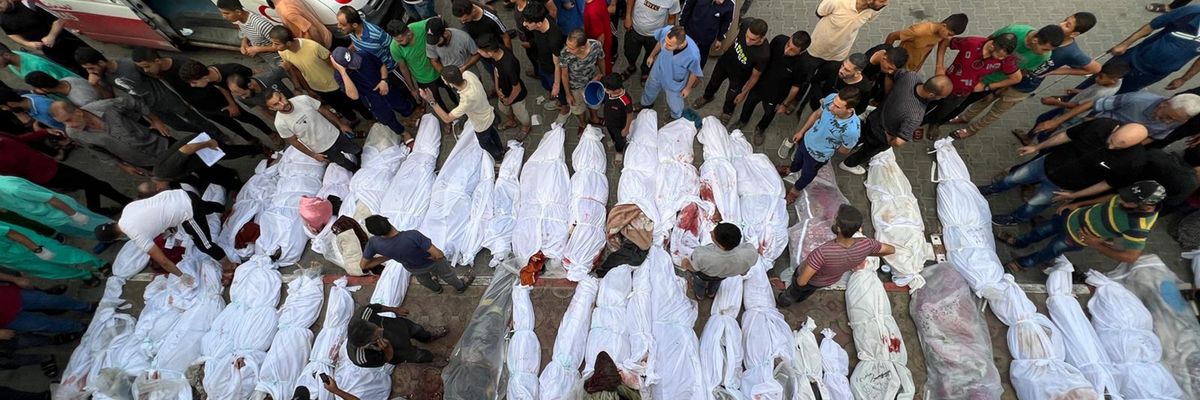
The bodies of victims of the October 31, 2023 Israeli bombing of the Jabalia refugee camp in the Gaza Strip are lined up outside the Indonesian Hospital in Gaza City. (Photo: Fadi Alwhidi/Anadolu via Getty Images) “Israel’s genocide on the Palestinians in Gaza is an escalatory stage of a long-standing settler colonial process of erasure.”
The United Nations Human Rights Council on Monday published a draft report that found “reasonable grounds to believe” that Israel is committing genocide in Gaza, a move that came on the same day as the U.N. Security Council passed a resolution demanding an immediate cease-fire in the ongoing war.
The advance unedited version of the report—entitled Anatomy of a Genocide—concludes that Israel’s far-right government and military “have intentionally distorted jus in bello principles, subverting their protective functions, in an attempt to legitimize genocidal violence against the Palestinian people.”
“The overwhelming nature and scale of Israel’s assault on Gaza and the destructive conditions of life it has inflicted reveal an intent to physically destroy Palestinians as a group,” the draft report states, enumerating Israeli actions that violate Article II of the Convention on the Prevention and Punishment of the Crime of Genocide: “Killing members of the group; causing serious bodily or mental harm to group members; and deliberately inflicting on the group conditions of life calculated to bring about its physical destruction in whole or in part.”
“Israel has de facto treated an entire protected group and its life-sustaining infrastructure as ‘terrorist’ or ‘terrorist-supporting,’ thus transforming everything and everyone into either a target or collateral damage, hence killable or destroyable,” the paper continues. “In this way, no Palestinian in Gaza is safe by definition. This has had devastating, intentional effects, costing the lives of tens of thousands of Palestinians, destroying the fabric of life in Gaza, and causing irreparable harm to its entire population.”
Israel rejected the report as “an obscene inversion of reality.”
According to Palestinian and international humanitarian officials, Israel’s 171-day Gaza onslaught has killed at least 32,333 Palestinians, most of them women and children, while wounding nearly 75,000 others and displacing around 90% of Gaza’s 2.3 million people. Thousands more Palestinians are missing and believed to be dead and buried beneath the rubble of bombed buildings. Disease and deadly starvation caused and exacerbated by Israel’s siege and blockade of Gaza are spreading rapidly.
“Israel’s genocide on the Palestinians in Gaza is an escalatory stage of a long-standing settler-colonial process of erasure,” the draft report asserts. “For over seven decades this process has suffocated the Palestinian people as a group—demographically, culturally, economically, and politically—seeking to displace it and expropriate and control its land and resources.”
Referring to the flight and ethnic cleansing of more than 750,000 Arabs from Palestine during the foundation of the modern state of Israel in 1948, the paper contends that “the ongoing Nakba must be stopped and remedied once and for all. This is an imperative owed to the victims of this highly preventable tragedy, and to future generations in that land.”
“The ongoing Nakba must be stopped and remedied once and for all.”
The draft report urges U.N. member states to “enforce the prohibition of genocide in accordance with their… obligations” under international law. In January, the U.N.’s International Court of Justice (ICJ) found that Israel was “plausibly” perpetrating genocide in Gaza and ordered the country’s government to “take all measures within its power” to prevent genocidal acts. Human rights defenders say Israel has ignored the order.
“Israel and those states that have been complicit in what can be reasonably concluded to constitute genocide must be held accountable and deliver reparations commensurate with the destruction, death, and harm inflicted on the Palestinian people,” the publication argues.
The draft report recommends measures including:
- Immediate implementation of an arms embargo on Israel, as it appears to have failed to comply with the binding measures ordered by the ICJ;
- Immediate referral of the situation in Palestine to the International Criminal Court in support of its ongoing investigation;
- Ensuring that Israel, as well as states who have been complicit in the Gaza genocide, acknowledge the colossal harm done, commit to nonrepetition, with measures for prevention and full reparations, including the full cost of the reconstruction of Gaza;
- Deploying an international protective presence to constrain the violence routinely used against Palestinians in the occupied territories; and
- Ensuring that the United Nations Relief and Works Agency for Palestine Refugees in the Near East (UNRWA) is properly funded to enable it to meet the increased needs of Palestinians in Gaza.
Israel on Monday informed the U.N. that it will no longer allow UNRWA convoys carrying food aid into northern Gaza, even as the Palestinians are starving to death, a move that one humanitarian campaigner called a “death sentence.”
Original article by BRETT WILKINS republished from Common Dreams under Creative Commons (CC BY-NC-ND 3.0).
- Australian PM First Western Leader Referred To ICC As ‘Accessory To Genocide In Gaza’ ›
- Israeli MP Says It Clearly For World To Hear: ‘Erase All Of Gaza From The Face Of The Earth’ ›
- 800+ Legal Scholars Say Israel May Be Perpetrating ‘Crime Of Genocide’ In Gaza ›
- With Genocide In Gaza, The Word ‘Never’ Has Been Stripped From ‘Never Again’ ›
- In Gaza, The West Is Enabling The Most Transparent Genocide In Human History ›
- Rejecting The Manufactured Case For Genocide In Gaza ›
- What Motivates Israel’s Genocidal Acts In Gaza? ›
US Abstains as UN Security Council Demands ‘Immediate Cease-Fire’ in Gaza
Original article by BRETT WILKINS republished from Common Dreams under Creative Commons (CC BY-NC-ND 3.0).
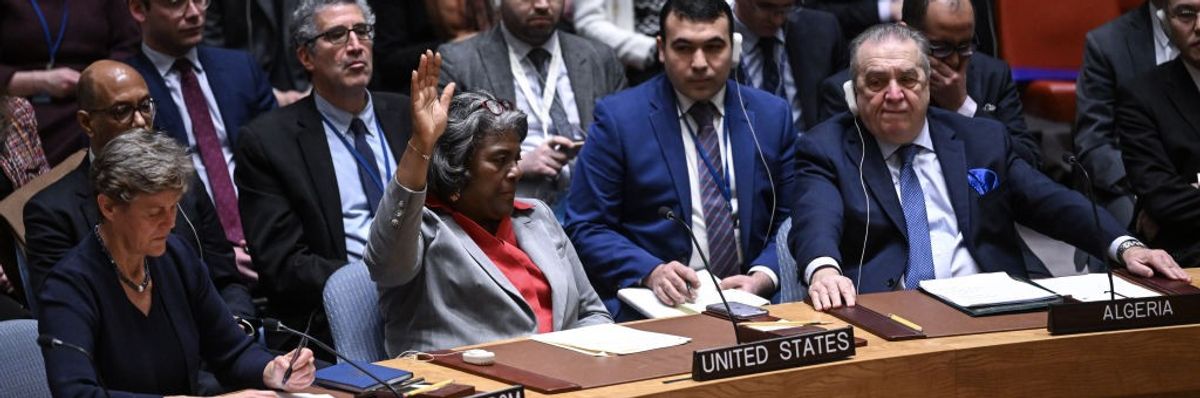
U.S. Ambassador to the United Nations Linda Thomas-Greenfield raises her hand to abstain during a U.N. Security Council vote on a Gaza cease-fire resolution on March 25, 2024 in New York City. (Photo: Fatih Aktas/Anadolu via Getty Images) “This resolution must be implemented,” said U.N. Secretary-General António Guterres. “Failure would be unforgivable.”
The U.S. on Monday declined to veto but still abstained from a United Nations Security Council on Monday to adopt a resolution demanding an “immediate cease-fire for the month of Ramadan” in the embattled Gaza Strip, a move that came amid an ongoing Israeli genocide in which more than 114,000 Palestinians have been killed or wounded and hundreds of thousands of others are starving.
The Security Council voted 14-0, with the U.S. abstaining, to approve a resolution for the cessation of hostilities during the Muslim holy month after member states overcame a sticking point over the removal of the word “permanent” from an earlier draft version. Instead, the resolution calls for an “immediate” cease-fire.
The U.S. had vetoed three of the previous four cease-fire resolutions.
“This resolution must be implemented,” U.N. Secretary-General António Guterres said following Monday’s vote. “Failure would be unforgivable.”
As the U.N. News explained:
The resolution is a bare-bones call for a cease-fire during the month of Ramadan, which began on March 11. It also demands the return of about 130 hostages seized in Israel and held in Gaza and emphasizes the urgent need to allow ample lifesaving aid to reach a starving population in the besieged enclave.
The demand to end hostilities has so far eluded the council following the Israeli forces’ invasion of Gaza in October after Hamas attacks left almost 1,200 dead and 240 taken hostage.
Since then, Israel’s daily bombardment alongside its near-total blockade of water, electricity, and lifesaving aid has killed more than 32,000 Palestinians in Gaza, according to the health ministry there, where a recent U.N.-backed report showed an imminent famine unfolding.
Palestinians—especially children—are starving to death in Gaza. Hospitals are under attack, with Israeli forces reportedly executing large numbers of people inside al-Shifa Hospital.
Meanwhile, the approximately 1.5 milllion Palestinians in the southern city of Rafah—most of them refugees forcibly displaced from other parts of Gaza—are bracing for an anticipated ground invasion, which Israeli leaders say will proceed despite a warning from U.S. Vice President Kamala Harris that such an operation would have “consequences.”
Monday’s vote followed intense negotiations over the measure introduced by 10 non-permanent Security Council members—Algeria, Ecuador, Guyana, Japan, Malta, Mozambique, Sierra Leone, Slovenia, South Korea, and Switzerland.
The United States—which, despite growing frustration over genocidal atrocities, still arms Israel—brushed off a threat from far-right Prime Minister Benjamin Netanyahu to cancel a planned visit to Washigton by a high-level Israeli delegation if the U.S. did not veto the resolution.
The Associated Press reported Netanyahu followed through with his threat and canceled the trip.
Human rights defenders welcomed Monday’s vote.
“Israel needs to immediately respond to the U.N. Security Council resolution adopted today by facilitating the delivery of humanitarian aid, ending its starvation of Gaza’s population, and halting unlawful attacks,” Louis Charbonneau, director of Human Rights Watch’s U.N. program, said in a statement.
“Palestinian armed groups should immediately release all civilians held hostage,” he added. “The U.S. and other countries should use their leverage to end atrocities by suspending arms transfers to Israel.”
Original article by BRETT WILKINS republished from Common Dreams under Creative Commons (CC BY-NC-ND 3.0).
- ‘Disastrous’: US Vetoes Cease-Fire Resolution At UN Security Council ›
- US Trying To Water Down New Cease-Fire Resolution At UN Security Council ›
- Rights Advocates Say US Has ‘No Justification’ To Veto UN Cease-Fire Resolution ›
- As Israeli Forces Fire On Starving Palestinians, US Again Vetoes UN Cease-Fire Resolution ›
- UN Members Support Gaza Cease-Fire In Overwhelming 153-10 Vote ›
- US Finally Backs UN Gaza Cease-Fire Resolution—But Only When ‘Practical’ ›