‘In Even the Best Coverage There Is No Accountability for the Fossil Fuel Industry’

Spread the love

Original article by JANINE JACKSON republished from FAIR under a Creative Commons Attribution-NonCommercial-NoDerivs 3.0 Unported License.

CounterSpin interview with Evlondo Cooper on climate coverage

Janine Jackson interviewed Media Matters’ Evlondo Cooper about climate coverage for the March 22, 2024, episode of CounterSpin. This is a lightly edited transcript.

Audio Player

00:00

00:00

Use Up/Down Arrow keys to increase or decrease volume. [Available at the original article]

Media Matters (3/14/24)

Janine Jackson: Climate disruption is, of course, one of the most disastrous phenomena of today’s life, affecting every corner of the globe. It’s also one of the most addressable. We know what causes it, we know what meaningful intervention would entail. So it’s a human-made tragedy unfolding in real time before our eyes.

To understate wildly, we need to be talking about it, learning about it, hearing about it urgently, which is why the results of our next guest’s research are so alarming. I’ll just spoil it: Broadcast news coverage of the climate crisis is going down.

Evlondo Cooper is a senior writer with the Climate and Energy Program at Media Matters for America. He joins us now by phone from Washington state. Welcome to CounterSpin, Evlondo Cooper.

Evlondo Cooper: Thank you for having me. I’m excited about our conversation today.

JJ: We’re talking about the latest of Media Matters’ annual studies of climate crisis coverage. First of all, just tell us briefly what media you are looking at in these studies.

EC: So we’re looking at corporate broadcast network coverage. That’s ABC, CBS and NBC. And for the Sunday morning shows, we also include Fox BroadcastingFox News Sunday.

JJ: All right. And then, for context, this decline in coverage that you found in the most recent study, that’s down from very little to even less.
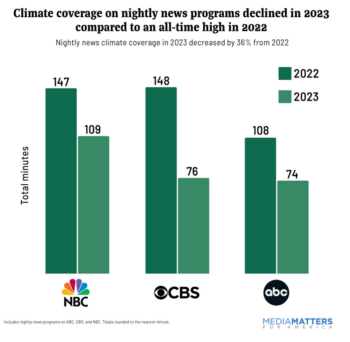
Media Matters (3/14/24)

EC: Yeah, so a little context: 2021 and 2022 were both record years for climate coverage, and that coverage was a little bit more than 1%. This year, we saw a 25% decrease from 2022, which brought coverage to a little bit less than 1%. We want to encourage more coverage, but even in the years where they were doing phenomenal, it was only about 1% of total coverage. And so this retrenchment by approximately 25% in 2023 is not a welcome sign, especially in a year where we saw record catastrophic extreme weather events, and scientists are predicting that 2024 might be even worse than ’23.

JJ: Let’s break out some of the things that you found. We’re talking about such small numbers—when you say 1%, that’s 1% of all of the broadcast coverage; of their stories, 1% were devoted to the climate crisis. But we’ve seen, there’s little things within it. For example, we are hearing more from actual climate scientists?

EC: That was a very encouraging sign, where this year we saw 41 climate scientists appeared, which was 10% of the featured guests in 2023, and that’s up from 4% in 2022. So in terms of quality of coverage, I think we’re seeing improvements. We’re seeing a lot of the work being done by dedicated climate correspondents, and meteorologists who are including climate coverage as part of their weather reports and their own correspondents’ segments, a bigger part of their reporting.

So there are some encouraging signs. I think what concerns us is that these improvements, while important and necessary and appreciated, are not keeping up with the escalating scale of climate change.

Media Matters (3/14/24)

JJ: It’s just not appropriate to the seriousness of the topic. And then another thing is, you could say the dominance of white men in the conversation, which I know is another finding, that’s just kind of par for the elite media course; when folks are talked to, they are overwhelmingly white men. But it might bear some relation to what you’re seeing as an underrepresentation of climate-impacted populations, looking at folks at the sharp end of climate disruption. That’s something you also consider.

EC: Yeah, we look at coverage of, broadly, climate justice. I think a lot of people believe it’s representation for representation’s sake, but I think when people most impacted by climate change—and we’re talking about communities of color, we’re talking about low-income communities, we’re talking about low-wealth rural communities—when these folks are left out of the conversation, you’re missing important context about how climate change is impacting them, in many cases, first and worse. And you’re missing important context about the solutions that these communities are trying to employ to deal with it. And I think you’re missing an opportunity to humanize and broaden support for climate solutions at the public policy level.

So these aren’t communities where these random acts of God are occurring; these are policy decisions, or indecisions, that have created an environment where these communities are being most harmed, but least talked about, and they’re receiving the least redress to their challenges. And so those voices are necessary to tell those stories to a broad audience on the corporate broadcast networks.

JJ: Yes, absolutely.

CBS (7/17/23)

Another finding that I thought was very interesting was that extreme weather seemed to be the biggest driver of climate coverage, and that, to me, suggests that the way corporate broadcast media are coming at climate disruption is reactive: “Look at what happened.”

EC: Totally.

JJ:  And even when they say, “Look at what’s happening,” and you know what, folks pretty much agree that this is due to climate disruption, these houses sliding into the river, it’s still not saying, “While you look at this disaster, know that this is preventable, and here is who is keeping us from acting on it and why.”

EC: Yeah, that is so insightful, because that’s a core critique of even the best coverage we see, that there is no accountability for the fossil fuel industry and other industries that are driving the crisis. And then there’s no real—solutions are mentioned in about 20% of climate segments this year. But the solutions are siloed, like there are solution “segments.”

But to your point, when we’re talking about extreme weather, when you have the most eyeballs hearing about climate change, to me, it would be very impactful to connect what’s happening in that moment—these wildfires, these droughts, these heat waves, these hurricanes and storms and flooding—to connect that to a key driver, fossil fuel industry, and talk about some potential solutions to mitigate these impacts while people are actually paying the most attention.

CNN (3/3/23)

JJ: And then take it to your next story about Congress, or your next story about funding, and connect those dots.

EC: Exactly. I mean, climate is too often siloed. So you could see a really great segment, for instance, on the Willow Project, at the top of the hour—and this is on cable, but the example remains—and then later in the hour, you saw a story about an extreme weather event. But those things aren’t connected, they’re siloed.

And so a key to improving coverage in an immediate way would be to understand that the climate crisis is the background for a range of issues, socioeconomic, political. Begin incorporating climate coverage in a much broader swath of stories that, whether you know it or not, indirectly or directly, are being impacted by global warming.

JJ: It’s almost as though corporate media have decided that another horrible disaster due to climate change, while it’s a story, it’s basically now like a dog-bites-man story. And if they aren’t going to explore these other angles, well, then there really isn’t anything to report until the next drought or the next mudslide. And that’s just a world away from what appropriate, fearless, future-believing journalism would be doing right now.

Evlondo Cooper: “It doesn’t have to be about just showing the destruction and carnage. There are ways that you can empower people to take action.”

EC: It’s out of step, right? Pull up the poll showing bipartisan support for government climate action, because, whether people know it or not, as far as the science, —and there’s some deniers out there, but anecdotally, people know something is happening, something is changing in their lives. We’re seeing record-breaking things that no one’s ever experienced, and they want the government to do something about it.

And so it’s important to cover extreme weather and to cover these catastrophes. And I know there’s a range of thought out there that says if you’re just focusing on devastating impacts, it could dampen public action. But to me, to your point, report on it and connect it to solutions, empower people to call their congressperson, their representative, their senator, to vote in ways that have local impacts to deal with the local climate impacts.

It doesn’t have to be about just showing the destruction and carnage. There are ways that you can empower people to take action in their own lives, and to galvanize public support.

And the public wants it. The public is asking for this. So I think just being responsive to what these polls are showing would be a way to immediately improve the way that they cover climate change right now.

JJ: All right, then. We’ve been speaking with Evlondo Cooper of Media Matters for America. You can find this work and much else at MediaMatters.org. Evlondo Cooper, thank you so much for joining us this week on CounterSpin.

EC: Thank you for having me.

Original article by JANINE JACKSON republished from FAIR under a Creative Commons Attribution-NonCommercial-NoDerivs 3.0 Unported License.
Continue Reading‘In Even the Best Coverage There Is No Accountability for the Fossil Fuel Industry’

4m hours of raw sewage discharges in England in 2023, data expected to show

Spread the love

https://www.theguardian.com/business/2024/mar/26/4m-hours-of-raw-sewage-discharges-in-england-last-year-figures-expected-to-show

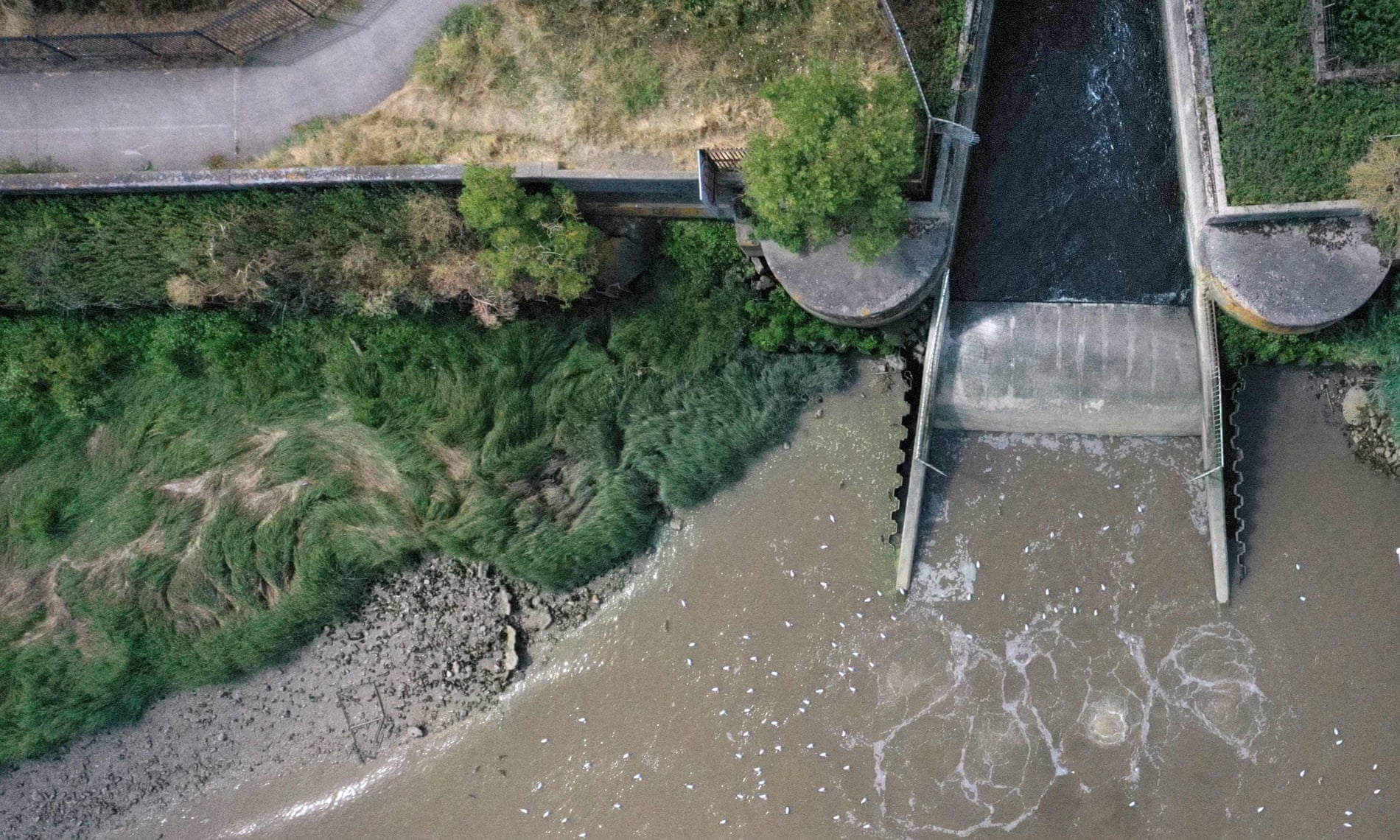
Raw sewage discharges are allowed to be released from storm overflows on the network only in exceptional circumstances, such as very heavy rain. Photograph: Ben Stansall/AFP/Getty Images

Exclusive: Environment Agency figures due out on Wednesday to reveal 129% increase in total discharges on previous 12 months

More than 4m hours of raw sewage discharges poured into rivers and seas last year, a 129% increase on the previous 12 months, new figures are expected to reveal on Wednesday.

Total discharges from the 14,000 storm overflows owned by English water companies that release untreated sewage into rivers and coastal waters increased by 59% to 477,972, making 2023 the worst year for sewage spills, according to an early estimate of the Environment Agency figures seen by the Guardian.

Senior industry sources were preparing for the government to turn its guns on water companies after the record year of discharges. The Environment Agency said it was setting up a whistleblowing hotline for people who work in the industry to report any activity that concerns them.

The heavy rainfall over the autumn and winter is likely to be blamed by the industry for the huge rise. Storm overflows are supposed to be used only in extreme weather but for many years they have been used routinely, discharging raw sewage even on dry days in some cases. The academic Peter Hammond has shown how water companies are routinely using storm overflow discharges in their water management.

https://www.theguardian.com/business/2024/mar/26/4m-hours-of-raw-sewage-discharges-in-england-last-year-figures-expected-to-show

Continue Reading4m hours of raw sewage discharges in England in 2023, data expected to show

Julian Assange’s extradition appeal hangs in the balance as UK court seeks US “assurances”

Spread the love

Original article by Tanupriya Singh republished from peoples dispatch under a Creative Commons Attribution-ShareAlike 4.0 (CC BY-SA) license.

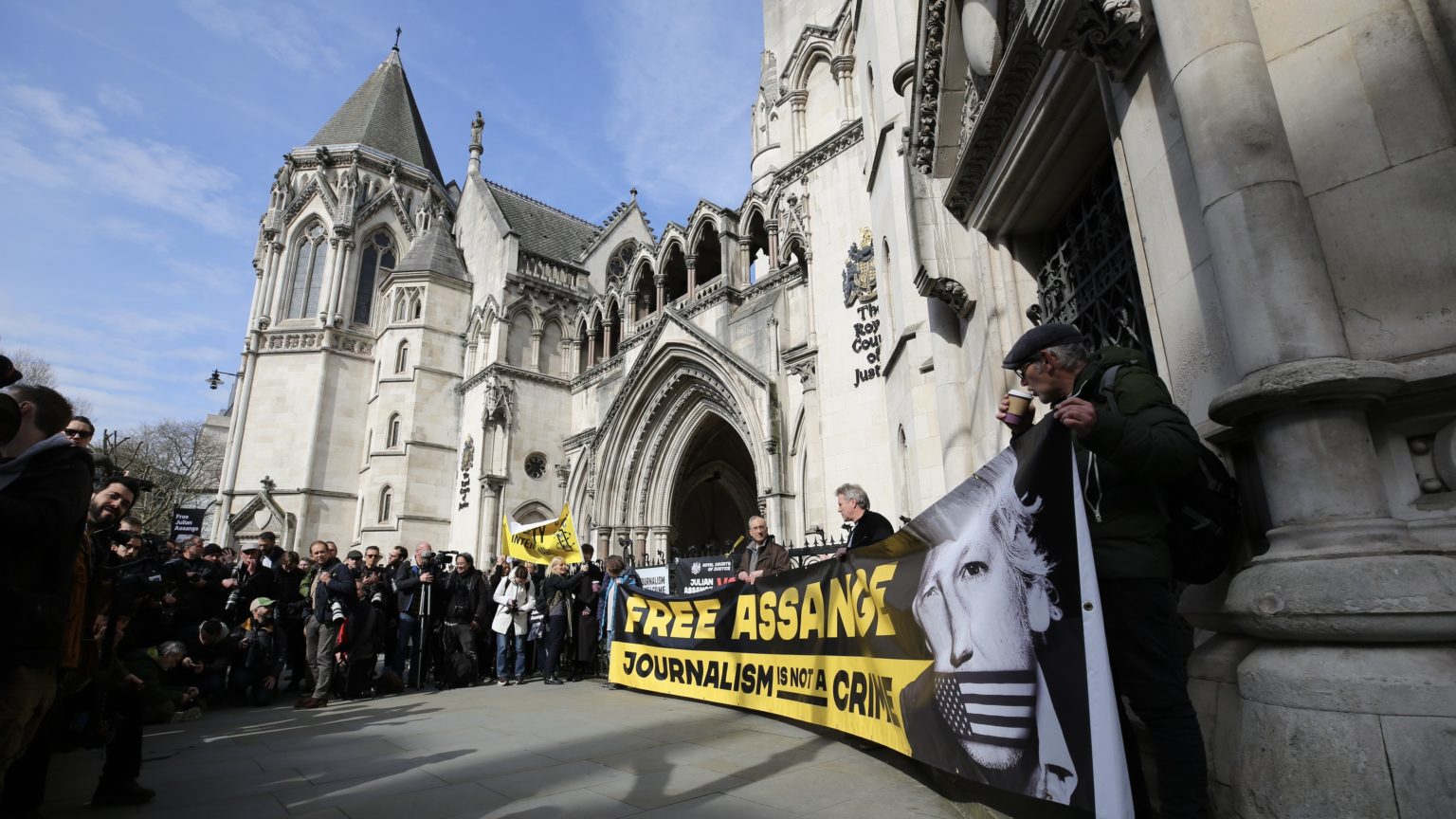
Protesters gathered outside the Royal Courts of Justice in London on Tuesday. Photo: Free Assange UK Campaign/X

The UK High Court has granted WikiLeaks founder Julian Assange provisional permission to appeal his extradition to the US, on grounds including the risk of the death penalty.

The UK High Court has granted provisional permission to journalist and WikiLeaks founder Julian Assange to appeal his extradition to the US. The ruling was handed down by judges Dame Victoria Sharp and Justice Jeremy Johnson in London on March 26, as supporters of Assange gathered outside the court to demand his freedom.

The US has sought to extradite Assange to prosecute him on 18 charges, 17 of which are under the draconian Espionage Act, for the publication of classified documents on WikiLeaks exposing war crimes and human rights abuses committed by US forces, including in Iraq and Afghanistan.

The extradition was approved by the UK Home Office in 2022, protracting an already difficult legal battle for the imprisoned journalist. Assange has been held at the Belmarsh high security prison for five years without a trial or conviction.

In its decision, the Court has granted Assange permission to appeal against his extradition, with the matter adjourned till May 20. However, the appeal will proceed only if the US and the UK are unable to provide the Court with assurances regarding Assange’s treatment following an extradition.

The US and the UK have until April 16 to file these assurances. This will also pave the way for further submissions to be made before a final decision is reached.

In the meantime, the temporary permission to appeal has been granted on three out of nine grounds including: a) that extradition may be “incompatible with the right of freedom of expression” under the European Convention on Human Rights; and b) that the applicant (Assange) might be “prejudiced on grounds of nationality” which is related to whether or not he will be protected under the First Amendment of the US Constitution given that Assange is not a citizen.

The third ground of appeal upheld by the Court for now is “inadequate speciality protection/death penalty protection”, which bars extradition under the UK’s 2003 Extradition Act.

In the application, Assange’s legal team noted that despite the fact that none of the charges leveled by the US as part of the extradition request carry the death penalty, the accusations made against him could lead to additional charges of aiding and abetting treason, which would be capital offenses.

They further highlighted statements made by US officials, including by Donald Trump, former president and potential Republican candidate for the upcoming US election, calling for the death penalty for Assange.

During the two-day “permission hearing” held in February ahead of the March 26 decision, the US prosecution admitted that there were no assurances that Assange would not be handed the death penalty.

Read more: US obfuscates and misrepresents on second day of Assange hearings

The US now has three weeks to provide the Court with “satisfactory assurances” that Assange will be permitted to rely on the First Amendment (protecting free speech), that he will not be prejudiced at trial (including sentence) because of nationality (his status as non- US citizen), that he will be afford the same protections under the First Amendment as a US citizen, and that the death penalty will not be imposed.

This is not the first time that such proposals have been made in Assange’s case. In fact, despite a lower court acknowledging Assange’s risk of suicide in 2021, his extradition was approved based on “diplomatic assurances” given by the US.

These included that Assange would not be subject to brutal Special Administrative Measures (SAMs), that he would not be kept at the ADX Florence maximum security prison, and that he could serve a custodial sentence in Australia, his country of origin. However, these protections would not apply if Assange was deemed to have committed a “future act” that could necessitate SAMs.

The entirely unilateral nature of these assurances raised alarm, especially given that these actions would be at the discretion of US prison authorities and not subject to judicial review.

“The UK remains intent on extraditing Assange despite the grave risk that he will be subjected to torture or ill-treatment in the US,” Simon Crowther, Legal Adviser at Amnesty International, said in response to Tuesday’s ruling.

“While the US has allegedly assured the UK that it will not violate Assange’s rights, we know from past cases that such ‘guarantees’ are deeply flawed — and the diplomatic assurances so far in the Assange case are riddled with loopholes.”

Meanwhile, the Court dismissed critical grounds for appeal raised by Assange’s team, in particular that the extradition was for a political offense, and as such prohibited under the UK-US Extradition Treaty. Assange’s lawyers had argued in February that espionage was universally accepted as a political offense, given that it was an offense directed at the state.

“These were the most important revelations of criminal US state behavior in history,” Assange’s lawyer, Mark Summers, had told the Court regarding the materials published by WikiLeaks. This included the “Collateral Murder Video” in which a US Army Apache helicopter had killed 11 unarmed civilians in Baghdad in 2007.

Read more: Assange’s Last Stand

Addressing the press outside the court, Assange’s wife, Stella, stated that the decision was “astounding”. She pointed out that though the Court had recognized the violation of Julian Assange’s rights, “what the Courts have done have done [is] to invite a political intervention from the United States to send a letter saying ‘it’s all okay’. Five years into this case, the US has managed to show the Court that their case remains an attack on press freedom, an attack on Julian’s life.”

“What the Courts have not agreed to look at is the evidence that the US has plotted to assassinate Julian, to kidnap him, because if it acknowledged that then of course he cannot be sent to the US.”

The Court astonishingly justified its refusal to admit this new evidence, of a plot by the US’ Central Intelligence Agency (CIA) to kidnap and assassinate Assange, stating that “on the face of the allegations…the contemplation of extreme measures against the applicant (whether poisoning for example or rendition) were a response to the fear that the applicant might flee to Russia”.

“The rationale for such conduct is removed if the applicant is extradited. Extradition would result in him being lawfully in the custody of the US authorities, and the reasons (if they can be called that) for rendition or kidnap or assassination then fall away”.

Meanwhile, Assange’s brother, Gabriel Shipton, reiterated that the fact that the Court had sought political assurances from the US revealed the political nature of the case itself.

Stella Assange added, “Julian is a political prisoner, he is a journalist, and he is being persecuted because he exposed the true cost of war in human lives. This case is a retribution, it is a signal to all of you, that if you expose the interests that are driving war they will come after you, they will put you in prison and they will try to kill you.”

“The Biden administration should not issue assurances, they should drop this shameful case that should have never been brought,” she said, calling people to pressure the US government and to support House Resolution 934.

The text, which is in the US Congress, states that “regular journalistic activities, including the obtainment and publication of information, are protected under the First Amendment and that the federal government should drop all charges against and attempts to extradite Julian Assange.”

“If Julian goes down for this, every serious journalist around the world is going to be slightly more cautious about exposing war crimes, corporate greed…We need the maximum pressure all across the US on the Biden administration, on the candidates in the forthcoming election, to say ‘Drop the charges against Julian Assange,’” MP and former Labor Party leader Jeremy Corbyn told Democracy Now.

If the UK High Court does not grant Assange the permission to appeal, he will have exhausted his options within the country’s legal system, and will have to approach the European Court of Human Rights (ECHR), immediately seeking an interim measure against the extradition under Rule 39 (“risk of irreparable harm”) pending a full hearing of the case. The ECHR’s verdict will be binding on the UK.

Original article by Tanupriya Singh republished from peoples dispatch under a Creative Commons Attribution-ShareAlike 4.0 (CC BY-SA) license.

Continue ReadingJulian Assange’s extradition appeal hangs in the balance as UK court seeks US “assurances”

Greens call for end to arms exports alongside boycotts, divestment and sanctions in wake of Security Council vote

Spread the love
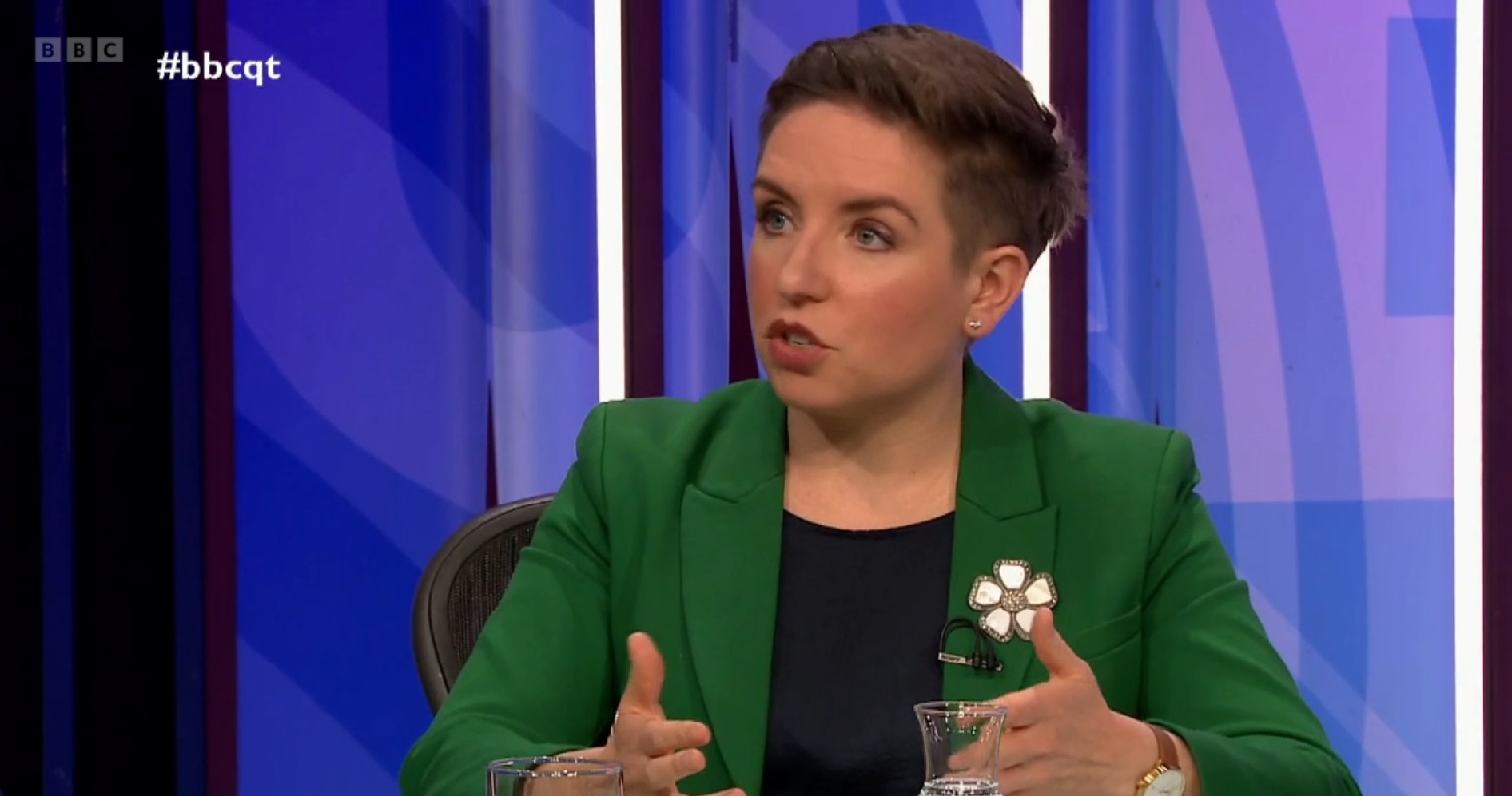
Image of the Green Party's Carla Denyer on BBC Question Time.
Image of the Green Party’s Carla Denyer on BBC Question Time.

Reacting to news that the UN Security Council has called for an immediate ceasefire in Gaza, without the US using its veto to block the resolution, co-leader of the Green Party Carla Denyer, said: 

“The Green Party has been calling for a ceasefire since last October, so this vote is hugely welcome if long overdue. With Israel’s greatest ally the United States abstaining, the Netanyahu regime is more isolated than ever – and rightly so.  

“This Security Council resolution comes too late for hundreds of thousands of people who have seen their families and friends killed, maimed, or seriously injured and their homes, hospitals and schools destroyed. Nonetheless, it ramps up international pressure on Israel to end its deadly assault on Gaza. 

“However, Netanyahu is not listening – the attacks continue. The UK government must now further pressurise the Netanyahu regime by immediately suspending export licenses for arms to Israel. The Green Party also calls for further leverage through boycotts, divestment and sanctions. This means withdrawing all public money from funds with investments in Israel and suspending beneficial trade arrangements with the country.  

“Only a full bilateral ceasefire and release of all hostages can stop more people dying. Israel must immediately stop blocking humanitarian aid to Gaza, where their blockade on aid is causing famine and intolerable suffering. And only a ceasefire can allow talks to begin on the long-term political solutions that will bring peace and security to everyone in the region.” 

Continue ReadingGreens call for end to arms exports alongside boycotts, divestment and sanctions in wake of Security Council vote

Protesters across Arab countries call for immediate ceasefire in Gaza

Spread the love

Original article by Peoples Dispatch republished from peoples dispatch under a Creative Commons Attribution-ShareAlike 4.0 (CC BY-SA) license.

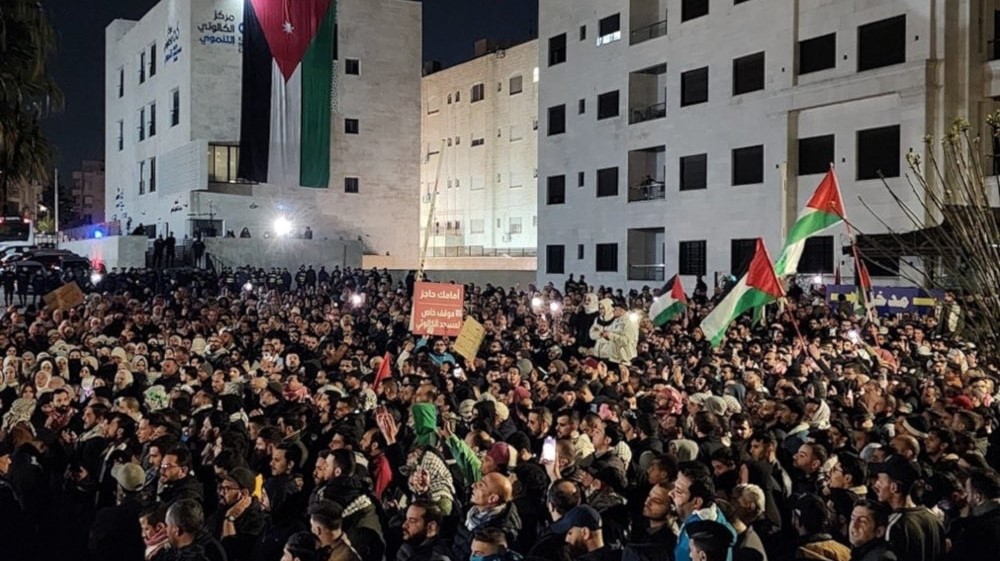
Protesters gather in Amman in Jordan demanding an immediate ceasefire in Gaza. Photo: Al Mayadeen

People took to the streets in a number of countries across West Asia and North Africa after the UN Security Council resolution calling for a ceasefire. However, Israel refused to heed the call and continued its attacks on Gaza on Tuesday

Large-scale protests broke out in different parts of West Asia and North Africa on Monday, March 25 in support of Palestine with people chanting slogans against the Israeli war in Gaza and demanding an immediate ceasefire. People took to the streets in a number of countries in the aftermath of the UN Security Council resolution that called for a ceasefire.

Jordanian security forces fired tear gas shells to disperse protesters who tried to storm the Israeli embassy in Amman. Thousands of these protestors chanted slogans in solidarity with the people in Gaza and in support of the Al-Aqsa mosque. Many of them carried Palestinian flags which they hoisted in nearby buildings.

Similar protests took place in other parts of the country. A day before, Jordanian forces had prevented a large group of people from marching to the Israeli embassy.

Protests were also organized in the Iraqi capital Baghdad and Cairo in Egypt as well on Monday where hundreds gathered to chant slogans in support of Palestine and demand an immediate ceasefire.

Hundreds also gathered in Tangiers in Morocco to demonstrate against the continued Israeli genocide of Palestinians in Gaza.

Protests were also organized in the Nur Shams refugee camp in Tulkarem and in Ramallah in the occupied West Bank on Tuesday. Hundreds of Palestinians, defying Israeli dictates and ongoing attacks, took to the streets in the morning to call for a ceasefire.

The protests followed the UNSC resolution demanding an immediate ceasefire. The resolution was adopted after the US, which had blocked three similar previous resolutions, decided to abstain. All the other members of the Security Council supported the resolution.

The resolution called for an immediate ceasefire during the month of Ramadan and for working towards a permanent cessation of hostilities and the release of all hostages. It was welcomed by the Palestinian resistance group Hamas and most of the countries in the region.

Hamas reiterated its demand for a permanent ceasefire that would lead to the complete withdrawal of all Israeli forces from Gaza and the return of all Palestinians displaced due to the war over five months.

Nearly the entire population of Gaza, around 2.3 million, has been displaced due to the Israeli war which has killed more than 32,000 and wounded close to 74,000 Palestinians.

The Iranian foreign ministry welcomed the UNSC resolution, calling it a positive step and demanded its immediate implementation. It also demanded the lifting of all blockades on the supply of aid to Gaza and the opening of all border crossings to the besieged territory and immediate resumption of reconstruction.

Israel has however rejected the resolution. It carried out fresh attacks on Gaza on Tuesday, killing dozens of Palestinians.

The resolution accepted by the Security Council is binding on all members of the UN. However, only a fresh vote in the Security Council can decide the future course of action in case one particular party chooses not to implement it.

Original article by Peoples Dispatch republished from peoples dispatch under a Creative Commons Attribution-ShareAlike 4.0 (CC BY-SA) license.

Continue ReadingProtesters across Arab countries call for immediate ceasefire in Gaza