‘Enough Is Enough’: Ireland Joins ICJ Genocide Case Against Israel

Spread the love

Original article byBRETT WILKINS republished from Common Dreams under Creative Commons (CC BY-NC-ND 3.0).
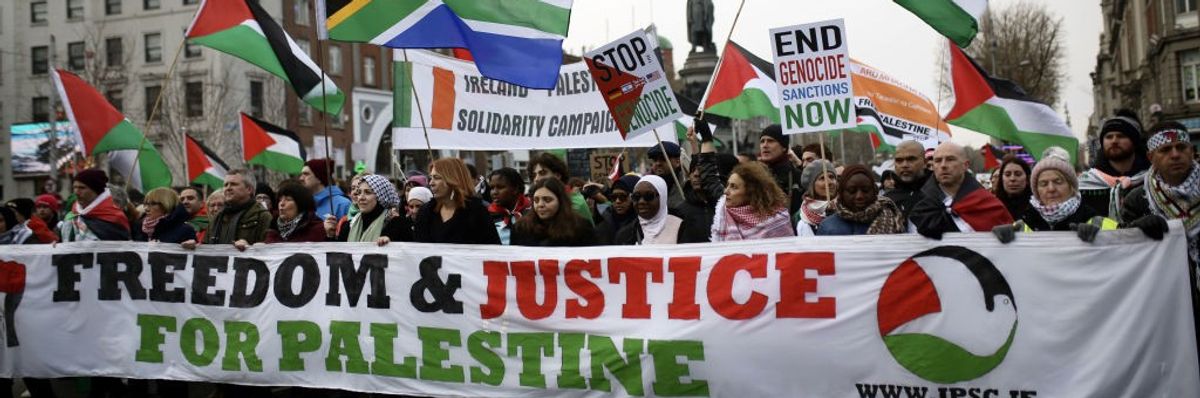
Palestinian and South African flags are seen at a January 13, 2024 protest for Gaza in Dublin, Ireland.  (Photo: Stringer/Andalou via Getty Images)

“What we saw on October 7 in Israel, and what we are seeing in Gaza now, represents the blatant violation of international humanitarian law on a mass scale,” said one top Irish official.

Citing Israel’s “blatant” human rights violations in Gaza, Ireland’s second-highest-ranking official said Wednesday that the country will join the South Africa-led genocide case before the International Court of Justice in The Hague.

Irish Tánaiste Micheál Martin—the equivalent of a deputy prime minister in other parliamentary nations—said that Ireland decided to intervene in the case after analyzing the “legal and policy issues” pertaining to the case under review by the United Nations’ top court.

“It is for the court to determine whether genocide is being committed,” Martin—who also serves as Ireland’s foreign and defense minister—said in a statement. “But I want to be clear in reiterating what I have said many times in the last few months; what we saw on October 7 in Israel, and what we are seeing in Gaza now, represents the blatant violation of international humanitarian law on a mass scale.”

Martin continued:

The taking of hostages. The purposeful withholding of humanitarian assistance to civilians. The targeting of civilians and of civilian infrastructure. The indiscriminate use of explosive weapons in populated areas. The use of civilian objects for military purposes. The collective punishment of an entire population.

The list goes on. It has to stop. The view of the international community is clear. Enough is enough. The U.N. Security Council has demanded an immediate cease-fire, the unconditional release of hostages, and the lifting of all barriers to the provision of humanitarian assistance at scale. The European Council has echoed this call.

South Africa’s case—which is supported by over 30 countries, the Arab League, African Union, and others—incisively details Israel’s conduct in the war, including the killing of tens of thousands of Palestinians, mostly women and children; the wounding of tens of thousands more; the forcible displacement of 90% of the besieged enclave’s 2.3 million people; and the inflicting of conditions leading to widespread starvation and disease. The filing also cited numerous genocidal statements by Israeli officials.

On January 26, the ICJ issued a preliminary ruling that Israel is plausibly committing genocide in Gaza and ordered its government and military to prevent genocidal acts. Palestinian and international human rights defenders say Israel has ignored the order.

A draft report released this week by the U.N.’s Human Rights Council found “reasonable grounds to believe” that Israel is committing genocide in Gaza, a move that came on the same day as the U.N. Security Council passed a resolution demanding an immediate cease-fire in the ongoing war.

“The situation could not be more stark; half the population of Gaza face imminent famine and 100% of the population face acute food insecurity,” said Martin. “As the U.N. secretary-general said as he inspected long lines of blocked relief trucks waiting to enter Gaza during his visit to Rafah at the weekend: ‘It is time to truly flood Gaza with lifesaving aid. The choice is clear: surge or starvation.’ I echo his words today.”

In a St. Partick’s Day White House meeting with U.S. President Joe Biden—a staunch supporter of Israel—Irish Toaiseach (Prime Minister) Leo Varadkar, who announced earlier this month that he would soon step down, said that “the Irish people are deeply troubled about the catastrophe that’s unfolding before our eyes in Gaza.”

“And when I travel the world, leaders often ask me why the Irish have such empathy for the Palestinian people,” he added. “And the answer is simple: We see our history in their eyes—a story of displacement, of dispossession and national identity questioned and denied, forced emigration, discrimination, and now hunger.”

Original article byBRETT WILKINS republished from Common Dreams under Creative Commons (CC BY-NC-ND 3.0).

Continue Reading‘Enough Is Enough’: Ireland Joins ICJ Genocide Case Against Israel

Support for Israel’s War on Gaza Plummeting Among Key Biden Voters: Poll

Spread the love

Original article by JAKE JOHNSON republished from Common Dreams under Creative Commons (CC BY-NC-ND 3.0). 

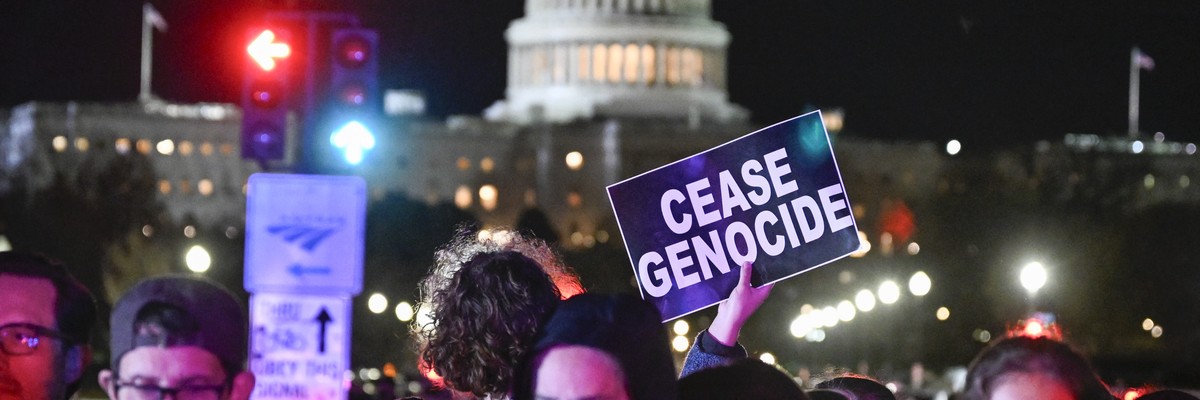
Hundreds of demonstrators demanding an immediate cease-fire in the Gaza Strip march in Washington D.C. on March 7, 2024. 
(Photo: Celal Gunes/Anadolu via Getty Images)

“Given these numbers,” said one progressive campaigner, “I don’t know how President Biden can reconcile his stalwart support for Israel with the clear preference that his core constituents have for an end to this war.”

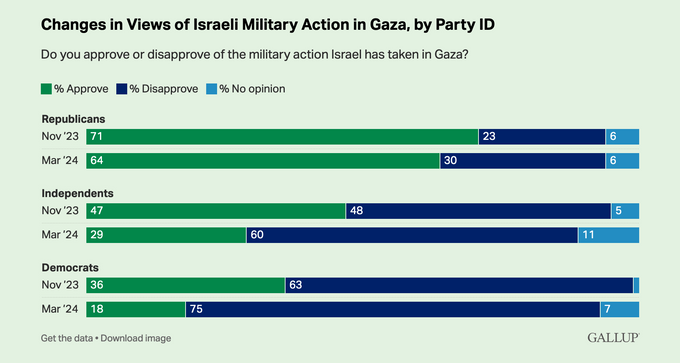
A Gallup survey released Wednesday shows that U.S. public support for Israel’s military assault on Gaza has plummeted since November, with the decline particularly sharp among Democratic voters whom President Joe Biden will need to turn out to win reelection against presumptive GOP nominee Donald Trump.

Just 18% of Democratic voters currently approve of “the military action Israel has taken in Gaza” and 75% disapprove, according to the new poll, which was conducted between March 1-20. In November, 36% of Democratic respondents expressed approval of Israel’s war and 63% disapproved.

“The crosstabs are even more striking—nearly two-thirds of people under 54, people of color, and women disapprove of the military action in Gaza,” Sam Rosenthal, political director of the progressive advocacy group RootsAction, told Common Dreams in response to the new poll. “That is effectively the Democratic Party’s base.”

“Given these numbers,” Rosenthal added, “I don’t know how President Biden can reconcile his stalwart support for Israel with the clear preference that his core constituents have for an end to this war.”

Overall, Gallup found that 55% of the American public—including 60% of Independents and 30% of Republicans—disapproves of Israel’s military campaign in the Gaza Strip, up from 45% in November. Just 36% of the U.S. public approves, down from 50% four months ago.

“Biden is risking his second term and our democracy by continuing to support the kind of violence and cruelty that is being perpetrated in Gaza right now.”

Observers noted that Gallup’s new poll was conducted after the Israeli military’s February 29 massacre of Palestinians seeking food aid. Since October, according to one human rights monitor, Israeli forces have killed more than 560 people waiting for humanitarian aid, the delivery of which Israel’s government has intentionally hindered—fueling the spread of famine across the territory.

The Biden administration has backed Israel’s assault from the beginning, providing the Netanyahu government with billions of dollars worth of weapons and diplomatic cover despite widespread and growing protests at home and abroad. Gallup’s survey found that 74% of U.S. adults say they are following developments in Gaza “closely.”

Political analyst Yousef Munayyer wrote on social media that “Biden’s policy of continued support for Israel’s war on Gaza is in line with the views of the right-wing Republicans,” noting that 64% of GOP voters still approve of the Israeli assault—down slightly from 71% in November.

“Just to emphasize how extreme his position is and out of line with his voters,” he added, “more Republicans disapprove of the war than Democrats who approve.”

Growing Democratic opposition to Israel’s military action in Gaza has fueled grassroots campaigns across the country urging voters to mark “uncommitted” on their Democratic primary ballots to pressure Biden to change course ahead of the general election against Trump, who has voiced support for Israel’s devastating assault on Gaza.

“Uncommitted” campaigns won 11 Democratic National Convention (DNC) delegates in Minnesota and two in both Michigan and Washington state.

“Biden is risking his second term and our democracy by continuing to support the kind of violence and cruelty that is being perpetrated in Gaza right now,” Faheem Khan, president of the American Muslim Advancement Council and a lead organizer of Uncommitted WA, said earlier this week.

Rosenthal of RootsAction told Common Dreams on Wednesday that the U.S. decision to abstain and allow the U.N. Security Council to pass a cease-fire resolution earlier this week was “a step in the right direction, and a clear indication that domestic pressure from campaigns like Listen to Michigan and other uncommitted voting efforts is working.”

“However, actual policy towards Israel has changed very little,” said Rosenthal. “Biden is still clamoring for more military aid to be sent, and the U.S. still largely supports Israel’s line, i.e., that military operations in Gaza are solely aimed at rooting out Hamas. What is manifestly obvious to the rest of the world, that Israel is committed to the wanton destruction of the Gaza Strip, is somehow escaping the administration’s notice.”

“President Biden should decide quickly whether he wants to continue to uphold policy that is increasingly associated with the opposition party,” Rosenthal added.

Original article by JAKE JOHNSON republished from Common Dreams under Creative Commons (CC BY-NC-ND 3.0). 

Another State Department Official Resigns Over Biden Gaza Policy

Democratic Insider Rips ‘Shocking’ US Claim That Israel Is Following International Law

US Under Fire for Downplaying Security Council Resolution as ‘Nonbinding’

Continue ReadingSupport for Israel’s War on Gaza Plummeting Among Key Biden Voters: Poll

Argentina: Javier Milei’s government poses an urgent threat to human rights

Spread the love
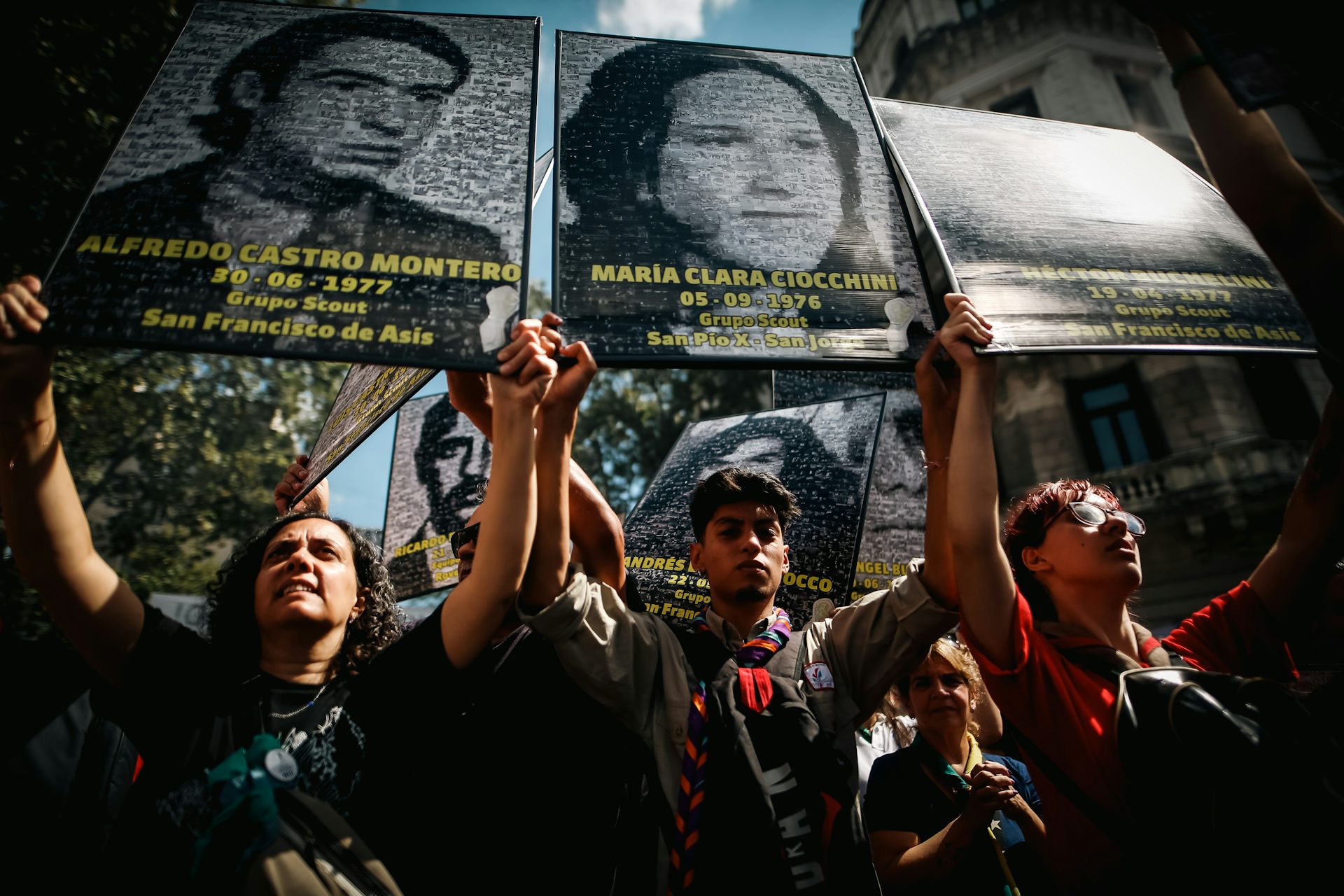
Demonstrators carry pictures of missing people during a march for the Day of Remembrance for Truth and Justice in Buenos Aires, Argentina, March 24 2024. Juan Ignacio Roncoroni / EPA

Cara Levey, University College Cork

“Milei, you scumbag, you are the dictatorship.” This was among the defiant shouts that rang out across downtown Buenos Aires on Sunday March 24 as some 400,000 Argentinians filled the Plaza de Mayo, the iconic square that has borne witness to pivotal moments in Argentina’s history.

People flock to Buenos Aires – and other cities across Argentina – on this date each year for an annual march to commemorate the victims of the country’s last military dictatorship. Between 1976 and 1983, an estimated 30,000 people were killed, imprisoned, tortured or forcibly disappeared in a state-led campaign that still haunts the country.

But this year the march felt a little different. Activists showed their palpable outrage at President Javier Milei’s administration for seeking to downplay the brutal legacy of the dictatorship.

And on March 21, Milei’s defence minister, Luis Petri, reportedly met with the wives of military officers convicted of crimes against humanity. The meeting occurred amid rumours of pardons for human rights abuses that had been committed under the dictatorship.

Many human rights have been rolled back too. Activists have faced threats, funding for the country’s commemorative sites has been withdrawn and their staff laid off, and workers in the Secretariat of Human Rights have been sacked. Human rights, which have been hard won over decades in Argentina, are in danger.

A large crowd of people in a street holding banners and pictures aloft.
People gather in cities across Argentina on March 24, the anniversary of a coup that installed a brutal military dictatorship in Argentina.
AstridSinai/Shutterstock

Political violence

Milei is a self-professed anarcho-capitalist. His policies are at best, nebulous, and at worst, dangerously chaotic. Since he was elected in November 2023, Milei has made clear plans for sweeping liberal economic reforms, cuts to funding for public services, and has opposed equal marriage and legal abortion.

Milei’s human rights policy is worrying. A number of active and retired military personnel have been appointed to various government positions, including chief of staff and to the Ministry of Defence. However, there would be worse to come in the run up to this year’s March 24 commemorations – an outright assault on human rights.

In early March, Sabrina Bölke, a member of HIJOS (Sons and Daughters for Identity and Justice against Oblivion and Silence), was attacked and sexually assaulted in her home. HIJOS is an Argentinian organisation founded in 1995 to represent the children of people who had been murdered, disappeared or imprisoned by the country’s military dictatorship

Before leaving, her attackers wrote “VVLC [viva la libertad, carajo] ñoqui” on one of the walls. This is Milei’s catchphrase and loosely translates as “Long live freedom, dammit”. Ñoqui (gnocchi) is a derogatory term for state workers, equivalent to “jobsworth” in English.

This is a lesson in what happens when radical “outsiders” like Milei (or Jair Bolsonaro in Brazil and Donald Trump in the US) come in from the shadows. They not only tolerate political violence, but actively encourage it. Lacking political experience, their leadership is founded on creating an “us v them” mentality which emboldens their supporters.

Revising history

The day of commemoration brought one more disturbing turn of events. The government released a video straight out of the denialist playbook, presenting a false, alternative portrayal of the military dictatorship’s crimes.

The video advocates for a “complete memory” that shifts the focus to those killed by armed left-wing organisations in the 1960s and 1970s and calls for the end of the pursuit of justice for military perpetrators. It stars Juan Bautista Yofre, the ex-chief of the Secretariat of Intelligence, and María Fernanda, the daughter of Captain Humberto Viola, who was killed in 1974 by the revolutionary left.

The video resurrects the “two demons” trope. This is a theory that equates systematic state terrorism with the violence committed by the revolutionary left. It justifies the disappearances as the result of a conflict between two warring factions.

It’s a viewpoint that had, in recent years, lost much credibility. In 2006, the prologue to the National Commission on the Disappearance of Persons’ truth commission report, which was originally published in 1983 to detail the extent of forced disappearance across Argentina, was rewritten specifically to remove allusions to this myth.

Such rejection of historical facts is not surprising. During his presidential campaign debates, Milei disputed the number that had disappeared at the hands of the dictatorship.

His vice president, Victoria Villarruel, the niece of a member of the armed forces under judicial investigation, has gone even further. She has called for an end to human rights trials and has pushed for the closure of the memory museum on the grounds of what was once the notorious former Navy Mechanics School that became a clandestine detention centre during the dictatorship.

What happens next?

Milei and Villarruel may struggle to block human rights trials completely, certainly not without a stand-off with the Argentine courts. The opposition of congress to Milei’s “omnibus law” (the collective name for his package of liberal reforms) in February 2024 is a reminder that he will undoubtedly face legislative roadblocks.

The Argentine Court of Appeal, which is responsible for ruling on human rights cases, has also been clear that it will prevent perpetrators of human rights abuses benefitting from house arrest. However, we will probably see a gradual undermining of judicial processes via the release of defendants and the replacement of judges, accompanied by an emboldening of those who deny state terrorism.

It is still early days in Milei’s tenure. But human rights activists and international observers should be concerned about the future of human rights in Argentina.The Conversation

Cara Levey, Senior Lecturer in Latin American Studies, University College Cork

This article is republished from The Conversation under a Creative Commons license. Read the original article.

Continue ReadingArgentina: Javier Milei’s government poses an urgent threat to human rights

Foreign Office faces legal challenge over pause in UNRWA funding for Gaza  

Spread the love

https://leftfootforward.org/2024/03/foreign-office-faces-legal-challenge-over-pause-in-unrwa-funding-for-gaza/

UK could be sued over decision to stop funding a key UN agency delivering aid to Gaza

A legal challenge is to be launched against the Foreign Office over its decision to pause funding for the UN’s Palestinian refugee agency. 

On behalf of a British-Palestinian man with family in Gaza, Bindmans LLP has issued a pre-action letter to the government department warning, if funding is not reinstated by Tuesday 2, April, the client will issue judicial review proceedings in the High Court. 

The legal challenge claims that the government’s decision to withdraw funds from the United Nations Relief and Works Agency for Palestine Refugees in the Near East (UNRWA) on 27, January was decided, “illogically and without due consideration of evidence, of international obligations, or of FCDO decision-making frameworks”.

Funding was paused by 10 governments including Australia, the United States and Canada following allegations by the Israeli authorities that several UNRWA staff were involved in the October 7 Hamas attacks. 

https://leftfootforward.org/2024/03/foreign-office-faces-legal-challenge-over-pause-in-unrwa-funding-for-gaza/

‘Death Sentence for Thousands’: Israel Bars UNRWA Food Aid to Northern Gaza

Continue ReadingForeign Office faces legal challenge over pause in UNRWA funding for Gaza