‘Enough Is Enough’: Australia Says Free Assange

Spread the love

Original article by AMY GOODMAN DENIS MOYNIHAN republished from Common Dreams under Creative Commons (CC BY-NC-ND 3.0). 
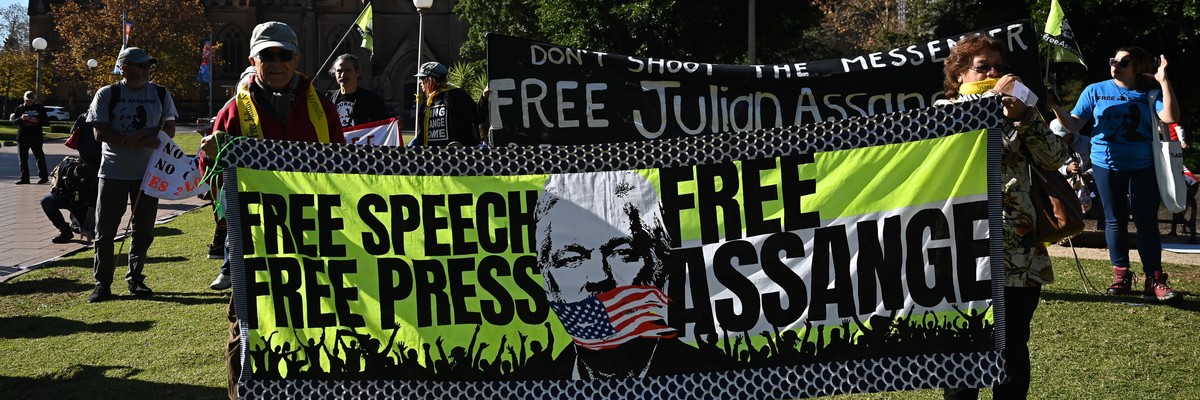
People participate in a rally demanding freedom for imprisoned WikiLeaks founder Julian Assange in Sydney, Australia, on May 24, 2023.  (Photo: Steven Saphore/Anadolu Agency via Getty Images)

U.S. and U.K. persecution of Assange has been continuous and severe.

Australian Prime Minister Anthony Albanese said during Prime Minister’s Questions on February 15, “This thing cannot just go on and on and on, indefinitely.”

The Prime Minister was addressing an action he took a day earlier, on Valentine’s Day. No, not his marriage proposal to his partner, Jodie Haydon (she said yes). He was explaining his support for a parliamentary motion that passed overwhelmingly, calling for the release of an Australian citizen, imprisoned WikiLeaks founder Julian Assange.

Albanese’s support builds on a growing demand from Australians across the political spectrum that the United Kingdom not extradite Assange to the United States, and for the U.S. to drop its espionage and hacking charges against him. Assange, who has been imprisoned in London’s notorious maximum-security Belmarsh Prison since 2019, has a court hearing in the UK.

Assange’s counsel, Jennifer Robinson, texted us on Thursday:

“The appeal next week could be Julian’s final appeal against U.S. extradition. If permission to appeal is denied, there are no further appeals available to us in the U.K.” If extradited, Assange faces up to 175 years in prison in the United States. Said Prime Minister Albanese, “Enough is enough.”

Prior to his imprisonment in Belmarsh, Julian Assange spent seven years cramped inside Ecuador’s small London embassy, where he’d been granted political asylum.

Assange founded WikiLeaks, a website that publishes leaked material while protecting the identity of the whistleblowers. While it launched in 2006, it wasn’t until 2010 that the U.S. government forcefully and publicly targeted Wikileaks and Assange, after Wikileaks made several massive disclosures of leaked documents related to the U.S. invasions and occupations of Iraq and Afghanistan.

On Monday, April 5, 2010, Julian Assange released a shocking video at the National Press Club in Washington, D.C. The video, which WikiLeaks titled “Collateral Murder,” was shot in 2007 from a U.S. military Apache helicopter flying over Baghdad, Iraq. The video shows in grainy black and white detail the gunship’s attack on a group of people on the ground. Twelve civilians, including two Reuters news employees, were mowed down by automatic fire from the helicopter. The voices of the crew were recorded, as they sought permission to “engage” with their targets, and as they laughed and cursed through the slaughter. It was a chilling video, documenting a war crime.

The video’s release was followed by the publication on Wikileaks.org of hundreds of thousands of digital records from the U.S. military, dubbed the Iraq War Logs and the Afghan War Diary. These documents provided further proof that the U.S. was committing war crimes. Some elected officials in the U.S. called for Assange to be assassinated. Then-Vice President Joe Biden called him a “high-tech terrorist.”

Not long after, the U.S. Justice Department convened a secret grand jury which issued a sealed indictment against Assange. Existence of that indictment itself was revealed on WikiLeaks, in a subsequent leak, in 2012. U.S. and U.K. persecution of Assange since then has been continuous and severe. In 2017, as revealed in 2021 by journalist Michael Isikoff and colleagues, the CIA hatched plans to either kidnap Assange from the Ecuadorian embassy or even to assassinate him.

Andrew Wilkie, an independent member of the Australian Parliament from Tasmania, introduced the resolution in support of Assange this week, saying, “This House notes that on 20 and 21 February 2024, the High Court of Justice in the United Kingdom will hold a hearing into whether Walkley Award-winning journalist Julian Assange can appeal against his extradition to the United States of America… both the Australian Government and Opposition have publicly stated that this matter has gone on for too long; and underlines the importance of the U.K. and USA bringing the matter to a close so that Mr Assange can return home to his family in Australia.”

The Australian government is not alone in calling for Assange’s release. In November, 2022, five major newspapers that collaborated with WikiLeaks—The New York TimesThe GuardianLe MondeEl Pais, and Der Spiegel—released a joint letter calling for an end to the prosecution. “Obtaining and disclosing sensitive information when necessary in the public interest is a core part of the daily work of journalists. If that work is criminalized, our public discourse and our democracies are made significantly weaker,” the letter read.

Assange’s attorney Jennifer Robinson will be in the London court for the hearing. She told us, “We have been saying for years: This is a political case which requires a political solution. The unprecedented showing of political support in the Australian Parliament overnight shows that Julian’s case is a priority for the Australian government, our parliament, and the people. The U.S. should listen to the concerns of its ally—and drop the case.”

Original article by AMY GOODMAN DENIS MOYNIHAN republished from Common Dreams under Creative Commons (CC BY-NC-ND 3.0). 

Continue Reading‘Enough Is Enough’: Australia Says Free Assange

Thousands take part in pro-Palestine protests across the world

Spread the love

https://www.aljazeera.com/news/2024/2/17/thousands-take-part-in-pro-palestine-protests-across-the-world

Protesters hold up flags and placards during a demonstration in support of Palestinian people in Gaza, in London [Alberto Pezzali/AP]

Protests took place in major world cities, including London, Madrid and Istanbul.

Thousands of people have taken to the streets around the world to protest against the war in Gaza as Israel pledges to go forward with its offensive in Rafah in southern Gaza.

Waving pro-Palestinian flags and banners, thousands marched through the streets of Madrid, Spain to demand an immediate ceasefire in Gaza.

In the UK’s capital London, approximately 250,000 people took part in the protest demanding a ceasefire in Gaza, according to the Palestine Solidarity Campaign (PSC).

https://www.aljazeera.com/news/2024/2/17/thousands-take-part-in-pro-palestine-protests-across-the-world

https://www.youtube.com/shorts/qCH3m2sq8gU

Continue ReadingThousands take part in pro-Palestine protests across the world

Big Oil, Plastics Industry Led ‘Campaign of Deception’ to Push Recycling Fraud

Spread the love

Original article by Olivia Rosane republished from Common Dreams under Creative Commons (CC BY-NC-ND 3.0).

More than 90% of plastics disposed of between 1950 and 2015 were not recycled. (Photo: Laura Lezza/Getty Images)

“The oil industry’s lies are at the heart of the two most catastrophic pollution crises in human history,” one advocate said.

The petrochemical industry—including major oil companies like ExxonMobil—knew for decades that recycling was not a sustainable solution to the problem of plastic waste, yet continued to promote it in order to avoid regulation and deceive consumers into continuing to buy and use their products, a report released Thursday by the Center for Climate Integrity reveals.

The report, titled The Fraud of Plastic Recycling: How Big Oil and the Plastics Industry Deceived the Public for Decades and Caused the Plastic Waste Crisis, includes newly disclosed industry documents proving that companies and trade groups knew that plastics could not be recycled indefinitely in the 1980s and 90s even as they launched a massive public relations campaign to sell voters and policymakers on the process.

“This evidence shows that many of the same fossil fuel companies that knew and lied for decades about how their products cause climate change have also known and lied to the public about plastic recycling,” Center for Climate Integrity (CCI) president Richard Wiles said in a statement. “The oil industry’s lies are at the heart of the two most catastrophic pollution crises in human history.”

Plastic pollution is a major environmental and public health crisis. If current trends continue, plastics are expected to outweigh fish in the ocean by 2050, and the toxic fumes from plastic production facilities and incineration are a major environmental justice hazard for frontline communities. Humans in general also ingest an estimated credit-card’s worth of plastic each week, with unknown but potentially serious health impacts.

Recycling is often touted as a solution for keeping plastic out of the environment, but this has proven to be ineffective and insufficient: More than 90% of the plastics disposed of between 1950 and 2015 were either burnt, sent to landfills, or dumped into the environment. There are several technical and economic reasons why plastic recycling doesn’t work at scale. Plastics lose quality as they are recycled and can only really be reused once or potentially twice. The decline in quality also means that recycled plastics are more likely to leach toxins added during production or picked up from other waste items. Economically, it is cheaper to produce new plastics than recycle older ones, and only two types of plastic—PET and HDPE—actually attract markets that will recycle them.

The industry has long been aware of these limitations. In 1969, the American Chemical Society declared, “It is always possible that scientists and engineers will learn to recycle or dispose of wastes at a profit, but that does not seem likely to happen soon on a broad basis.”

“We are committed to the activities, but not committed to the results.”

Despite this, petrochemical companies and their trade groups began to push plastic recycling in the 1980s and 90s as a response to growing public concern over plastic waste, and the threat that this would lead to bans on plastic products.

“No doubt about it, legislation is the single most important reason why we are looking at recycling,” Wayne Pearson, the executive director of industry front group the Plastics Recycling Foundation and a DuPont marketing director, said in 1988.

The plastics industry used various strategies to sell the public on recycling, according to the report. These included:

  1. Funding front groups to promote recycling;
  2. Running ad and PR campaigns;
  3. Investing in recycling research to convince the public that it was taking action;
  4. Setting unrealistic internal recycling goals;
  5. Writing educational material promoting recycling to school children;
  6. Advocating for “advanced recycling,” a term for breaking plastics down to chemical components that can theoretically be reused but are not in practice; and
  7. Claiming, against evidence, that recycling can be part of a “circular economy.”

CCI provides new evidence that, while the industry was employing these strategies, it was simultaneously aware of recycling’s limitations.

For example, a report from the Vinyl Institute trade group concluded in 1986 that “recycling cannot be considered a permanent solid waste solution, as it merely prolongs the time until an item is disposed of.”

In 1994, Exxon Chemical Vice President Irwin Levowitz told employees of the American Plastics Council that “we are committed to the activities, but not committed to the results.”

CCI argued that the petrochemical industry should face legal consequences for its “campaign of deception” similar to suits brought against tobacco and opioid companies.

“When corporations and trade groups know that their products pose grave risks to society, and then lie to the public and policymakers about it, they must be held accountable,” Wiles said. “Accountability means stopping the lying, telling the truth, and paying for the damage they’ve caused.”

CCI vice president of legal and general counsel Alyssa Johl added: “Big Oil and the plastics industry’s decades-long campaign to deceive the public about plastic recycling has likely violated laws designed to protect consumers and the public from corporate misconduct and pollution.”

“Attorneys general and other officials should carefully consider the evidence that these companies defrauded the public and take appropriate action to hold them accountable,” Johl said.

Original article by Olivia Rosane republished from Common Dreams under Creative Commons (CC BY-NC-ND 3.0).

Continue ReadingBig Oil, Plastics Industry Led ‘Campaign of Deception’ to Push Recycling Fraud

Patients with chronic illnesses in Gaza failing to get treatment, doctors warn

Spread the love

https://www.theguardian.com/global-development/2024/feb/17/patients-with-chronic-illnesses-in-gaza-failing-to-get-treatment-doctors-warn

A Palestinian woman receives dialysis treatment at the Al-Aqsa Martyrs Hospital on February 8, 2024. Photograph: Anadolu/Getty Images

The lack of medicine, food and water means thousands of people with asthma, kidney disease or diabetes are unable to treat or control their conditions

Four months of conflict in Gaza is jeopardising the health of thousands of people with chronic illnesses such as kidney disease, diabetes and asthma, doctors have warned.

The chronically ill are the hidden casualties of the war, as access to water, food and medicine is severely restricted, said Guillemette Thomas, the Médecins Sans Frontières (MSF) medical coordinator for Palestine.

“Hospitals that are still functioning are overwhelmed with injured people, they are not able to deal with chronic illness at all,” she said. “Before the war there were 3,500 hospital beds in Gaza, now there are fewer than 1,000, and hundreds and hundreds of injured. We don’t know how many people are dying because they can’t access healthcare.”

Currently, only 14 of Gaza’s 36 hospitals are able to provide any medical services.

When medication is allowed into the territory there are no safe ways of distributing it, Thomas said. “We have some insulin coming in aid trucks, but patients can’t get to the places where it is stocked because of the airstrikes. People are bombed on their way to the hospital.”

The scarcity of clean water combined with the lack of medicines means many are unable to control their conditions. About 70% of Palestinians in Gaza have had to resort to drinking contaminated or salinised water, while 50% are experiencing food insecurity and 25% of the population are starving, according to the UN.

https://www.theguardian.com/global-development/2024/feb/17/patients-with-chronic-illnesses-in-gaza-failing-to-get-treatment-doctors-warn

Continue ReadingPatients with chronic illnesses in Gaza failing to get treatment, doctors warn

February on course to break unprecedented number of heat records

Spread the love

https://www.theguardian.com/environment/2024/feb/17/february-on-course-to-break-unprecedented-number-of-heat-records

Experts struggle to explain how rises in sea-surface temperatures have accelerated so quickly. Photograph: PPAMPicture/Getty Images

Rapid ocean warming and unusually hot winter days recorded as human-made global heating combines with El Niño

February is on course to break a record number of heat records, meteorologists say, as human-made global heating and the natural El Niño climate pattern drive up temperatures on land and oceans around the world.

A little over halfway into the shortest month of the year, the heating spike has become so pronounced that climate charts are entering new territory, particularly for sea-surface temperatures that have persisted and accelerated to the point where expert observers are struggling to explain how the change is happening.

“The planet is warming at an accelerating rate. We are seeing rapid temperature increases in the ocean, the climate’s largest reservoir of heat,” said Dr Joel Hirschi, the associate head of marine systems modelling at the UK National Oceanography Centre. “The amplitude by which previous sea surface temperatures records were beaten in 2023 and now 2024 exceed expectations, though understanding why this is, is the subject of ongoing research.”

Humanity is on a trajectory to experience the hottest February in recorded history, after a record January, December, November, October, September, August, July, June and May, according to the Berkeley Earth scientist Zeke Hausfather.

Continue ReadingFebruary on course to break unprecedented number of heat records