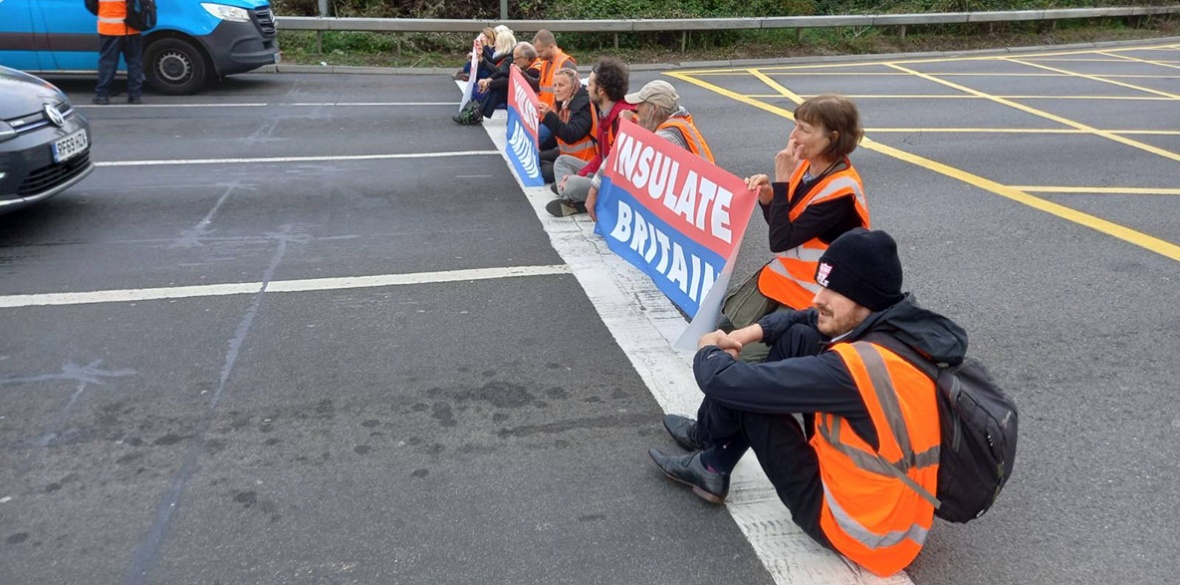
Insulate Britain activists block a road during a protest Photo: Insulate Britain
TRIALS of 18 climate activists who participated in non-violent action are set to begin next week as the government enforces authoritarian laws curbing the right to protest.
Five Extinction Rebellion activists are accused of causing criminal damage to the European headquarters of the half-a trillion-dollar financial firm JP Morgan, during a protest in September 2021 against its funding of fossil fuel firms.
Eight Insulate Britain supporters are accused of causing public nuisance by peacefully stopping traffic on the M25 motorway in the same month to press the government to insulate Britain’s homes to end fuel poverty and cut carbon emissions.
And five Just Stop Oil supporters face trial for alleged conspiracy to cause a public nuisance after they they occupied tunnels close to Grays oil terminal in August 2022 in pursuit for their demand for a halt to all new oil, coal and gas projects.
The trials coincide with fresh government attempts to undermine trials by jury.
People during a pro-Palestine march in Edinburgh, February 3, 2024
PALESTINE solidarity campaigners are planning a reception of their own as Holyrood prepares to welcome “profiteers of genocide.”
Despite the Scottish Parliament backing calls for an immediate ceasefire in the Israeli invasion of Gaza in November, and the International Court of Justice since ruling that there was a “plausible” case that genocide was being committed by Israeli forces, Holyrood is set to host weapons suppliers on February 21.
The reception for aerospace trade body the ADS Scotland Council, which includes firms such as Raytheon Systems — which controversially received £600,000 in Scottish government funding via Scottish Enterprise in 2021 — and drone manufacturer Thales, had been sponsored by Labour MSP Paul Sweeney.
After investigative journalist co-operative the Ferret exposed the reception, Mr Sweeney withdrew his sponsorship, but the corporate body that oversees the operation of the parliament building has taken the unusual step of allowing the event to go ahead without a parliamentary sponsor, adding to the fury felt by campaigners.
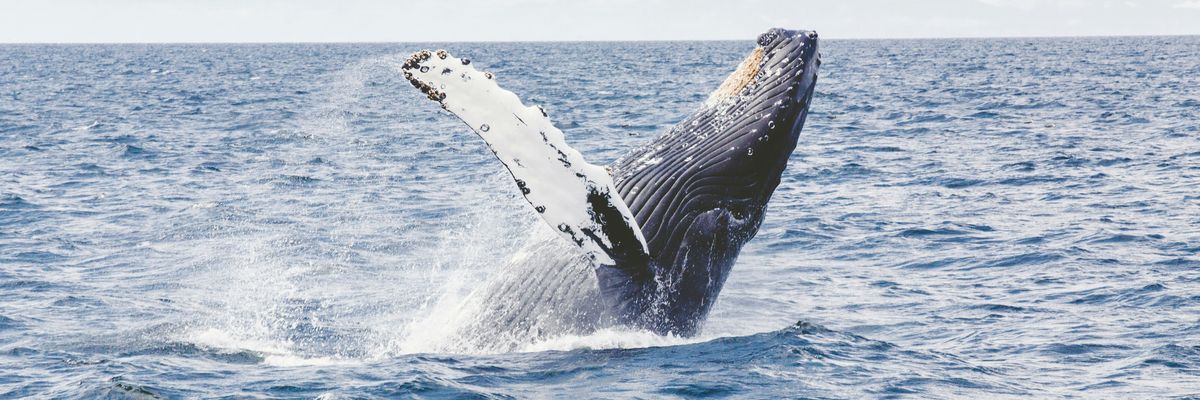
A humpback whale is seen in the ocean. (Photo: Thomas Kelley/Unsplash)
“The global community has an opportunity to translate this latest science of the pressures facing migratory species into concrete conservation action,” said one U.N. official.
As world governments gathered in Uzbekistan Monday for the United Nations conference on migratory species, they centered the theme “Nature Knows No Borders”—an idea that a new landmark report said must take hold across the globe to push policymakers in all countries and regions to protect the billions of animals that travel each year to reproduce and find food.
The Convention on the Conservation of Migratory Species of Wild Animals (CMS) marked the opening of the 14th Conference of the Parties (CMS COP14) to the United Nations biodiversity treaty by releasing the first-ever State of the World’s Migratory Species report, showing that nearly half of migrating species are declining in population.
The crisis is especially dire for more than 1 in 5 species that are threatened with extinction, and 70 species listed under the CMS which have become more endangered, including the steppe eagle, the Egyptian vulture, and the wild camel.
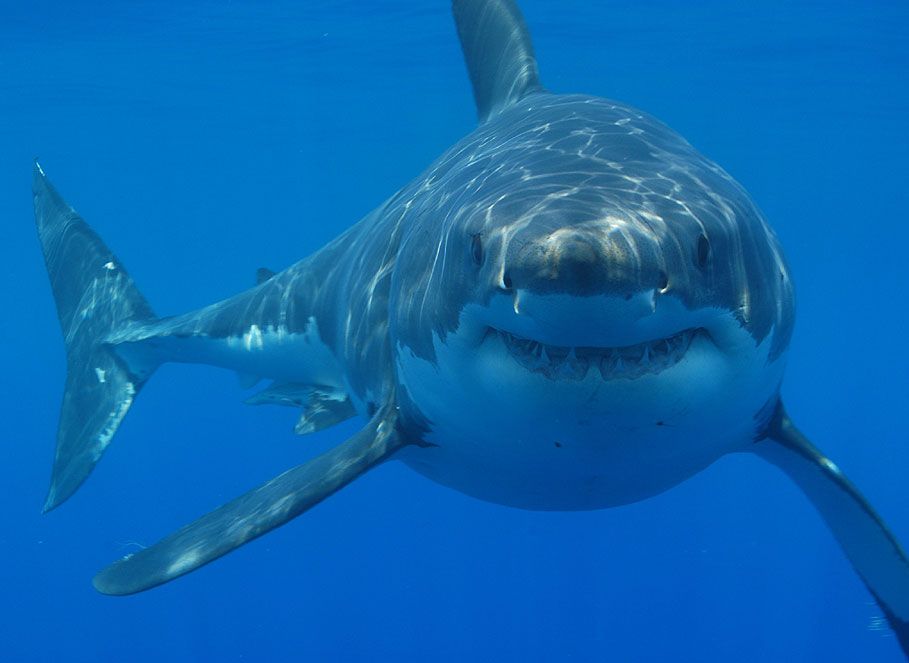
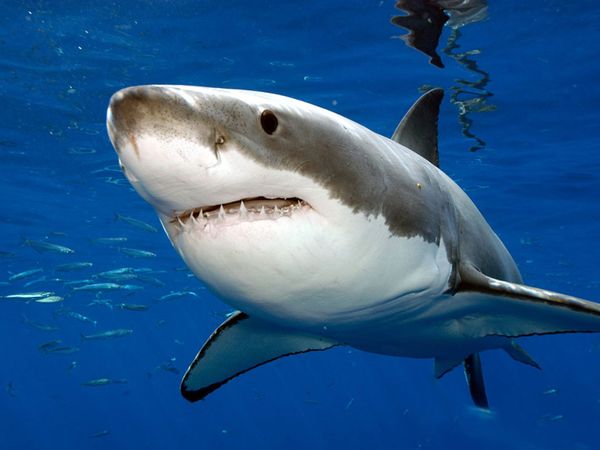
The populations of nearly all species of fish listed in the U.N. treaty, including sharks and rays, have declined by 90% since the 1970s.
The two biggest drivers of endangerment and threatened extinction are overexploitation—including incidental and intentional capture—and habitat loss, and both are directly caused by human activity.
Seven in 10 CMS-listed species are threatened by overexploitation, while 3 in 4 of the species are at greater risk of dying out due to habitat loss, as humans expand energy, transportation, and agricultural infrastructure across the globe.
The climate crisis and planetary heating, pollution, and the spread of invasive species—thousands of which are introduced by humans—are also major threats to migratory species, the report says.
“Unsustainable human activities are jeopardizing the future of migratory species—creatures who not only act as indicators of environmental change but play an integral role in maintaining the function and resilience of our planet’s complex ecosystems,” said Inger Andersen, undersecretary-general of the U.N. and executive director of the U.N. Environment Program (UNEP). “The global community has an opportunity to translate this latest science of the pressures facing migratory species into concrete conservation action. Given the precarious situation of many of these animals, we cannot afford to delay.”
Migratory species “reinforce” the fact that nature does not observe borders put in place by humans, Andersen added in a video posted on social media, and humans must work across borders to ensure these species are protected.
Nature knows no borders. Migratory species reinforce this, uniting us all as they travel across the world.
According to the report, nearly 10,000 of the world’s key biodiversity areas are crucial for the survival of migratory species, but more than half are not designated as areas that must be conserved—and 58% are under threat due to human activities.
Mapping and taking adequate steps to protect “the vital locations that serve as breeding, feeding, and stopover sites for migratory species” is a key priority, said the CMS in a statement.
“Migratory species rely on a variety of specific habitats at different times in their lifecycles,” said Amy Fraenkel, CMS executive secretary. “When species cross national borders, their survival depends on the efforts of all countries in which they are found. This landmark report will help underpin much-needed policy actions to ensure that migratory species continue to thrive around the world.”
In addition to increasing understanding of migration paths and minimizing human infrastructure in the pathways, the report recommended that policymakers “strengthen and expand efforts to tackle illegal and unsustainable taking of migratory species”; scale up efforts to tackle climate change and light, noise, chemical, and plastic pollution; and consider expanding CMS listings to include more at-risk migratory species in need of international attention.
“There are many things that are needed to be done on addressing the drivers of environmental change, such as agriculture for habitat destruction, the sprawl of cities, we have to look at rail, road, and fences,” said Fraenkel. “One of the most important things for migratory species is something we call ecosystem integrity: they need particular sites to breed, feed, and travel. If those sites cannot be accessed or don’t exist any more, then it’s obviously going to be detrimental.”
The report focused on 1,189 migratory species identified by the U.N. as needing protection, but found that another 399 migratory species are either threatened or near threatened with extinction.
“People might not realize that whales, lions, gorillas, giraffes, and many birds are migratory species,” Fraenkel said.
At the opening ceremony of CMS COP14, Andersen called on policymakers to live up to the conference’s theme “by ensuring free passage of migratory species and by ensuring that, through multilateralism, we reach a hand across every border to ensure long-term sustainability, for people and for planet.”
Reversing population decline is possible, the report emphasized, pointing to coordinated local action in Cyprus that reduced illegal bird netting by 91% and “hugely successful” conservation and restoration work in Kazakhstan, “which has brought the saiga antelope back from the brink of extinction.”
“I ask parties to consider how to work in harmony with other processes for mutually assured success,” said Andersen, “all in the interests of sustainable economies and societies.”
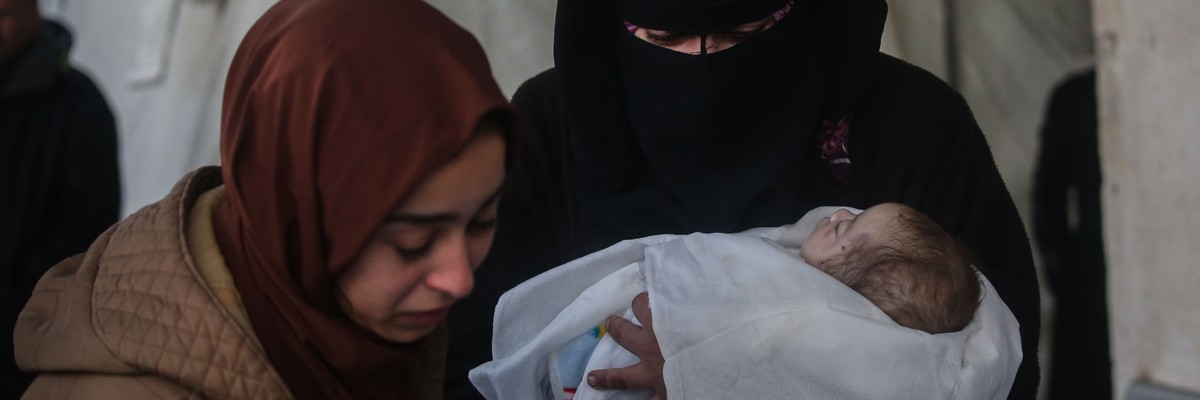
People mourn as they receive the dead bodies of victims of an Israeli airstrike on February 12, 2024 in Rafah, Gaza. (Photo by Ahmad Hasaballah/Getty Images)
Gruesome new data shows that kids make up around 43% of the death toll from Israel’s assault on the Gaza Strip.
Israeli forces have killed more than 12,300 Palestinian children in the Gaza Strip in just over four months, a staggering toll that’s likely to grow as the Netanyahu government ramps up its assault on and prepares to invade the overcrowded city of Rafah.
New figures that Gaza health authorities provided to The Associated Press show that children make up roughly 43% of the total death toll in the Palestinian enclave since October 7. Women and children combined account for three-quarters of the death toll, according to the new data.
“Are they ‘Hamas’?” Kenneth Roth, former executive director of Human Rights Watch, asked in response to the numbers, referring to Israel’s claim that it is targeting militants despite the massive and growing body of evidence to the contrary.
An Amnesty Internationalreport released Monday examining four recent Israeli airstrikes on Rafah. Amnesty said that “in all four attacks,” it did not find “any indication that the residential buildings hit could be considered legitimate military objectives or that people in the buildings were military targets.”
Virtually all of Gaza’s 1 million-plus children have been traumatized in some way by Israel’s monthslong war on the Gaza Strip: Around 17,000 have been separated from their families, more than 1,000 have had one or both of their legs amputated, and more than 610,000 are currently trapped in Rafah, a small city that was previously considered a relative safe zone for people fleeing Israeli bombs and bullets.
“Israel is erasing generations in Gaza and its soldiers are killing children in numbers competing with the cruelest of wars,” Israeli journalist Gideon Levy wrote in a column last month. “This will not and cannot be forgotten. How can a people ever forget those who killed its children in such a manner? How can people of conscience around the world remain silent?”
“This is the gravest test of all. Will they uphold international law and children’s right to life? Or will they stand by while the lives, bodies, and futures of more children are decimated?”
Children were among the dozens of Palestinians killed Monday in a wave of Israeli airstrikes conducted as the U.S.-armed Israel Defense Forces raided an apartment building to rescue two hostages.
Jason Lee, Save the Children’s country director for the occupied Palestinian territory, said last week that “much of the international community has failed tests of their commitment to protect children so far.”
“This is the gravest test of all,” Lee said of Rafah. “Will they uphold international law and children’s right to life? Or will they stand by while the lives, bodies, and futures of more children are decimated?”
The United Nations Children’s Fund, known as UNICEF, similarly appealed to the international community to act to prevent catastrophe for children and others in Rafah.
“We need an immediate humanitarian cease-fire in Gaza, and the safe and immediate release of all hostages—especially children—who have suffered so much,” Catherine Russell, UNICEF’s executive director, said Friday. “A humanitarian cease-fire will save lives. It will allow for the expansion of the humanitarian response, and help provide the best protection for children whose lives and futures are hanging in the balance.”
“This bill provides Netanyahu $10 billion more in unrestricted military aid for his horrific war against the Palestinian people. That is unconscionable,” said Sen. Bernie Sanders.