Supreme Court Hears Koch-Backed Cases Designed to Unleash Deregulatory Bonanza

Spread the love

Original article by JAKE JOHNSON republished from Common Dreams under Creative Commons (CC BY-NC-ND 3.0). 

Supreme Court Justice Neil Gorsuch attends an event in Hagerstown, Maryland on March 11, 2022.  (Photo: Andrew Lichtenstein/Corbis via Getty Images)

The conservative-dominated U.S. Supreme Court on Wednesday heard oral arguments in a pair of cases taking direct aim at a critical precedent that, if overturned, would gut federal agencies’ ability to set and enforce regulations—a potentially massive blow to the climate, civil rights, public health, and more.

Central to Loper Bright Enterprises v. Raimondo and Relentless, Inc. v. Department of Commerce is the so-called Chevron doctrine, which stems from a 1984 Supreme Court opinion that said judges should defer to federal agencies’ reasonable interpretation of a law if Congress has not specifically addressed the issue.

The precedent has long been a target of the fossil fuel industry and right-wing groups that are backing the plaintiffs in Loper and Relentless, both of which involve herring fishermen who challenged federal rules requiring them to pay for onboard compliance monitors.

Organizations that have received millions of dollars from the oil-soaked Koch network are supporting the effort to overturn the Chevron doctrine. In Loper, the plaintiffs’ lawyers are “working pro bono and belong to a public-interest law firm, Cause of Action, that discloses no donors and reports having no employees,” The New York Timesreported Tuesday.

“However,” the Times added, “court records show that the lawyers work for Americans for Prosperity, a group funded by [Charles] Koch, the chairman of Koch Industries and a champion of anti-regulatory causes.”

Relentless plaintiffs are represented by the New Civil Liberties Alliance, a right-wing group that has received millions from the Charles G. Koch Charitable Foundation.

Caroline Ciccone, president of the watchdog group Accountable.US, said in a statement Wednesday that “the special interests who spent big to stack the court may get their way if the Supreme Court weakens the government’s ability to hold industry accountable when they pollute for profit.”

“Everything from the climate to consumer safety could be worse off thanks to this potential decision and the corporate lobbyists who brought us to this point,” Ciccone added.

Earlier this week, Accountable.US urged right-wing Justice Neil Gorsuch—who has criticized the Chevron doctrine—to recuse from Loper, citing his ties to a billionaire oil tycoon who is positioned to benefit from a ruling that scraps the decades-old precedent. Justice Clarence Thomas also faced calls to recuse over his ties to the Koch network.

Neither agreed to step away from the case.

At the start of the Supreme Court’s hearing Wednesday, liberal Justice Elena Kagan expressed concern that gutting Chevron would give judges who lack subject-matter expertise power over policy decisions previously made by agencies staffed with scientists and other experts.

“You think that the court should determine whether a new product is a dietary supplement or a drug, without giving deference to the agency where it is not clear from the text of the statute or from using any traditional methods of statutory interpretation whether in fact the new product is a dietary supplement or a drug?” Kagan asked Roman Martinez, an attorney for the plaintiffs in Relentless. “You want the courts to decide that?”

The U.S. Supreme Court, which includes three justices appointed by former President Donald Trump, has recently shown a willingness to curb federal agencies’ power to enforce key laws. In its 2022 ruling in West Virginia v. Environmental Protection Agency, the court’s conservative supermajority limited the EPA’s authority to regulate power plants under the 1970 Clean Air Act.

But environmentalists and others warned that a ruling in favor of the plaintiffs in Loper and Relentless would strike a far more sweeping and devastating blow.

“The consequences of this case will be serious for fishery management, yes,” said Meredith Moore, director of Ocean Conservancy’s fish conservation program. “But it also puts at risk all of the environmental and social programs that keep our air and water clean, our homes and workplaces safe, and ourselves and our children healthy.”

“If the Supreme Court eradicates Chevron deference, it will overturn 40 years of foundational administrative and environmental law that has provided stable public resource management,” Moore added. “It will allow science-based management and agency expertise to be replaced with the inexpert policy and ideological preferences of unelected judges, potentially resulting in dramatically different interpretations of law across the country.”

Tishan Weerasooriya, senior associate of policy and political affairs at Stand Up America, echoed those concerns, saying in a statement that “if the MAGA justices of the court overturn another decades-old precedent, it will greatly reduce the ability of scientists and experts at government agencies to defend every Americans’ right to clean water and air, worker protections, healthcare, and more.”

“Billionaires and elite corporations have been gunning to overturn this precedent for years, hoping to increase their profits even further if experts and scientists are no longer setting safety standards,” said Weerasooriya. “If the Roberts court overturns Chevron, it will continue to erode our fundamental freedoms and safety in deference to the wealthy and corporations.”

Original article by JAKE JOHNSON republished from Common Dreams under Creative Commons (CC BY-NC-ND 3.0). 

Continue ReadingSupreme Court Hears Koch-Backed Cases Designed to Unleash Deregulatory Bonanza

Global heating may breach 1.5°C in 2024 – here’s what that could look like

Spread the love

Original article by Jack Marley republished from the Conversation under Creative Commons Attribution-No Derivatives licence.

Sunrise on Lake Michigan, US during a heatwave. August 2023. Antonio Perez/Chicago Tribune/TNS/Alamy Stock Photo

It’s official: 2023 was Earth’s hottest year ever recorded, beating the previous record set in 2016 by a huge margin. Last year was also the first in which the world was close to 1.5°C (1.48°C) hotter than the pre-industrial average (1850-1900). We are brushing against the threshold scientists urged us to limit long-term warming to.

Some scientists, including former Nasa climatologist James Hansen, predict 2024 will be humanity’s first year beyond 1.5°C. As what were once dire warnings from climate experts become our shared reality, what can you expect?

The 1.5°C temperature target, enshrined in the 2015 Paris agreement, is not shattered on first contact. Most of the climate tipping points scientists fear could send warming hurtling out of control are not expected until Earth is consistently warmer than 1.5°C. The global average temperature is likely to dip down again once the present El Niño (a warm phase in a natural cycle focused on the equatorial Pacific Ocean) dissipates.

Instead, 2024 could be our first glimpse of Earth at 1.5°C. Here’s what research suggests it will look like for people and nature.

Ecosystems on the brink

Tropical coral reefs are in hot water. These habitats comprise a network of polyp-like animals (related to jellyfish) and colourful algae encased in calcium carbonate. The complex forms they build in shallow water around the Earth’s equator are thought to harbour more species than any other ecosystem.

“Corals have adapted to live in a specific temperature range, so when ocean temperatures are too hot for a prolonged period, corals can bleach – losing the colourful algae that live within their tissue and nourish them via photosynthesis – and may eventually die,” say coral biologists Adele Dixon and Maria Beger (University of Leeds) and physicists Peter Kalmus (Nasa) and Scott F. Heron (James Cook University).

Coral bleaching, once rare, now occurs on an almost annual basis. Damsea/Shutterstock

Climate change has already raised the frequency of these marine heatwaves. In a world made 1.5°C hotter, 99% of reefs will be exposed to intolerable heat too often for them to recover according to Dixon’s research, threatening food and income for roughly one billion people – not to mention biodiversity.

Coral reefs will earn their reputation as the “canaries in the coal mine” for climate change’s impact on the natural world. As global heating ticks up towards 2°C, the devastation already seen on reefs will become evident elsewhere according to an analysis by biodiversity scientist Alex Pigot at UCL:

“We found that limiting global warming to 1.5°C would leave 15% of species at risk of abruptly losing at least one third of their current geographic range. However, this doubles to 30% of species on our present trajectory of 2.5°C of warming.”

Heat beyond human tolerance

Above 1.5°C, humanity risks provoking heatwaves so intense they defy the human body’s capacity to cool itself.

Intense heat and humidity have rarely conspired to create “wetbulb” temperatures of 35°C. This is the point at which the air is too hot and humid for sweating to cool you down – different from the “drybulb” temperature a thermometer reports.

Earth’s rising temperature could soon change that according to climate scientists Tom Matthews (Loughborough University) and Colin Raymond (California Institute of Technology).

“Modelling studies had already indicated that wetbulb temperatures could regularly cross 35°C if the world sails past the 2°C warming limit … with The Persian Gulf, South Asia and North China Plain on the frontline of deadly humid heat,” they say.

A relief camp for heat stroke in Hyderabad, Pakistan, May 2023. Owais Aslam Ali/Pakistan Press International (PPI)/Alamy Stock Photo

But different areas of the the world are warming at different rates. In a world that is 1.5°C hotter on average, temperatures in your local area may have actually risen by more than that.

To account for this, Matthews and Raymond studied records from individual weather stations worldwide and found that many sites were closing in much more rapidly on the lethal heat and humidity threshold.

“The frequency of punishing wetbulb temperatures (above 31°C, for example) has more than doubled worldwide since 1979, and in some of the hottest and most humid places on Earth, like the coastal United Arab Emirates, wetbulb temperatures have already flickered past 35°C,” they say.

“The climate envelope is pushing into territory where our physiology cannot follow.”

How long do we have?

Species extinctions and deadly heat become more likely after 1.5°C. So do catastrophic storms and collapsing ice sheets.

For a chance to avoid these horrors, we must eliminate the greenhouse gas emissions heating Earth and that means rapidly phasing out coal, oil and gas, which account for 80% of energy use worldwide.

Will carbon emissions from fossil fuels keep growing in 2024? TTstudio/Shutterstock

How fast? According to the latest estimate, published in October, very fast indeed.

“If humanity wants to have a 50-50 chance of limiting global warming to 1.5°C, we can only emit another 250 gigatonnes (billion metric tonnes) of CO₂,” say climate and atmospheric scientists Chris Smith at the University of Leeds and Robin Lamboll at Imperial College London.

“This effectively gives the world just six years to get to net zero.”

Original article by Jack Marley republished from the Conversation under Creative Commons Attribution-No Derivatives licence.

Continue ReadingGlobal heating may breach 1.5°C in 2024 – here’s what that could look like

Extreme UK flood levels are happening much more often than they used to, analysis shows

Spread the love

Original article by Louise Slater and Jamie Hannaford republished from the Conversation under Creative Commons Attribution-No Derivatives licence.

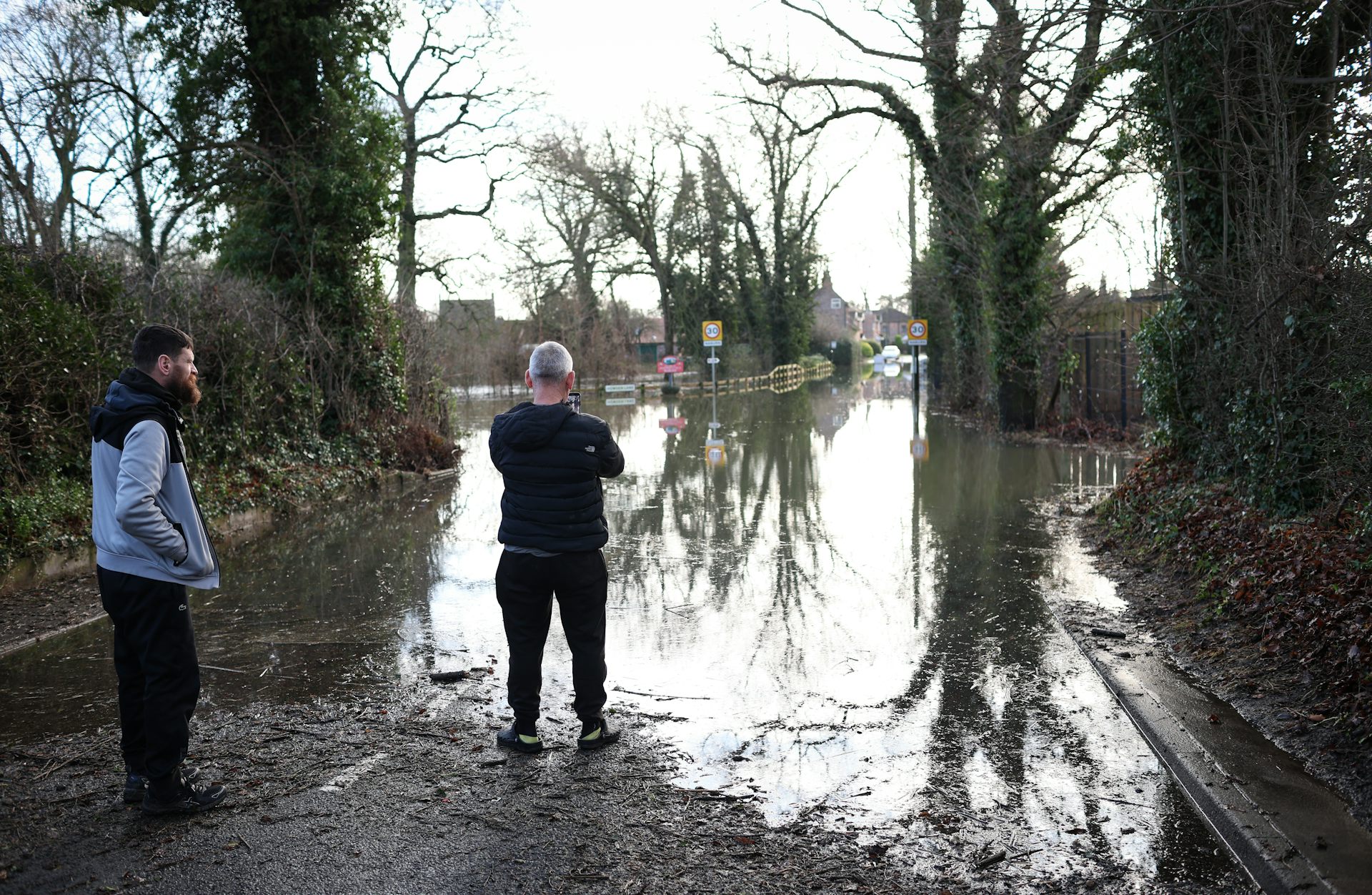
Flooding on the River Ouse, near York. January 4 2024. EPA-EFE/Adam Vaughan

Heavy rain across southern Britain meant that most rivers in England swelled at the beginning of 2024, prompting widespread flooding.

The River Trent was among the most severely affected. Water levels at the Drakelow gauging station in the west Midlands reached 3.88 metres on January 4 – well above the previous record set less than four years earlier in February 2020.

Are floods growing larger and happening more often in the UK? There are two ways to answer this question. One is to consult computer models which project Earth’s climate in the future, and the other is to search the historical record.

Climate projections are important but highly uncertain as they indicate a wide range of potential futures for any given river. Projections also only tell part of the story as they do not reflect the patterns of water use, changes to groundwater levels or to the urban environment that can decide flooding on a particular river.

That’s why we give equal importance to historical data, although we cannot project past changes directly into the future. Historical archives of river monitoring data can help us understand how the largest floods are changing on the River Trent.

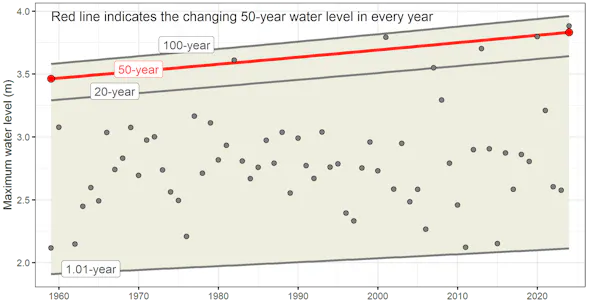
For instance, how is the 50-year water level (the highest point a river would be expected to reach in 50 years on average) changing? On the River Trent at Drakelow, the 50-year water level has risen from about 3.46 metres in 1959 to 3.83 metres in 2024. This means the largest floods are indeed getting bigger.

How the January 2024 floods compare

The flood water level on the Trent at the start of January 2024 was actually higher than what scientists would consider a once-in-50-year event in today’s warmer climate.

The 50-year water level on the River Trent has risen in 65 years. Grey circles indicate the highest water level in each year. L. Slater

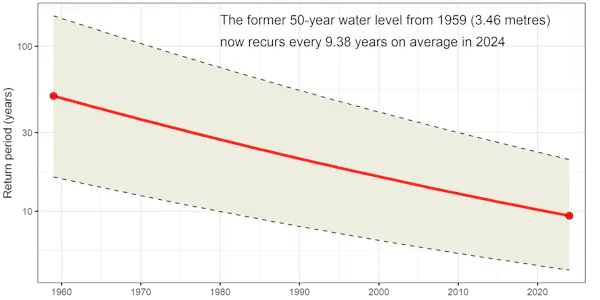
Another way to understand how much floods have changed is to consider how often they happen today compared with the past. If we look at the 50-year level from 1959 (about 3.46 metres), how often would such a flood occur in today’s climate?

On the Trent, a 3.46-metre flood level would now be expected to occur every 9.38 years, on average, in 2024. This makes sense, considering there have already been six events in which the river level exceeded 3.5 metres since the 1980s. The historical data shows that extreme water levels are being reached more frequently on the Trent.

The 50-year flood level from 1959 (3.5 metres) now recurs every nine years in 2024. L. Slater

Our analysis of the Trent aligns with results from a previous study which looked at rivers across the rest of the UK. In many places, 50-year floods are now happening less than every ten years, on average.

This is partly due to climate change and also partly due to natural variations in the climate which see rivers cycle through spells of more and less flooding. The UK went through a “flood-poor” period in the 1960s, 70s and 80s, and has been going through a “flood-rich” period since then.

Prepare for worse

It is worth noting that there are caveats to this type of analysis which tries to assess how extreme events are changing over time. Caution must be exercised when looking at long records of river levels given changes in river management practices and measurement techniques over time.

It should also be noted that these results use a different methodology to the industry standard for flood estimation.

But what matters is not the precise changes in the frequency of major floods (from 50 years down to nine or even two-and-a-half years, according to some statistical methods). It is understanding that the frequency of large floods is changing fast.

For many UK rivers with more extensive historical archives of river level measurements, floods appear to be occurring far more frequently than before. In a smaller number of places, they are occurring less frequently.

We need to better understand how flood risk will evolve in response to further human-induced warming. The UK’s efforts to predict and prepare for future floods are supported by the Environment Agency’s flood hydrology roadmap, which is mobilising a wide community of researchers and practitioners.

Overall, the UK must prepare to live with bigger floods and be able to predict flood-rich periods several years ahead. This starts with an understanding of how the severity and frequency of such events is changing.

To support this effort, we are preparing a range of tools to guide flood planners, including an interactive map allowing users to explore how flood return periods are changing across the UK. Being better prepared for extreme events in a warming climate starts with understanding what it will mean for your local area.

Original article by Louise Slater and Jamie Hannaford republished from the Conversation under Creative Commons Attribution-No Derivatives licence.

Continue ReadingExtreme UK flood levels are happening much more often than they used to, analysis shows

Elon Musk accused of silencing marginalised workers after deletion of union’s social media account

Spread the love

https://morningstaronline.co.uk/article/elon-musk-accused-silencing-marginalised-workers-after-deletion-unions-social-media

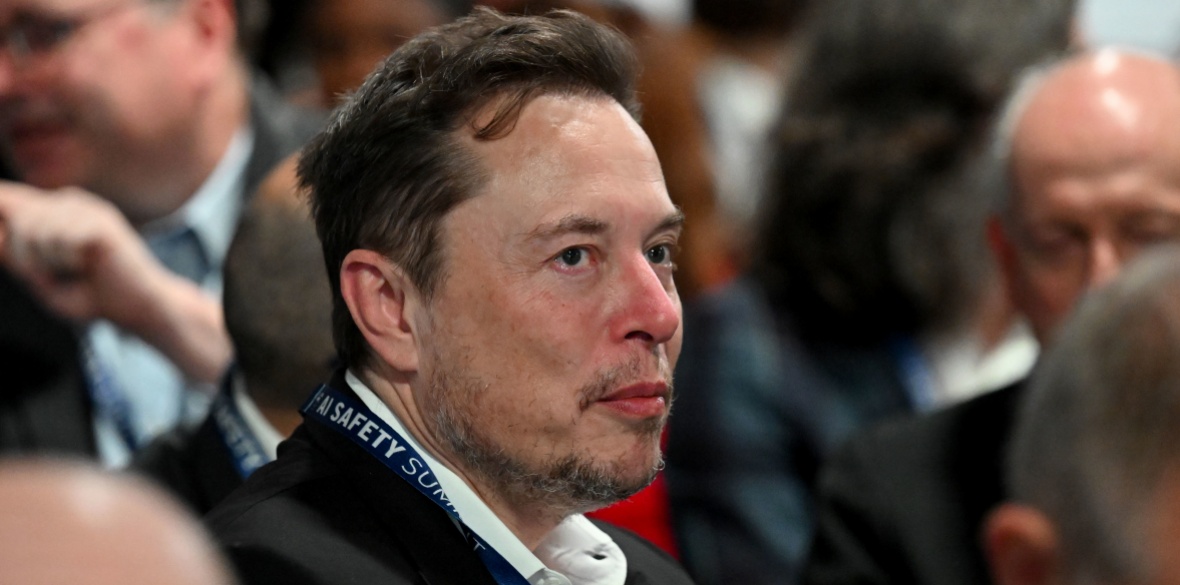
Tesla and SpaceX’s CEO Elon Musk during the opening plenary at the AI safety summit, at Bletchley Park in Milton Keynes, Buckinghamshire, November 1, 2023

BILLIONAIRE Elon Musk was accused of silencing the voices of marginalised workers today after grassroots union United Voices of the World announced that their Twitter account had been officially deleted.

The account, which had amassed over 20,000 followers, was suspended in December, erasing a decade of work.

The platform ignored multiple requests to restore the account, which had been used to amplify the voices of low-paid, migrant and precarious workers represented by the union.

Union general secretary Petros Elia said: “Elon Musk isn’t interested in free speech for workers.

“Under his ownership, Twitter has reinstated the accounts of neonazis and racists while silencing workers’ and progressive voices.

https://morningstaronline.co.uk/article/elon-musk-accused-silencing-marginalised-workers-after-deletion-unions-social-media

Continue ReadingElon Musk accused of silencing marginalised workers after deletion of union’s social media account

PMQs: Caroline Lucas takes Rishi Sunak to task over Gaza ceasefire

Spread the love

https://leftfootforward.org/2024/01/pmqs-caroline-lucas-takes-rishi-sunak-to-task-over-gaza-ceasefire/

‘What will it take for him to back a permanent, bilateral ceasefire?’

Rishi Sunak faced MPs in parliament today at the latest Prime Minister’s Questions (PMQs). He fielded questions from the Labour leader Keir Starmer on the Rwanda scheme and the SNP’s Westminster leader Stephen Flynn on the cost of living crisis.

But one of the most dramatic moments in the exchanges came as a result of a question from Green Party MP Caroline Lucas. She asked Sunak “what will it take for him to back a permanent, bilateral ceasefire?”

Speaking in the House of Commons, Lucas said: “Until the UK government calls for an immediate ceasefire, it is complicit in Gaza. Not my words, but those of the head of Oxfam, who like every single agency trying to operate on the ground is clear: that aid can’t be effectively delivered while fighting continues. More UK aid is, of course, welcome, but even when it does get through, it can result in what one Palestinian aid worker calls ‘bombing us on full stomachs’.

“24,000 people have already been killed. So can he tell us what will it take for him to back a permanent, bilateral ceasefire?”

https://leftfootforward.org/2024/01/pmqs-caroline-lucas-takes-rishi-sunak-to-task-over-gaza-ceasefire/

Continue ReadingPMQs: Caroline Lucas takes Rishi Sunak to task over Gaza ceasefire