Military interests are pushing new nuclear power – and the UK government has finally admitted it

Spread the love

Original article by Andy Stirling republished from the Conversation under a Creative Commons Attribution-No Derivatives licence.

Ben Birchall / Alamy

The UK government has announced the “biggest expansion of the [nuclear] sector in 70 years”. This follows years of extraordinarily expensive support.

Why is this? Official assessments acknowledge nuclear performs poorly compared to alternatives. With renewables and storage significantly cheaper, climate goals are achieved faster, more affordably and reliably by diverse other means. The only new power station under construction is still not finished, running ten years late and many times over budget.

So again: why does this ailing technology enjoy such intense and persistent generosity?

The UK government has for a long time failed even to try to justify support for nuclear power in the kinds of detailed substantive energy terms that were once routine. The last properly rigorous energy white paper was in 2003.

Even before wind and solar costs plummeted, this recognised nuclear as “unattractive”. The delayed 2020 white paper didn’t detail any comparative nuclear and renewable costs, let alone justify why this more expensive option receives such disproportionate funding.

A document published with the latest announcement, Civil Nuclear: Roadmap to 2050, is also more about affirming official support than substantively justifying it. More significant – in this supposedly “civil” strategy – are multiple statements about addressing “civil and military nuclear ambitions” together to “identify opportunities to align the two across government”.

These pressures are acknowledged by other states with nuclear weapons, but were until now treated like a secret in the UK: civil nuclear energy maintains the skills and supply chains needed for military nuclear programmes.

The military has consistently called for civil nuclear

Official UK energy policy documents fail substantively to justify nuclear power, but on the military side the picture is clear.

For instance, in 2006 then prime minister Tony Blair performed a U-turn to ignore his own white paper and pledge nuclear power would be “back with a vengeance”. Widely criticised for resting on a “secret” process, this followed a major three volume study by the military-linked RAND Corporation for the Ministry of Defence (MoD) effectively warning that the UK “industrial base” for design, manufacture and maintenance of nuclear submarines would become unaffordable if the country phased out civil nuclear power.
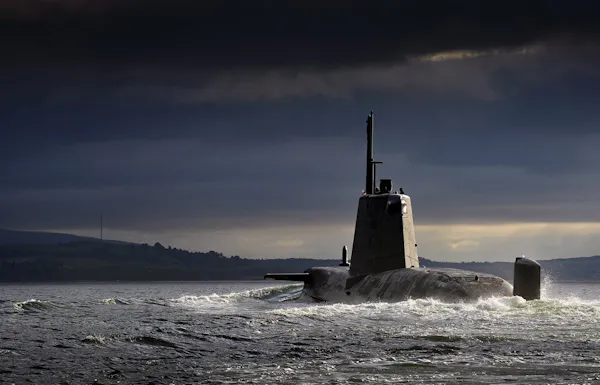
The UK navy has ten nuclear-powered submarines. Defence Imagery / flickrCC BY-SA

A 2007 report by an executive from submarine-makers BAE Systems called for these military costs to be “masked” behind civil programmes. A secret MoD report in 2014 (later released by freedom of information) showed starkly how declining nuclear power erodes military nuclear skills.

In repeated parliamentary hearingsacademicsengineering organisationsresearch centresindustry bodies and trade unions urged continuing civil nuclear as a means to support military capabilities.

In 2017, submarine reactor manufacturer Rolls Royce even issued a dedicated report, marshalling the case for expensive “small modular reactors” to “relieve the Ministry of Defence of the burden of developing and retaining skills and capability”.

The government itself has remained coy about acknowledging this pressure to “mask” military costs behind civilian programmes. Yet the logic is clear in repeated emphasis on the supposedly self-evident imperative to “keep the nuclear option open” – as if this were an end in itself, no matter what the cost. Energy ministers are occasionally more candid, with one calling civil-military distinctions “artifical” and quietly saying: “I want to include the MoD more in everything we do”.

In 2017, we submitted evidence to a parliamentary public accounts committee investigation of the deal to build Hinkley Point C power plant. On the basis of our evidence, the committee asked the then MoD head (who – notably – previously oversaw civil nuclear contract negotiations) about the military nuclear links. His response:

We are completing the build of the nuclear submarines which carry conventional weaponry. We have at some point to renew the warheads, so there is very definitely an opportunity here for the nation to grasp in terms of building up its nuclear skills. I do not think that that is going to happen by accident; it is going to require concerted government action to make it happen.

This is even more evident in actions than words. For instance hundreds of millions of pounds have been prioritised for a nuclear innovation programme and a nuclear sector deal which is “committed to increasing the opportunities for transferability between civil and defense industries”.

An open secret

Despite all this, military pressures for nuclear power are not widely recognised in the UK. On the few occasions when it receives media attention, the link has been officially denied.

UK prime minister Rishi Sunak announces a US-UK-Australia nuclear submarine deal in March 2023. Etienne Laurent / EPA

Other nuclear-armed states are also striving to maintain expensive military infrastructures (especially around submarine reactors) just when the civilian industry is obsolescing. This is true in the USFranceRussia and China.

Other countries tend to be more open about it, with the interdependence acknowledged at presidential level in the US for instance. French president Emmanuel Macron summarises: “without civil nuclear power, no military nuclear power, without military nuclear, no civil nuclear”.

This is largely why nuclear-armed France is pressing the European Union to support nuclear power. This is why non-nuclear-armed Germany has phased out the nuclear technologies it once lead the world in. This is why other nuclear-armed states are so disproportionately fixated by nuclear power.

These military pressures help explain why the UK is in denial about poor nuclear performance, yet so supportive of general nuclear skills. Powerful military interests – with characteristic secrecy and active PR – are driving this persistence.

Neglect of this picture makes it all the more disturbing. Outside defence budgets, off the public books and away from due scrutiny, expensive support is being lavished on a joint civil-military nuclear industrial base largely to help fund military needs. These concealed subsidies make nuclear submarines look affordable, but electricity and climate action more costly.

The conclusions are not self-evident. Some might argue military rationales justify excessive nuclear costs. But history teaches that policies are more likely to go awry if reasons are concealed. In the UK – where nuclear realities have been strongly officially denied – the issues are not just about energy, or climate, but democracy.


The Conversation asked the UK Department for Energy Security and Net Zero to comment but did not receive a reply before the publication deadline.

Don’t have time to read about climate change as much as you’d like?
Get a weekly roundup in your inbox instead. Every Wednesday, The Conversation’s environment editor writes Imagine, a short email that goes a little deeper into just one climate issue. Join the 30,000+ readers who’ve subscribed so far.

Original article by Andy Stirling republished from the Conversation under a Creative Commons Attribution-No Derivatives licence.

Continue ReadingMilitary interests are pushing new nuclear power – and the UK government has finally admitted it

EU Gaza Resolution Slammed as ‘Green Light for Butchery to Continue’

Spread the love

Original article by at Common Dreams republished under Creative Commons (CC BY-NC-ND 3.0). 

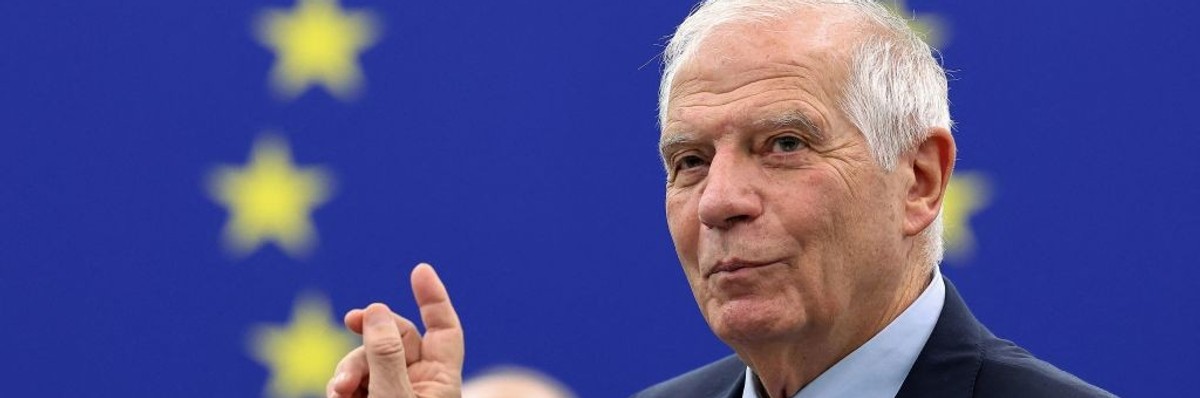
European Union High Representative for Foreign Affairs and Security Policy Josep Borrell gestures as he speaks during a debate on the humanitarian situation in Gaza, at the European Parliament in Strasbourg, eastern France on November 22, 2023.  (Photo by Frederick Florin/AFP via Getty Images)

The final text advocated for a “permanent cease-fire and to restart efforts towards a political solution provided that all hostages are immediately and unconditionally released and the terrorist organisation Hamas is dismantled.”

For the first time since Israel’s assault on Gaza began on October 7, the European Parliament called for a cease-fire Thursday—but not without significant conditions that critics said strip the resolution of all meaning.

The measure passed 312 to 131, with 72 abstaining.

Instead of endorsing an unconditional cease-fire, the text backed “a permanent cease-fire and to restart efforts towards a political solution provided that all hostages are immediately and unconditionally released and the terrorist organisation Hamas is dismantled,” as Agence France-Pressereported

“It is not a call for a cease-fire. It is an open-ended license for genocide, and will be understood by Israel as such.”

The Members of European Parliament (MEPs) expressed sorrow over all civilian deaths.

“While condemning in the strongest possible terms the despicable terrorist attacks committed by Hamas against Israel, they also denounce the disproportionate Israeli military response, which has caused a civilian death toll on an unprecedented scale,” the parliament said in a statement.

Hamas’ October 7 attack on southern Israel killed about 1,100 people and resulted in the taking of 240 hostages. Israel’s bombardment and invasion of Gaza has now killed 24,620 people and wounded 61,830, according to Thursday’s update from Gaza’s Ministry of Health.

The resolution also called for humanitarian access to the Gaza Strip, restarting the peace process with a goal of implementing a two-state solution, ending Israel’s occupation of the Palestinian territories, and accountability for all who carried out terrorist attacks or violated international law.

The vote comes the week after South Africa presented a case to the International Court of Justice (ICJ) arguing that Israel is committing genocide in Gaza. The text reiterates the E.U.’s support for the work of both the ICJ and the International Criminal Court.

The resolution was the result of a compromise between different parties in the parliament. The socialist, centrist, and green parties had all supported a resolution calling for a cease-fire, a political solution to the conflict, the release of the hostages, and the dismantling of Hamas, Reuters explained. However, the largest party in the body—the European People’s Party (EPP)—hesitated to join them and added an amendment that conditioned the cease-fire and restarting of the peace process on the release of hostages and the dismantling of Hamas.

“Sustainable peace cannot exist as long as Hamas and other terrorist groups hijack the Palestinian cause and threaten the existence of Israel, the only democracy in the region,” EPP MEP Antonio López-Istúriz told the body on Tuesday, as Euronews reported.

However, Manus Carlisle, the policy and press officer for Green MEP Grace O’Sullivan, said on social media that EPP had “sabotaged” the resolution by making the cease-fire conditional on the ending of Hamas, “which arguably makes the call entirely meaningless.”

O’Sullivan herself wrote on social media that EPP’s amendment “hands Israel a blank cheque to continue the massacre for as long as they want.”

“We need a braver E.U. than this,” she said.

Independents 4 Change MEPs Mick Wallace and Clare Daly denounced the text of the resolution.

“Reporting characterizing it as ‘the European Parliament calls for a permanent ceasefire’ is a misrepresentation of the text that has actually been passed,” they wrote in a statement. “Under no circumstances should it be allowed to go unchallenged.”

The MEPs pointed out that the parliament’s conditions for a cease-fire were the same as Israeli Prime Minister Benjamin Netanyahu’s.

“This is Israel’s repeatedly stated pretext for genocide, plain and simple, adopted by the European Parliament,” Wallace and Daly wrote in a statement. “It is not a call for a cease-fire. It is an open-ended license for genocide, and will be understood by Israel as such. The people of Gaza who are being murdered in their thousands by Israel are not responsible for the actions of Hamas.”

“In every respect, this resolution is the opposite of what is needed,” they added. “While the text claims to be a call for a cease-fire, it is a green light for butchery to continue.”

The resolution as a whole is non-binding, Reuters explained, though European Parliament resolutions can sometimes have an influence on foreign governments. The final text will be sent to other E.U. institutions, E.U. members, Israel, Palestinian officials, Egypt, and the United Nations.

Previously, the parliament had called for a humanitarian pause to allow aid into Gaza, but had not gone further and demanded a cease-fire, according to Euronews. The leaders of E.U. member states have not agreed to call for a cease-fire as a bloc and still endorse “humanitarian pauses and corridors.”

Original article by at Common Dreams republished under Creative Commons (CC BY-NC-ND 3.0). 

Continue ReadingEU Gaza Resolution Slammed as ‘Green Light for Butchery to Continue’

‘Banker of the Climate Crisis’: Lawsuit Targets ING in the Netherlands

Spread the love

Original article by OLIVIA ROSANE republished from Common Dreams under Creative Commons (CC BY-NC-ND 3.0). 

“Whether you are drilling for oil yourself, or have paid for the drill, in both cases you are contributing to and bear responsibility for the climate crisis we are currently experiencing,” one campaigner said of the suit against the Dutch banking giant.

Friends of the Earth Netherlands, which won a historic climate case against Shell in 2021, announced a new lawsuit on Friday against ING, the country’s largest bank.

The environmental group, known as Milieudefensie in Dutch, is demanding that the bank bring its climate policy in line with the Paris agreement goal of limiting global warming to 1.5°C, slash its carbon dioxide emissions by 48% of 2019 levels by 2030 and its carbon-dioxide equivalent emissions by 43%, take measures to ensure its clients are not destroying the Earth, and begin a dialogue with Milieudefensie about meeting these demands.

“The bank finances oil and gas companies, deforestation, and heavy industry, all of which add to the climate crisis,” Milieudefensie director Donald Pols said in a statement. “Whether you are drilling for oil yourself, or have paid for the drill, in both cases you are contributing to and bear responsibility for the climate crisis we are currently experiencing.”

In 2022, ING emitted at least 61 megatons of climate pollution, more than Ghana, Switzerland, or Sweden. Almost all of ING’s emissions come through the companies it invests in and does business with, and it emits more than any other bank in the Netherlands.

“He who pays the piper calls the tune. Due to ING’s financing of, e.g., oil and gas companies, ING is the banker of the climate crisis,” Pols said.

In a letter to ING, Milieudefensie outlined several steps the bank should take to reduce the climate footprint of its investments. These included requiring all clients to develop a Paris-compliant climate plan and refusing large clients that don’t develop one within a year, requiring all fossil fuel clients to stop expanding fossil fuels and develop a plan to phase them out entirely, and cutting ties with clients who refuse after one year.

“Large polluters like ING and Shell have to seriously get to work.”

In the letter, Miliedefensie said that ING had eight weeks from Friday to respond to its demands.

“If ING does not present a positive answer to Milieudefensie’s claims within the requested period of time, Milieudefensie will assume that ING is unwilling to comply with this request,” the group wrote in the letter. “Milieudefensie will in such case see no other option than to issue summons against ING with the goal of obtaining a court order instructing ING to take the aforementioned measures.”

The environmental group said that the legal argument behind its victory against Shell would also apply against ING, namely that large corporations must comply with the Paris agreement.

“Since the climate agreements in Paris, it is clear what the world needs to do: reduce the CO2 emissions to limit the warming of the Earth to 1.5°C,” the group’s attorney Roger Cox said in a statement. “This means that large polluters like ING and Shell have to seriously get to work. It is evident that they are not doing enough, and I am therefore confident that we will win this case too.”

While ING has made some progress on its internal climate goals, Mileudefensie believes it is not moving fast enough, as it plans to continue funding oil and gas projects through 2040 and has not set any goals for reducing its total emissions.

“We young people are not in charge, but companies like ING, with their fossil fuel financing, are helping to ruin our world and future,” Winnie Oussoren, a 21-year-old who chairs Young Friends of the Earth Netherlands, said in a statement.

Original article by OLIVIA ROSANE republished from Common Dreams under Creative Commons (CC BY-NC-ND 3.0). 

Continue Reading‘Banker of the Climate Crisis’: Lawsuit Targets ING in the Netherlands

Damning poll reveals what the public really think about the Rwanda scheme

Spread the love

https://leftfootforward.org/2024/01/damning-poll-reveals-what-the-public-really-think-about-the-rwanda-scheme/

Rishi Sunak has staked his political future on getting the Rwanda scheme off the ground. Under the proposals, asylum seekers who arrive in the UK other than through an existing asylum scheme would be deported to Rwanda where their claim would then be processed.

Polling from YouGov found that if Labour were to win the next election, 40% of voters would want Keir Starmer to scrap the plan. That compares to 34% who think it should be kept.

Asking a slightly different question, YouGov more recently found that just one in five voters think the Rwanda scheme should be pushed through in its current form. Again, 40% of the public think it should be scrapped altogether.

https://leftfootforward.org/2024/01/damning-poll-reveals-what-the-public-really-think-about-the-rwanda-scheme/

Continue ReadingDamning poll reveals what the public really think about the Rwanda scheme

Shell urged to improve environmental targets in biggest climate resolution to date, as activists hold ‘Go To Hell Shell’ event in London

Spread the love

https://leftfootforward.org/2024/01/shell-urged-to-improve-environmental-targets-in-biggest-climate-resolution-to-date-as-activists-hold-go-to-hell-shell-event-in-london/

‘The time is over for oily corporations to operate with impunity.’

A group of 27 investors, owning around 5 percent of Shell’s shares, is demanding the multinational improves its environmental targets. The resolution is the biggest such drive to date and was coordinated by the activist group Follow This.

Similar motions have been organised by the group at Shell meetings since 2016. Last year, a resolution put forward by Follow This won the backing of 20 percent of shareholders in what was an eventful AGM where protesters tried to storm the stage.

However, support for the upcoming resolution has drawn the largest number of investment managers, said Mark van Baal, founder of Follow This. It includes Europe’s largest asset manager, Amundi. 

The group calls on Shell to align its ‘medium term’ greenhouse gas emission target with the Paris Agreement, to limit global warming. The resolution will be brought to a vote at Shell’s annual general meeting later this year.

The bid to shore up pressure on Shell’s climate commitments comes as its CEO, Wael Sawan, aims to boost the company’s profits, partly by increasing fossil fuel production and slowing down investments in renewables. In October 2023, Shell announced it was to cut at least 15 percent of its low-carbon solutions division workforce and scale back on its hydrogen business.

https://leftfootforward.org/2024/01/shell-urged-to-improve-environmental-targets-in-biggest-climate-resolution-to-date-as-activists-hold-go-to-hell-shell-event-in-london/

Continue ReadingShell urged to improve environmental targets in biggest climate resolution to date, as activists hold ‘Go To Hell Shell’ event in London