Original article by Zoe Alexandra republished from peoples dispatch under a Creative Commons Attribution-ShareAlike 4.0 (CC BY-SA) license.
Across Argentina millions are participating in a national general strike to protest the Milei government’s widespread attacks on people’s rights
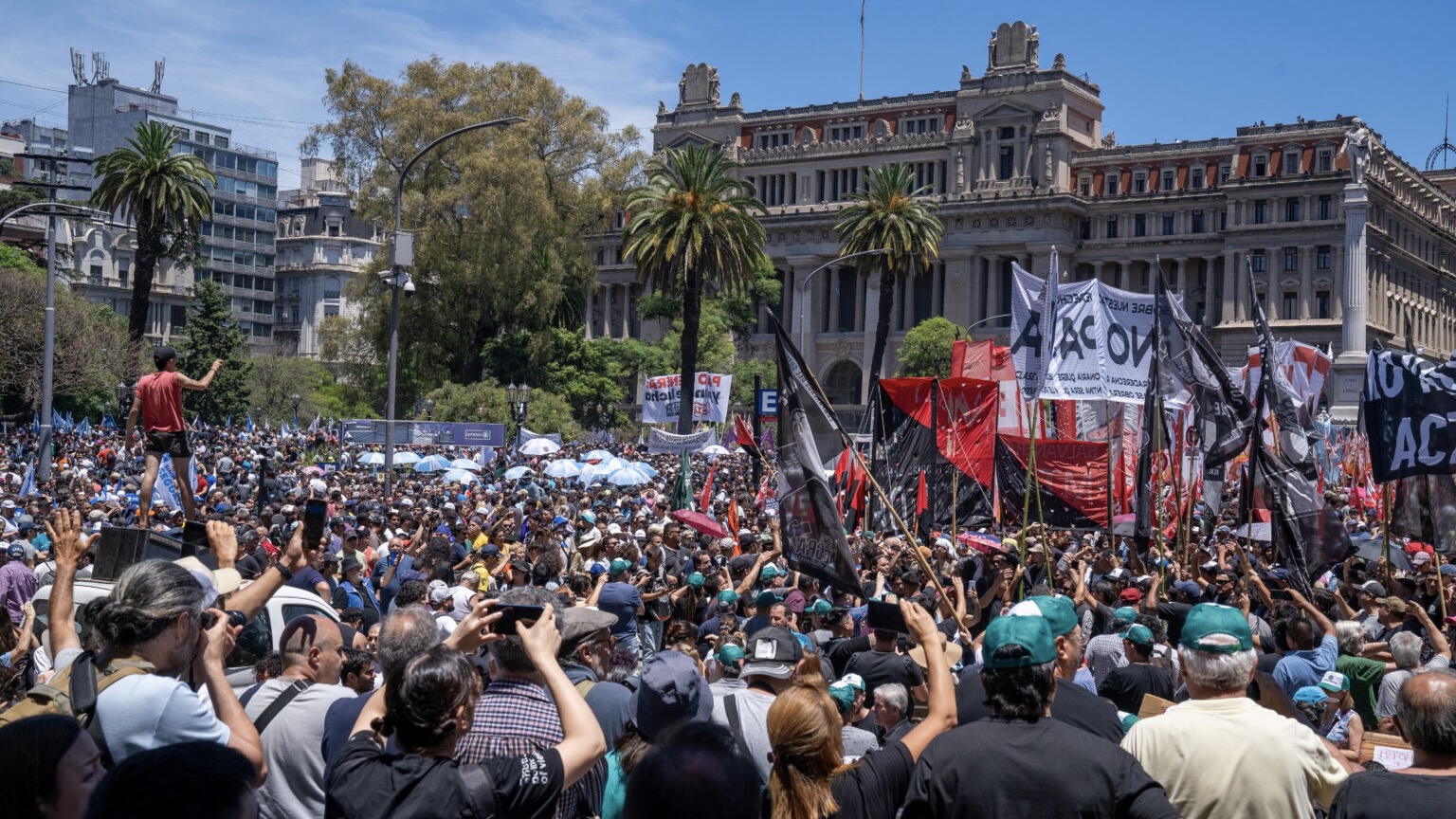
On January 24, across Argentina, millions of workers are participating in a national general strike against the anti-workers laws pushed forward by far-right libertarian president, Javier Milei.
Since he was inaugurated on December 10, 2023, Milei has worked quickly to draft legislation which threatens the hard-fought for rights of the Argentine people.
In response, Argentina’s trade unions, social movements, and human rights organizations have been on the streets to reject these measures, and called for a national general strike for January 24. For the last several weeks, hundreds of trade unions, neighborhood associations, cultural groups, left groups, community kitchens, and social movements have been organizing local and neighborhood assemblies and meetings to mobilize for the strike.
The largest concentration will be in Buenos Aires, Argentina’s capital, where hundreds of thousands are expected to congregate in the center of the city outside Congress. Mobilizations are also scheduled in dozens of other cities across the country like Córdoba, Rosario, San Miguel de Tucumán, Mendoza, Mar del Plata, Bahía Blanca, and others. While basic essential services will not be disrupted by the strike, the majority of the economy and daily life is set to be paralyzed due to the massive industrial action.
Who is participating?
The January 24 national strike is historic, as it is the first time in recent history that the country’s three major labor confederations are uniting for a joint industrial action. The General Confederation of Labor (CGT), the Argentine Workers’ Central Union, and the Argentine Workers’ Central Union (Autonomous) together represent millions of workers and have all called on their affiliated unions to participate in the day of mobilization.
The confederations are made up of dozens of unions representing workers in education, construction, civil service, food processing, healthcare, mining and metalwork, restaurants, commercial transportation (truck drivers, shipping, etc.), public transportation (buses, subway, and provincial trains), state workers, auto industry, textile, real estate, commercial, acting, national companies, the courts, music industry, communications and technology, among others. In other words, nearly the totality of the Argentine working class.
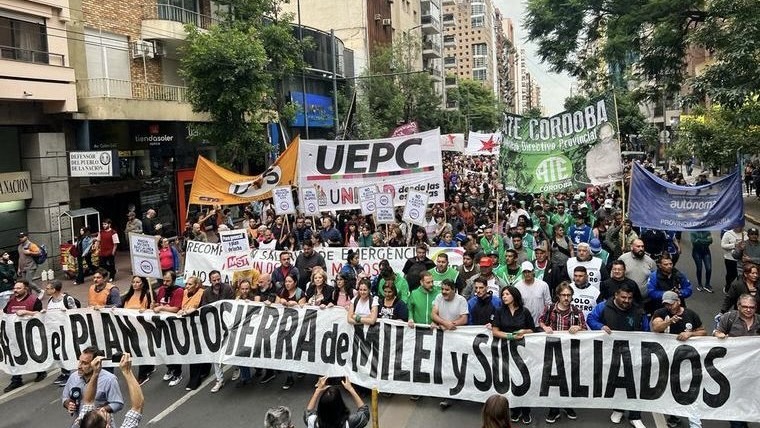
Other unions such as the Union of Workers of the Popular Economy (UTEP) which represents street vendors, cooperatives, recyclers, agricultural workers, childcare workers, community kitchen workers, and others from the informal sector or “popular economy” have also pledged their participation in the mass mobilization.
Human rights organizations are also heeding the call for mobilizations such as the Grandmothers of the Plaza de Mayo, the Center of Legal and Social Studies (CELS), HIJOS (Sons and Daughters for Identity and Justice Against Forgetting and Silence), and others.
Several social and political forces that were part of the Union for the Homeland coalition which was defeated by Javier Milei in the presidential race in November, have also declared they will join the mobilization, such as Frente Patria Grande, La Campora, and Movimiento Evita.
Why are they mobilizing?
The strike has been called to reject Milei’s DNU and Omnibus Law, both pieces of legislation which trade unions say directly attack workers rights, impose brutal economic neoliberal austerity measures, and threaten the national sovereignty of the country. Organizations have called on the judiciary and the legislature to intervene to rule the DNU unconstitutional and revoke it in Congress, and to stop his Omnibus law from being passed. Both pieces of legislation have already met major legal roadblocks and have already undergone modifications from their first versions.
The Decree of Necessity and Urgency (DNU) 70/2023 was announced by Milei on December 20, 2023 (10 days after he took office). DNUs can be used by the executive to circumvent Congress and implement change immediately. Milei’s DNU titled “Bases to Rebuild the Argentine Economy” contains over 350 articles which would affect over 70 pieces of legislation, some completely overturned and others modified.

The DNU calls for the deregulation of major sectors of the Argentine economy such as energy, export, the credit card industry, transportation – including the aeronautic sector, healthcare, communications, tourism, and more. It also opens the door for the privatization of key state companies and the national bank and promotes foreign investment. It also impacts labor rights and rights of trade unions, such as the right to strike, the right to overtime pay, and other hard fought for rights of workers.
Read more: Milei declares war on Argentine working class with presidential decree
The Omnibus Law, officially called the Bases and Starting Points for the Liberty of Argentines, was sent to Congress by Milei on December 27, 2023. The 351-page bill contains more than 664 articles which will be debated in Congress. The Omnibus law attempts to take Milei’s “deregulation” approach a step further and expands it to all major areas of life in Argentina.
It includes a proposed reform to the Penal Code focused on “control of the streets” and calls for increasing sentences against protesters and in some cases eliminating the possibility of bail. It also initially stated that any meeting of three or more people in a public space must have the permission of the Minister of Security – this was later withdrawn.
It calls for the privatization of major state enterprises such as Argentine Airlines, ARSAT – a state telecommunications company, Argentine Trains, Public TV, the Water and Sewage Company (AySA), and the National Bank. Milei also included a list of another several dozen companies that have majority state participation such as Argentina Energy, military factories, the General Port Administration, Corredores Viales or the highway company, Argentine Mail, and Telam, the National News Agency.
The Omnibus law also calls for major reforms of the country’s public education system, notably taking away free higher education for foreigners. It also calls for major modifications of the entrance requirements and huge cuts to the overall budget. The country’s robust culture sector would also see major budget cuts under the law with a call to close historic artistic institutions of the country.
Environmental protections such as the Glacier Law, the Forest Law, and the Environmental Protection Law for the Control of Burning Activities would also undergo massive modifications.
The Omnibus also threatens retirees, emboldens police to use their full force, including gunfire, with little consequences, and transforms the electoral system.
The broad and expansive nature of the Omnibus and its outright attacks on so many sectors of society also helps explain why so many will be mobilizing in the strike.
The Secretary of Gender and Diversity of the Association of State Workers (ATE), Clarisa Gambera said, “This January 24, all of the union centers and social organizations of this country will be on the streets, to stop the ferocious advance of the right. Those who say that particular interests were generated over time, what they call particular interests are the rights that we won with struggle over more than 100 years and we are not willing to lose them. We continue to build unity, debates are taking place at the federal level. Comrades from all over the country participate in multi-sectoral meetings, assemblies, plenary sessions that are different ways to activate and add numbers of comrades on the streets this 24th.”
The CGT wrote in a statement rejecting Milei’s austerity measures and his claim that they only affect the “political caste”, not the people. CGT argues that, “The fiscal and exchange adjustment plan announced by the Government will generate a rapid acceleration of the inflationary process, which will destroy the purchasing power of the salaries of formal and informal workers, workers in the social and solidarity economy, self-employed workers, as well as of retirees and pensioners. This means that the announced adjustment does not adjust to the ‘so-called’ caste as promised in the campaign. Milei’s adjustment, once again, falls on the people.”
Repression
Another major point of contention for the Argentine people is the repressive policy imposed by the Minister of Security Patricia Bullrich, to dissuade mass participation in the inevitable mass mobilizations against Milei’s economic measures. Following the first protests against Javier Milei’s administration, Bullrich warned that it would use all “deterrent measures” to stop protests and on December 14 announced the “Public Order Protocol”.
Among other things, the protocol authorizes the police and security forces to intervene in response to any attempt to partially or totally block any national roads, transportation, or “free movement.” It has been dubbed the “anti-picket” protocol as it targets the historic picket and roadblock tactic of Argentine movements.
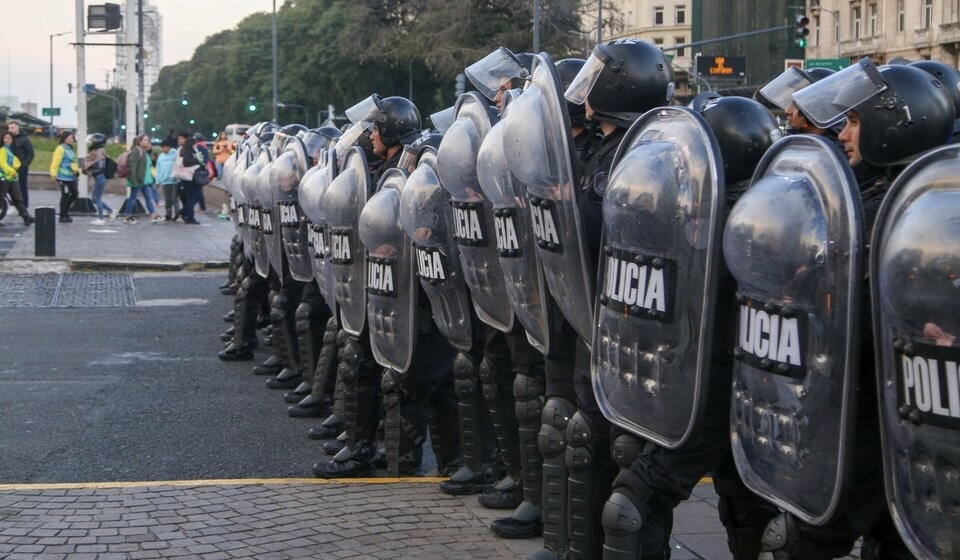
Another government “deterrence measure” is the threat from Bullrich that those who participate in protest actions and road blockades that are recipients of social programs will not receive this support: “he who blocks the street does not get paid,” she declared.
On January 10, 2024, Bullrich made good on her threats and, under the auspices of her protocol, sent letters to the major trade union centers of Argentina, unions, social, political and human rights organizations that had participated in protests on December 20, 22, and 27 of 2023 against Milei’s austerity measures and demanded they pay millions in fines for their participation in the allegedly “illegal activity”.
CELS wrote that in issuing these economic sanctions for participation in protests, the Ministry of National Security is “assuming powers that it does not have” and that it is also “trying to condition future action”. For the human rights research center, “This policy constitutes an infringement of the right to protest and demonstration and an act of state interference against freedom of association.”
International solidarity
The national general strike has gained widespread international support. Trade unions across Latin America and the Caribbean, as well as from Pakistan, Italy, Switzerland, Canada, the Netherlands, South Korea, Spain, and more, have pledged to mobilize on January 24 in solidarity with their Argentine comrades, with many calling for protests in front of their Argentine embassies or consulates.
The International Trade Union Confederation (ITUC), which brings together 191 million workers in 163 countries from all continents, released a statement expressing its support for its affiliated organizations in their call for the national general strike against “Milei’s shock therapy”. “Three major union federations, the CGT, the CTA-T, and the CTA-A, have united to stand against the serious threat to fundamental workers’ rights and civil liberties posed by Milei’s move to resurrect out-dated and debunked neo-liberal policies,” reads the statement.
ITUC General Secretary Luc Triangle said, “The actions of the Milei government aim to recreate the darkest days of dictatorship, and they require a strong, united response from the global union movement. We stand in full solidarity with the working people of Argentina in their defense of justice and democracy.”
The World Federation of Trade Unions (WFTU), which represents 105 million workers in 133 countries, expressed its support for its affiliate unions participation in the January 24 strike to “express their opposition to the measures of the ultra-liberal and neo-fascist government of Javier Milei”. It has called on its affiliates in other countries to mobilize in solidarity with the Argentine workers.
Trade Union Confederation of the Americas (TUCA-CSA) joined the other international confederation in standing with the struggle of Argentine workers, and calling on its affiliate organizations to mobilize in solidarity on January 24.
The PIT-CNT of Uruguay, Argentina’s northern neighbor, stated that “it is necessary to join forces and have as a horizon to advance Latin America on the path of struggle and hope towards a more just, free and equal society.”
Original article by Zoe Alexandra republished from peoples dispatch under a Creative Commons Attribution-ShareAlike 4.0 (CC BY-SA) license.