At large: Benjamin Netanyahu. (Ohad Zwigenberg / Alamy)
International Criminal Court’s stance on Gaza should trigger an end to British military ties with Israel, critics say.
Britain’s ongoing involvement in Israeli military operations in Gaza “opens the UK up to charges of complicity in war crimes”, an opposition politician has told Declassified.
Liz Saville Roberts MP spoke out after seeing UK spy flights continue to surveil Gaza despite Israel’s prime minister Benjamin Netanyahu now being wanted for war crimes.
Flight tracking data shows Royal Air Force surveillance planes over the besieged enclave have not been interrupted by the International Criminal Court (ICC) issuing arrest warrants.
Although ministers claim the flights, which began last year, are solely looking for hostages, Saville Roberts said “there is a clear risk that the information shared with Israel from these flights may have been used in attacks on civilians.”
Labour has also refused to implement a complete arms embargo on Israel. Spare parts for Israel’s most advanced fighter jet, the F-35, can still be shipped to Tel Aviv if they go via the US.
Human rights lawyers say this loophole is “unconscionable”. General Herzi Halevi, the Israeli army’s chief of staff, was even allowed to visit the UK on Monday for talks with military officials.
Sharing intel with war criminals?
UK contact with Israel’s military has come under increasing scrutiny since the ICC issued arrest warrants for Netanyahu and former defence minister Yoav Gallant last week.
Both men are accused by the ICC of “the war crime of intentionally directing an attack against the civilian population” and using “starvation as a method of warfare”.
Britain is sending surveillance flights over Gaza almost every day to gather intelligence for Israel, claiming it could find hostages held by Hamas.
dizzy: Israel’s genocides should be regarded as a joint pursuit involving the United States, the United Kingdom and Israel.
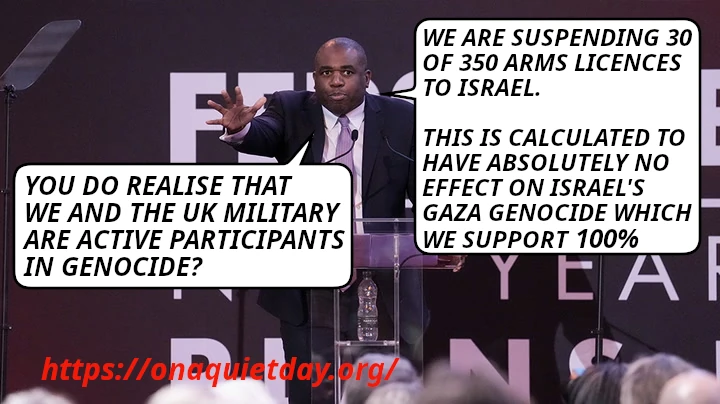
Genocide denier and Current UK Prime Minister Keir Starmer is quoted that he supports Zionism without qualification. He also confirms that UK air force support has been essential in Israel’s mass-murdering genocide. Includes URLs https://www.declassifieduk.org/keir-starmers-100-spy-flights-over-gaza-in-support-of-israel/ and https://youtu.be/O74hZCKKdpAGenocide denying UK Foreign Secretary David Lammy says that UK is suspending 30 of 350 arms licences to Israel. He also confirms the UK government’s support for Israel’s Gaza genocide and the UK government and military’s active participation in genocide.
Israeli prime minister Benjamin Netanyahu and chief of staff Gen.Herzi Halevi visit the Netzarim corridor in Gaza, 19 November 2024 (Credit: Abaca Press/Alamy Live News)
Exclusive: Days after the International Criminal Court issued arrest warrants for Israeli leaders, its top general flew to London.
Israel’s top soldier, Lieutenant General Herzi Halevi, visited Britain earlier this week, the UK government has confirmed to Declassified.
The visit came three days after the International Criminal Court (ICC) issued arrest warrants for Israeli prime minister Benjamin Netanyahu and former defence minister Yoav Gallant for “crimes against humanity and war crimes”.
Those include “the war crime of starvation as a method of warfare; and the crimes against humanity of murder, persecution, and other inhumane acts”, as well as “intentionally directing an attack against the civilian population”.
Halevi was initially reported to have been included in the ICC’s arrest applications for the crime of having “deliberately starved Palestinians in Gaza”. He was also forced to apologise in April after the Israeli military killed seven international aid workers including three Britons in Gaza.
A Ministry of Defence spokesperson told Declassified: “As part of the concerted UK effort, along with allies and partners, to reach a peaceful resolution to the ongoing conflicts in Lebanon and Gaza, the Chief of the Defence Staff hosted his counterparts from Israel and other European partners”.
The spokesperson added: “Discussions included the UK calls for an immediate ceasefire in both Lebanon and Gaza and the need for all parties to comply with international humanitarian law while recognising Israel’s right to security”.
A ceasefire deal to end fighting between Israel and Hezbollah in Lebanon was announced on Tuesday.
NatWest among several banks in ‘net zero’ alliance continuing to support the fossil fuel industry
At a glance
Banks with net zero pledges helped raise $1 trillion for companies expanding fossil fuels
Among them is NatWest, which may have broken climate pledge by funding BP
BP is developing a ‘carbon bomb’ in Azerbaijan, host of COP climate talks
Less than a hundred miles from where world leaders are discussing how to meet their climate pledges, BP is drilling for gas.
The Shafag-Asiman project, a sprawling gas field off the Azerbaijani coast, could inject more than 1 billion tonnes of carbon into the atmosphere. That is more than the UK would emit over three years, striking a major blow to efforts to slow down global warming.
BP has said it intends to invest heavily in new oil and gas fields in the coming years. But it would be unable to pursue these dirty projects without billions in support from big banks. NatWest, for one, helped BP raise almost $500m last year in an apparent breach of its climate commitments.
Banks will be in focus at Cop29, currently underway in Baku, Azerbaijan, as world leaders discuss how to raise trillions of dollars for countries suffering the effects of climate change.
Although talks are unlikely to address their continued support for dirty energy, more than 140 banks worldwide have pledged to cut emissions associated with their lending and investments to almost zero by 2050.
In May 2021, the IEA, the global body coordinating countries’ energy policies, sounded the alarm. Any new oil and gas developments would make it inevitable that temperatures would rise by more than 1.5 degrees. In other words, they would devastate the planet.
Meanwhile, at BP’s Shafag-Asiman field, engineers were celebrating after finding fossil gas several thousand metres under the seabed – a new discovery that could significantly increase its output from the region. And the bankers were preparing to raise billions more for BP.
That’s not all. Since May 2021, global banks that have committed to net zero have poured almost $1 trillion into companies pursuing expansion of oil and gas projects that would push the world beyond its survivable limits. Taken together these projects would produce almost seven times the annual emissions of the US.
“It’s indefensible,” said John Lang, founder of the Net Zero Tracker, which evaluates big companies’ green plans. “There’s no way we can meet the temperature goals of the Paris Agreement if we continue financing the exploration of oil and gas.”
He said banks with net zero commitments covering direct and indirect emissions could not fund oil and gas expansion. “It’s greenwashing, plain and simple.”
NatWest said it could not comment on specific customers. It said it had conducted a review into its relationships with a number of oil and gas companies “to ensure they had a credible transition plan aligned with the 2015 Paris Agreement”. It refuted the suggestion it had not met its public commitments.
BP said it is aiming to be a net zero company by 2050 or sooner and believes its strategy is consistent with the goals of the Paris Agreement.
‘Net zero’
It was at Cop26 three years ago that a number of major banks first pledged that by 2050 they would cut almost all the emissions from their lending and investments to zero and invest in financial products to offset the remaining emissions – which has come to be known as “net zero”. NatWest, for instance, promised to stop funding companies that do not have a credible plan to shift their business away from fossil fuels. Its support for BP suggests it may have broken that promise.
BP reported record profits in February last year and promptly announced it would scale back its climate commitments and increase investments in oil and gas. It then enlisted the help of NatWest and a host of other ‘net zero’ banks to raise a total of $5.3bn in 2023 – and went on to invest $4.8bn in its oil and gas operations in the first half of this year.
In April, BP announced the first oil to be extracted from a new platform off the coast of Azerbaijan, which is expected to be operating until at least 2049, just a year before the world is supposed to have cut its dependence on fossil fuels.
The world-leading Grantham Research Institute assessed how credible the largest oil and gas companies’ transition plans were. It said BP’s fell short by a significant margin.
Many of the world’s biggest banks trumpet their net zero pledges to bolster their green credentials. But Nigel Topping, a member of the UK’s Climate Change Committee, explains that even when banks commit to cutting emissions associated with their financing in line with net zero, “it doesn’t stop them from financing companies who are continuing to expand [oil and gas production]”.
More than 180 companies expanding fossil fuel production have raised money from ‘net zero’ banks since May 2021, according to an analysis of data from the environmental campaign group, Rainforest Action Network. Their expansion projects are spread across the globe, from ConocoPhillips in the Arctic circle to Petrobras near the mouth of the Amazon river, and Shell in the UK’s North Sea.
A TBIJ analysis of the Global Oil and Gas Exit list, compiled by environmental campaign group Urgewald, shows these expansionary projects could produce almost 90 billion barrels of oil equivalent, which scientists say should stay in the ground. Around half of that is oil and half is gas, according to Urgewald, and calculations suggest it could generate more than 34 billion tonnes of CO2 emissions when burned.
Topping said: “The fundamental problem is that the transition is not driven by regulation … The only people who can make companies change are regulators, and the regulators are letting us down.”
Lead image: Offshore oil rigs at Baku Bay, near Baku, Azerbaijan. Anatoliy Zhdanov / Sipa US / Alamy Stock Photo
Reporter: Josephine Moulds Environment editor: Rob Soutar Deputy editors: Katie Mark & Chrissie Giles Editor: Franz Wild Production editor: Alex Hess Fact checker: Somesh Jha
TBIJ has a number of funders, a full list of which can be found here. None of our funders have any influence over editorial decisions or output.