Guest post: What 1.5C overshoot would mean for climate impacts and adaptation

Spread the love

Original article by multiple authors republished from Carbon Brief under a CC license

With average global temperatures set to see another record high this year, the chances of holding warming to no more than 1.5C continue to dwindle.

Keeping warming below 1.5C by the end of the century – in line with the long-term goal of the Paris Agreement – now likely involves “overshooting” 1.5C and then bringing temperatures back down later by removing carbon dioxide (CO2) from the atmosphere. 

(What this means for “net-negative” emissions is covered in a previous guest post.)

This raises a number of unknowns in terms of what overshoot means for the impacts of climate change on the planet, people and ecosystems. 

For example, even if global temperatures can be brought back down again by the end of the century, will the impacts of climate change also reduce? Will coral reefs be able to recover or will glaciers reform? What will it mean for the world’s coastlines, food production and endangered species?

For the past three years, we have been working on a Horizon Europe-funded project called PROVIDE to dive deeper into what overshoot really looks like for countries, regions and cities. 

This data is available on the Climate Risk Dashboard – a tool to help people see how climate change will affect them and how it depends on the actions taken today.

Until carbon emissions are reduced to net-zero, the world will not stop warming. Delay will result in ever more intense climate impacts – and increase the risk of crossing irreversible thresholds. 

Urban heat stress under overshoot

One of the clearest and most acute impacts of climate change is on extreme heatwaves. Our findings suggest that, were global average temperatures to decline, extreme heat events in most locations will also decrease, on average. 

But achieving a new balance in local climates would be a slow process, influenced by ongoing climate system adjustments for decades – if not centuries – to come.

Reversing climate change would most probably take several decades, even if overshoot is limited to a few tenths of a degree. This implies that the climate risks that generations alive today will be exposed to are largely determined by collective actions today. 

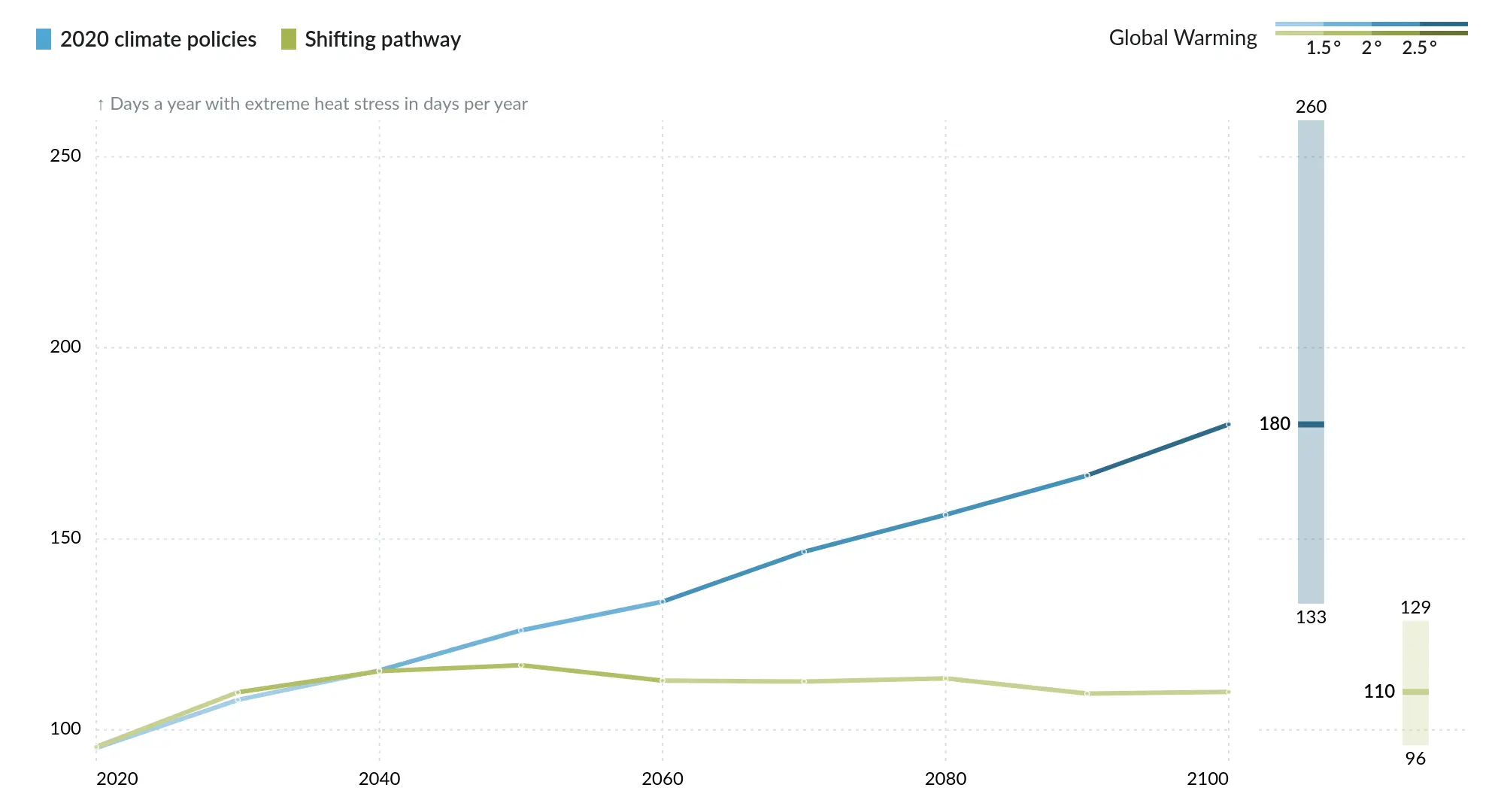
We can illustrate these differences for the risks of extreme heat stress for the Indian city of Chennai, one of 140 cities for which we modelled urban heat stress risks at 100-metre spatial resolution.  

The chart below shows the projected annual number of days of extreme heat stress in Chennai – defined as days where wet-bulb globe temperature (WBGT) goes over 31C. (WBGT is a metric that combines air temperature, humidity and exposure to direct sunlight.)

This level of heat stress approaches the limits of human survivability (without adaptation) – for example, physical outdoor labour is almost impossible under these conditions.

Under current 2020 climate policies, leading to a best estimate of about 3C of warming in 2100, extreme heat days increase pretty much unchecked. By the end of the century, around half of the days (180) per year would experience extreme heat stress conditions (or even higher). 

In contrast, in a 1.5C low-overshoot scenario (the IPCC Shifting Pathway), the number of extreme heat stress days would peak mid-century at around 120 days , before declining again to around 110 days by 2100 as global average temperature decreases from just above 1.5C to around 1.3C. This is a modest decline in extreme heat risk, yet a profound difference from a 3C world. 
Projected days a year with extreme heat stress in Chennai from 2020 to 2100
Projected days a year with extreme heat stress in Chennai from 2020 to 2100 under the climate policies of 2020 (blue) and 1.5C low-overshoot scenario called “IPCC Shifting Pathway” (green). Source: PROVIDE Dashboard

Irreversible consequences from overshoot

There are many other impacts of climate change that will be irreversible – for centuries to millennia – at peak temperatures, let alone if society is able to bring warming back down.

Coral reef lossglacier losssea level rise and the loss of many species and ecosystems all fall into this category.

Yet, a lot of these losses can still be avoided by stringent mitigation. For example, our multi-scenario framework allows us to explore glacier futures showing unavoidable, or “locked-in”, risks even under the lowest emission scenario we have explored, and compare them with the avoidable risks through stringent mitigation. 

Below, we provide an example for glacier volume projections for Peru, where glaciers serve as an essential freshwater resource during the extremely dry season of June to September. Due to past warming, glacier loss will continue over the coming decades. Under a current policy scenario (blue dots), 50% of the glacier volume might be lost as early as 2050.

Yet this does not need to happen. In fact, stringent mitigation pathways (green dots) are still possible that give a four-in-five chance of preserving 50% of today’s glacier ice in Peru, avoiding the worst and helping to maintain some of their vital uses.

Chart illustrating risks of losing 50% of 2020 glacier volume for Peru today and in 2030, 2050 and 2100
Chart illustrating risks of losing 50% of 2020 glacier volume for Peru today and in 2030, 2050 and 2100, under the climate policies of 2020 (blue) and 1.5C low-overshoot scenario called “IPCC Shifting Pathway” (green). Shading highlights the avoidable risk. Source: PROVIDE Dashboard.

Overshoot risks for the biosphere

Climate change represents a major threat to biodiversity globally. We modelled species at risk from local extinction for about 135,000 terrestrial fungi, plants, invertebrates and vertebrates based on the Wallace Initiative

Under the assumption that the 1950-2000 reference climate was suitable for the species at question, we model the proportion of species for which the local climate becomes unsuitable under ongoing climate change. 

In the chart below, we illustrate the risks to species in one of the countries with the world’s richest terrestrial biodiversity, Brazil. Under the current policy scenario (blue dots), the likelihood of 50% of species being at risk of local extinction rises to 74% by 2100. Yet, our analysis shows that this likelihood can still be avoided almost entirely by stringent mitigation (green dots). 

Chart showing the likelihood of 50% of Brazilian species being at risk of local extinction today and in 2030, 2050 and 2100
Chart showing the likelihood of 50% of Brazilian species being at risk of local extinction today and in 2030, 2050 and 2100, under the climate policies of 2020 (blue) and 1.5C low-overshoot scenario called “IPCC Shifting Pathway” (green). Shading highlights the avoidable risk. Source: PROVIDE Dashboard.

It is important to highlight that species loss does depend on a range of factors – of which climate suitability is only one. Yet there is a range of other human-caused stressors to biodiversity loss and a complex interdependencies of species and food webs in particular in the most biodiverse ecosystems implies the risk of knock-on effects and ecosystem tipping points

We also note that our results do not necessarily imply global species extinction and do not allow us to quantify if and how species survival under different overshoot trajectories would emerge. 

Overshoot will stress adaptation planning

Overshoot outcomes matter for climate risk assessments. Yet, in contrast with the prominence of overshoot pathways in the climate mitigation literature, their implications for adaptation planning have not been widely explored.

Overshoot would increase the threat of climate change that society needs to adapt to – and make that adaptation more difficult. Some options may become unavailable due to limits of adaptation

Also, timescales matter. Reversing an overshoot will take decades. Even assuming reversibility of climate hazards in the future as temperatures come down, this might only matter for adaptation decisions that involve a planning horizon of 50 years or more.

This is illustrated in the chart below, from our recent Nature study. This shows a stylised trajectory of warming (top chart) with overshoot (red bars) and how it compares to planning horizons for some example adaptation options (green bars), the lifetime of those measures (blue bars) and the intergenerational equity they involve (bottom chart).

The possibility of reversing long-term impacts in the future does not reduce the urgent need to act now on closing the wide gap in current adaptation efforts.

Figure showing stylised temporal evolution of a reversible climate impact driver
Figure showing: a) stylised temporal evolution of a reversible climate impact driver under a peak and decline scenario. Dashed lines indicate a low and high overshoot outcome with median timescales of global temperature reversibility typically in line with those from the IPCC AR6 database; and b) stylised illustration of adaptation-relevant timescales starting in 2030, including different planning horizons for adaptation planning (green bars) and lifetimes of individual adaptation measures (blue), and the effect of applying discounting (reflecting societal preferences towards intergenerational equity) to future damages and adaptation benefits. Source: Schleussner et al. (2024)

Limit peak warming and aim for long-term decline

While our results clearly underscore the importance of limiting peak warming to as low as possible, there are also very good arguments for aiming for a long-term global temperature decline, irrespective of the peak warming level. 

For a wide range of time-lagged climate impacts, such as ice sheet, peatland and permafrost loss, as well as large-scale irreversible tipping points, achieving temperature decline well below 1.5C is key to limiting long-term risks from global warming. 

Overshoot is clearly not an alternative way to achieve a similar climate outcome. Effectively limiting climate risks requires restricting peak warming as low and as close to 1.5C as possible – and then aim for long-term decline to reduce the climate impact legacy of human-caused emissions.

This guest post is by:

Dr Carl-Friedrich Schleussner leads the integrated climate impact group at the International Institute for Applied Systems Analysis (IIASA) and is a scientific advisor at Climate Analytics, Berlin.

Prof Rachel Warren, professor of global change and environmental biology at the University of East Anglia.

Dr Fabien Maussion, associate professor in glaciology at the School of Geographical Sciences, University of Bristol, UK.

Dr Niels Souverijns, urban climatologist at VITO Belgium and guest professor at KU Leuven.

Dr Quentin Lejeune, a climate scientist who has led the development of the PROVIDE Climate Risk Dashboard at Climate Analytics.

Original article by multiple authors republished from Carbon Brief under a CC license

Continue ReadingGuest post: What 1.5C overshoot would mean for climate impacts and adaptation

Activists blockade two Israeli weapons sites in Bristol

Spread the love

https://morningstaronline.co.uk/article/activists-blockade-two-israeli-weapons-sites-bristol


Protesters use a van to block the gates to Elbit at Filton near Bristol Photo: Neil Terry Photography

ACTIVISTS blockaded two Israeli weapons sites in Bristol as they vowed to redouble their efforts to shut down Elbit Systems today.

Palestine Action used lock-on devices inside vans to block the gates at the entrances of both sites, preventing anyone from coming in or out.

One of the sites, a facility at Filton, is the brand new £35 million research and development hub of Israel’s biggest weapons firm.

The other site is Elbit’s headquarters at Aztec West 600, which the activists said is used by Elbit to oversee their logistical, financial, and operational affairs throughout the country.

https://morningstaronline.co.uk/article/activists-blockade-two-israeli-weapons-sites-bristol

Continue ReadingActivists blockade two Israeli weapons sites in Bristol

Trump’s return threatens renewed assault on Venezuela

Spread the love

https://morningstaronline.co.uk/article/trump’s-return-threatens-renewed-assault-venezuela

An image of Republican presidential nominee former President Donald Trump hangs in the window of a campaign office in Hamtramck, Michigan, November 4, 2024

TIM YOUNG warns that the president-elect’s record of economic and political interference from his last stint in the White House show dangerous potential for escalated aggression against the Bolivarian government from 2025

THE US election result raises the spectre of Trump renewing the assault on Venezuela that his loss to Biden interrupted in 2020.

In office between 2016 and 2020, Trump’s approach to Latin America showed an implacable hostility towards Venezuela, as well as other governments in the region determined to advance their population’s interests, not those of the US.

Venezuela has been subjected to US extraterritorial intervention and interference for over two decades. From the early days of Hugo Chavez’s election as president in 1998, the US has sought, in conjunction with Venezuela’s economic and political elites, to topple the Venezuelan government and re-establish its control and influence over the country and its oil wealth.

While the global situation has changed since 2020, with wars in Ukraine and the Middle East and the US’s developing aggressive strategy towards Russia and China, there is no reason to believe the US’s long-standing desire to destabilise the Venezuelan government and achieve “regime change” is off the table.

For his part, Trump made it plain when campaigning this year in North Carolina what motivated his drive to unseat Maduro: “When I left, Venezuela was ready to collapse. We would have taken it over; we would have gotten all that oil.”

The solidarity movement in Britain must be prepared to defend Venezuela’s sovereignty against any renewed offensive by Trump when he assumes the presidency in 2025 — as well as continuing to campaign for Britain to give Venezuela back its gold.

https://morningstaronline.co.uk/article/trump’s-return-threatens-renewed-assault-venezuela

Continue ReadingTrump’s return threatens renewed assault on Venezuela

US finds that Israel is not impeding assistance to Gaza

Spread the love

Original article republished from MEMO under a Creative Commons Attribution-NonCommercial-ShareAlike 4.0 International License

Palestinians wait in line to receive aids at the school where UNRWA distributes food parcels in Deir al-Balah, Gaza on November 07, 2024. [Ashraf Amra – Anadolu Agency]

President Joe Biden’s administration has concluded that Israel is not currently impeding assistance to Gaza and, therefore, is not violating US law, the State Department said on Tuesday, although Washington acknowledged the humanitarian situation remained dire in the Palestinian enclave, Reuters reports.

US Secretary of State, Antony Blinken, and Defence Secretary, Lloyd Austin, in a 13 October letter gave their Israeli counterparts a list of specific steps that Israel needs to take within the next 30 days to address the worsening situation in Gaza. Failure to do so may have possible consequences on US military aid to Israel, they said in the letter.

But, on Tuesday, the deadline mentioned in the letter, State Department deputy spokesperson, Vedant Patel, repeatedly declined to say if the specific criteria were fulfilled. Instead, he told reporters that Israel has taken steps to address the demands and that Washington would continue to assess the situation.

“We’ve seen some progress being made. We would like to see some more changes happen. We believe that had it not been for US intervention, these changes may not have ever taken place,” Patel said, adding that Washington will continue to assess Israel’s compliance with US law.

READ: UN: 85% of humanitarian aid requests to Northern Gaza blocked or delayed by Israel

International aid groups said Israel had failed to meet the series of US demands intended to improve the humanitarian crisis in Gaza by the Tuesday deadline.

Patel, fielding repeated questions from reporters in the briefing, declined to explain why Washington chose to make the assessment based on Israel’s measures to address the problems instead of actual results on the ground, which US officials have repeatedly said would be their measuring stick.

Earlier this month, the State Department said the results on the ground as of 4 November were not good enough.

On Tuesday, Patel said Israel had taken some steps, including reopening the Erez Crossing, waiving certain customs requirements and opening additional delivery routes within Gaza.

For more than a month, Israeli forces have been pushing deeper into north Gaza, surrounding hospitals and shelters and displacing new waves of people in an operation they say is designed to prevent Hamas fighters regrouping.

Biden, whose term ends soon, has offered strong backing to Israel since Hamas-led gunmen attacked Israel last October, killing 1,200 people and taking more than 250 hostages.

However, since then, it has been revealed by Haaretz that helicopters and tanks of the Israeli army had, in fact, killed many of the 1,139 soldiers and civilians claimed by Israel to have been killed by the Palestinian Resistance.

More than 43,500 Palestinians have been killed in Gaza over the past year and Gaza has been reduced to a wasteland of wrecked buildings and piles of rubble where more than 2 million Gazans seek shelter as best they can.

READ: Israel fails to meet US aid demands to ease Gaza catastrophe, aid groups say

Original article republished from MEMO under a Creative Commons Attribution-NonCommercial-ShareAlike 4.0 International License

Global Fury After State Dept Claims Israel Not Violating US Law by Blocking Gaza Aid

Current UK Prime Minister Keir Starmer is quoted that he supports Zionism without qualification. He also confirms that his active support and that of UK's air force has been essential in Israel's mass-murdering genocide. Includes URLs <a href="https://www.declassifieduk.org/keir-starmers-100-spy-flights-over-gaza-in-support-of-israel/">https://www.declassifieduk.org/keir-starmers-100-spy-flights-over-gaza-in-support-of-israel/</a> and <a href="https://youtu.be/O74hZCKKdpA">https://youtu.be/O74hZCKKdpA</a>
Current UK Prime Minister Keir Starmer is quoted that he supports Zionism without qualification. He also confirms that his active support and that of UK’s air force has been essential in Israel’s mass-murdering genocide. Includes URLs https://www.declassifieduk.org/keir-starmers-100-spy-flights-over-gaza-in-support-of-israel/ and https://youtu.be/O74hZCKKdpA
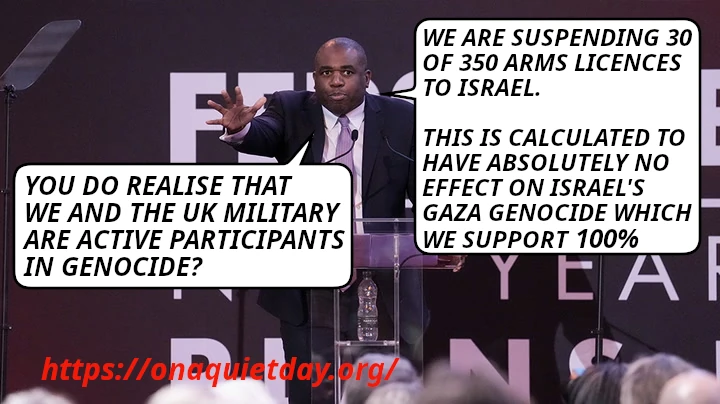
UK Foreign Secretary David Lammy says that UK is suspending 30 of 350 arms licences to Israel. He also confirms the UK government's support for Israel's Gaza genocide and the UK government and military's active participation in genocide.
UK Foreign Secretary David Lammy says that UK is suspending 30 of 350 arms licences to Israel. He also confirms the UK government’s support for Israel’s Gaza genocide and the UK government and military’s active participation in genocide.
Continue ReadingUS finds that Israel is not impeding assistance to Gaza

Thoughts of the Day :: Apply international law, hold war criminals to account

Spread the love

I urge political parties and trade unions to adopt policies to enact and apply international law, to hold war criminals to account. It is well worth doing even if it takes a decade or more to get to that position.

2.05pm Possibly better to phrase it as uphold and enforce international law.

Current UK Prime Minister Keir Starmer is quoted that he supports Zionism without qualification. He also confirms that his active support and that of UK's air force has been essential in Israel's mass-murdering genocide. Includes URLs https://www.declassifieduk.org/keir-starmers-100-spy-flights-over-gaza-in-support-of-israel/ and https://youtu.be/O74hZCKKdpA
Current UK Prime Minister Keir Starmer is quoted that he supports Zionism without qualification. He also confirms that his active support and that of UK’s air force has been essential in Israel’s mass-murdering genocide. Includes URLs https://www.declassifieduk.org/keir-starmers-100-spy-flights-over-gaza-in-support-of-israel/ and https://youtu.be/O74hZCKKdpA
UK Foreign Secretary David Lammy says that UK is suspending 30 of 350 arms licences to Israel. He also confirms the UK government's support for Israel's Gaza genocide and the UK government and military's active participation in genocide.
UK Foreign Secretary David Lammy says that UK is suspending 30 of 350 arms licences to Israel. He also confirms the UK government’s support for Israel’s Gaza genocide and the UK government and military’s active participation in genocide.
Continue ReadingThoughts of the Day :: Apply international law, hold war criminals to account