Commemorating Fall of Fascism in Spain, PM Sánchez Warns Against Musk Political Interference

Spread the love

Original article by Julia Conley republished from Common Dreams under Creative Commons (CC BY-NC-ND 3.0).
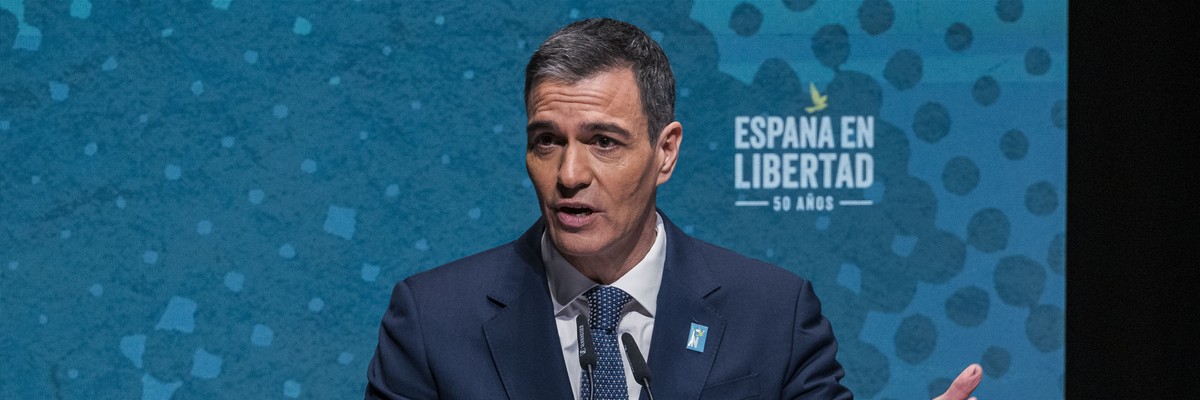
Spanish Prime Minister Pedro Sanchez gives the inaugural speech during the opening event of the “España en Libertad” (Spain in Freedom) commemorations, held at the Reina Sofia Museum in Madrid on January 8, 2025. (Photo: Guillermo Gutierrez Carrascal/SOPA Images/LightRocket via Getty Images)

“Forgetting the mistakes of the past is the first step towards repeating them again.”

Right-wing billionaire Elon Musk’s decision to wade into the political battles of several European countries did not go unnoticed by Spanish Prime Minister Pedro Sánchez, who used a Wednesday event marking the 50th anniversary of the death of Spanish dictator Francisco Franco as an opportunity to warn against Musk’s recent commentary.

Without naming Musk, Sánchez warned that the billionaire Tesla CEO’s leadership of an “international reactionary” movement is a threat “that should challenge all of us who believe in democracy.”

The Spanish leader spoke days after Musk—an ally and megadonor to U.S. President-elect Donald Trump who he’s selected to co-lead the proposed Department of Government Efficiency—commented on an article that stated foreign nationals in Catalonia are disproportionately convicted for sexual assault, writing, “Wow” in response.

“Foreign nationals are neither better nor worse than Spanish citizens in terms of criminality,” Sánchez said in response to Musk’s commentary, following his remarks at the event Wednesday by rebuking the man he referred to as “the richest man on the planet.”

He pointed to Musk’s recent perceived interference in Germany’s upcoming snap elections, which are scheduled for February. Musk has written an op-ed in support of Alternative for Germany (AfD), an anti-immigration right-wing party that the German domestic intelligence agency has designated a “suspected extremist” group.

“You don’t have to be of a particular ideology, left, center, or right, to look with sadness, with great sadness and also with terror, at the dark years of Franco’s regime and fear that this regression will be repeated.”

One candidate aligned with AfD said last year that Nazi paramilitaries under Adolf Hitler’s regime were “not all criminals.”

Musk, said the Spanish prime minister on Wednesday, “openly attacks our institutions, stirs up hatred, and openly calls for the support of the heirs of Nazism in Germany’s upcoming elections.”

“You don’t have to be of a particular ideology, left, center, or right, to look with sadness, with great sadness and also with terror, at the dark years of Franco’s regime and fear that this regression will be repeated,” he said at the commemoration at the Reina Sofía Museum in Madrid. “Forgetting the mistakes of the past is the first step towards repeating them again.”

Musk’s recent commentary on Spain played on similar narratives to those he’s recently pushed in the United Kingdom, attacking Prime Minister Keir Starmer and other Labour Party leaders for allegedly not being aggressive enough in prosecuting child sexual exploitation cases involving suspects who were originally from Pakistan.

Starmer, French President Emmanuel Macron, and German Chancellor Olaf Scholz have all spoken out against Musk’s recent foray into European politics and accused him of spreading disinformation, with Scholz telling one media outlet, “Don’t feed the troll.”

French Foreign Minister Jean-Noel Barrot on Wednesday called on the European Commission to protect its member states against political interference by Musk.

“Either the European Commission applies with the greatest firmness the laws that we have given ourselves to protect our public space, or it does not do so and then it will have to agree to give back the capacity to do so to the E.U. member states,” Barrot told France Inter radio. “We have to wake up.”

Members of European Parliament on Wednesday called on the European Commission to investigate whether the social media platform X, which Musk owns, can legally promote Musk’s posts on the app under the E.U.’s Digital Services Act. Last year, the tech news site Platformer reported the X algorithm has been reconfigured to amplify Musk’s comments.

The pressure from MEPs and recent comments from European leaders came as Musk prepared to host a livestream conversation with AfD leader Alice Weidel on X Thursday.

“I don’t understand why people believe that free speech is not affected by the concentration of opinion-making power in the hands of the few,” MEP Damian Boeselager of the pan-European Volt party, a candidate for the Bundestag in the German election, told The Guardian. “For me, that has rather illiberal, autocratic tendencies, rather than liberal tendencies, when one voice is so much more powerful than all the others.”

Original article by Julia Conley republished from Common Dreams under Creative Commons (CC BY-NC-ND 3.0).
Continue ReadingCommemorating Fall of Fascism in Spain, PM Sánchez Warns Against Musk Political Interference

Many species reach their heat limits at similar temperatures, leaving ecosystems at risk of sudden climate-driven collapse – new study

Spread the love

Tropical countries like Panama have lots of different tree species, but most may die at the same temperature. Martin Pelanek / shutterstock

Joseph Williamson, UCL

Last year, much of the world’s largest coral reef system was transformed into a white boneyard, featuring ghostly silhouettes of horns, brains and lettuces. The threat of sudden biodiversity loss from climate change had been realised through what’s known as a mass bleaching event.

The abrupt loss of many species from a system is generally attributed to a breakdown in ecological functioning. As species are sequentially knocked out, the whole community becomes unstable, and it all comes crashing down. There is, however, another mechanism that may be at play.

In our new paper, colleagues and I argue that despite the fact life on Earth displays such great variety, many species that live together appear to share remarkably similar thermal limits. That is to say, individuals of different species can tolerate temperatures up to similar points.

Bleached coral
Ghost brains and lettuces: corals turn white when the water is too warm. blueplanet97 / shutterstock

This is deeply concerning as it suggests that, as ecosystems warm due to climate change, species will disappear from an ecosystem at the same time rather than gradually, resulting in sudden biodiversity loss. It also means that ecosystems may exhibit few symptoms of heat stress before a threshold of warming is passed and catastrophic losses occur.

One way we can see this is by looking at how species are distributed across the globe to infer their maximum tolerance to heat. In doing so, it becomes apparent that species living in the same places tend to have similar tolerances, warning of potentially abrupt losses of biodiversity in the decades to come.

This will be felt most acutely in the tropics, where maximum tolerances are closest to the temperatures already experienced by its inhabitants.

Ground truthing

These “global models” are rather abstract, however. Do we find the same phenomenon if we actually go out into the natural world and test this? Scientists can do just that by measuring the temperatures at which species stop being able to function normally by putting them through “heat trials” (think of it as a sauna for bugs or plants).

The trees that make up a rainforest canopy in Panama are a good place to start. Surely, with all their weird and wonderful shapes, we might expect the wide variety of species here to have variable tolerances to warming? It turns out they don’t. By measuring photosynthetic rates in leaves, researchers have shown that the leaves of many tree species malfunction at roughly 50°C.

But what about animals? To work out their thermal limits, biologists heat up creatures until they fall over to predict when they would become incapacitated by heatwaves in the wild.

A few years ago, I conducted experiments on 45 species of dung beetle in south-east Asia, showing that almost half of them stopped functioning normally at around 39°C. When the lush forests of Borneo get too hot, we might expect half of their resident dung beetles to go extinct as temperatures reach this threshold. Without these diligent forest caretakers, the dung could really hit the fan.

Dung beetles rolling some dung
Ecologically crucial – and vulnerable to hot temperatures. Andries Combrinck / shutterstock

Unfortunately, this pattern of clustered thermal tolerances appears widespread: we found further examples from tadpoles in South America, to insects in the mountains of Pakistan.

Why species have similar heat limits

My colleagues and I reviewed the literature to identify several mechanisms that may drive these similar warming tolerances. The first operates at the scale of our entire planet. The most common temperatures on Earth are relatively hot, as the tropics cover a much larger area than the poles. This could drive species to be adapted to the conditions that have been most prevalent, meaning many of them have the same tolerance to high temperature.

Alternatively, we know that tolerances to heat evolve slowly compared to tolerances to the cold. We are unsure why this is the case, but it might simply be that it is highly costly (and therefore difficult to evolve) a change in molecular make-up that would allow a species to tolerate more heat. For example, at higher temperatures cell membranes become more fluid. Perhaps the costs of preventing cell death in such conditions are simply too high.

Hope for the future

Without deep and rapid cuts to greenhouse gas emissions, clustered thermal tolerances will continue to threaten the ecosystems on which humanity depends. Regardless of whether drivers occur at the scale of proteins or planets, understanding how and why species have similar thermal tolerances may give us clues as to how we can promote climate change resilience in the natural world.

For example, we know that more distantly related groups of species will probably have more diverse thermal tolerances. A practical step we can take, therefore, is to protect a wide-ranging sample of the tree of life through conservation action. If distinct lineages of life are protected, we increase our chances of harbouring a diverse portfolio of responses to warming.

Crucially, by advancing our understanding of why, and in what contexts, thermal tolerances are more similar, we can predict where and when catastrophic declines may occur. Are they more similar in reefs or rainforests, in Africa or Antarctica? When we answer such questions, we can intervene in at-risk systems, safeguarding the future of our fragile planet.

Joseph Williamson, Research Fellow in Biological Responses to Climate Change, UCL

This article is republished from The Conversation under a Creative Commons license. Read the original article.

Continue ReadingMany species reach their heat limits at similar temperatures, leaving ecosystems at risk of sudden climate-driven collapse – new study