‘1.5ºC Is Dead’: Climate Movement Holds Funeral for Paris Agreement Target
Original article by Jessica Corbett republished from Common Dreams under Creative Commons (CC BY-NC-ND 3.0).
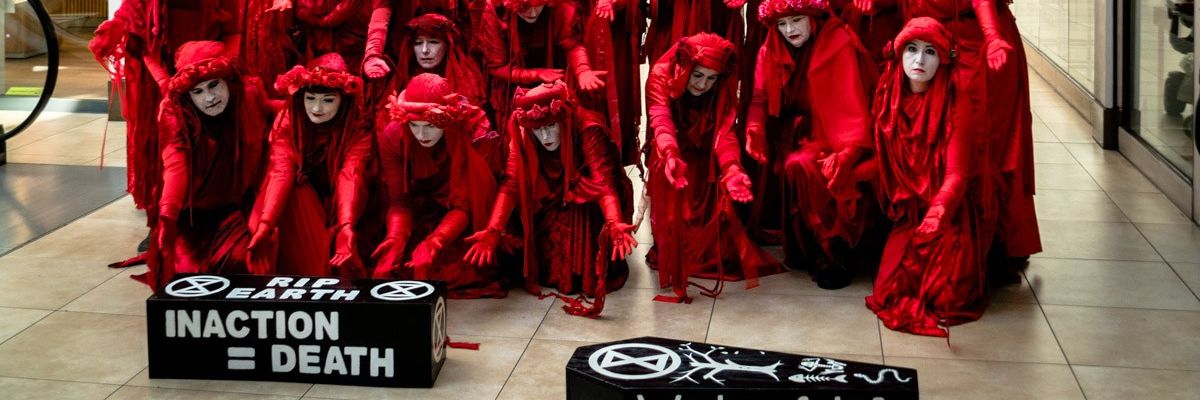
“We felt we needed a physical space where we could grieve together for what we are losing, and reflect on how to respond to the challenge now in front of us,” said Alex Martin of Extinction Rebellion Cambridge.
Extinction Rebellion and other climate organizations on Saturday held a funeral for the Paris agreement’s 1.5ºC temperature target in Cambridge, England.
“The mock funeral idea grew out of the need to process the enormity and sadness of this moment,” Alex Martin of Extinction Rebellion (XR) Cambridge said in a statement. “While many people are distracted by 1,001 things on their phones, we felt we needed a physical space where we could grieve together for what we are losing, and reflect on how to respond to the challenge now in front of us.”
Almost a decade ago, parties to the Paris treaty agreed to work toward limiting temperature rise this century to 1.5ºC—but 2024 was the hottest year in human history, and countries around the world show no signs of reining in planet-wrecking fossil fuels anywhere near the degree that scientists warn is necessary to prevent catastrophic climate breakdown.
“Crossing 1.5ºC for a whole calendar year is a wake-up call for the world,” said Olympic gold medalist and XR U.K. spokesperson Etienne Stott, highlighting another alarming record from last year. “If we want to avoid crossing further tipping points we need a complete transformation of society.”
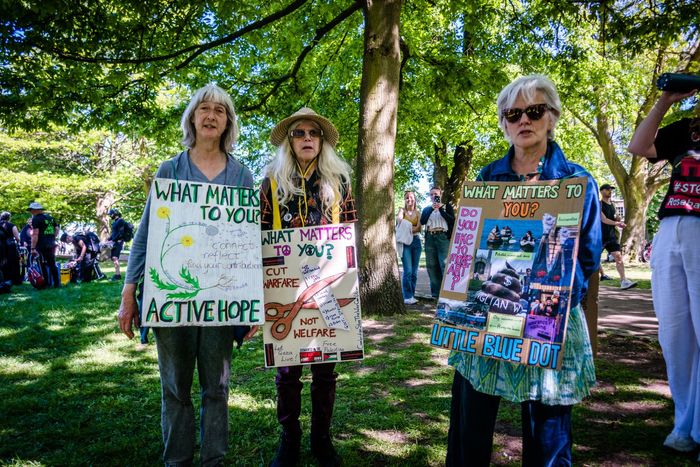
Scientists from universities in the United Kingdom and Germany warned in a peer-reviewed paper published in the journal Earth System Dynamics last month that humankind is at risk of triggering various climate tipping points absent urgent action to dramatically reduce emissions from fossil fuels.
“There are levers policymakers can pull to rapidly phase out fossil fuels, but this requires standing up to powerful interests,” Stott said Saturday. “Activists need to build power, resilience, and the world we want to see in our communities; but we also need to keep seeking the spark that will cause the worldwide transformation we need to see.”
In addition to the Cambridge and U.K. arms of Extinction Rebellion, Saturday’s action was organized by Cambridge Greenpeace, Cambridge Stop the War, and the Organization of Radical Cambridge Activists (ORCA).
Varsity, the independent student newspaper at the University of Cambridge, reported that the marchers “rallied at Christ’s Pieces, where they heard from one of the organizers, who emphasised the harm caused by exceeding 1.5ºC of warming.”
“The march then proceeded up Christ’s Lane and down Sidney Street, led by a group of ‘Red Rebels,’ dressed in red robes with faces painted white, followed by ‘pall bearers’ carrying coffins painted black, with the words ‘Inaction Is Death’ in white,” according to Varsity. “The procession was completed by a samba band who drummed as they walked, followed by protesters carrying a large sign reading ‘Don’t silence the science,’ along with many other smaller placards.”
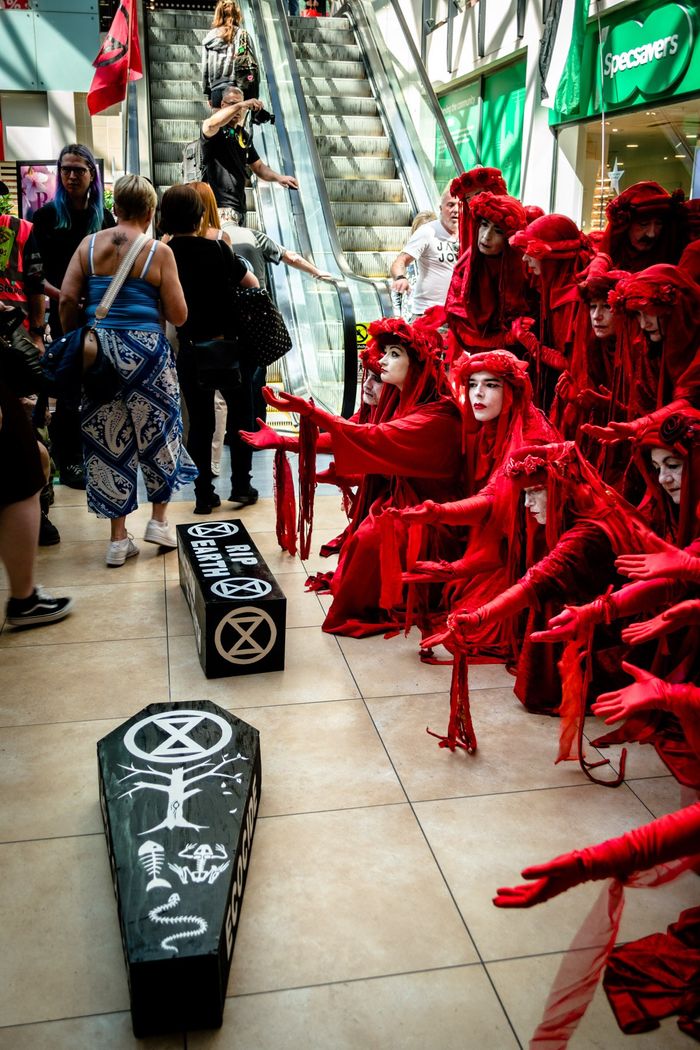
Photos from organizers show participants displaying banners with messages such as “No Future on a Dead Planet,” and additional messages painted on the black coffins: “1.5ºC Is Dead,” “Act Now,” “Ecocide,” “RIP Earth,” and “Web of Life.”
“Politicians have broken their promises to keep global temperature rises to a livable 1.5ºC,” declared Zoe Flint, a spokesperson for XR Cambridge. “For decades, people around the world have been resisting environmental devastation in their own communities and beyond—often facing state repression and violence as a result.”
“With dozens of political protesters now in prison in this country, that repression has come to the U.K. too,” Flint noted. “But when those least responsible for climate breakdown suffer the worst effects, we can’t afford to give up the fight.”
Parties to the Paris agreement are set to gather next in November at the United Nations climate summit, COP30, in Belém, Brazil.
Original article by Jessica Corbett republished from Common Dreams under Creative Commons (CC BY-NC-ND 3.0).


- After Ending in Overtime, COP29 Called ‘Big F U to Climate Justice’
- extinction rebellion News and Opinion | Common Dreams
- ‘Never Happened Before’: WMO Finds Past 10 Years Have Been 10 Hottest on Record
- US Faced 27 Billion-Dollar Disasters in 2024, the Hottest Year on Record
- ‘We Need Urgent Global Action’: Study Warns Humanity on Path to Trigger 16 Climate Tipping Points
Trump’s NOAA Will Stop Tracking Costliest Climate Disasters
Original article by Julia Conley republished from Common Dreams under Creative Commons (CC BY-NC-ND 3.0).

(Photo: Axelle/Bauer-Griffin/GC Images)
“Their philosophy is, if we ignore it, it’s not a problem,” said one meteorologist.
On the heels of the news that higher-than-average temperatures continued globally in April, one of the United States’ top science agencies announced Thursday that it will no longer update a database that tracks climate disasters that cause billions of dollars in damage.
As of Thursday, the Billion Dollar Weather and Climate Disasters database on the National Oceanic and Atmospheric Administration’s (NOAA) website was replaced with a message saying there have been no such events in 2025 through April 8.
That flies in the face of an analysis by the National Centers for Environmental Information, which has maintained the database and said before it was taken down that six to eight billion-dollar climate disasters have happened so far this year, including the wildfires that devastated parts of Los Angeles in January and caused an estimated $150 billion in damage.
The World Weather Attribution said in late January that planetary heating, fueled by greenhouse gas emissions, caused weather conditions in Southern California that made the fires 35% more likely.
Hundreds of people have been laid off from NOAA in recent weeks as the so-called Department of Government Efficiency, led by billionaire tech CEO Elon Musk, has pushed to slash government spending, and those who have lost their jobs include scientists who helped maintain the database.
NOAA spokesperson Kim Doster told The Washington Post that in addition to staff changes, “evolving priorities” were also partially behind the retiring of the database, which will now show disasters that occurred only between 1980-2024.
Between 2020-24, the number of billion-dollar disasters averaged 23 per year, compared to just a few per year in the 1980s.
“This Trump administration move is the dumbest magic trick possible: covering their eyes and pretending the problem will go away if they just stop counting the costs. Households across the country already have to count these costs at their kitchen table as they budget for higher insurance costs and home repairs. Families and retirees dipping into their savings or going bankrupt to recover from wildfires and hurricanes know what disasters cost,” said Carly Fabian, senior insurance policy advocate with Public Citizen’s Climate Program. “Hiding the national tallies will only undermine our ability to prepare and respond to the climate crisis. Deleting the data will exacerbate the devastating delays in acting to slow climate change, and the impacts it is having on property insurance and housing costs.”
NOAA’s “evolving priorities” have also included decommissioning other datasets, including one tracking marine environments and one tracking ocean currents.
Without NOAA’s Billion Dollar Weather and Climate Disasters database, Jeremy Porter, co-founder of the climate risk financial modeling firm First Street, told CNN that “replicating or extending damage trend analyses, especially at regional scales or across hazard types, is nearly impossible without significant funding or institutional access to commercial catastrophe models.”
“What makes this resource uniquely valuable is not just its standardized methodology across decades, but the fact that it draws from proprietary and nonpublic data sources (such as reinsurance loss estimates, localized government reports, and private claims databases) that are otherwise inaccessible to most researchers,” he said.
Chris Gloninger, a meteorologist who resigned from an Iowa news station after receiving threats for his frank, science-based coverage of climate disasters, said the retiring of the database suggests the Trump administration is “okay with spending billions of dollars on disasters.”
“Every dollar that we spend on mitigation or adaptation saves $13 in recovery costs,” said Gloninger. “But their philosophy is, if we ignore it, it’s not a problem.”
Original article by Julia Conley republished from Common Dreams under Creative Commons (CC BY-NC-ND 3.0).


Labour delivers ‘crushing blow to Britain’s fragile care sector’
https://morningstaronline.co.uk/article/labour-delivers-crushing-blow-britains-fragile-care-sector

 Home Secretary Yvette Cooper makes a speech at the Organised Immigration Crime Summit at Lancaster House in central London, March 31, 2025
Unions and campaigners condemn Home Secretary after government confirms scrapping of care worker visas
UNIONS and campaigners have condemned Labour’s immigration reforms after Home Secretary Yvette Cooper confirmed that the government will scrap the care worker visa for overseas recruitment.
Announcing the policy ahead of Monday’s Immigration White Paper, Ms Cooper said the visa route would be closed to “prevent” international recruitment for care jobs, though companies may continue to employ people already in Britain on care visas whose sponsorship has subsequently been cancelled.
The White Paper will also change skilled visa thresholds to graduate-level and includes tighter restrictions on recruitment for jobs with skills shortages.The legislation aims to bring down net migration — the number of foreign nationals who arrive in Britain, minus the number of people who leave — which stood at 728,000 in 2024.
…
Unison general secretary Christina McAnea said: “The NHS and the care sector would have collapsed long ago without the thousands of workers who’ve come to the UK from overseas.
“Migrant health and care staff already here will now be understandably anxious about what’s to happen to them. “The government must reassure these overseas workers they’ll be allowed to stay and continue with their indispensable work.”
Ms McAnea, whose union represents NHS and care workers, said that care workers from around the world “no longer want” to come to Britain due to “hostile” policies, bans on bringing family members, and widespread exploitation by unscrupulous employers.
…
https://morningstaronline.co.uk/article/labour-delivers-crushing-blow-britains-fragile-care-sector
dizzy: This appears a very stupid, short-sighted step but then that is this Fascist Labour party. What do they hope to achieve? To look tough on migration by stopping foreign workers willing to be paid a pittance for wiping UK asses and exploited by their UK employers in other ways? Migrant agricultural workers too?

Zia Yusuf Wants to be the UK’s Elon Musk
Original article by Rei Takver republished from DeSmog.

Reform UK leader and figurehead Nigel Farage hasn’t been alone in basking in the media spotlight of late.
Farage has been accompanied by his party chair, Zia Yusuf, a multi-millionaire tech entrepreneur who has helped to orchestrate Reform’s explosive rise.
Yusuf has overseen the party’s growth to over 200,000 members and 400 regional branches since he took the role in July 2024 – helping to propel Reform to a swathe of victories at last week’s local elections.
The party is now being shaped in Yusuf’s image, who has “extraordinary” powers to kick out Reform members, and even its candidates. His position has no term limit, and there is no formal procedure to remove him – not even by Farage.
With these vast constitutional powers in place, Yusuf appears to be following the lead of his hero in business and politics: Elon Musk.
“The greatest entrepreneur of all time”
Press coverage of the Reform chair often describes him as having worked in “finance”, but Yusuf refers to himself as a “tech entrepreneur” and to Reform as a “start-up”.
While he did spend several years at the investment banks Merrill Lynch and Goldman Sachs in his early 20s, Yusuf left the world of finance for tech entrepreneurship in 2014, becoming the CEO of the luxury digital concierge company Velocity Black, which he co-founded.
Velocity Black is a mobile app for the super rich that allows them to have anything they want at the touch of a button, from exclusive restaurant reservations to private jet holidays. Yusuf founded the firm alongside Alex MacDonald, his old classmate at the private Hampton School in London.
They sold the company in 2023 to the U.S. bank Capitol One for £233 million, with Yusuf reportedly making £32 million on the sale.
Long before he turned to politics, Yusuf credited Musk – the CEO of the electric car company Tesla – as an inspiration for the founding of Velocity Black, telling The Independent in 2018 that “we agreed with Elon Musk – it [Velocity Black] can’t be slightly better; it’s got to be amazing”.
This fondness has continued following their mutual journeys into the political limelight. In the wake of Musk falling out with Farage over the latter’s refusal to embrace far-right organiser Tommy Robinson, Yusuf praised Musk for being, “by some distance, the greatest entrepreneur of all time”, saying that he “will be forever grateful for all [Musk] has done and will do for humanity”.
More recently, Yusuf has called Musk the “ideal person” to run Donald Trump’s Department of Government Efficiency (DOGE), which aims to radically reduce the size of the federal government. Musk’s department has made sweeping cuts to public services – including to climate agencies – sacked government staff en masse, and closed whole departments with no oversight or transparency.
And though Musk’s relationship with Farage has frayed in recent months, Yusuf hasn’t ruled out the possibility of receiving a major donation from Musk in the future – even despite his extreme unpopularity in the UK.
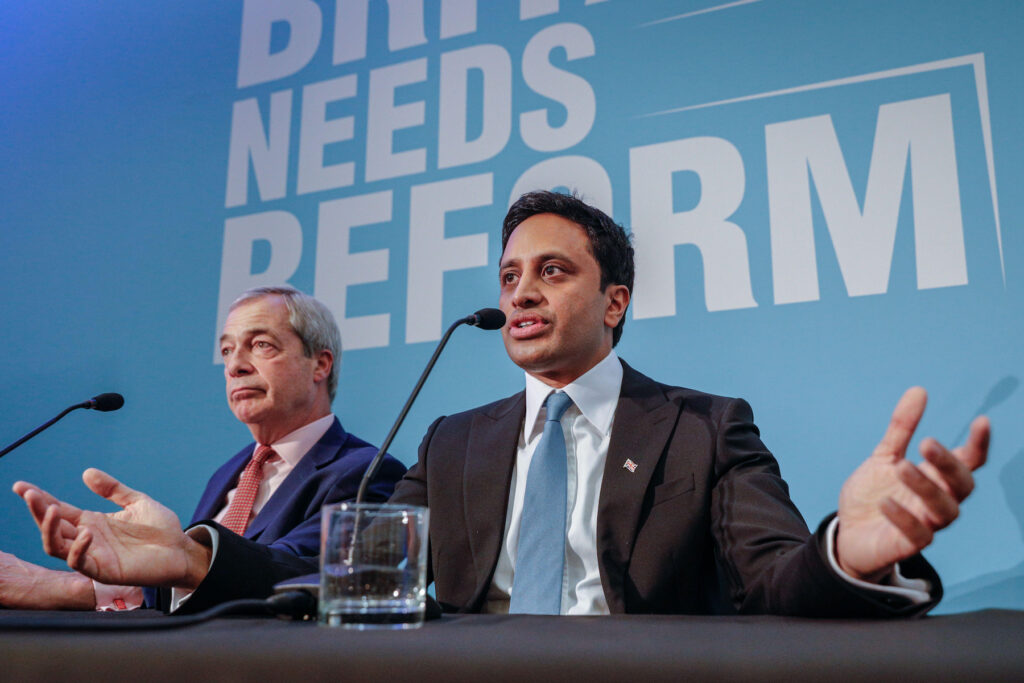
Yusuf’s admiration for Musk is clear, but to what extent will admiration lead to imitation?
There are clues in his recent speaking engagements. “Silicon Valley has a unique culture that’s impossible for anyone else to replicate, but look, we need to stop wasting taxpayer money,” Yusuf said in March, alluding to Musk’s attempts to eliminate “government waste”.
Yusuf has argued that a Reform government in Westminster should replicate the efforts of DOGE, saying that “we do need to massively cut the size of the bureaucratic state and probably cut the civil service by more than half”.
As he’s stated on X, the social media platform owned by Musk, “Reform is drafting detailed plans to identify, immobilise and remove all elements of the Blob [a derogatory reference to the civil service] hostile to the interests of the British people. This plan will be implemented on day one of Nigel Farage becoming prime minister”.
Reform has also vowed to set up “a British DOGE for every county and every local authority in this country” following its victories in last week’s local elections.
This potentially poses a threat to the UK’s climate ambitions. Farage and Yusuf have stated their intention to cut local climate schemes, advocating instead for more fossil fuel production.
Since becoming party chair, Yusuf has expressed a variety of anti-climate stances. He has claimed that North Sea oil reserves are a “gift from God”, and that the pursuit of net zero emissions by 2050 is “religious madness” and a “catastrophic act of self-harm” to the UK economy.
“President Trump’s victory represents the rejection of open borders, socialist economics, woke ideology, net zero fanaticism and [diversity, equity, and inclusion schemes] by right thinking people in America,” Yusuf posted in November. “The UK is next.”
A Power Grab?
Yusuf crashed onto the political scene in the summer of 2024, taking on the role of Reform chair shortly after donating £200,000 to the party. His contribution was the second-highest to the party of the general election campaign and almost a-third of the total funds raised by Reform in the final week before the election.
The 38-year-old has a close relationship with Farage, who he met at a cocktail party held by Stuart Wheeler, the former treasurer of UKIP, close to a decade ago. On the general election campaign trail, Farage said that Yusuf could one day lead Reform, commenting that “aside from his generosity, [Yusuf] will be a great asset and media performer during this campaign and beyond”.
When asked by The Guardian whether he would run for a seat in Parliament in 2029, Yusuf responded: “I’m absolutely open to it. This is a sincere comment. I will serve in whatever capacity Nigel asks of me”.
Recently, there has been talk of Yusuf gaining an unusual amount of power in the party. The Independent’s political editor David Maddox wrote in early March that “the only person to regularly get top billing on Reform events along with Mr Farage is Mr Yusuf. […] Press notices for their mini conferences state that people will hear from ‘Nigel Farage, Zia Yusuf and many more’. No mention of MPs.”
Maddox added that a “senior member” inside Reform had claimed that Yusuf was plotting a leadership coup “in plain sight”.
This bears some resemblance to Musk and his role in the Trump administration. Though he is less actively involved in DOGE following plunging Tesla sales across the globe, Musk has been accused of setting the new government’s agenda from the shadows, after donating more than $290 million to Trump’s campaign.
And there are other ways in which Yusuf is mirroring Musk.
Reform has stated its intention to profile every UK voter, and is already facing allegations of breaching private data.
Though the Reform privacy policy says that it aims to comply with UK data protection laws, the party is being sued by a group of 50 claimants for failing to respond to Data Subject Access Requests, through which voters can ask political parties to disclose the information they hold on them. Following the initiation of legal proceedings, Reform told the claimants that it did not hold any of their data.
DOGE has been accused of being slapdash with data, having accessed vast amounts of highly-sensitive personal information held by the U.S. government, despite rulings from several judges that Musk’s department is violating privacy law.
Given his constitutional powers, his party’s hunger for personal data, his anti-government ideology, and his tech background, Zia Yusuf seems to have many close parallels with Elon Musk.
On the BBC’s Political Thinking with Nick Robinson in February, he was asked the question directly: “Are you Nigel Farage’s Elon Musk?”
Yusuf demurred. “I am certainly no Elon Musk. I think Elon Musk is singular,” he said.
However, he hastened to add: “I’ve tried to learn as much as I can about him”.

The sole responsibility for any content supported by the European Media and Information Fund lies with the author(s) and it may not necessarily reflect the positions of the EMIF and the Fund Partners, the Calouste Gulbenkian Foundation and the European University Institute.
Original article by Rei Takver republished from DeSmog.

