Activists in Italy defend trade unionist targeted for opposing arms transfer
Original article by Ana Vračar republished from peoples dispatch under a Creative Commons Attribution-ShareAlike 4.0 (CC BY-SA) license.
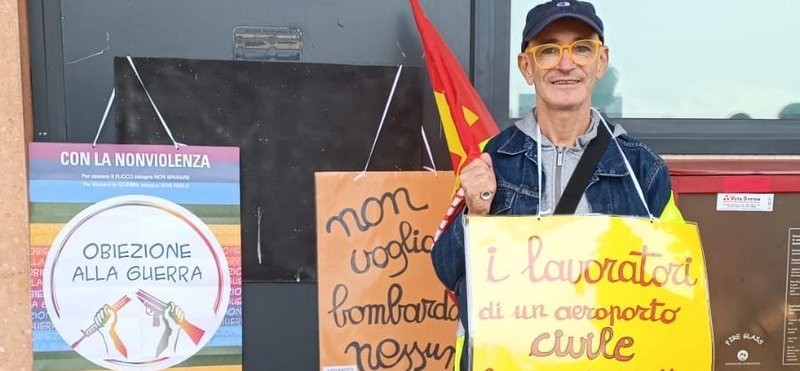
Workers and activists rally in Brescia against company retaliation targeting trade unionist who resisted arms transfers through civilian airport
Workers from the trade union Unione Sindacale di Base (USB) and other anti-armament activists are protesting today in Brescia, Lombardy, against attempts to intimidate trade unionists who speak out and take action against the use of civilian transport hubs for arms deliveries. Ahead of the protest, USB’s Dario Filippini told Peoples Dispatch that the union expects a diverse range of groups to join the mobilization, building on a protest organized in June against an arms shipment via Montichiari Airport in Brescia.
Read more: Italian workers strike against war and militarization
At that time, long-time airport employee and trade unionist Luigi Borrelli raised concerns about the possible transfer of military goods through the airport, which, as Filippini points out, is intended for the transport of cargo such as mail, medicine, and food. Borrelli’s warning triggered an organized response and ultimately led to the cancellation of the flight. However, the airport operator, GDA Handling, retaliated by threatening Borrelli with dismissal for allegedly breaching confidentiality and “loyalty to the company.”
Filippini notes that this is not the first time GDA Handling has targeted Borrelli over his opposition to the airport’s apparent covert role in transporting military cargo. Since at least mid-2024, when he began raising concerns about suspicious packages moving through Montichiari, Borrelli has faced suspensions and fines – measures seemingly aimed at silencing him and deterring others.
“The obvious goal is to prevent any scrutiny of the repeated use of the airport for operations related to weapons deliveries to active war zones,” USB stated.
Nevertheless, trade unions and other organizations argue that Borrelli’s actions are legally sound and morally justified. The Italian Constitution clearly states that the Republic “repudiates war,” which raises questions about the legitimacy of transporting arms to countries engaged in conflict. There are also practical implications for workers, Filippini points out: “If you’ve been hired to handle mail or food, why should you suddenly be expected to handle weapons?” he asks. “If arms have to be handled in the first place, wouldn’t soldiers be better placed to do that?” he adds, noting the proximity of Ghedi Air Base.
Read more: “Disarmiamoli!” brings 30,000 to Rome against NATO and war
In several cases across Europe, workers have refused to handle military shipments destined for Israel during its ongoing genocide in Gaza, including over health and safety concerns. As an elected workers’ representative, Borrelli echoed similar concerns when he publicly denounced military transports through Montichiari. But this appears to matter little to Italian authorities or airport management.
Instead, broader efforts to discredit and constrain workers taking industrial action against the arms trade have emerged. Some official interpretations have even said arms were “essential goods,” thereby potentially limiting workers’ ability to legally strike over such shipments. Giorgio Cremaschi of the left political party Potere al Popolo described this as a form of militarization of labor, where “workers at ports, railways, airports, and throughout logistics become de facto soldiers, carriers of arms.”
USB and Potere al Popolo have called for resistance to these efforts and for the protection of workers’ rights – both to strike and to speak out against war. “We are convinced that strike, disobedience, collective action, and individual refusal by working men and women can be the most effective forms of nonviolent resistance,” reads a statement issued by dozens of trade unionists, legal scholars, and academics ahead of the protest in Brescia. “Such actions can stop the warmongers and the madness of rearmament, allowing the Republic, founded on labor, to repudiate war and consign it to history.”
“This is about going beyond the slogan ‘not in my name’ and declaring through concrete acts: ‘not with my hands, not with my knowledge, not with my labor,’” the statement adds.
Read more: Athens dockworkers obstruct military cargo shipment to Israel
Reflecting this approach, the mobilizations in Brescia are contributing to a growing movement among transport and logistics workers in the region who are standing up against Europe’s armament agenda, Filippini says. These efforts have earned solidarity from workers’ organizations abroad. Among them is Greece’s All-Workers Militant Front (PAME), which stated: “The persecution and the threat of dismissal against trade unionist Luigi Borrelli is an attack on the unions that resist the plans and the wars of the imperialist, that fight for peace between peoples.”
As solidarity with Borrelli continues, USB and its allies remain committed to expanding the campaign against the arms trade and defending workers’ right to conscientiously object to participating in weapons transfers. “Wars should be boycotted,” Potere al Popolo wrote in a statement of support. “Blocking arms shipments is not only legitimate: it is an act of justice and democracy.”


 Prime Minister Sir Keir Starmer during a meeting with German Chancellor Friedrich Merz, in Downing Street, London, on his first official visit to Britain, July 17, 2025
