Former Labour Party leader, Jeremy Corbyn M.P. (left) and Zarah Sultana, MP for Coventry South on the picket line outside London Euston train station, August 18, 2022
Corbyn and Sultana commit to launching new socialist party
JEREMY CORBYN and Zarah Sultana have reaffirmed their intention to launch a new political party of the socialist left to challenge a system rigged against working people.
The two former Labour MPs issued a joint statement today committing to the new party after three weeks of sometimes tense and challenging discussions since Ms Sultana quit the Labour Party.
They pledged the creation of “a new kind of political party — one that belongs to you” and looked ahead to a founding conference at which members would “decide the party’s direction, the model of leadership and the policies that are needed to transform society.”
The founding process will also determine the name of the new party. It is understood that the process will be overseen by a working group to be established by the Independent Alliance of MPs, of which Corbyn and Sultana are both members.
Polling shows that the party will pose a serious threat to Labour, with one survey putting the two neck-and-neck on 15 per cent.
In alliance with the Greens, currently in the midst of their own leadership contest, it could overhaul Labour as the main electoral expression of the left in British politics.
…
“The system is rigged when the government says there is no money for the poor, but billions for war. We cannot accept these injustices, and neither should you.”
The statement continued: “We will only fix the crises in our society with a mass redistribution of wealth and power. That means taxing the very richest in our society.
“That means an NHS free from privatisation and bringing energy, water, rail and mail into public ownership,” it added, and “investing in a massive council-house building programme” — recalling some of the most popular policies of Labour under Corbyn.
The Corbyn-Sultana statement also takes aim at “the government’s complicity in crimes against humanity. Now, more than ever, we must defend the right to protest against genocide.
“That is why we will keep demanding an end to all arms sales to Israel and for the only path to peace — a free and independent Palestine.
“The great dividers want you to think that the problems in our society are caused by migrants or refugees. They’re not. They are caused by an economic system that protects the interests of corporations and billionaires.
Keir Starmer says that the Labour Party under his leadership all feel a small part of Scunthorpe.Keir Starmer chases Nigel Farage’s racist bigot vote.Keir Starmer objects to criticism of the IDF. He asks how could anyone obect to them starving people to death, forced marches like the Nazis did, bombing Gaza’s hospitals and universities,mass-murdering journalists, healthworkers and starving people queuing for food, killing and raping prisoners and murdering children. He calls for people to stop obstructing his genocide for Israel.
The government’s official position of genocide denial contradicts the consensus of actual genocide scholars who dedicate their lives to the field. That includes Israeli academics such as Omer Bartov, a pre-eminent professor of Holocaust and genocide studies, who said that as a former IDF officer he agonised over reaching his conclusion: “But I have been teaching classes on genocide for a quarter of a century. I can recognise one when I see one.”
Those who have facilitated or justified this abomination have no excuses, no place to hide. More than a year ago, South Africa’s legal team composed a dossier detailing statements of genocidal and criminal intent issued by Israeli leaders and officials: it was 121 – pages long, and is now completely out of date. There is more video footage of civilians being slaughtered and civilian infrastructure being destroyed than any other war crime as it was happening in history.
Yet not only does Britain supply Israel with those crucial F-35 components, its government refuses to describe a single Israeli act as a “war crime”, because it knows that then imposes sweeping legal obligations. Britain continues its annual trade with Israel, which last year was worth £5.8bn. Days after its tokenistic gesture of suspending trade treaty talks, Britain’s embassy in Israel celebrated the arrival of the UK trade envoy. When Britain imposed sanctions on two far-right Israeli ministers, it did so on the grounds of their “horrendous extremist language”, rather than actions, because the latter implicates the British government. They refuse to impose meaningful sanctions on Israel itself.
By proscribing Palestine Action, the government has assured that it is opponents of genocide who face being hauled before the dock in the here and now. Our foreign secretary no doubt believes that the impunity traditionally enjoyed by western leaders and Israel itself will protect him and his colleagues for ever. That assumes the winds will never change. There is no statute of limitation for complicity in genocide. Israel’s crime is not yet complete. Lammy must believe that his freedom is safe for ever: that there will be no knock on his door in five, 10, 20 years. That is quite the bet.
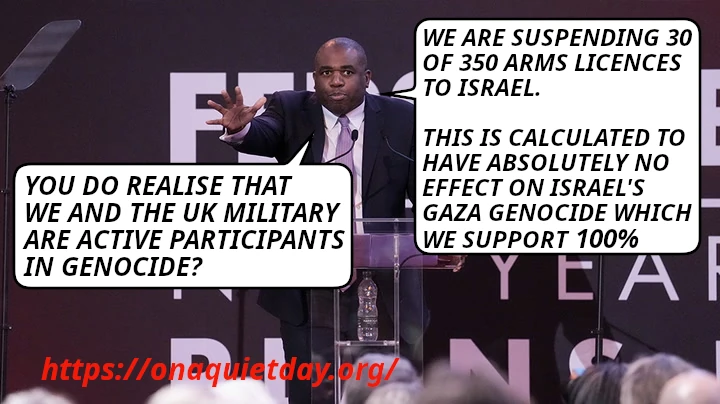
Genocide denying UK Foreign Secretary David Lammy says that UK is suspending 30 of 350 arms licences to Israel. He also confirms the UK government’s support for Israel’s Gaza genocide and the UK government and military’s active participation in genocide.Keir “I support Zionism without Qualification” Starmer supporting genocide.UK Labour Party government ministers Keir Starmer, Angela Rayner and Rachel Reeves explain that they are partners complicit in Israel’s Gaza genocide. The UK has provided Israel with arms, military and air force support. They explain that they don’t do gas chambers but do do forced marches, starvation, destroy hospitals, mass-murders of journalists and healthcare workers.
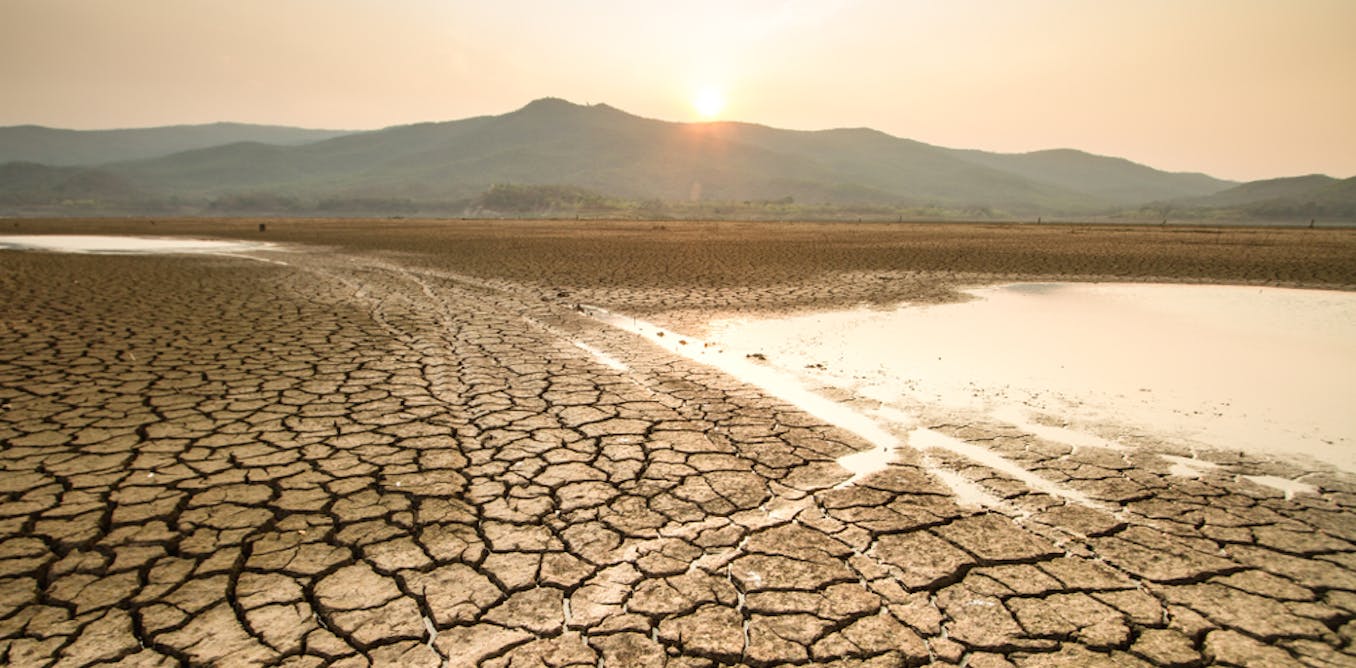
We are living in a world that is warming at the fastest rate since records began. Yet, governments have been slow to act.
The annual global climate change conference of the parties (COP30) is just months away. All of the 197 countries that belong to the United Nations were supposed to have submitted updated national climate plans to the UN by February this year. These plans outline how each country will cut its greenhouse gas emissions in line with the legally binding international Paris Agreement. This agreement commits all signatories to limiting human-caused global warming to no more than 1.5°C above pre-industrial levels.
Governments must also bring their newly updated national climate action plans to COP30 and show how they plan to adapt to the impacts that climate change will bring.
The nationally determined contributions are very important in setting out countries’ short- to medium-term commitments on climate change. They also provide a direction of travel that can inform broader policy decisions and investments. Aligning climate plans with development goals could lift 175 million people out of poverty.
But arguably only one of the submitted plans – the UK’s – is compatible with the Paris Agreement.
We are climate scientists, and one of us (Piers Forster) leads the global science team that publishes the annual Indicators of Global Climate Change report. This report gives an overview of the state of the climate system. It is based on calculations of the net emissions of greenhouse gases globally, how these are concentrating in the atmosphere, how temperatures are rising on the ground, and how much of this warming has been caused by humans.
The report also looks at how extreme temperatures and rainfall are intensifying, how much the sea levels are rising, and how much carbon dioxide can still be emitted before the planet’s temperature exceeds 1.5°C more than it was in pre-industrial times. This is important because staying within 1.5°C is needed to avoid the worst impacts of climate change.
Our report shows that human-caused global warming reached 1.36°C in 2024. This boosted average global temperatures (a combination of human-induced warming and natural variability in the climate system) to 1.52°C. In other words, the world has already reached the level where it has warmed so much that it cannot avoid significant impacts from climate change. There is no doubt we are in dangerous waters.
Our dangerously hot planet
Although last year’s global temperatures were very high, they were also alarmingly unexceptional. The data speaks for itself. Continued record high levels of greenhouse gas emissions have led to rising atmospheric concentrations of carbon dioxide, methane and nitrous oxide.
The result is rising temperatures that are rapidly eating into the remaining carbon budget (the amount of greenhouse gases that can be emitted within an agreed time). This will be exhausted in less than three years at current levels of emissions.
We need to face this head on: the window to stay within 1.5°C is essentially shut. Even if we can bring temperatures back down in future, it will be a long and difficult road.
At the same time, climate extremes are intensifying, bringing long-term risks and costs to the global economy but also, importantly, people. The African continent is now facing its deadliest climate crisis in over a decade.
It would be impossible to imagine economies operating without fast access to trusted data. When share prices plummet or growth stalls, politicians and business leaders act decisively. None would tolerate outdated intelligence on sales or the stock market.
But when it comes to climate, the speed of climate change often outpaces the data available. This means fast decisions can’t be made. If we treated climate data as we do financial reports, panic would ensue after each dire update. But while governments routinely pivot when faced with an economic downturn, they have been far slower to respond to what key climate indicators – the Earth’s vital signs – are telling us.
What needs to happen next
As more countries develop their climate plans, it’s time for leaders across the globe to face the hard truths of climate science.
Governments need to have fast access to trusted climate data so that they can develop up-to-date national climate plans. The national climate plans need to take a global perspective too. This is really important for fairness and equity. For example, developed countries must acknowledge that they’ve emitted more greenhouse gases and take the lead in presenting ambitious mitigation efforts and in providing finance for other countries to decarbonise and adapt.
In Africa, the UN is hosting UNFCCC Climate Week in Addis Ababa in September. As well as making plans for COP30, there will be sessions on accessing climate finance and ensuring that the transition to zero human-caused carbon emissions by 2050 (net zero) is just and equitable. The summit also aims to support countries that are still working on their national climate plans.
If nationally determined contributions are implemented, the pace of climate change will slow down. This is vital not just for the countries – and economies – currently on the frontline against climate change, but for a functioning global society.
Just five of the G20 countries have submitted their 2035 plans: Canada, Brazil, Japan, the United States and the United Kingdom. But the G20 is responsible for around 80% of global emissions. This means that South Africa’s current G20 presidency can help to ensure that the world prioritises efforts to help developing countries finance their transition to a low-carbon economy.
Another worrying factor is that just 10 of the updated nationally determined contributions have reaffirmed or strengthened commitments to move away from fossil fuels. This means that national climate plans from the European Union, China and India will be key in testing their climate leadership and keeping the Paris Agreement’s 1.5°C temperature goals alive. Many other countries will be scrutinising what these countries commit to before they submit their own national climate plans.
The data in our report helps the world to understand not just what’s happened in recent years, but also what to expect further down the track.
Our hope is that these and other countries submit ambitious and credible plans well before COP30. If they do, this will finally close the gap between acknowledging the climate crisis and making decisive efforts to address it. Every tonne of greenhouse gas emissions matters.
Piers Forster, Professor of Physical Climate Change; Director of the Priestley International Centre for Climate, University of Leeds and Debbie Rosen, Research and Innovation Development Manager for the Priestley Centre for Climate Futures, University of Leeds
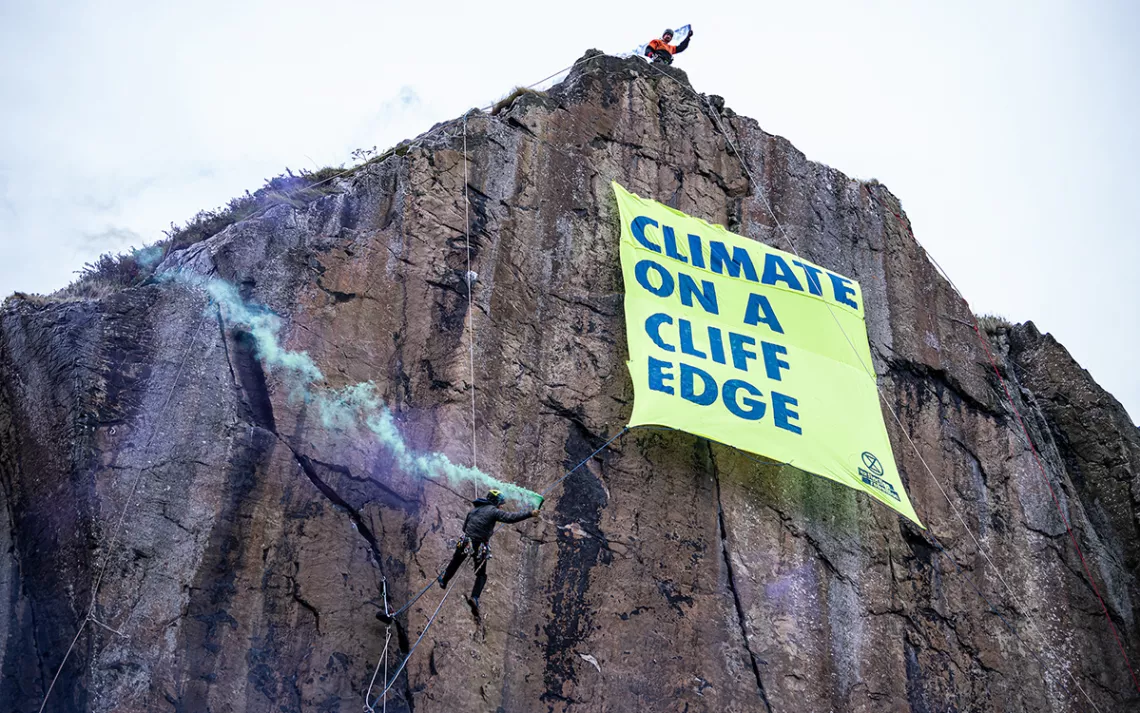
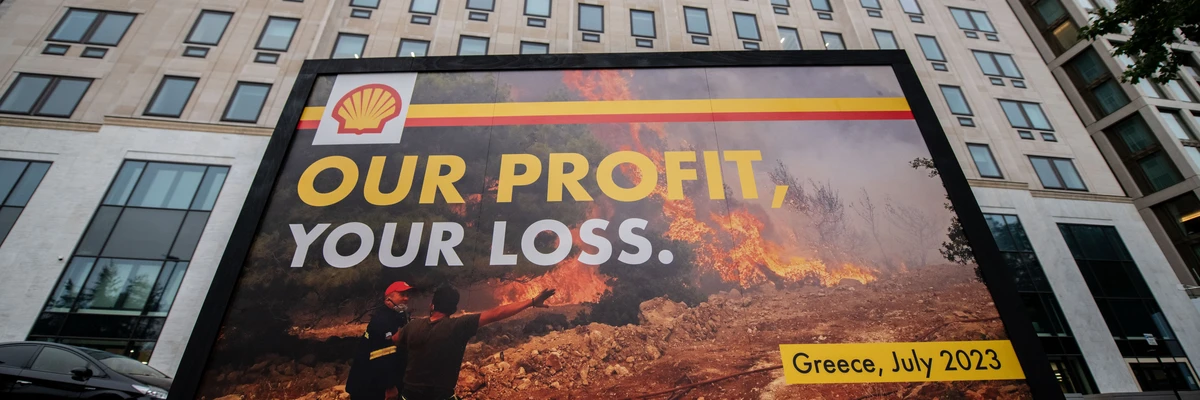
Experienced climbers scale a rock face near the historic Dumbarton castle in Glasgow, releasing a banner that reads “Climate on a Cliff Edge.” One activist, dressed as a globe, symbolically looms near the edge, while another plays the bagpipes on the shores below. | Photo courtesy of Extinction Rebellion and Mark RichardsGreenpeace activists display a billboard during a protest outside Shell headquarters on July 27, 2023 in London. (Photo: Handout/Chris J. Ratcliffe for Greenpeace via Getty Images)
England’s privatised water industry may one day be considered a textbook case study of failed corporate responsibility, regulation and governance. The Cunliffe review, the recent report into England’s privatised water industry, concluded that the financial regulator, OfWat, needs to be disbanded and a new water regulator will be introduced.
For that to work effectively, better pollution monitoring and more clearly defined pollution incident criteria are essential. While politicians and water companies have claimed to be reducing pollution incidences, they might not strictly be tackling sources of pollution, so communications must be carefully scrutinised for disinformation.
The UK’s environment minister Steve Reed MP has described the water industry as “broken”. The public have rising water bills. Water companies owe over £60 billion in debts and have left the country with uncertain water security in the face of climate change.
The Environment Agency (EA) in England recently announced that serious pollution incidents in 2024 rose by 60% to 75 from 47 in the previous year. The EA classifies pollution incidents using a four-point scale called the common incident classification scheme. Trained EA officers consider the evidence reported via their incident hotline to assess its credibility and severity.
Get your news from actual experts, straight to your inbox.Sign up to our daily newsletter to receive all The Conversation UK’s latest coverage of news and research, from politics and business to the arts and sciences.
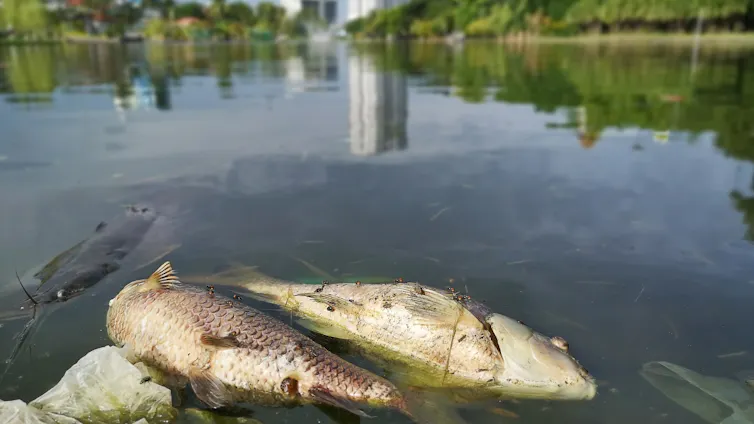
Category 1 is for major incidents, 2 for significant, 3 for minor incidents and 4 for no impact. Category 1 and 2 typically involve visible signs of dead fish floating. For salmon, if more than 10 adult or 100 young fish are dead, this is category 1. With fewer than ten adult and 100 young fish dead, it’s category 2.
No dead fish, no serious problem? The EA can also record damage on protected habitats as “pollution incidents” but these are harder to substantiate without investigative research that takes time and money.
Last year, more than 450,000 sewage discharges were recorded by event duration monitors. These are devices fitted to the end of overflow pipes that indicate when and for how long they have been discharging.
These discharges represent 3.6 million hours of untreated sewage going into our rivers and coasts. These contain chemical contaminants including pharmaceuticals, detergents and human pathogens. Only 75 incidents were recorded as serious or significant in 2024. Another 2,726 were classed as minor.
So lots of sewage discharges are not being classified as pollution incidents, despite containing pollutants. The EA advises its investigating officers to “record substantiated incidents that result in no environmental impact, or where the impact cannot be confirmed, as a category 4”.
The EA has been criticised for turning up late to 74% of category 1 and 2 pollution incidents and for being pressured to ignore low-level pollution – all claims that they have denied. However, they admit they are constrained by finances. Any new regulator must be adequately resourced and independent.
Pollution isn’t always classified as an official pollution incident. YueStock/Shutterstock
In their recent report into pollution incidences, the EA states that they respond to all category 1 and 2 (serious and significant) water industry incidents and will be increasing their attendance at category 3 (minor) incidents. They highlight that more inspections will identify more issues. This shows some acceptance that the more incidents they attend, the more would be substantiated or recorded appropriately.
Most sewage discharges would not have been reported to, or recorded by, the EA as pollution incidents because they were permitted discharges from combined stormwater overflows. Water companies are allowed to discharge untreated wastewater under exceptional rainfall or snowfall conditions to prevent sewage backing up through the pipes.
Extra water flow in rivers from rainfall is meant to dilute chemical contaminants in wastewater. However, some discharges can last days or weeks. The EA is currently investigating whether water companies have been breaching their permits and discharging untreated wastewater when there is low or even no rainfall.
What counts as pollution?
The UN classifies pollution as “presence of substances and energy (for example, light and heat) in environmental media (air, water, land) whose nature, location, or quantity produces undesirable environmental effects”. This definition differs markedly from the EA’s working definition of pollution incidents.
Many sewage discharges containing low concentrations of pollutants won’t kill fish but might still be harmful to fish larvae or small insects, for example.
However, the broad picture from EA data is that invertebrate communities at least are in a better state than they were three decades ago before wastewater treatment plants were upgraded following the EU’s Urban Wastewater Directive.
Some pollutants bioaccumulate through the food chain, so they become concentrated in top predators such as orcas. Some chemicals mimic reproductive hormones even in low concentrations and can feminise fish, for example. High levels of nutrients from agriculture and sewage in rivers can cause fungal diseases in seagrass meadows.
Other families of chemicals build up in wildlife and people, such as persistent “forever chemicals”, much of which comes from wastewater discharges. Continued discharges of antibiotics into waterways might not be classified as pollution incidents but still pose a substantial risk to human and ecosystem health through bacteria developing antibiotic resistance.
The government has just committed to cut sewage pollution by 50% by December 2029 based on 2024 data. But it’s not yet clear whether these involve cutting the frequency of discharges, the duration or both.
This data could also be manipulated so that a large number of small discharges can be consolidated into one official discharge event. Currently, the volume of discharges from stormwater overflows isn’t known. Without this vital data we can’t ascertain the risk posed by their contaminants.

 Former Labour Party leader, Jeremy Corbyn M.P. (left) and Zarah Sultana, MP for Coventry South on the picket line outside London Euston train station, August 18, 2022