400,000 in Mexico City’s Zócalo celebrate one year of Claudia Sheinbaum’s government

Spread the love

Original article by Tallis Boerne Marcus republished from peoples dispatch under a Creative Commons Attribution-ShareAlike 4.0 (CC BY-SA) license.

Mexican President Claudia Sheinbaum greets supporters in the Zócalo on October 5, marking one year of her administration. Photo: MORENA / X

In her speech to a full Zócalo, Sheinbaum reviewed her government’s major accomplishments in a year of global turbulence largely amid a US tariff war and military threats

Mass mobilizations have been a feature of Claudia Sheinbaum’s first year presiding over Mexico, and to finish her first “accountability” tour of Mexico and mark one year of governance, she had her biggest yet. More than 400,000 people came out to watch her speak for nearly an hour on Sunday, October 5, reflecting on her and the party’s achievements in the first year of her term, and the continued “fourth transformation” of Mexico.

In recent weeks, Sheinbaum has visited all 31 states of Mexico, outlining her administration’s current projects, plans and results in each state.

The communication strategy of MORENA, the governing party, is very front-facing, with both Sheinbaum and her predecessor Andrés Manuel López Obrador hosting daily press conferences from Monday to Friday, and then generally traveling to one or two parts of Mexico over the weekend. This has proven extremely effective in countering the narratives from the large press corporations that own and operate the majority of Mexican media outlets, as well as of course maintaining closer communication and accountability with the people of Mexico.

Sheinbaum has faced significant challenges in her first year, most notably due to relations with the administration of US President Donald Trump, with problems ranging from tariff threats even to members of his administration suggesting unilateral military intervention against Mexico. While Trump has threatened Mexico with tariffs at every turn, Sheinbaum’s firm but open stance has proved effective in negotiations with Trump and today the country has managed to achieve important exceptions to the aggressive tariff regime.

Sheinbaum arrives at one year in charge with historic levels of approval, depending on the poll you choose your approval rate is somewhere between 72% and 79%. While other countries around the world aren’t as comprehensive in approval polls as Mexico, this likely makes Sheinbaum the most popular leader in the world.

Her approval is above 70% in all states of Mexico and remarkably, she even has over 70% approval from voters of the three opposition parties in Mexico, the centrist party Movimiento Ciudadano and the right-wing parties of PAN and PRI.

So, how did she get to that level of popularity and what are her challenges in maintaining or growing it? Here are some of the points mentioned by Sheinbaum in her speech and the highlights from her first year governing Mexico.

Reiterating economic achievements

  • Sheinbaum began by reiterating some of the economic achievements, both that MORENA has accomplished since 2018, and some of the present moment.
  • Between 2018 and 2014, 13.5 million Mexican, Mexico is now the second least unequal country in the Americas, behind only Canada, and the income gap between the richest and poorest was reduced from 27 to 14 times over.
  • Annual inflation has settled at 3.7% percent, unemployment is at 2.7%, a record level of foreign direct investment was reached and annual economic growth is expected at 1.2%.

Sheinbaum’s initiatives from her first 12 months.

  • Sheinbaum created three new social programs. One is Salud Casa por Casa, a door-to-door free healthcare system for the elderly, where healthcare professionals come into their home for regular check ups. Another is Pensión Mujeres Bienestar, which gives women their pension from 60 years of age, rather than 65, to recognize unpaid work in the home. The final is Beca “Rita Cetina”, which is a universal scholarship for all secondary students in public schools, this is a payment every two months of 1900 pesos (USD 103) to cover schooling costs.
  • The constitutional recognition of several rights, such as the right for women to live lives free from violence, the right of access to the internet, the right of access to housing, the right to social programs and more.
  • Mexico has served more than 86,000 deported Mexicans who have been deported from the US in special comprehensive care centers, under a program called ‘Mexico embraces you”. This includes registering them into Mexicans social security systems to assist them with access to housing, employment and transportation to their area of origin, as well as food and shelter in the meantime.
  • Sheinbaum said the “4T is bringing back the trains”, with many rail projects underway, after they were previously privatized in the late 90s. These make up more than 3000kms of railway across the country, including two trains from Mexico City, to Pacucha and Queretaro respectively, and further expansion of the Interoceanic train, which is a key part of Mexico’s attempt to create an alternative trade corridor to the Panama Canal.
  • Sheinbaum emphasized the administration’s goal to “promote equality and the recognition and just development of women in Mexico.” The current government has created The Secretariat for Women as an official government ministry, opened a national support line for women, has opened the first 678 free centers for women that focus on comprehensive care for women, but the administration is aiming to build 2,500 in total. The government is also aiming to build 1,000 early education and childcare centers, which will provide free childcare to children from 40 to 1,000 days old.
  • Sheinbaum has also made access to water a key feature of her first year in charge. About four billion cubic meters of water have been de-privatized, a new agricultural irrigation technology program is being developed across 13 states, and there are 20 new strategic drinking water and sanitation projects.
  • The Sheinbaum administration will build 1.7 million homes, 400,000 of those for Mexicans without social security, and the rest with accessible loan offers for those who earn less than two minimum wages.
  • Another key feature of her first year in charge has been more scientific investment and projects, with funding for scientific research projects increasing by 193%. These include the production of an electric car, a project for Mexico to make its own semiconductors, the production of observation satellites and more.

Security

A challenge moving forward for Sheinbaum will be continuing to manage the security situations, although her early strategies have proved effective.

52% of Mexicans rank insecurity and drug trafficking as the most important issue affecting the country, and 63% of Mexicans living in urban areas consider it unsafe to live in their city. This figure rose from the previous year, but in fairness, levels were historically low before.

Sheinbaum and Omar Garcia Harfuch, her secretary of security, have taken a different approach to security than AMLO had. Sheinbaum and Garcia Harfuch also worked together when Sheinbaum was the mayor of Mexico City, and homicides dropped 50% in the six years they worked together.

Sheinbaum’s shift was towards a more direct and carefully coordinated strategy against crime and drug trafficking was clear. In her first 100 days of governing operations against criminal groups went up 597%, arrest numbers grew by 1216%, confiscated weapons went up 5811% and drug seizures went up 1000%.

The results have been swift, with Sheinbaum reporting a 32% reduction in homicides over her first year. Between September 2024 and July 2025, there was an average of 64.9 homicides per day. While these numbers are stark, it is a marked improvement from the 98.5 per day that Mexico was experiencing in 2018, when MORENA first came to power.

In 2007, before Felipe Calderon’s aggressive, US-backed security strategy, Mexico was experiencing 24.3 daily homicides.

Mexico also recently managed to get the United States to sign an agreement to attempt to limit the inflow of weapons from the US into Mexico. This is a huge point for Mexican security as even the US itself has recognized that 74% of weapons used by organized crime groups in Mexico arrive illegally from the United States.

However, Mexican political commentator and editor of Mexico Decoded, Viri Rios makes the point that this agreement focuses only on increased border surveillance and inspection, and misses the core problem of dangerous weapons being too easily acquired and severely unregulated in the US.

In theory, the US agreeing to this new policy will give them more accountability for the guns that continue to arrive in Mexico.

Early results are extremely promising, but Sheinbaum’s grapple with security and US relations will be critical moving forward.

Tallis Boerne Marcus is an Australian journalist currently based in Mexico City.

Original article by Tallis Boerne Marcus republished from peoples dispatch under a Creative Commons Attribution-ShareAlike 4.0 (CC BY-SA) license.

Continue Reading400,000 in Mexico City’s Zócalo celebrate one year of Claudia Sheinbaum’s government

Protests continue in Peru, as polls register 96% rejection of Boluarte

Spread the love

Original article by Pablo Meriguet republished from peoples dispatch under a Creative Commons Attribution-ShareAlike 4.0 (CC BY-SA) license.

Graffiti in Lima condemning police repression of protests. Photo via Joxe Carlos / X

Protesters are demanding an end to the government with the highest disapproval rating on the entire continent. Boluarte, however, says she will not resign.

Another massive mobilization took place on October 4 in Lima, Peru’s capital, against the government of Dina Boluarte. With this mobilization, it has now been three weeks in a row that thousands of Peruvians have taken to the streets to demand an end to the proposed pension reform, corruption, insecurity, and police abuse.

But, as several analysts have pointed out, the protests are no longer focused solely on specific issues, but on raising the demand for an end to the Boluarte government. Boluarte took office after the overthrow of then-President Pedro Castillo, and led to the deaths of more than 60 Peruvians following massive protests between 2022 and 2023.

Protests in Lima

On Saturday, October 4, the streets of downtown Lima were once again filled with cries against the government and the national congress. The demonstrations were attended by young people, university students, workers, transport workers, and various collectives who denounced the Peruvian state structure as corrupt due to the presence of political and economic mafias. The General Confederation of Workers of Peru (CGTP) also joined the demonstration.  

The demonstration marched through the city center along Abancay Avenue until it reached the National Congress, one of the institutions most criticized by the protesters. It did not take long for the police, as has been customary during the Boluarte administration, to quickly repress the protesters. Tear gas, pellets, and baton blows were the order of the day.

The resistance

However, journalist Ricardo Rodríguez argues that perhaps the most important aspect of the protests is not the repression, but rather the ability of Peruvians to mobilize in the face of a government that refuses to step aside: “It’s not just about bullets, tear gas, or arrests. What those in power fear – and are already beginning to feel – is that these young people are not just taking to the streets: they know, they understand, they articulate. They organize in a decentralized manner; they mobilize without waiting for permission; they use social media not as a showcase but as a tool for coordination; they demand not crumbs, but real change.

Rodríguez also pointed out that there is a spirit of rejection not only of the current government, but of a system that offers no opportunities for growth for Peruvians, felt most strongly among young people: “Many reject the economic model that offers them precariousness, miserable wages, and old age without decent pensions. The proposed reform is not the only cause: it is the trigger for accumulated resentment against decades of broken promises and state neglect.”

Transport workers’ strike

In addition to the demonstrations on Saturday, October 4, several dozen transport companies in Peru staged protests against the government of Dina Boluarte on October 7.

Their main demand is that the government take action to stop the growing wave of insecurity and extortion suffered by transport workers at the hands of organized crime groups. Attacks on transport workers have caused the deaths of 47 drivers.

At various points in Lima, transport workers stopped work and gathered in the streets to demand a change in the state’s security policy, even blocking roads to make themselves heard.

France 24 correspondent Francisco Zacarías reported that there were clashes between protesters and police. He also stated that President Boluarte “downplayed” the transport strike and said that the protests “will not solve the problem,” which has further provoked the transport unions.

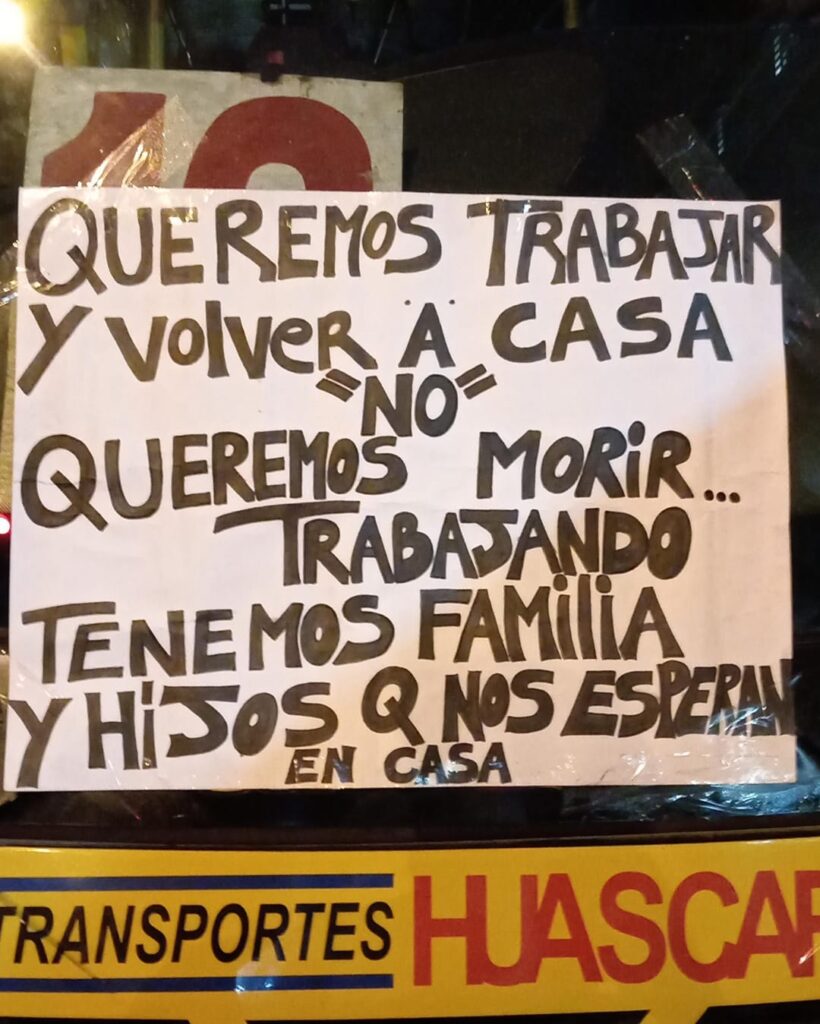
Transport workers strike Lima
Sign on a bus reads “We want to work and return home. We do NOT want to die working. We have family and children that wait for us at home.” Photo via X

Almost total rejection of the Boluarte government and Congress

Currently, Peru’s Congress has one of the lowest approval ratings among the country’s various state institutions, reaching almost total rejection. Not far behind, President Boluarte has a 96% disapproval rating, according to an IPSOS poll.

In this regard, IPSOS CEO Alfredo Torres stated: “This is something that has never been seen before in history, nor has it been seen in other countries. A poor approval rating for any president is 20% in favor and 80% against, but a 96% disapproval rating is extremely high. It is absolute rejection, absolute distrust. People no longer expect anything. It is also outrageous that scandals continue to emerge and nothing happens.”

“I will not resign,” says Boluarte

Faced with periodic protests and a huge crisis of legitimacy, President Boluarte stated that she has no intention of leaving power before the 2026 elections. According to Boluarte, Peru has become a prime destination for foreign investment, so her administration is more than justified.

“If those small-time leaders believe that with riots, violence, hatred, and the desire to impose an anarchic world, they are going to change the history of Peru … We are seeing other countries that have done the same and have failed governments,” Boluarte said.

However, Boluarte will still have to endure protests that seem to be increasing in frequency in line with the disapproval of her mandate.

Original article by Pablo Meriguet republished from peoples dispatch under a Creative Commons Attribution-ShareAlike 4.0 (CC BY-SA) license.

Continue ReadingProtests continue in Peru, as polls register 96% rejection of Boluarte

‘Insulting and counterproductive’

Spread the love

https://morningstaronline.co.uk/article/insulting-and-counterproductive

 Protesters take part in a demonstration outside the Foreign, Commonwealth and Development Office (FCDO) in Whitehall, London, calling for the government to protect the crew of Madleen, June 9, 2025


Jewish campaigners condemn Starmer’s claim that demonstrations against genocide are ‘un-British’

JEWISH campaigners have condemned Sir Keir Starmer’s “insulting” claim that demonstrations against genocide were “un-British.”

The Prime Minister’s remarks, made today, came ahead of several student protests on the anniversary of October 7, and the national march for Palestine this weekend.

An inter-university march set off in the capital from King’s College at 2pm, before passing the London School of Economics, University College London and ending at the gates of SOAS.

Joining them was Mark Etkind, the son of a Holocaust survivor, who said: “As we speak today, weapons made in Britain are contributing to the deaths of children and others in Gaza — that has to stop now in order to save those lives, so these brave student protesters have to keep demonstrating until that genocide stops.”

He accused the government of having slandered the students, making them out to be insensitive to October 7, “while ignoring the obvious fact that their priority is to … oppose the ongoing conflict which Britain unfortunately is complicit in.”

Rallies also took place in Sheffield, Glasgow and Edinburgh, where the institution’s principal emailed students warning them to “think carefully about their actions” ahead of the protest.

Edinburgh’s Justice for Palestine Society called it a “blatant attempt to suppress campus discourse on an ongoing genocide.”

Writing in the Times, Sir Keir said it was “un-British to have so little respect for others,” echoing comments made by Home Secretary Shabana Mahmood, who described Palestine protests held following Thursday’s attack on a Manchester synagogue as “fundamentally un-British.”

Naomi Wimborne-Idrissi, media officer for Jewish Voice for Liberation, said: “Those who protest are in despair at our government’s abject failure to take any kind of meaningful action to make the bombing, shooting, burning and starvation stop.

“For leaders of that government to accuse protesters of ‘un-Britishness’ is both insulting and counterproductive.

Article continues at https://morningstaronline.co.uk/article/insulting-and-counterproductive

Keir Starmer objects to criticism of the IDF. He asks how could anyone object to them starving people to death, forced marches like the Nazis did, bombing Gaza's hospitals and universities, mass-murdering journalists, healthworkers and starving people queuing for food, killing and raping prisoners and murdering children. He calls for people to stop obstructing his genocide for Israel.
Keir Starmer objects to criticism of the IDF. He asks how could anyone object to them starving people to death, forced marches like the Nazis did, bombing Gaza’s hospitals and universities, mass-murdering journalists, healthworkers and starving people queuing for food, killing and raping prisoners and murdering children. He calls for people to stop obstructing his genocide for Israel.
Orcas discuss Genocide-supporting and complicit Zionists. Donald Trump, Keith Starmer, David Lammy, Rachel Reeves, Angela Rayner and Wes Streeting are acknowledged as evil genocide-complicit and supporting cnuts.
Vote Labour for Genocide.
Continue Reading‘Insulting and counterproductive’