Daring to dream after two years under fire: Life in Gaza

Spread the love

Original article by Hassan Herzallah republished from Open Democracy under a Creative Commons Attribution-NonCommercial 4.0 International licence.

Palestinians follow the news about the ceasefire agreement in Khan Yunis, Gaza, on 9 October 2025 
| Abdallah F.s. Alattar/Anadolu via Getty Images)

For two years, our lives have been on hold amid constant air strikes and fighting. Now, we finally have reason to hope

Growing up in Gaza, my friends and I often heard older relatives’ stories of the Nakba; learning about the homes that Israeli troops forced them out of in 1948, and the keys they forever carried with them in hopes of returning. We never imagined that we would one day carry this pain ourselves.

For the last two years, history has repeated itself before the eyes of the world. Those of us in Gaza who have survived the Israeli genocide have lived a new Nakba, not knowing where to go or if we will ever return home.

This has not been one war, but multiple wars happening at once. It is the war of relentless bombing that destroyed homes and neighbourhoods, the war of forced displacement that has pushed hundreds of thousands into the unknown at a moment’s notice, and the war of tents that offer no protection from the scorching summer heat or the cold and rain of winter.

Today, as we hear news of a ceasefire, we’re caught between feeling joy and fear – between believing and doubting.

I was in my hometown of Rafah in May last year when the Israeli occupation launched its invasion of the city. In a single day, Rafah was transformed from an overcrowded city sheltering more than 1.5 million people – both its own residents and those who’d sought refuge there after being displaced from elsewhere in Gaza – to an empty wasteland.

Within hours, the roads filled with overloaded cars and carts as hundreds of thousands of people, my family included, abandoned their homes and most of their belongings, fleeing towards the unknown. There was no time to think or to salvage what remained; fearing what would happen to those trapped, we all chose survival over everything else.

A few days later, the evacuation operation expanded further, forcing tens of thousands of us to move to the Mawasi area in Khan Younis. I’d never been to Mawasi before, but I had heard about it from friends online: a barren land with sand dunes unlike anything we’d seen before. When we arrived, we found dilapidated plastic tents, extreme overcrowding, no sewage or basic services.

The tents’ flimsy fabric roofs offered no protection from the summer heat or the winter cold. Our daily life turned into a continuous struggle of finding water, trying to charge our phones, and dealing with internet cuts, with scorching days and freezing nights. Even sleeping and talking became difficult amid the complete lack of privacy.

Life in the camps offered no safety at all. One evening, my cousin Ali was returning from the sea at sunset when he was chased by a quadcopter – a small, remote-controlled drone that Israel has used to surveil, intimidate and even kill civilians in Gaza. Ali froze in place for minutes that he said felt like hours before the drone disappeared, and he ran away, terrified. After that, we no longer dared to leave the area once darkness fell.

Every night, we would lay awake listening to stray bullets from occupation snipers piercing the air, planting terror in our hearts. We would lie on the ground instinctively, fearing any bullet that might pierce the tent, and sometimes six of us would gather in a small stone room at my aunt’s place, seeking a sliver of safety. After a neighbour’s child was paralysed by a stray bullet that pierced their tent, some of my relatives dug small trenches inside theirs to hide in.

On 10 September 2024, we lived through a night we will never forget. The evening began like any other; my family was in the tent and I was laying out front, trying to escape the heat, reading Letter from Gaza, a short story about a young man who returns home to Gaza to find his neighbourhood destroyed. It could have been penned any day over the past two years, but was written nearly 70 years ago by Palestinian author and militant Ghassan Kanafani.

I was interrupted by the sound of a military helicopter, followed by five consecutive airstrikes that destroyed much of the camp. My family managed to escape unharmed, which was a miracle, but in an instant, we lost everything we owned for a second time: our tent, our few belongings, my university certificates, and the computer that I used for my studies.

I remember screams, blood, and mothers searching for their children in the smoke. The Palestinian Civil Defence Agency later reported that 40 people had died that night, and 60 others were injured. But we had nowhere else to go, so my mother and sisters moved briefly into a friend’s tent, and within a week my father and I had rebuilt a shelter for us.

Then came the ceasefire on 18 January 2025, bringing a ray of hope. I returned to my home in Rafah, clutching the key as if it were all I had left. But my joy did not last long. When I reached the neighbourhood, I found nothing but rubble. My house, the homes of my relatives and friends, even my grandmother’s house, the place I most loved spending time – they were all gone.

The key I had believed would take me back home became merely a symbol of a Nakba that my ancestors had already endured, a memory of a home that no longer exists. Still, we stayed in Rafah, staying with a relative and trying to rebuild our lives.

My family is far from alone. Since the start of the invasion, 1.9 million people, nearly 90% of Gaza’s population, have been internally displaced – many of them forced to move over and over again as Israel expands its war into areas it told us would be safe. The occupation now controls large parts of the Strip, leaving less than 30% of Gaza’s original area habitable and making freedom of movement impossible.

In mid-March, two months after it started, the ceasefire ended abruptly and the war’s devastation resumed overnight. The bombardment intensified worse than ever, and by the morning, Rafah was surrounded by Israeli tanks. We were forced to evacuate for a fifth time, returning to a tent in Mawasi without any of the belongings I had managed to salvage from our shelled home.

On that day, I realised my old life would never return. For me, it was a new phase of the war, a new chapter of terror. I had to face that the relentless and violent bombing was not just a passing event, but our everyday reality – everything I knew from before the war was gone, just memories.

For more than a year, Rafah has been entirely under occupation, with no news of when we might be able to go home. The city is no longer as I knew it growing up. There is no safety, and freedom of movement is impossible.

Despite all the loss and suffering tied into displacement, it has reunited me with friends whom war stopped me from seeing for over a year. Hamdan, my friend from Khan Younis, Mahmoud from Gaza City, and Ramez from East Khan Younis; we all found ourselves in the same area, a small solace in all the devastation.

My friends and I began sharing our stories and sorrows every day. Mahmoud, with whom I went to university before its buildings were destroyed and our dreams were shattered, told us of how his family spent most of the past two years refusing to leave Gaza City, in the north of the Gaza Strip, choosing to endure the war in their home.

Then, last month, Binyamin Netanyahu’s occupation announced its plan to fully occupy the city. The shelling intensified, and every time Mahmoud looked out of his window, he would see the trucks that were carrying more than half a million people and their belongings south.

Over 200,000 families remained in the city, though. Some had nowhere else to go, some could not afford the up to $5,000 it can cost to transport belongings and purchase tents, and some, like Mahmoud’s family, simply did not want to leave.

Eventually, the shelling hit the neighbourhood where Mahmoud and his family lived, and became a daily occurrence. Several nearby tower blocks were destroyed. All services in the area collapsed; there was no potable water, or even dirty water, and no people on the streets or in the markets. Life became impossible. Mahmoud’s family was finally forced to evacuate.

Mahmoud and I are no longer who we once were. We used to have breakfast together in the university cafeteria, walk through the lecture halls together to attend our daily classes, and go together to Gaza City’s central library to borrow a book or one of the English novels. Now, we still see each other most days – living as we do in nearby camps – but our lives are so different now; we are unrecognisable from who we once were.

Two years have passed in which life has been on hold. Every day we have asked ourselves the same question: will this nightmare ever end? Then, last night, we finally heard the news that we have all been waiting for: Israel and Hamas appear ready to reach a peace deal.

The camp instantly came alive. Women began to ululate and children laughed, it felt as though everyone had been waiting for just one moment to breathe, a brief pause from this long fear. No one knows if this is truly the end or just another pause in the war, but today, we all need to believe that peace – even for a moment – is still possible.


Hassan Herzallah is a Palestinian translator and writer based in Gaza.

Original article by Hassan Herzallah republished from Open Democracy under a Creative Commons Attribution-NonCommercial 4.0 International licence.

Keir Starmer objects to criticism of the IDF. He asks how could anyone object to them starving people to death, forced marches like the Nazis did, bombing Gaza's hospitals and universities, mass-murdering journalists, healthworkers and starving people queuing for food, killing and raping prisoners and murdering children. He calls for people to stop obstructing his genocide for Israel.
Keir Starmer objects to criticism of the IDF. He asks how could anyone object to them starving people to death, forced marches like the Nazis did, bombing Gaza’s hospitals and universities, mass-murdering journalists, healthworkers and starving people queuing for food, killing and raping prisoners and murdering children. He calls for people to stop obstructing his genocide for Israel.
Experiencing issues with this image not appearing. I suspect because it's so critical of Zionist Keir Starmer's support of and complicity in Israel's genocides.
Genocide denier and Current UK Prime Minister Keir Starmer is quoted that he supports Zionism without qualification. He also confirms that UK air force support has been essential in Israel’s mass-murdering genocide. Includes URLs https://www.declassifieduk.org/keir-starmers-100-spy-flights-over-gaza-in-support-of-israel/ and https://youtu.be/O74hZCKKdpA
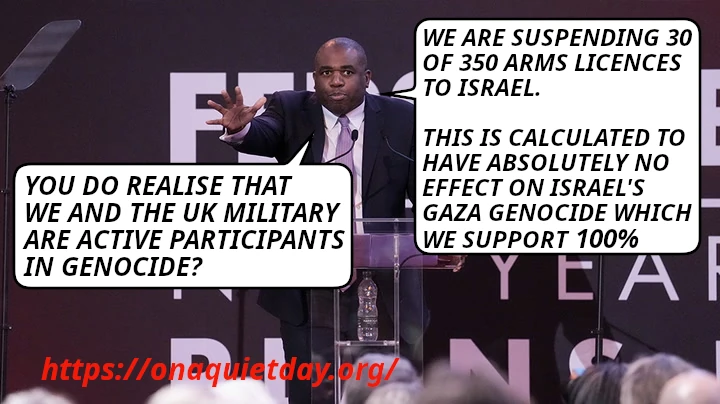
Genocide denying UK Foreign Secretary David Lammy says that UK is suspending 30 of 350 arms licences to Israel. He also confirms the UK government's support for Israel's Gaza genocide and the UK government and military's active participation in genocide.
Genocide denying UK Foreign Secretary David Lammy says that UK is suspending 30 of 350 arms licences to Israel. He also confirms the UK government’s support for Israel’s Gaza genocide and the UK government and military’s active participation in genocide.
Continue ReadingDaring to dream after two years under fire: Life in Gaza

US troops begin arriving in Israel to join Gaza ceasefire monitoring mission: Report

Spread the love

This work by Middle East Monitor is licensed under a Creative Commons Attribution-NonCommercial-ShareAlike 4.0 International License.

USA Flag in San Diego. [Mario Tama/Getty Images]

US troops began arriving in Israel on Saturday to take part in a joint task force to monitor the implementation of the Gaza ceasefire agreement, according to media reports, Anadolu reports.

Citing two US officials, ABC News reported that 200 troops will arrive in Israel “to set up a coordination center that will oversee implementation of the ceasefire agreement in Gaza” and operate in different fields, including transportation, planning, logistics, security, and engineering.

US troops will not enter the Gaza Strip; they will carry out their activities in Israel under the command of US Central Command (CENTCOM) Commander Adm. Bradley Cooper, alongside different units and contingents sent from countries in the region, according to the report.

On Wednesday, US President Donald Trump announced that Israel and Hamas agreed to the first phase of a 20-point plan he laid out on Sept. 29 to bring a ceasefire to Gaza, release all Israeli captives being held there in exchange for around 2,000 Palestinian prisoners, and a gradual withdrawal of Israeli forces from the entire Gaza Strip.

A second phase of the plan calls for the establishment of a new governing mechanism in Gaza without Hamas’ participation, the formation of a security force comprising Palestinians and troops from Arab and Islamic countries, and the disarmament of Hamas.

Since October 2023, Israeli attacks have killed nearly 67,200 Palestinians in the enclave, most of them women and children, and rendered it uninhabitable.

Israeli airstrikes target heavy machinery yards in southern Lebanon, destroy over 300 vehicles: Report

This work by Middle East Monitor is licensed under a Creative Commons Attribution-NonCommercial-ShareAlike 4.0 International License.

Continue ReadingUS troops begin arriving in Israel to join Gaza ceasefire monitoring mission: Report

Israeli airstrikes target heavy machinery yards in southern Lebanon, destroy over 300 vehicles: Report

Spread the love

This work by Middle East Monitor is licensed under a Creative Commons Attribution-NonCommercial-ShareAlike 4.0 International License.

The Israeli army violated the ceasefire by launching more than ten airstrikes on the town of al-Musaylih in southern Lebanon, causing powerful explosions, extensive destruction at industrial facilities, and the burning of bulldozers that were rendered unusable on October 11, 2025. [Houssam Shbaro – Anadolu Agency]

The Israeli army on Saturday carried out airstrikes on six heavy machinery yards along the Al-Msayleh road in southern Lebanon, destroying more than 300 vehicles, according to local media, Anadolu reports.

Citing the Health Ministry, the state-run National News Agency reported that one Syrian national was killed in the attack, while another Syrian and six Lebanese citizens, including two women, were injured.

It said that more than 300 vehicles, including bulldozers and excavators, were destroyed, causing an estimated loss of hundreds of millions of dollars.

The facilities, including buildings and tents, in addition to a number of cars that were parked in the area were also destroyed.

“The exhibition sites that were completely destroyed are considered among the largest and most prominent heavy machinery exhibition sites in Lebanon,” the agency said.

It added that the airstrikes left the area engulfed in flames and Al-Msayleh road was closed due to significant damage.

The Israeli army claimed that it “struck and destroyed Hezbollah’s infrastructure in the area of southern Lebanon, where engineering equipment used to rebuild” its infrastructure in the area was located.

From Sabra and Shatila to Gaza: The vicious cycle of US-Israeli ‘peace’ ploys

Lebanese President Joseph Aoun denounced the attack, calling it “a blatant act of aggression.”

“The seriousness of this assault lies in the fact that it comes after the ceasefire agreement in Gaza,” Aoun said, and warned against a possible Israeli attempt to transfer the conflict towards Lebanon.

Separately, Israeli drones were reported flying over Lebanon’s capital Beirut, and the southern suburbs since early Saturday, according to the agency.

A ceasefire was reached in November 2024 following a year-long cycle of cross-border attacks between Hezbollah and Israel that began in October 2023. The conflict escalated into a full-scale Israeli offensive by September 2024, resulting in more than 4,000 deaths and around 17,000 injuries.

Under the terms of the truce, Israel was supposed to fully withdraw from southern Lebanon by January. But it has so far only partially pulled out troops and continues to maintain a military presence at five border outposts.

This work by Middle East Monitor is licensed under a Creative Commons Attribution-NonCommercial-ShareAlike 4.0 International License.

Continue ReadingIsraeli airstrikes target heavy machinery yards in southern Lebanon, destroy over 300 vehicles: Report

Thousands of Palestinians returning to areas vacated by Israeli forces in Gaza Strip

Spread the love

This work by Middle East Monitor is licensed under a Creative Commons Attribution-NonCommercial-ShareAlike 4.0 International License.

Hundreds of Palestinians continued returning from the south to the north, carrying their belongings along Rashid Street that connects the two parts of the enclave on the second day of the ceasefire in the Gaza Strip on October 11, 2025. [Stringer – Anadolu Agency]

Tens of thousands of Palestinians set off toward areas vacated by Israeli forces after a ceasefire took effect on Friday, according to an Anadolu correspondent, Anadolu reports.

Thousands of displaced civilians departed from southern Gaza to their homes northward, the majority on foot. Some made the hours-long journey using the few vehicles still running amid fuel shortages, along with animal-drawn carts, bicycles, and motorcycles.

Simultaneously, thousands returned to their homes in the central Gaza Strip and some eastern parts of Khan Younis in the south, following the withdrawal of Israeli forces.

The transfers from the south to the north were carried out via the coastal Al-Rashid Street in the west and Salah al-Din Road in the east.

Hundreds of displaced civilians had to set up tents on the rubble of their homes upon returning.

A gradual withdrawal of Israeli forces toward the yellow line was completed on Friday in accordance with US President Donald Trump’s plan.

The army forces withdrew from Gaza City in the north, excluding the Shejaiya neighborhood and some parts of the Al-Tuffah and Zeitoun neighborhoods; and the central and eastern parts of Khan Younis in the south. Palestinians were prevented from entering Beit Hanoun and Beit Lahia in northern Gaza.

The Gaza Government Media Office said on Saturday that more than 5,000 missions, including humanitarian, health, rescue, and relief operations, were carried out in the past 24 hours across Gaza governorates.

READ: Israel will allow Gaza residents to return to Gaza via Rafah crossing, 1st since war began

Trump announced Wednesday that Israel and Hamas agreed to the first phase of a 20-point plan he laid out on Sept. 29 to bring a ceasefire to Gaza, release all Israeli captives being held there in exchange for around 2,000 Palestinian prisoners, and a gradual withdrawal of Israeli forces from the entire Gaza Strip.

The first phase of the deal came into force at 12 noon local time Friday (0900 GMT).

A second phase of the plan calls for the establishment of a new governing mechanism in Gaza without Hamas’ participation, the formation of a security force comprising Palestinians and troops from Arab and Islamic countries, and the disarmament of Hamas.

Since October 2023, Israeli attacks have killed nearly 67,200 Palestinians in the enclave, most of them women and children, and rendered it uninhabitable.

This work by Middle East Monitor is licensed under a Creative Commons Attribution-NonCommercial-ShareAlike 4.0 International License.

Continue ReadingThousands of Palestinians returning to areas vacated by Israeli forces in Gaza Strip

‘We have to break the Tory-Labour duopoly and we will’

Spread the love

https://morningstaronline.co.uk/article/we-have-break-tory-labour-duopoly-and-we-will

 From left to right: La France Insoumise deputy leader Nathalie Oziol, Die Linke general secretary Janis Ehling, Workers’ Party of Belgium general secretary Peter Mertens, British-Palestinian activist Leanne Mohamad, Jeremy Corbyn and Zarah Sultana

Jeremy Corbyn and Zarah Sultana discuss the formation of a new leftwing party 

THE Tories and Labour’s grip on power must come to an end, people attending The World Transformed Festival 2025 in Manchester heard today.

A massive queue wrapped around the Niamos Radical Arts Centre in Manchester’s Moss Side in the afternoon as people waited eagerly to join a panel discussion with former Labour Party leader Jeremy Corbyn and independent MP Zarah Sultana focused on the formation of their new political party.

“For too long, our politics has been trapped in a cycle: the same two parties, the same tired promises, the same broken failures; a nightmare that keeps us stuck divided and ignored,” began prominent British-Palestinian activist Leanne Mohamad.

“The truth is that the two-party system has failed us all,” she said. “Everything that these two parties touch is corrupted. And that is why we have to break this duopoly and we will.”

Ms Sultana began a passionate speech by first addressing the new party’s rocky start. “Obviously, you’ve all seen what’s happened over the past few weeks,” she said. “But I’m here to tell you, the show is back on the road.”

Continues at https://morningstaronline.co.uk/article/we-have-break-tory-labour-duopoly-and-we-will

Keir Starmer says that the Labour Party under his leadership all feel a small part of Scunthorpe.
Keir Starmer objects to criticism of the IDF. He asks how could anyone object to them starving people to death, forced marches like the Nazis did, bombing Gaza's hospitals and universities, mass-murdering journalists, healthworkers and starving people queuing for food, killing and raping prisoners and murdering children. He calls for people to stop obstructing his genocide for Israel.
Keir Starmer objects to criticism of the IDF. He asks how could anyone object to them starving people to death, forced marches like the Nazis did, bombing Gaza’s hospitals and universities, mass-murdering journalists, healthworkers and starving people queuing for food, killing and raping prisoners and murdering children. He calls for people to stop obstructing his genocide for Israel.
UK Conservative Party leader Kemi Badenoch explains her reality that the Earth is flat, the Moon is made of cheese and that she was born from Unicorn horn dust
UK Conservative Party leader Kemi ‘not a genocide’ Badenoch explains her reality that the Earth is flat, the Moon is made of cheese and that she was born from Unicorn horn dust
Continue Reading‘We have to break the Tory-Labour duopoly and we will’