Sophie Ellis Bextor performing in 2023. Photograph: Tin!y/Alamy Live News/Alamy Live News.
Organised by Olly Alexander and the Mighty Hoopla festival to ‘fight back against the politics of fear and exclusion’, Trans Mission will take place at Wembley Arena in March
Artists including Sugababes, Wolf Alice, Romy, Sophie Ellis-Bextor, Christine and the Queens, Beth Ditto, Beverley Knight, Jasmine.4.T, Kae Tempest and more will perform at an all-star charity concert at Wembley Arena in support of trans rights next year.
Organised by Olly Alexander and the Mighty Hoopla festival, Trans Mission will also feature appearances from figures including Green party leader Zack Polanski, actor Ian McKellen, comedian Grace Campbell, author Shon Faye, actor Mawaan Rizwan, model Munroe Bergdorf and actor Nicola Coughlan.
The concert will raise funds for the Good Law Project, a charity that uses the law to push for change and government accountability, and trans-led charity Not a Phase.
Alexander said in a statement: “I believe that in these times, community action isn’t just important – it’s essential! We need real and lasting change. Through solidarity, creativity and collective fundraising, we can fight back against the politics of fear and exclusion and build a world where everyone can thrive.
“I am very fortunate to know and work closely alongside incredible trans and non-binary people whose creativity and presence are essential to the cultural fabric we all share. Trans Mission is going to be a special and unforgettable night, and I’m excited to share the stage with so many wonderful people I hugely admire.”
Organisers said the show was in response to rising hate crimes and discrimination against trans people, particularly after the UK supreme court’s ruling on biological sex and the subsequent interim advice of the Equality and Human Rights Commission.
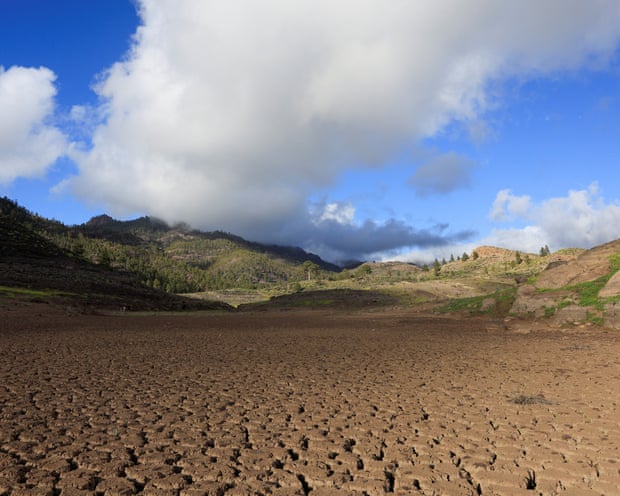
Parched land at Cueva de Las Niñas reservoir in the island of Gran Canaria, Spain, in March 2025. Photograph: Borja Suárez/Reuters
Exclusive: UCL scientists find large swathes of southern Europe are drying up, with ‘far-reaching’ implications
Vast swathes of Europe’s water reserves are drying up, a new analysis using two decades of satellite data reveals, with freshwater storage shrinking across southern and central Europe, from Spain and Italy to Poland and parts of the UK.
Scientists at University College London (UCL), working with Watershed Investigations and the Guardian, analysed 2002–24 data from satellites, which track changes in Earth’s gravitational field.
Because water is heavy, shifts in groundwater, rivers, lakes, soil moisture and glaciers show up in the signal, allowing the satellites to effectively “weigh” how much water is stored.
The findings reveal a stark imbalance: the north and north-west of Europe – particularly Scandinavia, parts of the UK and Portugal – have been getting wetter, while large swathes of the south and south-east, including parts of the UK, Spain, Italy, France, Switzerland, Germany, Romania and Ukraine, have been drying out.
Climate breakdown can be seen in the data, the scientists say. “When we compare the total terrestrial water storage data with climate datasets, the trends broadly correlate,” said Mohammad Shamsudduha, professor of water crisis and risk reduction at UCL.
Elon Musk urges you to be a Fascist like him, says that you can ignore facts and reality then.Donald Trump urges you to be a Climate Science denier like him. He says that he makes millions and millions for destroying the planet, Burn, Baby, Burn and Flood, Baby, Flood.Nigel Farage urges you to ignore facts and reality and be a climate science denier like him and his Deputy Richard Tice. He says that Reform UK has received £Millions and £Millions from the fossil fuel industry to promote climate denial and destroy the planet.
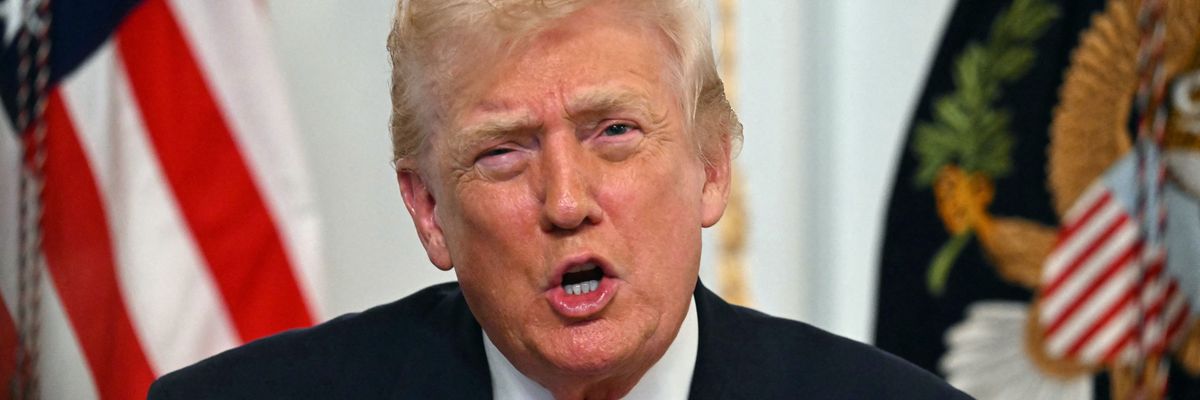
US President Donald Trump participates in a video call with service members from his Mar-a-Lago residence in Palm Beach, Florida, on November 27, 2025, during the Thanksgiving holiday. (Photo by Jim Watson/AFP via Getty Images)
“Even if unenforced, Trump’s declaration functions as an improvised, extralegal no-fly zone created through fear, FAA warnings, and military pressure,” said the anti-war group CodePink.
Policy experts and advocates on Saturday denounced President Donald Trump’s claim that he had ordered the airspace above and around Venezuela “to be closed in its entirety”—an authority the US president does not have but that one analyst said signaled a “scorched earth” policy in the South American country and that others warned could portend imminent airstrikes.
Francisco Rodriguez, a senior research fellow at the Center for Economic and Policy Research, said that after months of escalating tensions driven by Trump’s strikes on boats in the Caribbean and other aggressive actions, the US government was treating the Venezuelan people as “chess pieces.”
“A country subject to air isolation is a country where medicine and essential supplies cannot enter, and whose citizens cannot travel even for emergency reasons,” Rodriguez told Al Jazeera.
US strikes on vessels in the Caribbean and the eastern Pacific have killed at least 83 people since early September, with Defense Secretary Pete Hegseth reportedly ordering US military officers to “kill everybody” on board when he directed the first strike. The administration claims it is conducting the strikes to stop drug trafficking from Venezuela, though US and international intelligence has shown the South American country is not involved in trafficking fentanyl to the US and serves as only a transit hub—but not a major production center—of cocaine.
The Trump administration has claimed it is engaged in an “armed conflict” with Venezuela, though Congress has not authorized any such conflict. Lawmakers from both sides of the aisle have introduced war powers resolutions to stop Trump from conducting more attacks on boats and inside Venezuela, where the president has also authorized covert CIA operations and has threatened to launch strikes.
On Thursday, Trump said in a statement to US service members that the military could begin targeting suspected drug traffickers on land “very soon,” before claiming the country’s airspace was closed Saturday morning.
To all Airlines, Pilots, Drug Dealers, and Human Traffickers, please consider THE AIRSPACE ABOVE AND SURROUNDING VENEZUELA TO BE CLOSED IN ITS ENTIRETY. Thank you for your attention to this matter! PRESIDENT DONALD J. TRUMP
The US has also sent an aircraft carrier and 10,000 troops to the region in the largest US deployment to Latin America in decades.
The Federal Aviation Administration (FAA) last week urged civilian aircraft to “exercise caution” when flying over Venezuela due to the “worsening security situation and heightened military activity in or around” the country.
That warning led six airlines to suspend flights to Venezuela, which in turn prompted President Nicolás Maduro’s government to ban the companies, including Turkish Airlines, Spain’s Iberia, Portugal’s TAP, Colombia’s Avianca, Chile and Brazil’s LATAM, and Brazil’s GOL. Maduro accused the airlines of “joining the actions of state terrorism promoted by the United States government.”
The anti-war group CodePink said Trump’s claim about Venezuelan airspace represented “a dangerous escalation with no legal basis and enormous regional consequences.”
“The United States has no authority to close another country’s airspace,” said the group. “Under international law, only Venezuela can determine the status of its skies and enforcing a foreign no-fly zone without UN authorization or host-state consent would constitute an act of war. Even if unenforced, Trump’s declaration functions as an improvised, extralegal no-fly zone created through fear, FAA warnings, and military pressure.”
Trump’s actions in Venezuela in recent weeks—which come two years after the president explicitly said he wanted to take control of the country’s vast oil reserves—“form a familiar pattern,” said CodePink.
“Manufacture a crisis, then paint a sovereign government as a danger to US interests, and finally use the manufactured urgency to justify military measures that would otherwise be politically impossible,” said the group. “Trying to ‘close’ the airspace of another country is an act of aggression. It risks flight disruptions, economic panic, and aviation accidents. It is also an attempt to isolate Venezuela without admitting that the US is imposing a de facto blockade. The people of Venezuela have lived with the consequences of Washington’s reckless interventions. They deserve peace, not another manufactured war.”
“Diplomacy, not domination, remains the only path that respects international law and regional sovereignty,” added CodePink. “Hands off Venezuela. Hands off Latin America.”
Charles Samuel Shapiro, a former US ambassador to Venezuela, emphasized that Trump’s latest move in what he claims is a battle against drug trafficking came a day after he announced a pardon for right-wing former Honduran President Juan Orlando Hernández, who was convicted of working with drug traffickers.
“The whole drug trafficking thing is simply a pretext,” Shapiro told Al Jazeera. “If you look at the US government’s own reports, drugs coming into the United States from Venezuela are minimal, so declaring these people to be ‘narcoterrorists’—it makes no sense.”
Donald Fuhrump says that Amerikkka doesn’t bother with crimes or charges anymore, not being 100% Amerikkkan and opposing his real estate intentions is enough.
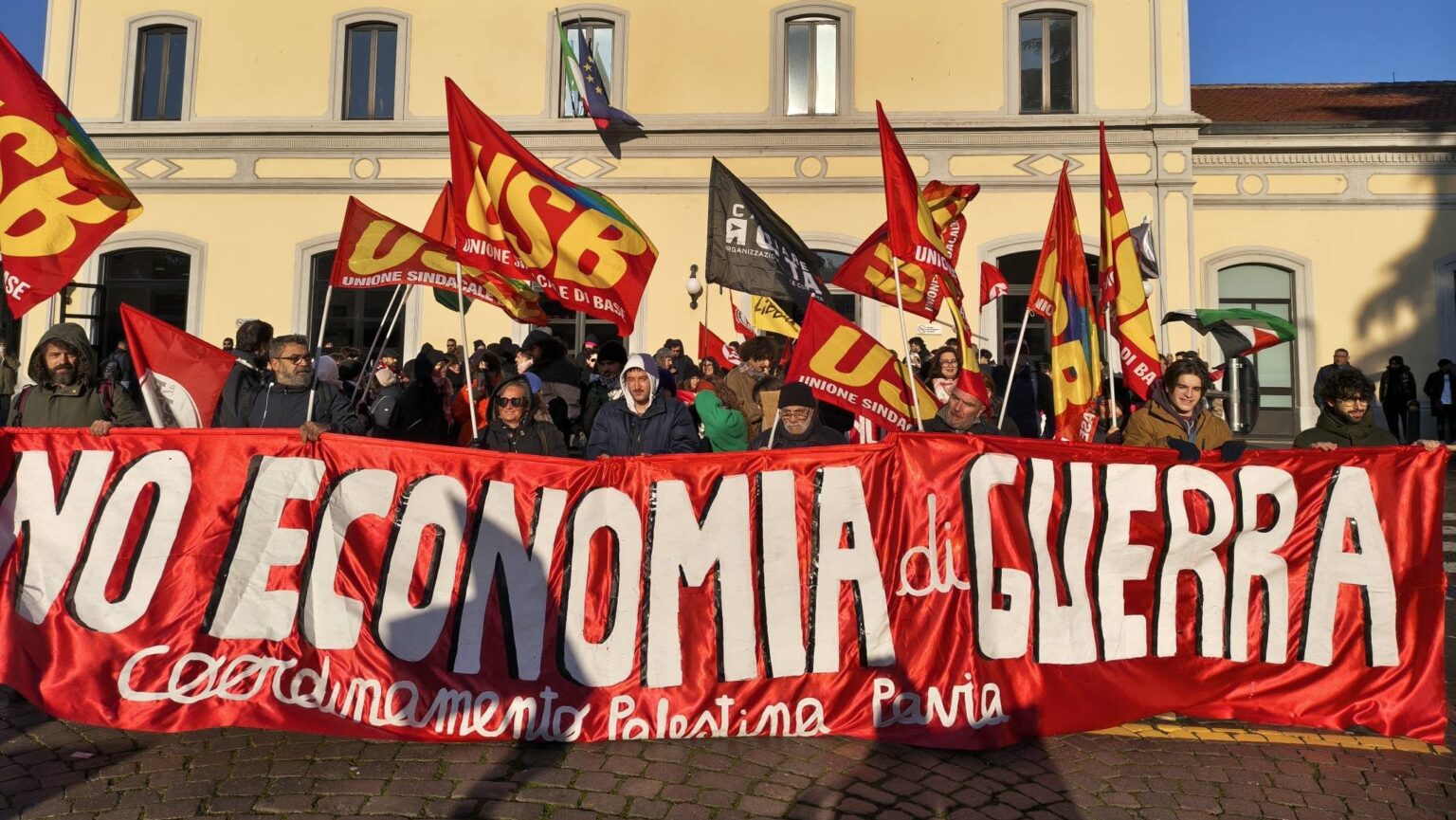
Strikers and activists holding banner reading “No to the war economy” during November 28 general strike in Italy. Source: Potere al popolo Pavia/Facebook
Workers in Italy have launched their third general strike in under three months, demanding an end to Meloni’s war agenda and budget.
Italy is on general strike for the third time in less than three months, following a call by the grassroots union Unione Sindacale di Base (USB). Pickets, industrial actions, and demonstrations were organized in over 40 cities, with massive rallies demanding an end to rearmament plans and the war budget shaped by Giorgia Meloni’s government.
On Friday, workers stressed that their mobilization is tied both to worsening material conditions at home and to international events, specifically the struggle of the Palestinian people – whose fate, they insist, is inseparable from Europe’s expanding war economy. As a result, those striking today reiterated their commitment to join the national march for Palestine in Rome, taking place on Saturday, November 29.
“The Meloni government’s rearmament budget is in line with the warmongering policies pursued in recent years, but it also represents a further leap in quality, with public services being sacrificed on the altar of the war economy, all while inflation continues to rise and wages have been stagnant for decades,” USB and the dockworkers’ collective CALP wrote in one of the strike calls.
“We want at least €2,000 in base pay, retirement no later than 62, an end to subcontracting, reduced working hours with no loss of pay, guaranteed housing rights, new public-sector hiring, and free, universal public health care,” USB added. “These are urgent needs in an exhausted country, needs that are incompatible with the government’s warmongering.”
Italy’s social situation is “a political choice,” workers say
Like other European governments, Meloni’s administration has aligned itself with the European Union’s armament agenda. According to trade unions, this will mean billions for the military and related industries while essential public services fall apart. CALP described the new budget as one that freezes wages, ignores inflation, and prioritizes banks and capital gains. “While prices keep rising, salaries stay stagnant and pensions are cut every year,” the collective stated. “We work more, earn less, and live worse. This isn’t a crisis: it’s a political choice, and workers are the ones paying for it.”
Calls for the government’s dismissal could be heard across today’s actions, together with refusals to accept the shift toward militarization and military enrollment. Groups including left party Potere al Popolo and student collectives CAU and Cambiare Rotta marched with striking workers, blocking roads and picketing companies set to profit from military budgets while healthcare and education are left underfunded.
Messages of support arrived from abroad as well. UN Special Rapporteur Francesca Albanese and Freedom Flotilla participants Greta Thunberg and Thiago Ávila announced they would join the 28-29 November mobilizations in person. Artists including Roger Waters, as well as international trade unions and Palestine solidarity coalitions, expressed solidarity with the strike. “USB’s strikes have shed a bright light on the shameful complicity of the Italian government and Italian corporations in enabling Israel’s genocide, illegal occupation and apartheid against Palestinians,” the BDS National Committee wrote. “They have shown the power of the people and inspired many across the globe.”
In a letter to USB, the Galician Unions Confederacy (CIG) emphasized the strike’s relevance in the context of the EU’s ReArm Europe strategy and the rise of the far right. “We reject the policies promoted by the EU and its member states, which fuel a warmongering escalation and commit to increasing military budgets at the expense of public services and social support,” CIG stated. “And we are concerned about the fascist drift toward which Europe is heading, of which the Meloni government is a clear example.”
Unlike the general strike in October, in which the confederation CGIL joined USB’s call in a rare moment of unity, the call for today’s action came from grassroots unions alone, with CGIL planning its own strike in mid-December. This, however, did not diminish USB’s determination. “Calling the third general strike in just over two months is not a decision to be taken lightly or symbolically,” they wrote.
Instead, they reiterated that today’s strike was intended to table concrete demands and alternatives. The strike, USB added, should not be perceived as a one-off protest but as “an event that represents not only a stage of mobilization, but also a decisive political step to give a voice to those who can’t make ends meet, those working for starvation wages, and those watching their futures crushed by wars, inequality, and the choices of a government hostile to workers.”