Former prime minister Gordon Brown speaks at a child poverty event, to mark the 60th anniversary of the Child Poverty Action Group (Cpag), at Somerset House, in central London, November 6, 2025
FORMER prime minister Gordon Brown piled pressure on Chancellor Rachel Reeves today to tackle the “shameful epidemic” of child poverty.
…
Marking the 60th anniversary of the Child Poverty Action Group (CPAG), he planned to say: “This is urgently needed to take half a million children out of poverty from April next year and to meaningfully tackle Britain’s shameful epidemic of child poverty.”
The Chancellor is expected to make changes to the two-child benefit limit in her Budget.
Reforms to gambling levies could generate the £3.2 billion needed to scrap both the two-child limit and benefit cap, according to the Institute for Public Policy Research.
Official estimates say 4.45 million children were in relative low income households, after housing costs, in the year to March 2024 – the highest number since comparable records for Britain began in 2002/03.
CPAG chief executive Alison Garnham said: “Now more than ever with child poverty at a record high, we need decisive action from government and the first step must be full abolition of the two-child limit.
“Half-measures and compromises will not shift the dial. The policy must be removed in its entirety or a generation of children will grow up cut off from opportunity.”
The sun rising behind a redundant oil platform moored in the Firth of Forth near Kirkcaldy, Fife, April 27, 2020
THE Treasury is considering changes to the windfall tax which could hand billions to oil and gas corporations, campaigners warned today.
Proposals drafted by oil and gas lobby group Offshore Energies UK suggest removing the Energy Profits Levy at the end of this year, which would save the industry a mammoth £5.8bn in tax over the next decade.
Politico, which first reported the story, said that the Treasury was weighing up energy bosses’ proposals to scrap the tax as soon as next year.
At the same time, promised investment in energy efficiency to cut household bills could also potentially be slashed.
Sources told the Guardian that the government is looking at reducing obligations under which energy firms help pay for measures such as insulation and new heating schemes.
Campaigners have suggested that the giveaway could effectively cut Britain’s energy efficiency budget by £6.4bn.
Uplift deputy director Robert Palmer said with firms already making billions while Britons struggle with unaffordable energy bills, considering scrapping measures to cut household bills while cutting taxes for profiteering oil companies would be deeply unfair.
Donald Trump urges you to be a Climate Science denier like him. He says that he makes millions and millions for destroying the planet, Burn, Baby, Burn and Flood, Baby, Flood.Keir Starmer commits to play the caretaker role for Capitalism through the “hard times”.UK Prime Minister Rishi Sunak describes his benefit to already filthy rich fossil fuel investors and how he hates poor people.
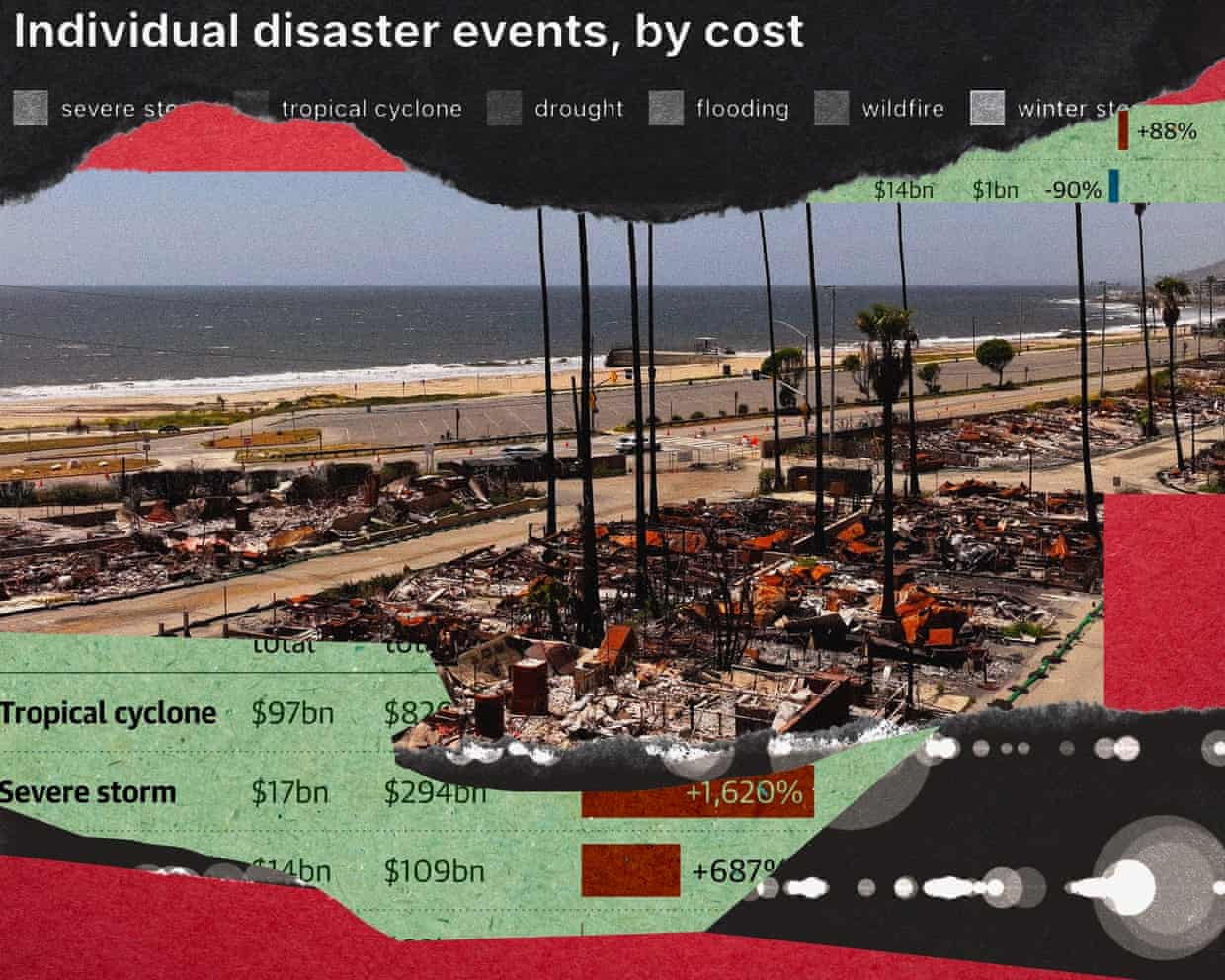
Fourteen separate weather-related disasters that each caused at least $1bn in damage hit the US in the first six months of the year. Composite: The Guardian/Getty Images
LA wildfires and storms this year cost $101bn, new study by non-profit resurrecting work axed by Trump says
The first half of 2025 was the costliest on record for major disasters in the US, driven by huge wildfires in Los Angeles and storms that battered much of the rest of the country, according to a climate non-profit that has resurrected work axed by Donald Trump’s administration that tracked the biggest disasters.
In the first six months of this year, 14 separate weather-related disasters that each caused at least $1bn in damage hit the US, the Climate Central group has calculated. In total, these events cost $101bn in damages – lost homes, businesses, highways and other infrastructure – a toll higher than any other first half of a year since records on this began in 1980.
The bulk of this toll was caused by the ferocious wildfires that razed parts of Los Angeles in January, a disaster that destroyed about 16,000 buildings and resulted in the indirect deaths of around 400 people. At $61bn in damages, the LA fires are one of the most expensive climate-related disasters on record in the US, and the only top 10 event that is not a hurricane.
…
Over the past four decades, such disasters have become far more savage. The cost of all disasters between 1985 and 1995 was $299bn, a figure dwarfed by the damages of the past decade – with $1.4tn in losses between 2014 and last year.
Neo-Fascist Climate Science Denier Donald Trump says Burn, Baby, Burn.Nigel Farage urges you to ignore facts and reality and be a climate science denier like him and his Deputy Richard Tice. He says that Reform UK has received £Millions and £Millions from the fossil fuel industry to promote climate denial and destroy the planet.Donald Trump urges you to be a Climate Science denier like him. He says that he makes millions and millions for destroying the planet, Burn, Baby, Burn and Flood, Baby, Flood.
Along with delegates from all over the world, I’ll be heading to the United Nations COP30 climate summit in the Brazilian Amazon city of Belém. Like many others, I’m unsure what to expect.
This year, the summit faces perhaps the greatest headwinds of any in recent history. In the United States, the Trump administration has slashed climate science, cancelled renewable projects, expanded fossil fuel extraction and left the Paris Agreement (again). Trump’s efforts to hamstring climate action have made for extreme geopolitical turbulence, overshadowing the world’s main forum for coordinating climate action – even as the problem worsens.
Climate talks are never easy. Every nation wants input and many interests clash. Petrostates and big fossil fuel exporters want to keep extraction going, while Pacific states despairingly watch the seas rise. But in the absence of a global government to direct climate policy, these imperfect talks remain the best option for coordinating commitment to meaningful action.
Here’s what to keep an eye on this year.
A smaller-than-usual COP?
A persistent criticism of the annual climate summits is that they have become too big and unwieldy – more a trade show and playground for fossil fuel lobbyists than an effective forum for multilateral diplomacy and action on climate change. One solution is to deliberately make these talks smaller.
The Belém conference may end up having a smaller number of delegates, though not by design so much as logistical headaches.
Brazilian President Luiz Inácio Lula da Silva backed the decision to invite the world to the Amazon to display how vital the massive rainforest is as a carbon sink. But Belém’s remote location on the northeast coast, limited infrastructure and shortage of hotels have seen prices soar, putting the conference out of reach for smaller nations, including some of the most vulnerable. These constraints could undermine the inclusive “Mutirão” (collective effort on climate change) sought by organisers.
Many delegates will sleep on ships at the Belem climate talks. Pictured is Curupira, a figure from Brazilian folklore and the COP30 mascot. Gabriel Della Giustina/COP30, CC BY-NC-ND
Show me the money
Climate finance is a perennial issue at COP meetings. These funding pledges by rich countries are intended to help poorer countries reduce emissions, adapt to climate change or recover from climate disasters. Poorer countries have long called for more funding, given rich countries have done vastly more damage to the climate.
At COP29 in Baku, Azerbaijan last year, a new climate finance goal was set for US$300 billion (~A$460 billion) to be raised annually by developed countries by 2035, with the goal of reaching $US1.3 trillion (~A$2 trillion) in funding from both government and private sources over the same period.
To deliver the second goal, negotiators laid out a “Baku to Belém” roadmap. The details are due to be finalised at COP30. But with the US walking away from climate action and the European Union wavering, many eyes will be on China and whether it will step into the climate leadership vacuum left by developed countries. The EU has only just reached agreement on a 2040 emissions reduction target and an “indicative” cut for 2035.
Climate finance will be the priority for many countries, as worsening disasters such as Hurricane Melissa in Jamaica and Typhoon Kalmaegi in the Philippines once again demonstrate the enormous human and financial cost of climate change.
The latest UN assessment indicates the need for this funding is outpacing flows by 12–14 times. In Belém, poorer countries will be hoping to land agreement on greater finance and support for adaptation. Work on a global set of indicators to track progress on adaptation – including finance – will be key.
Brazilian organisers hope to rally countries around another flagship funding initiative set to launch at COP30. The Tropical Forests Forever Facility would compensate countries for preserving tropical forests, with 20% of funds directed to Indigenous peoples and local communities who protect tropical forest on their lands. If it gets up, this fund could offer a breakthrough in tackling deforestation by flipping the economics in favour of conservation and protecting a huge store of carbon.
2035 climate pledges
Belém was supposed to be a celebration of ambitious new emissions pledges which would keep alive the Paris Agreement goal of holding warming to 1.5°C. Nations were originally due to submit their 2035 pledges (formally known as Nationally Determined Contributions) by February, with an extension given to September after 95 per cent of countries missed the deadline.
When pledges finally arrived in September, they were broadly underwhelming. Only half the world’s emissions were covered by a 2035 pledge, meaning the remaining emissions gap could be very significant. Australia is pledging cuts of 62–70% from 2005 emissions levels.
That’s not to say there’s no progress. A new UN report suggests countries are bending the curve downward on emissions but at a far slower pace than is needed.
How negotiators handle this emissions gap will be a litmus test for whether countries are taking their Paris Agreement obligations seriously.
Rise of the courts
Even as some countries back away from climate action, courts are increasingly stepping into the breach. This year, the International Court of Justice issued a rousing Advisory Opinion on states’ climate obligations under international law, including that national targets have to make an adequate contribution to meeting the Paris Agreement’s temperature goal. The court warned failing to take “appropriate action” to safeguard the climate system from fossil fuel emissions – including from projects carried out by private corporations – may be “an internationally wrongful act”. That is, they could attract international liability.
It will be interesting to see how this ruling affects negotiating positions at COP30 over the fossil fuel phase-out. At COP28 in 2023, nations promised to begin “transitioning away from fossil fuels in energy systems”. If countries fail to progress the phase-out, accountability could instead be delivered via the courts. A new judgement in France found the net zero targets of oil and gas majors amount to greenwashing, while lawsuits aimed at making big carbon polluters liable for climate damage caused by their emissions are in the pipeline.
An Australia/Pacific COP?
A big question to be resolved is whether Australia’s long-running bid to host next year’s COP in Adelaide will get up. The bid to jointly host COP31 with Pacific nations has strong international support, but the rival bidder, Turkey, has not withdrawn.
If consensus is not reached at COP30, the host city would default back to Bonn in Germany, where the UN climate secretariat is based.
Outcome unknown
As climate change worsens, these sprawling, intense meetings may not seem like a solution. But despite headwinds and backsliding, they are essential. The world has made progress on climate change since 2015, due in large part to the Paris Agreement. What’s needed now on its tenth anniversary is a reinfusion of vigour to get the job done.
Neo-Fascist Climate Science Denier Donald Trump says Burn, Baby, Burn.Donald Trump urges you to be a Climate Science denier like him. He says that he makes millions and millions for destroying the planet, Burn, Baby, Burn and Flood, Baby, Flood.Nigel Farage urges you to ignore facts and reality and be a climate science denier like him and his Deputy Richard Tice. He says that Reform UK has received £Millions and £Millions from the fossil fuel industry to promote climate denial and destroy the planet.
Renewable energy is often pitched as cheaper to produce than fossil fuel energy. To quantify whether this is true, we have been studying the financial impact of expanding wind energy in the UK. Our results are surprising.
From 2010 to 2023, wind power delivered a benefit of £147.5 billion — £14.2 billion from lower electricity prices and £133.3 billion from reduced natural gas prices. If we offset the £43.2 billion in wind energy subsidies, UK consumers saved £104.3 billion compared with what their energy bills would have been without investment in wind generation.
UK wind energy production has transformed over the past 15 years. In 2010, more than 75% of electricity was generated from fossil fuels. By 2025, coal has ceased and wind is the largest source of power at 30% – more than natural gas at 26%.
This massive expansion of UK offshore wind is partly due to UK government subsidies. The Contracts for Difference scheme provides a guaranteed price for electricity generated, so when the price drops below this level, electricity producers still get the same amount of money.
The positive contribution of wind power to reducing the UK’s carbon footprint is well known. According to Christopher Vogel, a professor of engineering who specialises in offshore renewables at the University of Oxford, wind turbines in the UK recoup the energy used in their manufacture, transport and installation within 12-to-24 months, and they can generate electricity for 20-to-25 years. The financial benefits of wind power have largely been overlooked though, until now.
Our study explores the economics of wind in the energy system. We take a long-term modelling approach and consider what would happen if the UK had continued to invest in gas instead of wind generation. In this scenario, the result is a significant increased demand for gas and therefore higher prices. Unlike previous short-term modelling studies, this approach highlights the longer-term financial benefit that wind has delivered to the UK consumer.
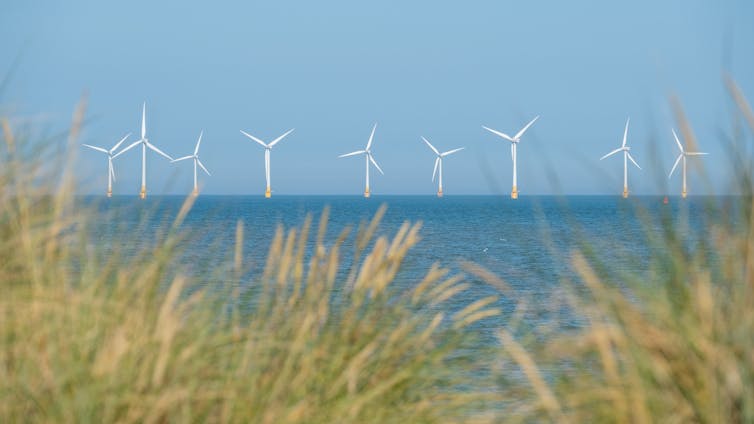
The authors’ new study quantifies the financial benefit of wind v fossil fuels to consumers. Igor Hotinsky/Shutterstock
Central to this study is the assumption that without the additional wind energy, the UK would have needed new gas capacity. This alternative scenario of gas rather than wind generation in Europe implies an annual, ongoing increase in UK demand for gas larger than the reduction in Russian pipeline gas that caused the energy crisis of 2022.
Given the significant increase in the cost of natural gas, we calculate the UK would have paid an extra £133.3 billion for energy between 2010 and 2023.
There was also a direct financial benefit from wind generation in lower electricity prices – about £14.2 billion. This combined saving is far larger than the total wind subsidies in that period of £43.2 billion, amounting to a net benefit to UK consumers of £104.3 billion.
Wind power is a public good
Wind generators reduce market prices, creating value for others while limiting their own profitability. This is the mirror image of industries with negative environmental consequences, such as tobacco and sugar, where the industry does not pay for the increased associated healthcare costs.
This means that the profitability of wind generators is a flawed measure of the financial value of the sector to the UK. The payments via the UK government are not subsidies creating an industry with excess profits, or one creating a financial drain. They are investments facilitating cheaper energy for UK consumers.
Wind power should be viewed as a public good — like roads or schools — where government support leads to national gains. The current funding model makes electricity users bear the cost while gas users benefit. This huge subsidy to gas consumers raises fairness concerns.
Wind investment has significantly lowered fossil fuel prices, underscoring the need for a strategic, equitable energy policy that aligns with long-term national interests. Reframing UK government support as a high-return national investment rather than a subsidy would be more accurate and effective.
Sustainability, security and affordability do not need to be in conflict. Wind energy is essential for energy security and climate goals – plus it makes over £100 billion of financial sense.
Colm O’Shea, Researcher, Renewable Energy, Geography Department, UCL and Mark Maslin, UCL Professor of Earth System Science and UNU Lead for Climate, Health and Security, UCL
Nigel Farage urges you to ignore facts and reality and be a climate science denier like him and his Deputy Richard Tice. He says that Reform UK has received £Millions and £Millions from the fossil fuel industry to promote climate denial and destroy the planet.Donald Trump urges you to be a Climate Science denier like him. He says that he makes millions and millions for destroying the planet, Burn, Baby, Burn and Flood, Baby, Flood.Orcas comment on killer apes destroying the planet by continuing to burn fossil fuels.

 Former prime minister Gordon Brown speaks at a child poverty event, to mark the 60th anniversary of the Child Poverty Action Group (Cpag), at Somerset House, in central London, November 6, 2025