Zack Polanski, Zarah Sultana and Jeremy Corbyn offer hope for the British left | Ben Montgomery/Stringer / Leon Neal/Staff / Kristian Buus/Contributor / Getty Images / Composition by James Battershill
In choosing big business over ordinary people, the PM has sacrificed the heart of the Labour Party. So what next?
Labour’s political position is increasingly the reverse of the ‘for the many, not the few’ policy pursued under former leader Jeremy Corbyn. The party has embraced corporate capture and the main features of neoliberalism, albeit with incredibly poor timing, as the neoliberal economic model drives runaway wealth that increases dissent across much of the world.
It is no coincidence that, at the same time, when it should be coasting along on a huge parliamentary majority won less than 18 months ago, Labour has been plunged into political disarray and seen its lead disappear in the polls.
By cosying up to big business and failing to offer anything to substantially improve the lives of ordinary people up and down the country, Keir Starmer’s New-New Labour has seen a collapse in its general support and, more significantly, its membership.
The Labour Party has lost 300,000 of the 550,000 members it had in the Corbyn era. While it has been able to recoup the financial support offered by these ordinary members from a few big donors, it has in the process lost the heart of the party.
Many issues demonstrate this, but a few stand out. The government’s repeated refusal (now rumoured to be U-turned on at next month’s Budget) to lift the two-child benefit cap. Its flagship welfare bill (already U-turned on), which would have cut Universal Credit and Personal Independence Payments for millions of vulnerable people. The decision, announced in February of this year, to cut the foreign aid programme to increase military spending.
And then came perhaps the biggest problem of all for Starmer’s Labour: Gaza, where the UK government’s continuing support for Israel as it engages in genocide still beggars belief for many. There have been 32 mass demonstrations in London in the past two years, the most recent being one of the largest protests ever held in the UK. That level of political activity will continue, given Israeli prime minister Binyamin Netanyahu seems determined to avoid a peaceful outcome, and Starmer is unlikely to stand up to him or, by extension, the US.
Widespread dismay and depression on the backbenches may ebb and flow, but at this point, it feels like even a change of leadership may not be enough for a real change in fortune.
The government’s current predicament is the main reason why Westminster politics is so uncertain. Looking at the UK-wide parties, the far-right Reform UK is leading polls with vote shares that vary but are typically over 30%, having soaked up plenty of support as a substantial protest vote. If that persists through to the next general election in 2029, it will likely put Nigel Farage into Downing Street.
Labour’s support, meanwhile, is hovering at around 20%, the Tories more like 15% and the Liberal Democrats rather less.
And until three months ago, the Greens were still weak in polling terms – despite having made some progress since last year’s election – and millions on the left were still disenfranchised, having been disillusioned with Starmer’s Labour leadership.
Two things have changed; the first being Zack Polanski winning the Green Party leadership at the start of September. He has brought a more radical and left-wing perspective to the party, which has led to a jump in the polls and an 80% increase in new members. The Greens announced this week that its membership now stands at 126,000 – more than either the Conservatives or the Lib Dems.
The second change is in the fortunes of the new Your Party group, fronted by Corbyn and former Labour MP Zarah Sultana. While the party’s initial request for expressions of interest received a massive 800,000 responses – at which point it appeared likely to provide a serious challenge to Starmer’s Labour – it ran into internal disagreements six weeks ago that knocked it right back and led to a period of utter dismay and anger among supporters.
Those feelings have eased somewhat over the past two weeks, as Your Party has published draft versions of its constitution, standing orders and an organisational strategy, all of which are to be discussed and developed before being decided at a large national conference in Liverpool at the end of November. The documents, including a draft political statement, are open to all and will no doubt be subject to intense debate and plenty of disagreement, but they do appear to be a genuine attempt at accountability that is a very long way from the opacity of the Labour Party.
A typical meeting of supporters, of which there are hundreds around the country, still sees some of the anger of a few weeks ago, but now also more determination to see things through. If the new party can recapture the mood of three months ago – and particularly if it and the Greens are willing to work with one another – then there may be some hope for the disenfranchised left.
One of the most interesting aspects of these rapid political changes is the potential for the three figureheads of these two parties to have a substantial impact.
Zarah Sultana, with an often combative style, appeals particularly to younger and frustrated audiences, while Zack Polanski’s normal and measured approach is persistently disarming for Reform’s far-right politicians. Then there is Jeremy Corbyn, who is already a national figure known for a long-term commitment to a progressive agenda and a remarkable personal following.
These are very early days in a time of rapid political change. Reform is still on the up, but compared with just three months ago, there is now a lot more reason for hope on the left.
Keir Starmer explains that he feels no shame or guilt benefitting personally from gifts from the rich and powerful while insisting on policies of severe austerity causing suffering and death.Keir Starmer says that the Labour Party under his leadership all feel a small part of Scunthorpe.Keir Starmer objects to criticism of the IDF. He asks how could anyone object to them starving people to death, forced marches like the Nazis did, bombing Gaza’s hospitals and universities, mass-murdering journalists, healthworkers and starving people queuing for food, killing and raping prisoners and murdering children. He calls for people to stop obstructing his genocide for Israel.
Chancellor Rachel Reeves and the rest of the Labour cabinet have been captured by corporate interests | Joe Giddens – WPA Pool/Getty Images
The party is steamrolling ahead with deregulation that will benefit big businesses at the expense of consumers. Why?
It’s no secret that Keir Starmer, Rachel Reeves, and the rest of the Labour cabinet have been captured by corporate interests.
Health secretary Wes Streeting has received at least £372,000 in donations from sources with links to private healthcare since 2015, equivalent to around £10,000 per month. The international lobbying and PR firm FGS Global, which is owned by the private equity firm that pulled out of buying Thames Water in June, sent a member of staff to work in Reeves’ office during the election campaign. And the party has received over £1m in donations from firms tied to the gambling industry in the past two years.
Labour’s links to big business and wealthy donors are concerning in themselves, but we now have direct evidence that they are being used to influence policy.
As openDemocracy reported this week, the party has defanged the Competition and Markets Authority, the regulator responsible for enforcing competition law, to appease business interests – at the expense of consumers.
The government’s deregulatory efforts began back in January, when it ousted Marcus Bokkerink as the CMA’s chair and replaced him with Doug Gurr, Amazon’s former UK boss. Appointing a former executive of one of the world’s most powerful monopolies as the head of a competition authority is so on the nose it defies satire; unions referred to the move as a “slap in the face”.
If this wasn’t enough, the business secretary, Jonathan Reynolds, instructed Gurr to deliver “pro-business decisions” in the role. The message from Labour is clear: we will not stand in the way of anti-competitive behaviour, regardless of the impact on people and planet.
Then, in May, the government issued a new “strategic steer to the CMA”, ordering the watchdog to prioritise “growth and investment” – a barely veiled instruction to wave through mergers and acquisitions that consolidate corporate power.
And just this week, the Financial Times reported that the chancellor plans to pursue a “blitz on bureaucracy” at the CMA by changing the way it reviews anti-competition investigations, which would likely make it easier for ministers to nudge outcomes in favour of big business. The move may come from Reeves, but its intellectual and political architect is reportedly Varun Chandra, one of Starmer’s most powerful advisers.
Chandra is a former managing partner at Hakluyt, the shadowy corporate intelligence firm founded by ex-MI6 officers, which counts among its clients many of the world’s biggest corporations and private equity funds. He retains a multimillion-pound stake in the company and deep relationships across the City and Silicon Valley. In government, he has pushed for a “pro-growth” deregulatory agenda.
This is how corporate capture works in the Labour Party today. There is a revolving door between corporate boardrooms and the highest offices of state. Ministers fall over themselves in their desperate attempts to gain the approval of the City and the Confederation of British Industry, an influential business lobby group. The party has demonstrated it is willing to take donations and gifts from almost anyone, and that it will happily return the favour by amending legislation or cutting regulation.
Ulterior motives
This corporate capture is, in part, a structural problem.
The state is not some neutral tool that political parties can pick up and use as they wish when they enter power. As Marxist theorist Nicos Poulantzas argued back in the 1970s, it is a social relation: a set of institutions that crystallise the balance of class power in society. In capitalist societies, capital is both better resourced and more organised than labour, and this imbalance of power is reflected within state institutions.
When a party severs its links with the working-class organisations that once anchored it in social struggle – from trade unions, to protest movements, to community organisers – it doesn’t float above class conflict; instead, it must fill the gap left by the mass base by deepening its links to capital. This reorganisation of the relationship between party and base is exactly what’s happened to Starmer’s Labour. Absent a mass movement capable of holding politicians to account, his government takes its cues from the boardroom rather than workers and communities.
But there’s also a more cynical dynamic at play, too. Everyone knows this government’s days are numbered, including Starmer himself. Nigel Farage’s Reform UK has cannibalised the Conservative Party and is now tearing ahead in the polls. Labour was probably hoping to rely on haranguing its disgruntled left-wing voters over the need to stop the rise of Reform, but with Starmer increasingly echoing Farage’s talking points, the Greens now seem like a more natural home for those people.
In short, Labour is toast – and it knows it. Ministers and advisers are already looking beyond government to the well-paid, cushy corporate positions they all want to take up when they leave office.
For the Tories who lost their seats at the last election, this transition was pretty easy thanks to the long-standing links between their party and big business and finance. Labour politicians have had to work harder to cultivate strong relationships with the private sector. In this context, the push for ‘pro-business’ policies isn’t just ideological – it’s personal.
Keir Starmer explains that he feels no shame or guilt benefitting personally from gifts from the rich and powerful while insisting on policies of severe austerity causing suffering and death.Keir Starmer says that the Labour Party under his leadership all feel a small part of Scunthorpe.
Atmospheric carbon dioxide (CO₂) rose faster in 2024 than in any year since records began – far faster than scientists expected.
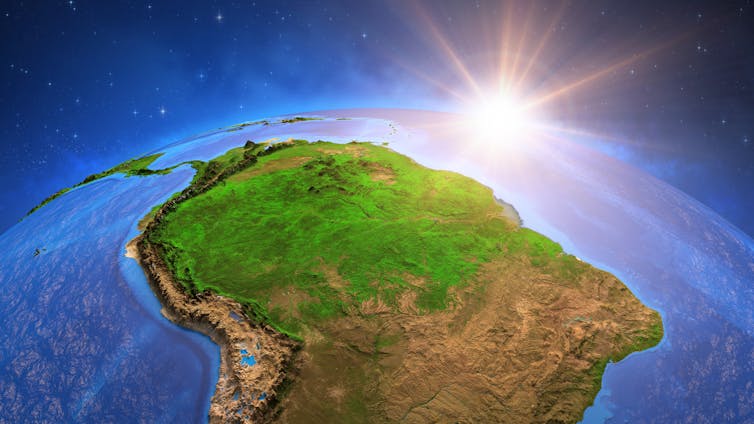
Our new satellite analysis shows that the Amazon rainforest, which has long been a huge absorber of carbon, is struggling to keep up. And worryingly, the satellite that made this discovery could soon be switched off.
Systematic measurements of CO₂ in the atmosphere began in the late 1950s, when the Mauna Loa observatory in Hawaii (chosen for its remoteness and untainted air) registered about 315 parts per million (ppm). Today, it’s more than 420ppm.
But just as important is the rate of change. The annual rise in global CO₂ has gone from below 1ppm in the 1960s to more than 2ppm a year in the 2010s. Every extra ppm represents about 2 billion tonnes of carbon – roughly four times the combined mass of every human alive today.
Across six decades of measurements, atmospheric CO₂ has gradually increased. There have been some large but temporary departures, typically associated with unusual weather caused by an El Niño in the Pacific. But the long-term trend is clear.
In 2023, CO₂ in the atmosphere grew by about 2.70ppm. That’s a large step up, but not too unusual. Yet in 2024, it was an unprecedented 3.73ppm.
How satellites observe atmospheric CO₂
Until recently, we could only monitor CO₂ through stations on the ground like the one in Hawaii. That changed with satellites such as Nasa’s Orbiting Carbon Observatory (OCO-2), launched in 2014.
The OCO-2 satellite analyses sunlight reflected from Earth. Carbon dioxide acts like a filter, absorbing specific wavelengths of light. By observing how much of that specific light is missing or dimmed when it reaches the satellite, scientists can accurately calculate how much CO₂ is in the atmosphere.
But air is always on the move. The CO₂ above any one point can come from many sources – local emissions, nearby forests, or air carried from far away. To untangle this mix, scientists use computer models that simulate how winds move CO₂ around the globe.
They then adjust these models until they match what the satellite sees. This gives us the most accurate estimate possible of where carbon is being released and where it’s being absorbed.
The decade-long data record from OCO-2 allows us to put 2023 and 2024 into historical context.
The result
From the satellite data, we infer that the largest changes in CO₂ emissions and absorption during 2023 and 2024, compared with the baseline year of 2022, were over tropical land.
Data from 2023 and 2024 shows the areas where more carbon was emitted (in red) and withdrawn (blue) compared with the ‘normal’ year of 2022. The Amazon stands out in both years. Feng et al
The largest change was over the Amazon, where much less CO₂ is being absorbed. Similar slowdowns also appeared over southern Africa and southeast Asia, parts of Australia, the eastern US, Alaska and western Russia.
Conversely, we detected more carbon being absorbed over western Europe, the US and central Canada.
Other data backs this up. For instance, plants emit a faint glow as they photosynthesise – remarkably, we can see this glow from space. Measurements of this glow along with vegetation greenness both show that tropical ecosystems were less active in 2023 and 2024.
Our analysis suggests that warmer temperatures explain most of the Amazon’s reduced capability to absorb carbon. Elsewhere in the tropics, changes in rainfall and soil moisture were more important.
Why 2023 and 2024 were special
In many ways, these years resembled previous El Niño years such as 2015-16, when drought and heat led to less carbon absorption and more wildfires. But what’s interesting about 2023-24 is that the responsible El Niño event was comparatively weak.
Something else must be amplifying the effect. The most likely culprit is the extensive, record-breaking drought that has gripped much of the Amazon basin. When plants are already stressed by a lack of water, even modest warming can push them beyond their tolerance, reducing their ability to absorb carbon.
Small boats left stranded as the Tapajós river (a major Amazon tributary) dries up in late 2023. Tarcisio Schnaider / shutterstock
Roughly half of the CO₂ emitted by humans stays in the atmosphere. The other half is absorbed, more or less equally, by the land and the oceans. If drought or heat means plants are less able to absorb carbon, even temporarily, more of our emissions will remain in the air.
Our ability to meet climate targets relies on nature continuing to provide this vital carbon storage.
Satellite shutdown
It’s not yet clear whether 2023-24 is a short-term blip or an early sign of a long-term shift. But evidence points to an increasingly fragile situation, as tropical forests are stressed by hot and dry conditions.
Understanding exactly how and where these ecosystems are changing is essential if we want to know their future role in the climate, and whether drought will delay their recovery. One step is to urgently send scientists to tropical ecosystems to document recent changes in person.
That’s also where satellites like OCO-2 come in. They offer global and almost real-time coverage of how carbon dioxide is moving between the land, oceans and atmosphere, helping us separate temporary effects like El Niño from deeper changes.
Yet, despite being fit and healthy and having enough fuel to keep it going until 2040, OCO-2 is at risk of being shut down due to proposed Nasa budget cuts.
We wouldn’t be blind without it – but we’d be seeing far less clearly. Losing OCO-2 would mean losing our best tool for monitoring changes in the carbon cycle, and we will all be scientifically poorer for it.
The Amazon is sending us a warning. We must keep watching – while we still can.
Orcas comment on killer apes destroying the planet by continuing to burn fossil fuels.Donald Trump urges you to be a Climate Science denier like him. He says that he makes millions and millions for destroying the planet, Burn, Baby, Burn and Flood, Baby, Flood.Nigel Farage urges you to ignore facts and reality and be a climate science denier like him and his Deputy Richard Tice. He says that Reform UK has received £Millions and £Millions from the fossil fuel industry to promote climate denial and destroy the planet.