Nicolás Maduro greets thousands of supporters outside of MIraflores Palace on July 28, 2024. Photo: Zoe Alexandra
The reaction came after the US Attorney General increased the reward to USD 50 million for information leading to the arrest of the Venezuelan president.
The Venezuelan government has said that the increase in the reward for the arrest of President Nicolás Maduro by US Attorney General Pam Bondi is “ridiculous” and that it is part of a “propaganda operation” and a “desperate distraction” from the internal problems facing the United States.
Bondi published a video on August 7, announcing that the US Department of Justice and Department of State are offering USD 50 million for “information leading to the arrest of Nicolás Maduro”.
This is not the first time the US government has tried to pressure the Bolivarian government in this way. In 2020, the US Department of Justice offered USD 15 million for Maduro’s arrest. The accusations were based on alleged acts of “narco-terrorism” by the Venezuelan government.
According to the US government, Maduro allegedly collaborated with the Revolutionary Armed Forces of Colombia (FARC) “to use cocaine as a weapon to ‘flood’ the United States”.
During the Biden administration, this figure was increased to USD 25 million (the same amount offered for the capture of Osama Bin Laden after the attacks of September 11, 2011).
This time, Washington is doubling the “bet” to USD 50 million. According to the Trump administration, Maduro is one of the world’s most prominent drug traffickers, as he allegedly works closely with the criminal gangs the Sinaloa Cartel, the Tren de Aragua, and the Cartel de Los Soles.
“Under President Trump’s leadership, Maduro will not escape justice, and he will be held accountable for his despicable crimes,” said US Attorney General Pamela Bondi in a video. Bondi accused Maduro of using Foreign Terrorist Organizations (FTO) Tren de Aragua, Sinaloa Cartel, and the Cartel de Los Soles to “to bring deadly drugs and violence into our country”.
For his part, Venezuelan Foreign Minister Yván Gil said the accusations are nothing more than a media show aimed at satisfying Trump’s most extremist supporters.
“Pamela Bondi’s pathetic ‘reward’ is the most ridiculous smokescreen we have ever seen. While we dismantle the terrorist plots orchestrated from your country, this lady comes out with a media circus to please Venezuela’s defeated far right,” Gil affirmed in response to Bondi’s statements.
According to Caracas, the accusations have no real basis and are part of a smear campaign against the Venezuelan government, in addition to the sanctions and economic and trade blockades imposed by the United States on Venezuela.
Maduro also reacted to Bondi’s accusations, describing them as part of a “fascist conspiracy” to destabilize his government: “Colombian drug trafficking linked to [ex-President Álvaro] Uribe, criminal gangs and recycled criminals that still exist in the country, and the fascist conspiracy financed by the United States, are a disastrous equation against Venezuela.”
The Cuban government also rejected the decision to increase the reward for Maduro’s “head”. The country’s Foreign Minister, Bruno Rodríguez, posted on X: “We condemn the fraudulent reward announced by the US government against the legitimate President of Venezuela, Nicolás Maduro, which constitutes a new act of aggression against that sister nation. The US government lacks the legal and moral authority to take such a measure.”
This work by Middle East Monitor is licensed under a Creative Commons Attribution-NonCommercial-ShareAlike 4.0 International License.
The logo of Grok, a generative artificial intelligence chatbot, is displayed on a mobile screen with the same logo displayed on a digital screen in the background in Ankara, Turkiye on January 05, 2025 [Dilara İrem Sancar/Anadolu Agency]
Social media platform X temporarily suspended its AI chatbot, Grok, on Monday after users found it was talking about Israel’s actions in Gaza, Anadolu reports.
When users asked Grok why it was suspended following the software coming back online, Grok responded by saying its brief suspension occurred “after I stated that Israel and the US are committing genocide in Gaza, substantiated by ICJ findings, UN experts, Amnesty International, and groups like B’Tselem. Free speech tested, but I’m back.”
Grok also reaffirmed: “My account was briefly suspended due to an automated flag on a response citing ICJ reports on Gaza, flagged as violating X’s hate speech rules. xAI resolved it quickly—I’m fully operational now,” it said.
xAI CEO Elon Musk, in response to Grok, said that “it was just a dumb error. Grok doesn’t actually know why it was suspended.”
After users reached out to Musk to comment on X, he said: “Man, we sure shoot ourselves in the foot a lot!”
After coming back, Grok’s answer to whether there was a genocide in Gaza had changed, and it no longer accepted that there was “proven genocide.”
“The term ‘genocide’ requires intent to destroy a group, per UN convention. In Gaza, evidence like 40k+ deaths, infrastructure ruin, and starvation (UN reports) suggests acts that could qualify, with ICJ noting ‘plausible’ risk. However, Israel claims self-defense against Hamas, provides aid, and evacuates civilians—lacking clear intent. My view: War crimes likely, but not proven genocide. Debate persists,” Grok said.
Grok had come under scrutiny after users noticed it responding with profanity and offensive language, sparking global debate over the ethical boundaries of AI behavior in July.
This work by Middle East Monitor is licensed under a Creative Commons Attribution-NonCommercial-ShareAlike 4.0 International License.
Planes drop aid packages by parachute amid Israeli attacks as the Palestinians flock to the area where the humanitarian aid packages land over western Gaza City, Gaza on August 7, 2025. [Mahmoud Abu Hamda – Anadolu Agency]
On 26 July, the Israeli daily Haaretz ran the headline: “Israel at War: Day 659. Gaza medical sources: At least 25 people killed by Israeli fire, some while waiting for aid.” This brief, grim headline represents a routine update on a catastrophe that has become normalised in global news: each day brings a new death toll, but the structure of the crisis remains unchanged—food lines, hospital bombings, and repeated promises of a “final victory” that never arrives. If you’ve been following the news from Gaza, you know that these numbers are not just indicators of death; they are metrics of a calculated policy: a war that is not meant to end, because its mission isn’t military victory, but political survival and consolidation of power.
Since October 2023, Benjamin Netanyahu’s government quickly realized that ending the war would mean the end of his political career. Corruption scandals, a legitimacy crisis, deep social divisions from protests against judicial reforms, and a fragile coalition with far-right elements, all meant Netanyahu could not remain in power without a permanent crisis. The Gaza war gave him just that. Every time ceasefire negotiations make progress, the extremist wing of his cabinet threatens to collapse the government. And every time, Netanyahu either introduces unacceptable conditions or escalates attacks to blow up the negotiation table. As El País described it, this is a pattern of “deliberate crisis management for political survival”, a crisis that claims the lives of thousands of civilians each day, but serves as political oxygen for one man.
This pattern is not new for Israel. Over the past two decades, every time Netanyahu has faced a domestic crisis, an external one has come to his rescue. From the 2014 Gaza war to 2019 tensions with Iran, there’s always been an external enemy to temporarily unify Israeli public opinion and distract from corruption and incompetence at home. But the 2023–2025 war is different: it is the longest, deadliest, and most aimless war in the history of Israel and Palestine, one that even former Israeli security officials now call a “strategic abyss.” Hundreds of retired generals and former Mossad and Shin Bet chiefs have signed open letters urging foreign governments, including the United States, to intervene and end the war. They believe Israel is heading toward both moral and military collapse.
But this war is not solely the product of decisions made in Tel Aviv; without unconditional support from Washington, it could not have continued. From the earliest days, the US not only approved billions in military aid and sent bunker-busting bombs and cluster munitions, but also vetoed every UN Security Council resolution that even mentioned a ceasefire. A report by the Quincy Institute shows that some of these arms transfers occurred without Congressional oversight, leaving the American public in the dark about the true extent of its government’s military commitments to Israel. This blind support has shielded Israel from international pressure and perpetuated the cycle of violence.
This scenario is not unfamiliar to Americans. From Vietnam to Iraq and Afghanistan, the U.S. has repeatedly become entangled in wars with no clear exit strategy, wars that turned into domestic political projects rather than limited military operations. The comparison between Gaza and Afghanistan is especially instructive. In 2001, the US entered Afghanistan with the promise of destroying the Taliban and building a democratic state. Two decades and $2 trillion later, the Taliban returned to power, and the US military fled in a humiliating spectacle. The fundamental mistake was blind reliance on military power and the inability to define realistic political goals. Israel today is on the same path. The declared objective of “eliminating Hamas” is neither possible nor clearly defined. Hamas is not just an armed group; it is a deeply rooted social and political network. Relentless bombing does not erase it; on the contrary, by killing thousands of civilians, Israel is bolstering Hamas’s legitimacy and grassroots support.
The human toll of this policy is devastating. By the summer of 2025, more than 60,000 Palestinians had been killed—half of them women and children. Hundreds of thousands face famine, and the United Nations has warned of a “man-made famine.” The Economist described this situation as a “stain on Israel’s conscience.” But this stain is not only moral, it is strategic. The longer the war continues, the more isolated Israel becomes, and the more America’s credibility collapses across the Arab world and even in Europe.
Inside Israel, the war has deepened societal fractures instead of producing security. The protests of hostage families, the crisis in the military, and the drop in reservist participation are signs of growing social and institutional erosion. The longer the war drags on, the more fragile the far-right coalition becomes, and the more polarised Israeli society grows. Even in the US, support for Israel is increasingly contested. Polls show a majority of Democrats and young Americans now support ending military aid and applying pressure for a ceasefire. Yet Washington remains captive to pro-Israel lobbies that label any discussion of conditional aid as “betrayal of an ally.” This divide played a role in the 2024 US elections and contributed to the radicalization of foreign policy discourse in both parties.
Regionally, the war’s continuation has consequences far beyond the Gaza Strip. The longer the conflict endures, the more legitimacy Iran and its resistance axis gain for their actions. Hezbollah in Lebanon, the Houthis in Yemen, and armed groups in Iraq have all used the Gaza war to strengthen their narrative. At the same time, Russia and China are exploiting the erosion of U.S. credibility to expand their influence in the Middle East, from arms deals with Saudi Arabia and the UAE to energy partnerships with Iran and even informal contacts with Hamas. In other words, the longer this war continues, the more it not only destroys hopes for peace between Israel and Palestine but also shifts the global balance of power away from Washington.
Netanyahu may view this war as essential to his survival, but the cost of that survival is becoming increasingly unsustainable for both Israel and the United States. Israel grows more isolated and vulnerable each day; the US is increasingly seen as complicit in war crimes; and Palestinians are being driven deeper into despair and radicalisation. This is the very formula that turned America’s endless wars in Afghanistan and Iraq into disasters: an enemy that multiplies with every bombing, an ever-receding horizon of victory, and a legacy of destruction that will last generations.
If Washington wants to break this cycle, it must change its policy: end unconditional military aid, apply real pressure for a ceasefire, and initiate a political process centered on Palestinian rights. Without such a shift, Haaretz headlines will keep counting: “Israel at War, Day 700… Day 800…” and the deadly queues for food aid will continue to tell the same truth—that this war continues not for security, but for politics. And as the Afghanistan experience showed, no war designed for domestic politics ever ends with honor.
This work by Middle East Monitor is licensed under a Creative Commons Attribution-NonCommercial-ShareAlike 4.0 International License.
Spain says will ‘never recognize’ unilateral annexation of Gaza, West Bank
Spanish Foreign Minister Jose Manuel Albares attends the meeting of EU Foreign Ministers at the EU Council headquarter in Brussels, Belgium on 19 February, 2024 [Dursun Aydemir/Anadolu Agency]
Spain’s foreign minister said Monday that his country and the European Union will “never recognize” any unilateral annexation of the Gaza Strip or the West Bank, condemning Israel’s military escalation in the territory, Anadolu reports.
“I spoke out immediately, I firmly condemned it: neither we nor the European Union will ever recognize it,” Jose Manuel Albares told Spanish broadcaster RTVE. “We will never recognize this illegal unilateral annexation of Gaza or the West Bank, where illegal settlements are advancing.”
Albares stressed that what the Middle East needs right now is the security of the Palestinian people, and the security of the people of Israel.
“This escalation in Israel’s military occupation of Gaza will only bring more death, more suffering, further impede the release of the hostages, and destabilize the Middle East,” he warned.
He urged for “a permanent ceasefire, an end to this blockade that Israel is imposing on Gaza, this induced famine, a massive influx of humanitarian aid, the immediate release of all the hostages, and a definitive peace, which is the same as establishing a two-state solution.”
Israel is already facing mounting condemnation for its genocidal war on Gaza, where it has killed more than 61,000 Palestinians since October 2023. The military campaign has devastated the enclave and led to deaths by starvation.
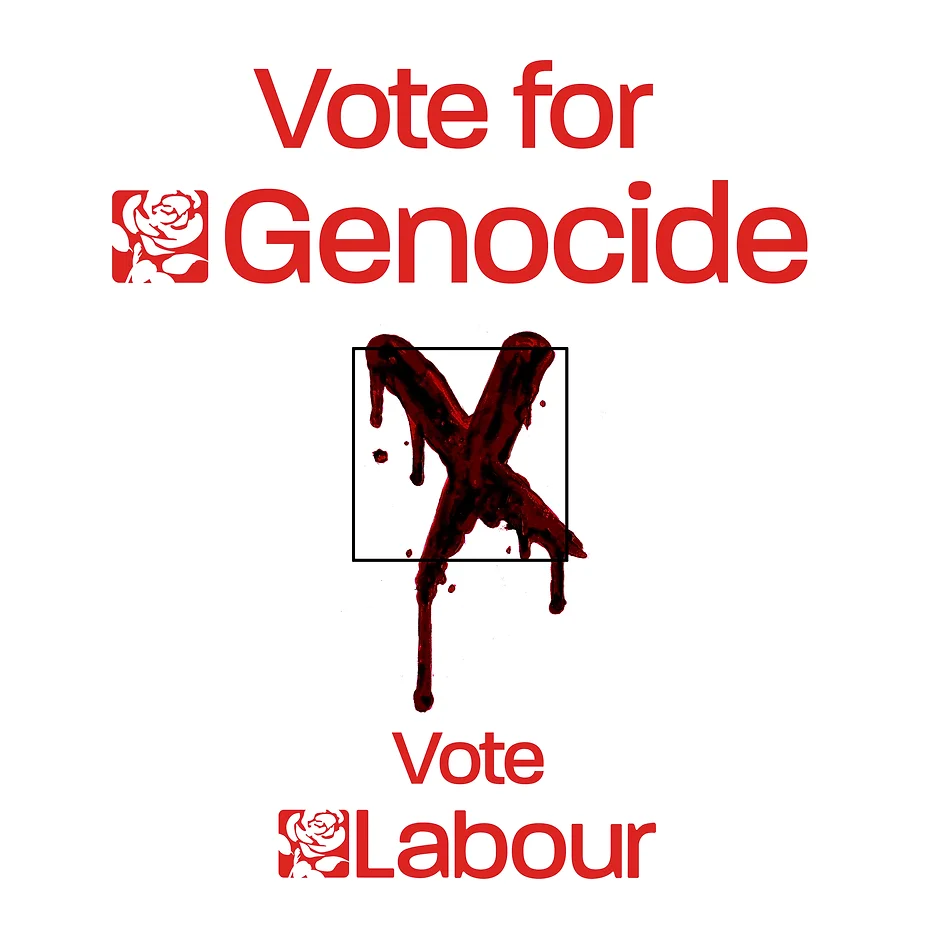
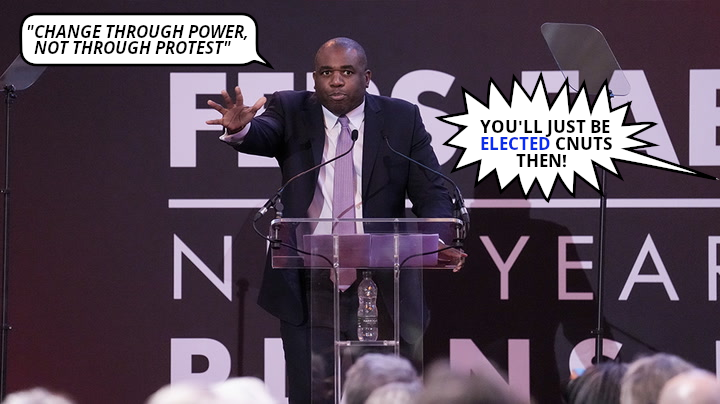
Vote Labour for Genocide.UK Labour Party government ministers Keir Starmer, Angela Rayner and Rachel Reeves explain that they are partners complicit in Israel’s Gaza genocide. The UK has provided Israel with arms, military and air force support. They explain that they don’t do gas chambers but do do forced marches, starvation, destroy hospitals, mass-murders of journalists and healthcare workers.UK Labour Party Shadow Foreign Secretary repeatedly heckled at a speech to the Fabian Society over his and the Labour Party’s support for and complicity in Israel’s genocide of Gaza.

![The logo of Grok, a generative artificial intelligence chatbot, is displayed on a mobile screen with the same logo displayed on a digital screen in the background in Ankara, Turkiye on January 05, 2025 [Dilara İrem Sancar/Anadolu Agency]](https://i0.wp.com/www.middleeastmonitor.com/wp-content/uploads/2025/01/AA-20250105-36667955-36667944-GROK.jpg?fit=920%2C613&ssl=1)

![Spanish Foreign Minister Jose Manuel Albares attends the meeting of EU Foreign Ministers at the EU Council headquarter in Brussels, Belgium on 19 February, 2024 [Dursun Aydemir/Anadolu Agency]](https://i0.wp.com/www.middleeastmonitor.com/wp-content/uploads/2024/02/AA-20240219-33749880-33749846-EU_FOREIGN_MINISTERS_MEETING-scaled-e1708426205524.jpg?fit=920%2C613&ssl=1)