This work by Middle East Monitor is licensed under a Creative Commons Attribution-NonCommercial-ShareAlike 4.0 International License.
Women protestors chant and wave Palestinian flags during a mass demonstration to protest the starvation crisis in Gaza, in Rabat Morocco on July 20 2025. [ISSAM ZERROK/Hans Lucas/AFP via Getty Images]
Hundreds of doctors in Morocco participated in a one-day hunger strike on Thursday to protest Israel’s starvation of Palestinians in the Gaza Strip.
The hunger strike came in response to a call from the Moroccan non-governmental organisation “Doctors for Palestine”.
A Moroccan doctor, Ahmed Zeroual, who is participating in the strike, told Anadolu Agency that the one-day hunger strike aims to show solidarity with medical personnel in Gaza and to protest the starvation imposed by Israel on Palestinians.
Dr Zeroual added that it also comes within the context of global solidarity with the Palestinian cause.
He explained that doctors in the Kingdom are trying to draw attention to the suffering of medical personnel in Gaza and the Palestinians as a whole due to the Israeli blockade imposed on the Strip.
Dr Zeroual noted that hundreds of doctors from across the country have responded to the call and participated in the hunger strike.
Dr Zeroual, an oral and maxillofacial surgeon, spent six weeks in Gaza hospitals during March and April.
This work by Middle East Monitor is licensed under a Creative Commons Attribution-NonCommercial-ShareAlike 4.0 International License.
UN Secretary General Antonio Guterres (C) makes a speech as he attends the three-day International Palestine Conference, led by France and Saudi Arabia and attended by Turkiye at the United Nations Trusteeship Council in New York, United States on July 28, 2025. [Selçuk Acar – Anadolu Agency]
More than 200 prominent figures from across the world, including political leaders, academics, human rights advocates, journalists, religious scholars and cultural icons, have issued a joint letter to United Nations Secretary-General António Guterres calling for “the dismantling of apartheid” and “an end to impunity” for Israel’s crimes against the Palestinian people.
The letter issued yesterday warns that “silence has become complicity and hesitation a betrayal of the very Charter upon which the United Nations was founded.” It accuses Israel of committing “one of the most extensive massacres in modern history” in Gaza during June and July 2025, in which more than 60,000 Palestinians – including over 17,000 children – were killed, and over two million displaced.
The letter presents what it calls “seven myths” that have sustained Israel’s oppression since before its creation. It describes the 1948 Nakba as a “deliberate erasure” of the indigenous Palestinian people, with over 500 villages destroyed and more than 700,000 Palestinians made stateless, and rejects the narrative of Israel’s “birth” as a lawful or just event.
Tracing an unbroken chain of violence, the signatories cite the massacre at Deir Yassin in 1948, the atrocities at Sabra and Shatila in 1982, the brutal assault on Jenin in 2002, repeated bombardments of Gaza from 2008 to 2021, and the devastation unleashed since 7 October 2023. These, they argue, expose a “deliberate project of colonial expansion, racial domination, and cultural erasure, underpinned by… legal impunity.”
The appeal condemns Israel’s June 2025 attack on Iran as an unprovoked act of aggression against a sovereign state and accuses it of “normalising assassination” as a state policy. It warns that the regime’s “vast apparatus of disinformation” has been used to criminalise resistance, silence dissent, and invert the moral order by branding victims as aggressors.
Affirming the Palestinian right to resist occupation under UN General Assembly Resolution 37/43, the letter insists that justice can only come through “a democratic referendum, inclusive of all indigenous inhabitants, be they Muslim, Christian, or Jew, and excluding those settled by colonial force.”
Declaring Zionism “not reformable” and the Israeli state “inherently exploitative, oppressive, war-mongering and unjust,” the signatories call for its dismantlement as a political and legal entity. They urge the UN to take “urgent and unequivocal action” not only in response to the June–July 2025 atrocities, but as “a historical reckoning for the accumulated crimes committed over more than a century against the Palestinian people.”
“Liberation from apartheid. Liberation from impunity. Liberation from a structure that for more than 80 years has perpetuated occupation, dispossession, and mass murder,” the letter concludes. “No arsenal of lies, no machinery of occupation, and no doctrine of impunity can withstand the long moral reckoning that history demands.”
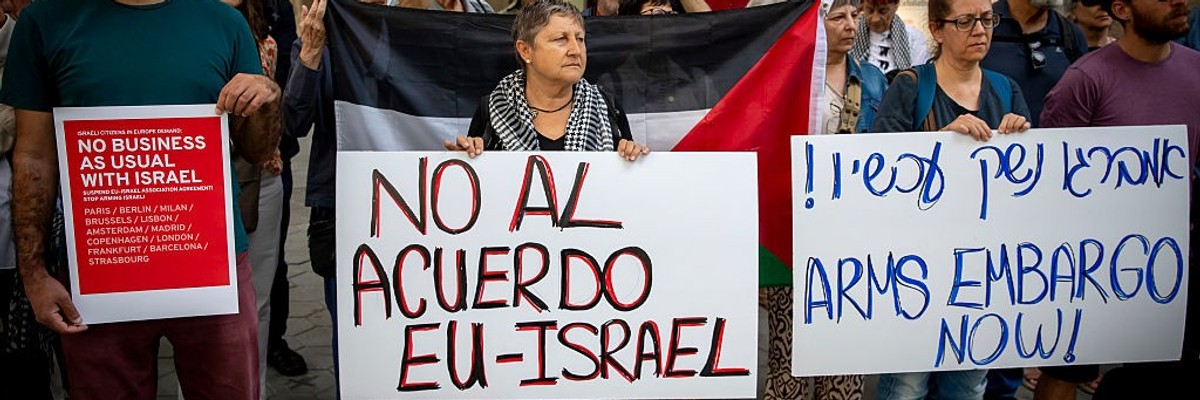
Protesters demand a European Union arms embargo on Israel and rejection of a trade deal with the country as punishmnent for its annihilation of Gaza during a May 27, 2025 demonstration outside the European Commission office in Barcelona. (Photo: Albert Llop/NurPhoto via Getty Images)
“The people have spoken and they refuse to be complicit,” said one campaigner. “Across continents, ordinary citizens demand an end to the fuel that powers settler colonialism, apartheid, and genocide.”
Large percentages of people in five nations want arms, fuel, and machinery embargoes on Israel in response to its obliteration and starvation of Gaza, a poll published Thursday revealed.
The survey—which was conducted last month by Pollfish for the Global Energy Embargo for Palestine and endorsed by Progressive International—queried people in Brazil, Colombia, Greece, South Africa, and Spain about whether their governments, fuel companies, weapons makers, and heavy machinery manufacturers should stop, reduce, continue, or increase business with Israel.
Nearly two-thirds of Spanish respondents said they strongly support or support their government taking action “to reduce trade in weapons, fuel, and other relevant goods to pressure Israel to end its military actions in Gaza.” In Greece, 63% back an embargo, while 35% oppose it. Sixty percent of Colombians, 58% of South Africans, and 48% of Brazilians strongly or somewhat support punitive sanctions on Israel.
Conversely, 27% of Brazilians said they do not support or strongly oppose an embargo on Israel, while 20% of South Africans, 14% of Colombians and Greeks, and 12% of Spaniards feel the same.
Support for ending or reducing weapons transfers was strong in all five nations, with 76% of Colombian respondents, 75% of Spaniards and Greeks, 66% of South Africans, and 59% of Brazilians favoring such action.
A majority of respondents in all five countries also said that companies providing arms, fuel, or heavy machinery to Israel “should be held responsible for how those products are used in Gaza.”
📊 New poll: People across the world say companies selling weapons, fuel, or heavy machinery to Israel should be held accountable for how those products are used in Gaza.🇪🇸 76%🇬🇷 71%🇨🇴 70%🇧🇷 62%🇿🇦 60%#EnergyEmbargoNow #NoFuelForGenocide@progintl.bsky.social
“The people have spoken and they refuse to be complicit,” Global Energy Embargo for Palestine campaigner Ana Sánchez said in a statement.
“Across continents, ordinary citizens demand an end to the fuel that powers settler colonialism, apartheid, and genocide,” Sánchez added. “No state that claims to uphold democracy can justify maintaining energy, military, or economic ties with Israel while it commits a genocide in Palestine. This is not just about trade; it’s about people’s power to cut the supply lines of oppression.”
The poll was published 670 days into Israel’s U.S.-backed assault and siege on Gaza, which has left at least 226,600 Palestinians dead, maimed, or missing and hundreds of thousands more starving amid increasingly deadly famine as Israel blocks aid from entering the embattled enclave.
The far-right government of Israeli Prime Minister Benjamin Netanyahu—a fugitive from the International Criminal Court wanted for alleged crimes against humanity and war crimes in Gaza—is moving ahead with plans for the “full conquest,” reoccupation, and ethnic cleansing of the strip, which U.S. President Donald Trumpwants to transform into “the Riviera of the Middle East.”
Israel’s conduct in the war is the subject of an International Court of Justice genocide case brought by South Africa and supported by around two dozen nations. Among the countries in the survey, Colombia—which severed diplomatic ties with Israel in May 2024—Spain, and Brazil have formally joined or signaled their intent to join South Africa’s case.
The ICJ also found last year that Israel’s occupation of Palestine is an illegal form of apartheid.
“What the Israeli government is doing to the Palestinian people is not war, it is genocide,” Brazilian President Luiz Inácio Lula da Silva said in February 2024 shortly after recalling his ambassador to Tel Aviv. “If this isn’t genocide, I don’t know what is.”
On Thursday, European Commission Executive Vice President Teresa Ribera—who is Spanish—toldPolitico, “If it is not genocide, it looks very much like the definition used to express its meaning.”
“What we are seeing is a concrete population being targeted, killed, and condemned to starve to death,” Ribera said. “A concrete population is confined, with no homes—being destroyed—no food, water, or medicines—being forbidden to access—and subject to bombing and shooting even when they are trying to get humanitarian aid. Any humanity is absent, and no witness[es] are allowed.”
Of the surveyed nations, all but Greece support an arms embargo on Israel. The other four countries took part in last month’s Hague Group emergency ministerial conference in Colombia, which was organized by Progressive International and ended with the publication of a joint action plan for “coordinated diplomatic, legal, and economic measures to restrain Israel’s assault on the occupied Palestinian territories and defend international law at large.”
“The message from the peoples of the world is loud and clear: They want action to end the assault on Gaza—not just words,” Progressive International co-general coordinator David Adler said in a statement accompanying the new survey’s publication.
“Across continents, majorities are calling for their governments to halt arms sales and restrain Israel’s occupation,” Adler added. “That’s why states are coming together through the Hague Group to take concrete measures toward accountability. It’s time for others to follow their lead.”
Meanwhile, a survey published Tuesday by the Israel Democracy Institute revealed that 8 in 10 Israeli Jews “are not so troubled or not at all troubled personally” by “the reports of famine and suffering among the Palestinian population in Gaza.”
Eight people, including a child, starved to death in Gaza that day, on which local officials said that more than 80 Palestinians were killed by Israel’s bombs, bullets, and blockade.
Keir Starmer objects to criticism of the IDF. He asks how could anyone object to them starving people to death, forced marches like the Nazis did, bombing Gaza’s hospitals and universities,mass-murdering journalists, healthworkers and starving people queuing for food, killing and raping prisoners and murdering children. He calls for people to stop obstructing his genocide for Israel.
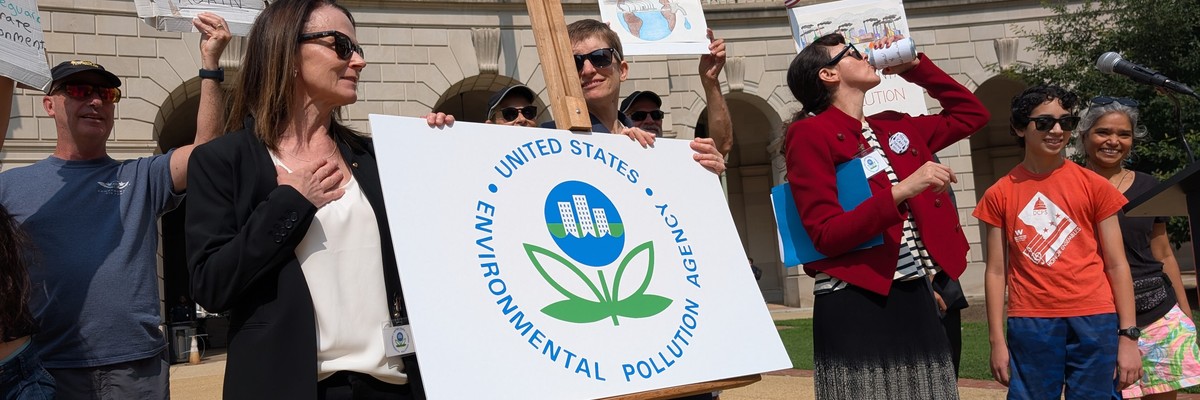
Protesters renamed the U.S. Environmental Protection Agency the Environmental Pollution Agency at its Washington, D.C. headquarters on August 7, 2025. (Photo: Extinction Rebellion D.C.)
“The days of shackling America’s oil, gas, and coal companies are over,” said spokesperson Melinda McFossilShill.
A renaming ceremony for the U.S. Environmental Protection Agency was held at its Washington, D.C. headquarters on Thursday to give the EPA a name that reflects its priorities under Administrator Lee Zeldin and Republican President Donald Trump.
On the heels of Zeldin’s visit to New England that spotlighted a push for the Constitution gas pipeline, a small group gathered outside the EPA building on Thursday to reintroduce it as the Environmental Pollution Agency and unveil its new logo.
“The days of shackling America’s oil, gas, and coal companies are over,” said Environmental Pollution Agency spokesperson Melinda McFossilShill. “The Trump administration stands for freedom, and that includes the freedom to pollute.”
McFossilShill is not a real representative of the agency, but rather a critic of what it’s become. Thursday’s “Make Pollution Great Again!” event was a protest, led by groups including Shut Down D.C. and the local arm of Extinction Rebellion.
In addition to McFossilShill, protesters took on the personas of fossil fuel executives and backers, including Joe Gasfracker, vice president for corporate capture of government (a false name and position) at the (real) American Petroleum Institute.
“I want to extend my deepest gratitude to Administrator Zeldin and President Trump for finally ending the charade of so-called ‘environmental protection’ and making government work for our patriotic fossil fuel corporations again,” he said.
“There are hundreds of people dying in floods, thousands dying in hurricanes, and millions being sickened by particulate matter pollution, wildfire smoke, and extreme heat, but we must balance that against the billions of dollars in profit that our members make,” Gasfracker continued. “Billions are more than millions, so obviously our profits must take precedence.”
Another protester—dubbed Pete Pollution, executive director of Energy Villains for Increased Leakage (EVIL)—declared that “the American Dream has always been about the freedom to pour toxic chemicals into every community.”
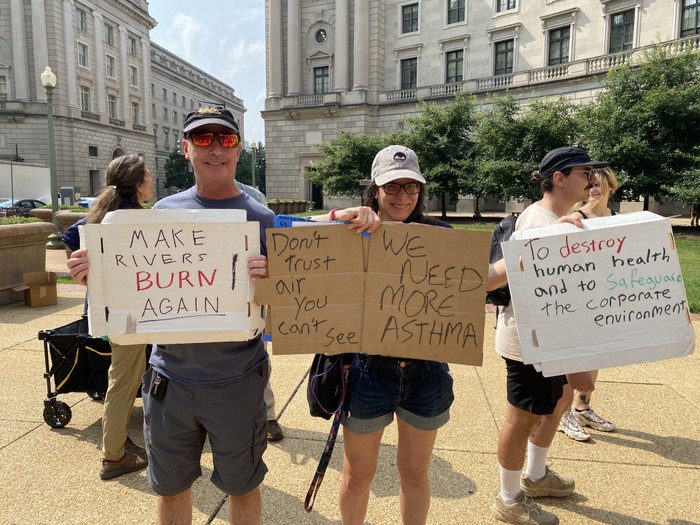
“If we don’t pollute America’s environment, who will?” added Pollution. Other participants held signs that called for making rivers burn, causing more asthma, and destroying human health.
Protesters renamed the U.S. Environmental Protection Agency the Environmental Pollution Agency at its Washington, D.C. headquarters on August 7, 2025. (Photo: Extinction Rebellion D.C.)
During Trump’s second term, the EPA has faced intense criticism for a range of actions. Over the past month, the agency has put 144 employees on leave after they signed a letter criticizing the administration’s “harmful” policies, eliminated its scientific research arm in the “ultimate Friday night purge,” proposed reregistering a pesticide twice banned by federal courts, and moved to cancel $7 billion in solar grants for low- and middle-income households.
Perhaps most notably, the agency also unveiled a rule to rescind the 2009 “endangerment finding” that has enabled federal regulations aimed at the fossil fuel-driven climate emergency over the past 15 years.
Further, Trump last month signed a series of proclamations to provide what he called “regulatory relief” to over 100 coal, chemical manufacturing, iron ore processing, and sterile medical equipment facilities, with the White House claiming that rules imposed on them under former Democratic President Joe Biden’s EPA were “burdensome.”
At the time, John Walke, clean air director for the environmental group Natural Resources Defense Council, accused Trump of signing a “literal free pass for polluters,” and warned that “if your family lives downwind of these plants, this is going to mean more toxic chemicals in the air you breathe.”
Elected Democrats—who have minorities in both chambers of Congress—have joined climate, environmental, and public health advocates in calling out Trump and Zeldin for various moves.
Jay Inslee: Trump and Zeldin have turned EPA into ‘Environmental Pollution Agency’ by revoking essential climate rule www.msnbc.com/ali-velshi/w…
On Thursday, U.S. Senate Minority Leader Chuck Schumer (D-N.Y.) and Environment and Public Works Committee Ranking Member Sheldon Whitehouse (D-R.I.) led a letter to Zeldin about his proposal to gut power plant pollution standards.
“Climate change and toxic air pollution are serious issues,” dozens of Senate Democrats wrote to the EPA administrator. “We represent millions of constituents who risk poisoning from mercury and air toxics and who are facing the rising costs of the climate crisis.”
“Congress established the Clean Air Act to protect our constituents from these dangers. We urge EPA to follow its directive,” they added, urging Zeldin to withdraw two proposals on fossil fuel plant emissions.
In a Thursday statement, Schumer said that “the Trump administration is saying to hell with five decades worth of protection against deadly pollution and neurotoxins that has saved thousands of lives, made communities safer, and our economy stronger. Why? To appease Big Oil and fossil fuel billionaires.”
“The Trump administration’s obsession with gutting clean air protections and allowing more poison into the air is reckless, dangerous, and a clear reminder: Republicans care about their donors, not you,” he charged. “The EPA needs to stop ignoring the science and the facts and immediately reverse course and put the health and safety of Americans first.”
Donald Trump urges you to be a Climate Science denier like him. He says that he makes millions and millions for destroying the planet, Burn, Baby, Burn and Flood, Baby, Flood.
Original article by Alan Macleod republished from MPN under a Creative Commons Attribution-NonCommercial-ShareAlike 3.0 International License.
As we commemorate the 80th anniversary of the Hiroshima and Nagasaki atomic bombings, the world is drifting as close to another nuclear confrontation as it has been in decades.
With Israeli and American attacks on Iranian nuclear energy sites, India and Pakistan going to war in May, and escalating violence between Russia and NATO-backed forces in Ukraine, the shadow of another nuclear war looms large over daily life.
Eighty Years Of Lies
The United States remains the only nation to have dropped an atomic bomb in anger. While the dates of August 6 and August 9, 1945, are seared into the popular conscience of all Japanese people, those days hold far less salience in American society.
When discussed at all in the U.S., this dark chapter in human history is usually presented as a necessary evil, or even a day of liberation—an event that saved hundreds of thousands of lives, prevented the need for an invasion of Japan, and ended the Second World War early. This, however, could not be further from the truth.
American generals and war planners agreed that Japan was on the point of collapse, and had, for weeks, been attempting to negotiate a surrender. The decision, then, to incinerate hundreds of thousands of Japanese civilians was one taken to project American power across the world, and to stymie the rise of the Soviet Union.
“It always appeared to us that, atomic bomb or no atomic bomb, the Japanese were already on the verge of collapse,” General Henry Arnold, Commanding General of the U.S. Army Air Forces in 1945, wrote in his 1949 memoirs.
Arnold was far from alone in this assessment. Indeed, Fleet Admiral William Leahy, the Navy’s highest-ranking officer during World War II, bitterly condemned the United States for its decision and compared his own country to the most savage regimes in world history.
As he wrote in 1950:
It is my opinion that the use of this barbarous weapon at Hiroshima and Nagasaki was of no material assistance in our war against Japan. The Japanese were already defeated and ready to surrender. My own feeling was that in being the first to use it, we had adopted an ethical standard common to the barbarians of the Dark Ages.”
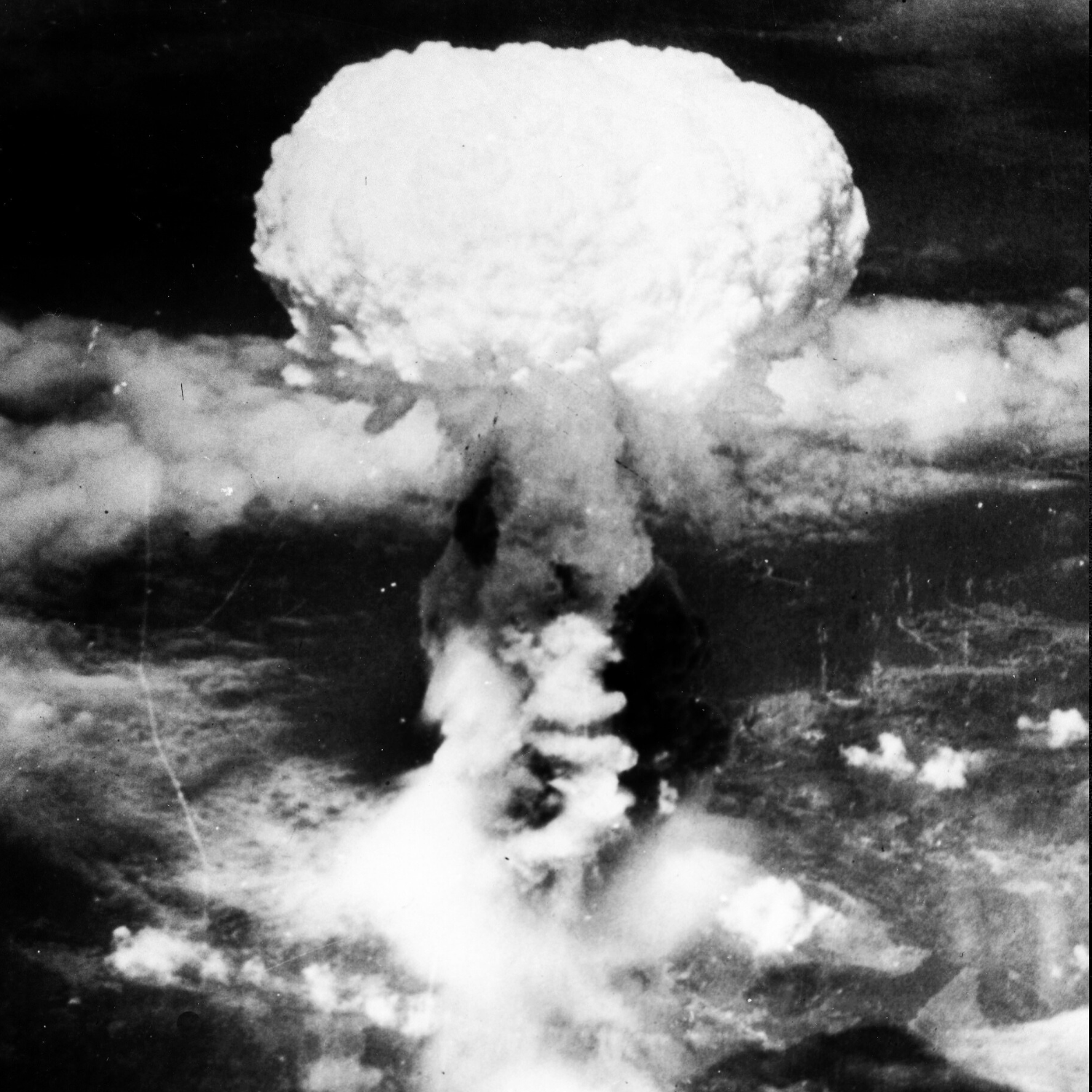
A column of smoke rises more than 60,000 feet into the air after the second atomic bomb ever used explodes over Nagasaki, Aug. 9, 1945. Photo | AP
By 1945, Japan had been militarily and economically exhausted. Losing key allies Italy in 1943 and Germany by May 1945, and facing the immediate prospect of an all-out Soviet invasion of Japan, the country’s leaders were frantically pursuing peace negotiations. Their only real condition appeared to be that they wished to keep as a figurehead the emperor—a position that, by some accounts, dates back more than 2,600 years.
“I am convinced,” former President Herbert Hoover wrote to his successor, Harry S. Truman, “if you, as President, will make a shortwave broadcast to the people of Japan—tell them they can have their emperor if they surrender, that it will not mean unconditional surrender except for the militarists—you’ll get a peace in Japan—you’ll have both wars over.”
Many of Truman’s closest advisors told him the same thing. “I am absolutely convinced that had we said they could keep the emperor, together with the threat of an atomic bomb, they would have accepted, and we would never have had to drop the bomb,” said John McCloy, Truman’s Assistant Secretary of War.
Nevertheless, Truman initially took an absolutist position, refusing to hear any Japanese negotiating caveats. This stance, according to General Douglas MacArthur, Commander of Allied Forces in the Pacific, actually lengthened the war. “The war might have ended weeks earlier,” he said, “If the United States had agreed, as it later did anyway, to the retention of the institution of the emperor.” Truman, however, dropped two bombs, then reversed his position on the emperor, in order to stop Japanese society from falling apart.
At that point in the war, however, the United States was emerging as the sole global superpower and enjoyed an unprecedented position of influence. The dropping of the atomic bomb on Japan underscored this; it was a power play, intended to strike fear into the hearts of world leaders, especially in the Soviet Union and China.
First Japan, Then The World
Hiroshima and Nagasaki drastically curbed the U.S.S.R.’s ambitions in Japan. Joseph Stalin’s forces had invaded and permanently annexed Sakhalin Island in 1945 and planned to occupy Hokkaido, Japan’s second-largest island. The move likely prevented the island nation from coming under the Soviet sphere of influence.
To this day, Japan remains deeply tied to the U.S., economically, politically, and militarily. There are around 60,000 U.S. troops in Japan, spread across 120 military bases.
Many in Truman’s administration wished to use the atom bomb against the Soviet Union as well. President Truman, however, worried that the destruction of Moscow would lead the Red Army to invade and destroy Western Europe as a response. As such, he decided to wait until the U.S. had enough warheads to completely destroy the U.S.S.R. and its military in one fell swoop.
War planners estimated this figure to be around 400. To that end, Truman ordered the immediate ramping up of production. Such a strike, we now know, would have caused a nuclear winter that would have permanently ended all organized life on Earth.
The decision to destroy Russia was met with stiff opposition among the American scientific community. It is now widely believed that Manhattan Project scientists, including Robert J. Oppenheimer himself, passed nuclear secrets to Moscow in an effort to speed up their nuclear project and develop a deterrent to halt this doomsday scenario. This part of history, however, was left out of the 2023 biopic movie.
By 1949, the U.S.S.R. was able to produce a credible nuclear deterrent before the U.S. had produced sufficient quantities for an all-out attack, thus ending the threat and bringing the world into the era of mutually assured destruction.
“Certainly prior to 31 December 1945, and in all probability prior to 1 November 1945, Japan would have surrendered even if the atomic bombs had not been dropped, even if Russia had not entered the war, and even if no invasion had been planned or contemplated,” concluded a 1946 report from the U.S. Strategic Bombing Survey.
Dwight D. Eisenhower, Supreme Allied Commander in Europe and future president, was of the same opinion, stating that:
Japan was already defeated and dropping the bomb was completely unnecessary…[it was] no longer mandatory as a measure to save American lives. It was my belief that Japan was, at this very moment, seeking a way to surrender with a minimum loss of face.”
Nevertheless, both Truman and Eisenhower publicly toyed with the idea of using nuclear weapons against China to stop the rise of Communism and to defend their client regime in Taiwan. It was only the development of a Chinese warhead in 1964 that led to the end of the danger, and, ultimately, the détente era of good relations between the two powers that lasted until President Obama’s Pivot to Asia.
Ultimately, then, the people of Japan were the collateral damage in a giant U.S. attempt to project its power worldwide. As Brigadier General Carer Clarke, head of U.S. intelligence on Japan wrote, “When we didn’t need to do it, and we knew we didn’t need to do it, and they knew that we knew we didn’t need to do it, we used them [Japanese citizens] as an experiment for two atomic bombs.”
Tiptoeing Closer To Armageddon
The danger of nuclear weapons is far from over. Today, Israel and the United States – two nations with atomic weaponry – attack Iranian nuclear facilities. Yet their continued, hyper-aggressive actions against their foes only suggest to other countries that, unless they too possess weapons of mass destruction, they will not be safe from attack. North Korea, a country with a conventional and nuclear deterrent, faces no such air strikes from the U.S. or its allies. These actions, therefore, will likely result in more nations pursuing nuclear ambitions.
Earlier this year, India and Pakistan (two more nuclear-armed states) came into open conflict thanks to disputes over terrorism and Jammu and Kashmir. Many influential individuals on both sides of the border were demanding their respective sides launch their nukes – a decision that could also spell the end of organized human life. Thankfully, cooler heads prevailed.
Meanwhile, the war in Ukraine continues, with NATO forces urging President Zelensky to up the ante. Earlier this month, President Trump himself reportedly encouraged the Ukrainian leader to use his Western-made weapons to strike Moscow.
It is precisely actions such as these that led the Bulletin of Atomic Scientists to move their famous Doomsday Clock to 89 seconds to midnight, the closest the world has ever been to catastrophe.
“The war in Ukraine, now in its third year, looms over the world; the conflict could become nuclear at any moment because of a rash decision or through accident or miscalculation,” they wrote in their explanation, adding that conflicts in Asia could spiral out of control into a wider war at any point, and that nuclear powers are updating and expanding their arsenals.
The Pentagon, too, is recruiting Elon Musk to help it build what it calls an American Iron Dome. While this move is couched in defensive language, such a system – if successful – would grant the U.S. the ability to launch nuclear attacks anywhere in the world without having to worry about the consequences of a similar response.
Thus, as we look back at the horrors of Hiroshima and Nagasaki 80 years ago, we must understand that not only were they entirely avoidable, but that we are now closer to a catastrophic nuclear confrontation than many people realize.
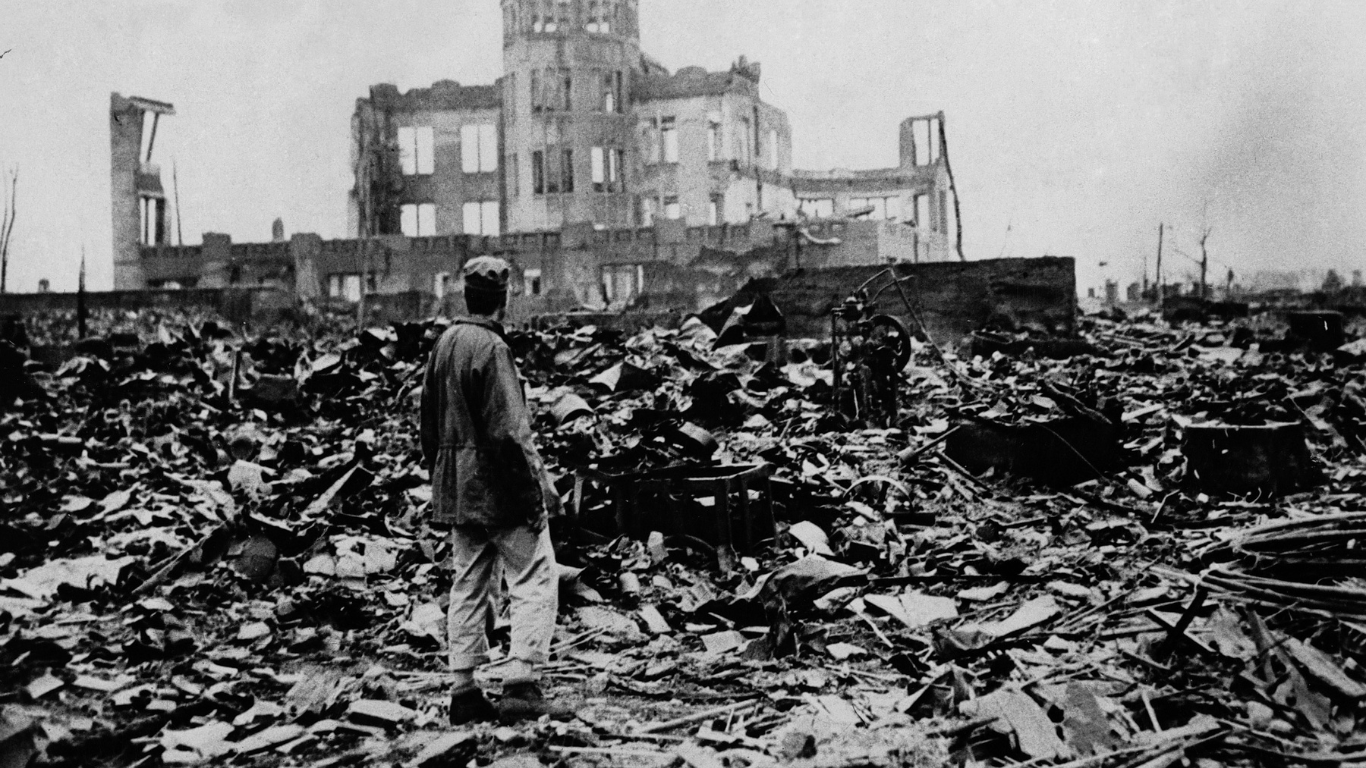
Feature photo | A man looks over the expanse of ruins left the explosion of the atomic bomb on August 6, 1945 in Hiroshima, Japan. Some 140,000 people died here immediately. Photo | AP