Keir Starmer’s home secretary Yvette Cooper (right) has banned Palestine Action. (Photo: Alastair Grant / Alamy)
The Home Office briefed the Times that Palestine Action could be funded by Iran, and then UK media kicked into action spreading the story.
The proscription of Palestine Action took place alongside claims made in sections of the British media that the group could have been funded by Iran.
On the same day, 23 June, that home secretary Yvette Cooper formally announced to parliament she would proscribe the group, the Times published a report saying “Iran could be funding Palestine Action, Home Office officials claimed”.
It added: “Officials are understood to be investigating its source of donations amid concerns that the Iranian regime, via proxies, is funding the group’s activities given that their objectives are aligned”.
The Times provided no quotes from Home Office officials or any evidence of Iranian funding to Palestine Action.
The same day, the paper published another article, stating: “Support for the group [Palestine Action] from campaigns with alleged links to Iran has fuelled concerns it is unwittingly and covertly being funded by Tehran. It received backing yesterday by a group described in a government report as ‘aligned with the Iranian regime’”.
This referred to the Islamic Human Rights Commission (IHRC), a pro-Iranian UK-based NGO which had posted on X: “We stand in solidarity with our comrades PalestineAction!”
The Times noted that the IHRC was described in a 2023 government review of the Prevent counter-extremism programme as an “Islamist group ideologically aligned with the Iranian regime, that has a history of ‘extremist links and terrorist sympathies’”.
Keir Starmer objects to criticism of the IDF. He asks how could anyone obect to them starving people to death, forced marches like the Nazis did, bombing Gaza’s hospitals and universities,mass-murdering journalists, healthworkers and starving people queuing for food, killing and raping prisoners and murdering children. He calls for people to stop obstructing his genocide for Israel.UK Labour Party government ministers Keir Starmer, Angela Rayner and Rachel Reeves explain that they are partners complicit in Israel’s Gaza genocide. The UK has provided Israel with arms, military and air force support. They explain that they don’t do gas chambers but do do forced marches, starvation, destroy hospitals, mass-murders of journalists and healthcare workers.Vote Labour for Genocide.
U.S. President Donald Trump and Vice President JD Vance acknowledge the crowd after Trump’s second inauguration in the U.S. Capitol Rotunda on January 20, 2025 in Washington, D.C. (Photo: Kenny Holston/Pool/Getty Images)
“Every month that Donald Trump has been in power, we’ve seen a raft of anti-climate measures come out which are music to the fossil fuel industry’s ears,” said one investigator.
Oil, gas, and coal companies and individuals linked to the climate-wrecking fossil fuel industry contributed more than $19 million to U.S. President Donald Trump’s second inaugural fund, an analysis by a leading international environmental and human rights group revealed Wednesday.
Scouring itemized U.S Federal Election Commission data, Global Witness identified 47 individual donations to the Trump-Vance Inaugural Committee between November 2024 and January 2025 totaling $19,151,933. Using an artificial intelligence tool developed by Global Witness to identify corporate lobbyists, the group’s researchers were able to automatically determine each donor’s ties to the fossil fuel industry.
SUBSCRIBE TO OUR FREE NEWSLETTER
Quality journalism. Progressive values. Direct to your inbox.
Global Witness said the $19.15 million figure “is likely an underestimate, as we did not count donations from diversified investors and businesses who couldn’t be said to primarily represent the fossil fuel industry,” and individuals with common names that couldn’t be identified were not included in the final report.
According to the analysis:
The list of donors includes individuals who were given ambassadorships or key positions in the Trump Cabinet.
For example, billionaire Warren Stephens donated $4 million on December 2, 2024, the same day Trump nominated him to be U.S. ambassador to the U.K. Stephens has extensive links to the oil and gas industry but also invests in other sectors and wasn’t included in our calculations of fossil fuel industry donors.
Trump also nominated Melinda Hildebrand—who donated $500,000 to the president’s inaugural fund—to be U.S. ambassador to Costa Rica.
Hildebrand is the vice president of Hilcorp Ventures, which claims to be of the largest privately owned oil and gas producers in the U.S. Her husband, founder and chairman of Hilcorp, donated another $500,000.
Among fossil fuel corporations, Chevron was by far the largest contributor to Trump’s inauguration fund, giving $2 million. Other companies including ExxonMobil, ConocoPhillips, and Occidental Petroleum each donated $1 million.
Overall, Big Oil gave $445 million to Trump and other Republican candidates during the 2024 election cycle.
Trump accepted over $23 million from Fossil Fuel Lobby & Big Oil independently spent $445 million in 2024 elections.
In return Trump eroded our environmental regulations, hired a Fossil Fuel Executive as his Energy Secretary & let Musk defund FEMA. He is responsible for this ⤵️ https://t.co/wZuqUUbf9hpic.twitter.com/rKoRPTnive
Trump, who ran on a “drill, baby, drill” energy policy, has signed a series of executive orders aimed at boosting fossil fuel production, including by declaring a fake “energy emergency” in a push to fast-track permit approvals. He also tapped former fossil fuel executives to head the Department of Energy and Interior Department, which have pursued a policy of opening up more public lands and waters for fossil fuel development.
At the same time, the Trump administration dropped out of the Paris climate agreement for the second time and moved to roll back the modest climate progress achieved under former President Joe Biden.
“It’s no surprise the oil and gas industry handed millions to Donald Trump for his inauguration, and they seem to have reaped a huge return on their investment,” Global Witness senior data investigator Nicu Calcea said in a statement Wednesday.
“Every month that Donald Trump has been in power, we’ve seen a raft of anti-climate measures come out which are music to the fossil fuel industry’s ears,” Calcea continued. “From plans to steamroll through dirty new coal plants, to the attempted quashing of ‘polluter pays’ laws that would hold oil giants accountable, it’s clear where his political priorities lie.”
“While Trump sides with his friends in oil and gas, we must keep up the fight for a fair, green future—that means pushing for wind and solar where we live, backing polluters pay bills, and resisting the development of oil, gas and coal projects across the country,” he added.
Donald Trump urges you to be a Climate Science denier like him. He says that he makes millions and millions for destroying the planet, Burn, Baby, Burn and Flood, Baby, Flood.Nigel Farage urges you to ignore facts and reality and be a climate science denier like him. He says that Reform UK has received millions and millions from the fossil fuel industry to promote climate denial and destroy the planet.Neo-Fascist Climate Science Denier Donald Trump says Burn, Baby, Burn.
COP30 President André Corrêa do Lago speaks to journalists at a press conference to launch an open letter on work towards the COP30 climate summit in Belem, Brazil. (Photo: Rafa Neddermeyer/ COP30 Amazônia/PR)
In an exclusive interview, André Corrêa do Lago says negotiators can work out rules or a timeline for the energy transition, but it’s up to countries to act on what they agreed
When it comes to the most important thing to curb climate change – moving away from planet-heating fossil fuels – governments have done enough negotiating, and their focus now should be on putting what they already agreed into practice, Brazil’s COP30 president told Climate Home News.
That does not require repeating language in new UN texts or even consensus among countries about how to transition from coal, oil and gas, although they could choose to design a roadmap for that energy shift at this year’s climate summit in the Amazon, André Aranha Corrêa do Lago said in an exclusive interview.
…
Brazil’s environment minister Marina Silva at a press conference in London. (Photo: Credit: Isabela Castilho / COP30 presidency)
The COP30 president emphasised that while this is up to governments, “we can’t keep the world waiting for negotiations to move forward” before acting to transition away from fossil fuels in energy systems.
“It’s not true that it depends on that. There’s already enough approval from countries. Individual countries can do it because implementation isn’t by consensus. Implementation is that each country does what it thinks it can do,” he explained.
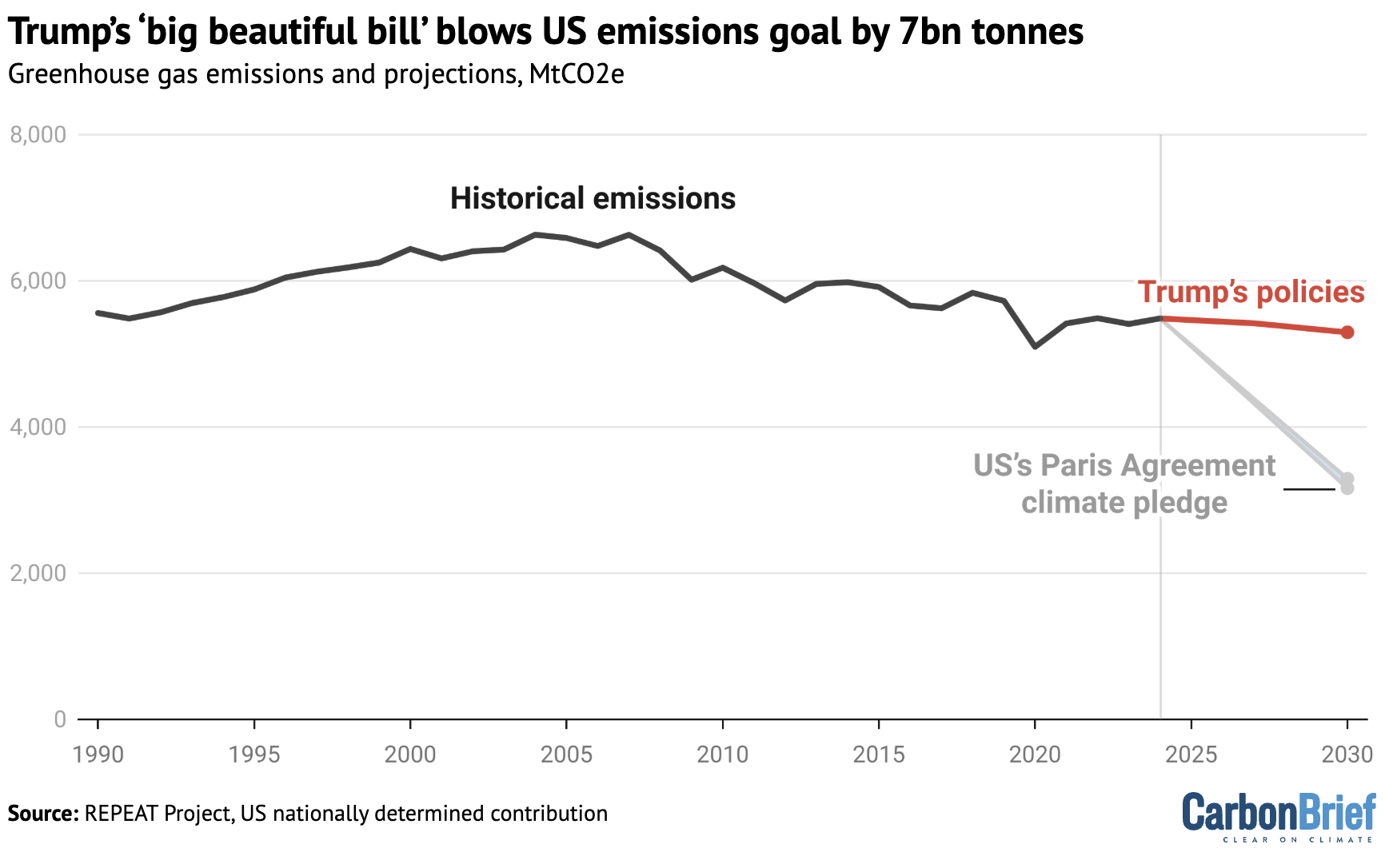
President Donald Trump’s dismantling of climate policy means the US will add an extra 7bn tonnes of emissions to the atmosphere from now until 2030, compared to meeting its former climate pledge under the Paris Agreement.
Since winning office last November, he has issued a series of executive orders and is poised to sign his “big beautiful bill” that effectively terminates Biden-era climate policies.
Carbon Brief’s analysis of modelling from the Princeton University REPEAT Project shows that this means US emissions are now set to drop to just 3% below current levels by 2030 – effectively flatlining – rather than falling 40% as required to hit the now-defunct target.
This would leave the US around 2bn tonnes short of its greenhouse-gas emissions target for that year, adding emissions equivalent to around 4% of the current global total each year
To put this in context, it is roughly the annual output of Indonesia, the world’s sixth-largest emitter.
Trump is already withdrawing his nation from its international climate obligations under the Paris Agreement.
The passage of the new Republican-backed “megabill” means that US climate targets pursued by Trump’s predecessor now appear firmly out of reach.
7bn tonnes
Trump is due to sign the so-called “big beautiful bill” into law after it was approved by the Republican-controlled US Congress on 3 July.
This “megabill” removes virtually all of the tax credits for renewable energy, electric vehicles and clean manufacturing that were at the core of Biden’s landmark Inflation Reduction Act (IRA).
(Ahead of the US presidential election last year, Carbon Brief estimated that, by reversing the IRA and other key policies, a Trump administration would add 4bn tonnes of emissions by 2030, compared to a continued Biden administration.)
Since his return to the White House, Trump has moved to strip away his predecessor’s climate policies, including via a series of executive actions. This includes targeting vehicle fuel-efficiency standards and power sector emissions standards.
The passage of the new bill means US solar and wind power expansion will likely slow down, as will sales of electric vehicles and energy efficiency improvements. The combined effect of these policy rollbacks can be seen in the chart below, based on modelling by the REPEAT Project.
Carbon Brief has compared the impact of Trump’s policies, including the megabill, to a pathway on which the US meets its former target, under the Paris Agreement, to cut greenhouse gas emissions by 50-52% from 2005 levels by 2030.
The cumulative gap between this pathway and the Trump administration’s trajectory amounts to 7bn tonnes of emissions over the next five years.
Based on the most recent central estimate of the “social cost of carbon” in 2030 from the US Environmental Protection Agency (EPA), published under the Biden administration, those 7bn tonnes of extra emissions would cause global climate damages worth more than $1.6tn.
Under this new set of US policies, emissions are only expected to be 20% lower than 2005 levels by 2030, rather than 50-52%, meaning the nation would be 2bn tonnes short of its goal.
This amounts to just a 3% drop from 2024 levels by 2030, meaning emissions are effectively flatlining.
Renewables down, prices up
Among the hundreds of provisions in the new Republican-backed bill are several key rollbacks that are expected to affect US emissions.
Under the IRA, wind and solar projects could receive tax credits up to 2034. Following the Republican bill, most projects would need to start construction within the next year to qualify.
Without federal support, the pipeline of new renewable-energy projects is expected to contract.
The REPEAT analysts estimate that cumulative new solar capacity additions will drop by 29 gigawatts (GW) by 2030 and around 140GW by 2035. For wind power, the decrease is set to be 43GW by 2030 and 160GW by 2035.
Some renewable projects will likely be built without support, but developers will need to contend with other Trump administration policies, such as stopping federal windfarm approvals.
The lost renewable capacity is unlikely to be entirely replaced by fossil fuels, due to a multi-year backlog in the construction of gas-fired power plants.
Tax credits for nuclear and geothermal power have been retained until 2036 in the bill. While these projects generate clean electricity, they can also take a long time to build.
Other key policies in the new bill include the removal of tax credits worth up to $7,500 to purchase electric vehicles, which could result in tens of millions fewer such cars and vans being sold. Ending tax credits for low-carbon manufacturing is also expected to undo progress in building clean technologies, such as solar panels and electric cars, domestically.
Beyond its effect on US emissions, various early analyses have suggested the Republican-backed bill is likely to increase energy prices and lead to job losses.
REPEAT estimates household energy costs are likely to be $165 higher in 2030 and more than $280 higher by 2035, following the passing of the bill.
Some of this increase can be attributed to fewer electric vehicles on the road, leading to higher petrol and diesel consumption and prices. Slowing construction of solar and wind projects as power demand increases will also likely affect the cost of electricity.
Without tax credits to boost the construction of new generation capacity, residential electricity prices are set to increase by 7% – or $110 – by 2026, for the average US customer, according to analysis conducted for trade body the Clean Energy Buyers Association.
In the state of Wyoming, the same analysis found that electricity prices may rise by as much as 30% over the next year. Other firmly Republican states, such as North Carolina and Tennessee, are also expected to see near-term price rises in the double digits.
The project has assessed the emissions impact of the executive actions that the Trump administration has already taken to unwind Biden-era policies, as well as the bill itself.
Carbon Brief compared this trajectory out to 2030 with a straight-line pathway towards the official US climate target for 2030. This is set out in the US’ nationally determined contribution (NDC) under the Paris Agreement. It is worth noting that the Trump administration is withdrawing the US from the Paris Agreement.
Donald Trump urges you to be a Climate Science denier like him. He says that he makes millions and millions for destroying the planet, Burn, Baby, Burn and Flood, Baby, Flood.Nigel Farage urges you to ignore facts and reality and be a climate science denier like him. He says that Reform UK has received millions and millions from the fossil fuel industry to promote climate denial and destroy the planet.Orcas discuss Donald Trump and the killer apes’ concept of democracy. Front Orca warns that Trump is crashing his country’s economy and that everything he does he does for the fantastically wealthy.
The strike was called by the trade unions and farmers groups against anti-workers labor codes and failures of the government to enact a legal support price for farm products.July 09, 2025 by Abdul Rahman
National strike against the “anti-worker” labor codes of the Modi government on July 9. Photo: CPI(M)
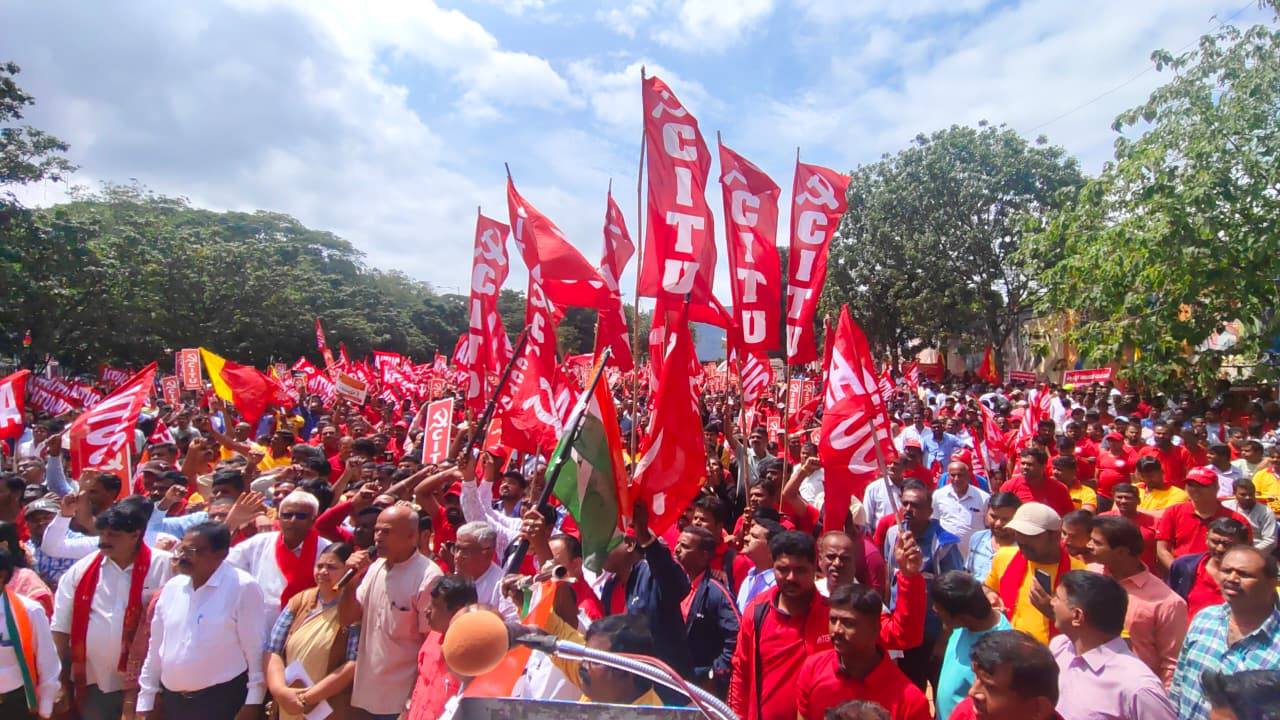
Millions took to the streets all over India on Wednesday, July 9, to observe a national strike call made by Central Trade Unions (CTU). They are striking against the anti-worker policies adopted by the ultra-right-wing government in the country.
CTU is a platform of all the major trade union federations in the country, spanning the ideological and political spectrum. It includes the Center for Indian Trade Unions (CITU), the All India Trade Union Congress (AITUC), the Indian National Trade Union Congress (INTUC) and several others.
The strike was also supported by all the major groups of farmers, students, women, and various professional unions such as teachers, journalists, and IT employees in the country.
According to various estimates, more than 250 million workers and farmers – both in organized and unorganized sectors – directly participated in the strike and protests across the country.
Workers in other organized sectors such as ports, airports, and banking also participated alongside those in various public sectors.
The strike affected most of the industrial activities in the country, particularly industries related to mining.
In several places, workers blocked the movement of trains, blocked highways, and picketed factory gates to mobilize greater support. In some cases, such as the Kochi refinery in the southern state of Kerala, workers defied court orders and observed the strike.
A total shut down of all major business was observed in various states in the country such as Kerala, Tripura, Bihar, Jharkhand, and others.
Anti-worker labor codes must be withdrawn
The workers were demanding immediate withdrawal of the new labor codes enacted by the ultra-right-wing government led by Narendra Modi at the center in 2020. CTU claims the four new labor codes are anti-worker, depriving them of their basic rights, including the right to collective bargaining, which was won through a historic and painful worker’s struggle.
The other major demands include:
The end of the privatization and contractualization of jobs
A national minimum wage of Rs. 26,000 (USD 303)
Improvements in working conditions across all sectors for all kinds of workers
The strike also supported the demands raised by the country’s major farmers groups, led by the Samyukta Kisan Morcha (SKM), for a legal minimum support price for all farm produce, the waiving of loans for farmers, an end to all forced land acquisition, and better employment opportunities.
The strike was originally scheduled for May 19. It had to be postponed following the war-like situation in the region created after India attacked several locations inside neighboring Pakistan, accusing it of supporting armed groups who carried out attacks on tourists in Pahalgam.
Popular action defeats government lies
A central protest rally was held in the national capital Delhi. The protest was attended by all the constituents of CTU and SKM, the farmers collective which has extended support to the strike.
CPI(M) Politburo Member and CITU General Secretary Tapan Sen addresses a strike demonstration in Jantar Mantar, New Delhi. Photo: CPI (M)
Addressing the rally, Tapan Sen, general secretary of CITU and a member of the Communist Party of India (Marxist) polit bureau, claimed that the success of the strike demolishes the myths created by the Modi government about the so-called economic prosperity his government’s policies have created.
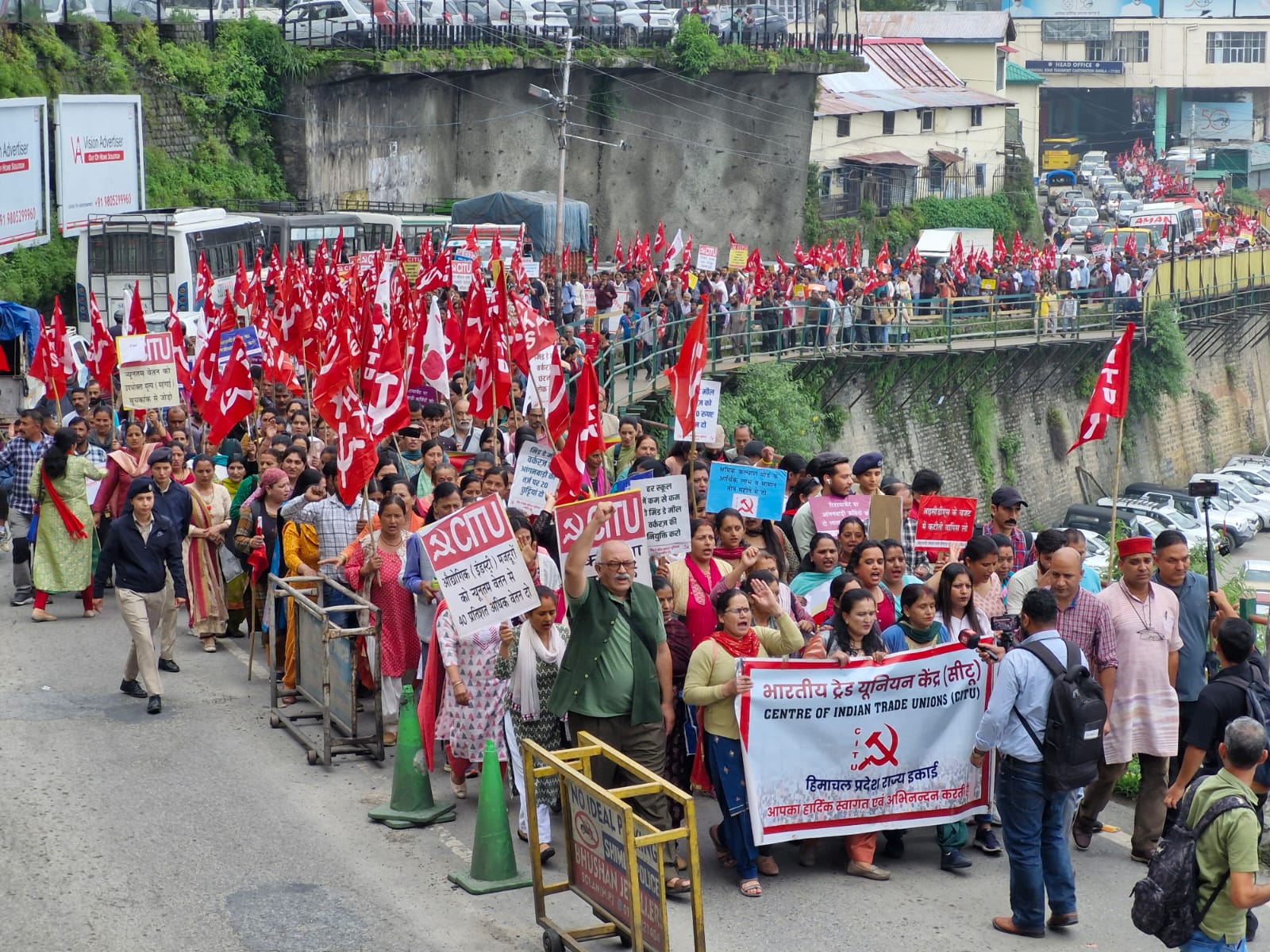
Strike demonstration in Shimla, Himachal Pradesh. Photo: CPI (M)
Most Indians today are struggling to find a decent source of livelihood and those who have one are struggling to protect it from the effects of the various wrongful and pro-corporate policies of the Bharatiya Janata Party (BJP)-led government, Sen underlined.
The lies about India being the third or fourth largest economy in the world, propagated by the present government in the country and magnified by the complicit media, have been exposed by the sheer number of people who participated in today’s strike. It establishes the fact that under Modi’s decade-long rule the condition of the working classes in India has gone from bad to worse, Sen told the protesters gathered at the rally.
Photo: CPI(M)
Sen also warned the government against going ahead with the proposed trade deal with the US, claiming that would further compromise the interest of workers and farmers in India.
Amarjeet Kaur, general secretary of the AITUC, claimed that the BJP used pro-government unions to divide the working classes in the country and falsely called the strike “illegal”.
“The attempts to divide the working class, so that the interest of its corporate bosses are protected, was defeated by the successful strike” Kaur declared. She noted that this was the fourth such strike since 2020 and more such strikes will happen in the future, with more intensity, if the government fails to correct its ways and take back the four draconian labor codes, and enact laws which really benefit the working classes of this country.