Ethnic cleansing awaits North Darfur’s besieged, starving population in war-torn Sudan

Spread the love

Original article by Pavan Kulkarni republished from peoples dispatch under a Creative Commons Attribution-ShareAlike 4.0 (CC BY-SA) license.
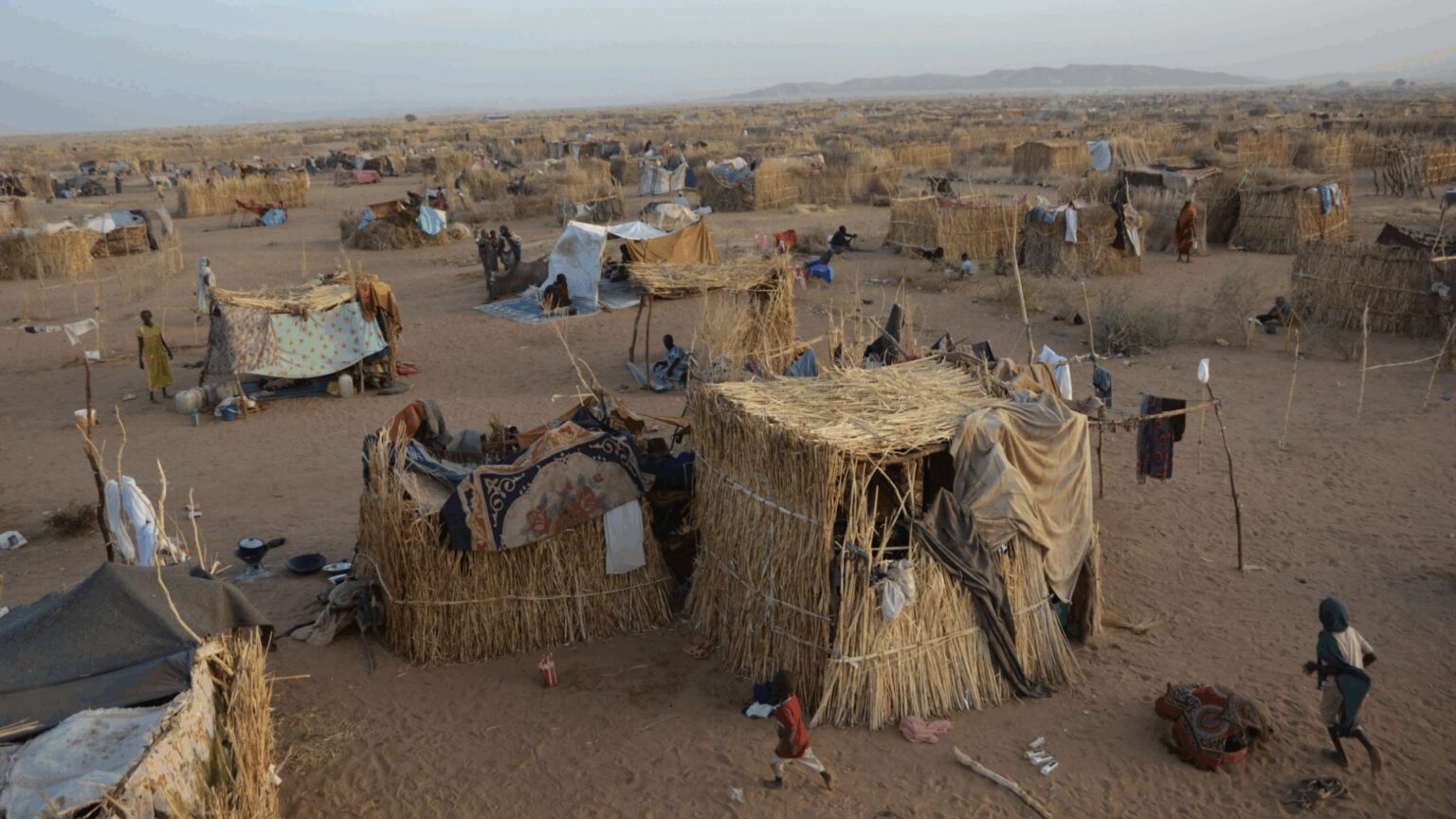
Over 400,000 people were forced to flee to El Fasher from the Zamzam refugee camp due to RSF ground operations. Photo: Doctors Without Borders

The specter of ethnic cleansing looms over hundreds of thousands trapped without food, water, or medicines in the North Darfur state’s besieged capital, El Fasher.

Nearly half a million people were forced to flee from North Darfur state’s capital, El Fasher, and the nearby Zamzam camp for displaced people in just the two months of April and May, the UN Secretary-General’s spokesperson, Stéphane Dujarric, said in a press briefing on Monday, July 7.

North Darfur is the only one of the five states where the Sudanese Armed Forces (SAF) have retained a foothold in the war-torn Sudan’s vast western region of Darfur, overrun by its rival, the paramilitary Rapid Support Force (RSF), within six months of the war’s start in April 2023. 

Moving against this last holdout, the RSF laid siege in May 2024 on El Fasher, where the SAF has a base, and the Zamzam camp on its outskirts, where some of the local self-defense units allied with the SAF are positioned.

Read more: Sudan’s paramilitary attacks largest IDP camps amid world’s biggest displacement crisis, killing over 100

“People are not only caught in indiscriminate heavy fighting between” the two warring forces, but are also being “actively targeted by the RSF and its allies, notably on the basis of their ethnicity,” Michel Olivier Lacharité, MSF head of emergencies, said on July 3. 

SAF created the RSF in Darfur

The RSF was coalesced in 2013 from the militias the SAF had spawned from Arabic-speaking nomadic communities to perpetrate mass atrocities on the regional-language-speaking groups of sedentary farmers that supported the rebel groups during the Darfur civil war in the 2000s.

The partnership between SAF and the RSF lasted a decade, during which they seized power together to form a military junta in 2019, when mass pro-democracy protests forced the ouster of Omar al-Bashir after a 30-year-long dictatorship.

The duo deployed its troops to jointly repress the militant protests that continued until April 15, 2023, when the intensifying power struggle within the junta between the two forces crossed the Rubicon, mobilizing their forces against each other and hurling the country into a civil war.

IDPs under attack

Now continuing into its third year, the civil war has claimed an estimated 150,000 lives and displaced nearly 13 million people, unleashing in this poor North African country the world’s worst displacement crisis.

Over three million of the displaced have fled to other countries as refugees. An estimated 8.6 million have remained as Internally Displaced People (IDPs). Darfur, which already had almost 3.1 million IDPs from the regional civil war in the 2000s, was among the worst-affected regions by this new war.

The RSF maneuvered quickly to take control over this region, starting with West Darfur, where it committed ethnically targeted massacres in June 2023 against the Masalit community, most of whom were displaced in the Darfur civil war. Ethnic cleansing of this community from West Darfur was nearly complete by November that year. 

Read more: Ethnic cleansing of West Darfur’s El Geneina culminates in largest massacre since onset of war in Sudan 

By then, the RSF had taken over most of the region, with North Darfur as the SAF’s only holdout. Members of the state’s Zaghawa community, which had until then remained neutral, volunteered in large numbers to form self-defense units that aligned themselves with the SAF.

“In light of the ethnically motivated mass atrocities committed on the Masalit in West Darfur… MSF fears such a scenario will be repeated in El Fasher – notably because witnesses report that RSF soldiers spoke of plans to ‘clean El Fasher’ of its non-Arab, and especially Zaghawa, community,” MSF said in a report released on July 3. 

Titled “Besieged, attacked, starved: Mass atrocities in El Fasher“, the report added: “Aside from the direct violence exerted on civilians, residents from El Fasher and surrounding areas [also] have been prevented from meeting their basic needs.”

Famine

The RSF’s siege since last May has cut off the city and its surrounding localities from supplies. Its markets have been repeatedly bombed by both sides. At the Zamzam camp located seventeen kilometers south of El Fasher, a famine was declared in August 2024. 

Among the largest IDP camps in the country, it was already sheltering about 350,000 displaced people from the Darfur civil war. With new displacements from this intra-junta civil war, IDPs nearly doubled in Zamzam. Its meagre resources in the form of aid were already stretched when its supply was cut off by the RSF’s siege in May 2024.

“When fighting erupted in Zamzam in December 2024 and then intensified at the end of January and in February 2025, the camp was hosting … up to 700,000,” MSF’s report added. 

Most of them had to flee again, for the second, even third time, after the RSF’s large-scale ground offensive this April, displacing over 400,000 in three weeks, according to the International Organization for Migration (IOM). 

“A large proportion of the population fled to El Fasher, where they remained trapped, out of reach of humanitarian aid and exposed to attacks and further mass violence,” the report warns.  

No escape for the Zaghawa community

Over 68,000 others have fled across the western border to Chad, according to the UN Refugee Agency (UNHCR). No one identified as Zaghawa was let through the RSF checkpoints, multiple survivors told the MSF. “They would only let mothers with small children under the age of five through,” said one of the refugees interviewed in Chad. 

“Other children and adult men didn’t go through. Males over fifteen can hardly cross the border [into Chad]. They take them, they push them aside, and then we only hear a noise, gunshots … Fifty families came along with me. Not even one boy of 15 years old or above.. [is] among us” in Chad. 

“The number of people killed and injured” in the RSF’s offensive on Zamzam is “unknown”, the report said, adding “with no functional hospital within the camp, most of the wounded had no access to life-saving medical assistance.” 

“Access to healthcare has been rendered near impossible, as most healthcare infrastructure has been partially or completely damaged.” MSF’s own medical facilities have been attacked over a dozen times since last May.

Original article by Pavan Kulkarni republished from peoples dispatch under a Creative Commons Attribution-ShareAlike 4.0 (CC BY-SA) license.
Continue ReadingEthnic cleansing awaits North Darfur’s besieged, starving population in war-torn Sudan

Repression of protests continues in Panama

Spread the love

Original article by Pablo Meriguet republished from peoples dispatch under a Creative Commons Attribution-ShareAlike 4.0 (CC BY-SA) license.
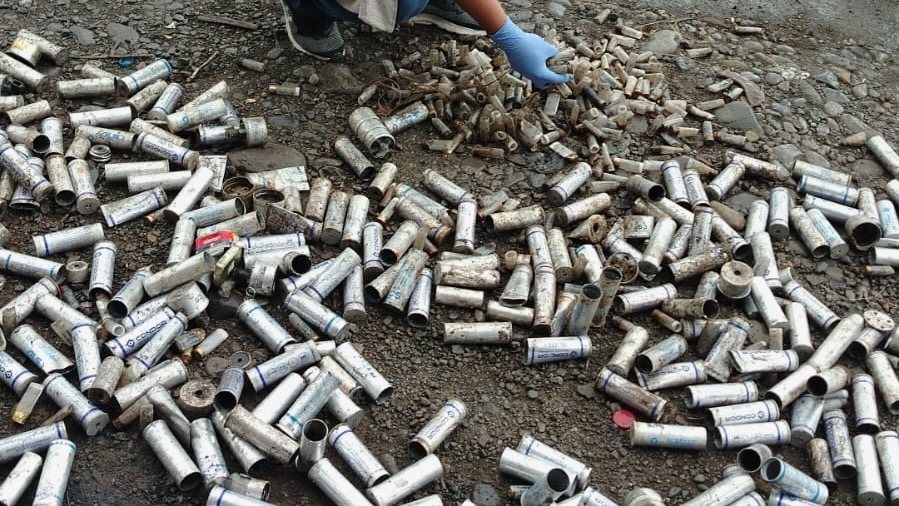
Ammunition used against protestors, which led to the death of a young girl, Michelle Becker, from the large amount of tear gas that filled her home. Photo: Claridad Panamá

The demonstrations, which have lasted more than 70 days, have been firmly repressed by the Mulino government, which has affirmed that it will not repeal the social security law that has caused so much controversy.

On July 5, nearly 800 people from 17 countries signed a letter addressed to the president of Panama, José Raúl Mulino, calling for international observation due to the increasing repression of protests in Panama. The document, signed by academics, artists, activists, workers, and trade unionists, also points out that the Central American country is witnessing growing criminalization of political dissent, which, according to the document, is reminiscent of the darkest years in its national history. Furthermore, the letter adds that the government is demonstrating an “authoritarian drift”.

The letter states: “President Mulino leads a legally legitimate government, but with minimal support. And he has responded to a wave of legitimate and democratic protests most violently and systematically ever recorded in the country’s history since 1903.”

For more than 70 days, thousands of Panamanians have taken to the streets, closed roads, and staged strikes against the neoliberal policies of the Mulino government. The demonstrators are demanding the repeal of:

  1. A law reforming Social Security – reducing pensions and opening the door for the privatization of the system. 
  2. Growing US interference – according to the demonstrators, the US intends to install several military bases in Panama.
  3. The reopening of a copper mine – the largest and most controversial in the country, already closed by the Panamanian justice system.

On June 20, the government suspended constitutional rights for 10 days in the banana-producing province of Bocas del Toro, the most active in the protests. According to the government, the measure was taken to safeguard the security of the area, although several demonstrators called that an excuse to persecute and imprison the leaders of the protests. More than 200 people have been arrested, including local community leaders.

In this regard, the letter states: “The step taken by the Executive to suspend constitutional guarantees in the province of Bocas del Toro makes it, de facto, an authoritarian government willing to suspend the Constitution when it is unable to negotiate, dialogue or listen to its people… The abuse of power of the State through the security forces and the arguments used to justify the violation of human rights, repression, and the prosecution of leaders are not acceptable in any way.”

Therefore, the letter denounces that the country is “going backwards in terms of human rights” and requests the immediate intervention of international human rights agencies to address the Panamanian situation and thus guarantee the fundamental freedoms of demonstrators and citizens alike.

Read more: Labor wins and increased repression: 50 days of Panama’s national strike

A few days ago, Roger Montezuma joined Michelle Becker and Arcenio Abrego on the growing list of those who have been killed during anti-government demonstrations. Montezuma, according to some accounts, was killed in Bocas del Todo in the context of “Operation Omega”, a campaign by the national police that protestors describe as “a bloody repression”.

For this and other cases, the National Human Rights Commission (CNDH) and the Indigenous Peasant Movement of the Ngäbe Buglé region requested that the legislature establish a commission specialized in studying cases of human rights violations to monitor the protests. The CNDH presented more than 100 alleged cases of human rights violations, including alleged arbitrary detentions, humiliating treatment, deaths, etc. The legislature has not yet offered a response to the request.

Thus, the Panamanian political dispute has led to a massive confrontation between protesters and the forces of law and order, which is still not over. 

However, as the days go by, more and more denunciations are surfacing in the media, increasing the discomfort for moderate Panamanians (former allies of Mulino), and raising concerns among international actors about partnering with a government that is widely seen as repressive.

Original article by Pablo Meriguet republished from peoples dispatch under a Creative Commons Attribution-ShareAlike 4.0 (CC BY-SA) license.
Continue ReadingRepression of protests continues in Panama

Trump announces 50% tariff on Brazilian goods in letter attacking the Supreme Court and defending Bolsonaro

Spread the love

Original article by Brasil de Fato republished from peoples dispatch under a Creative Commons Attribution-ShareAlike 4.0 (CC BY-SA) license.
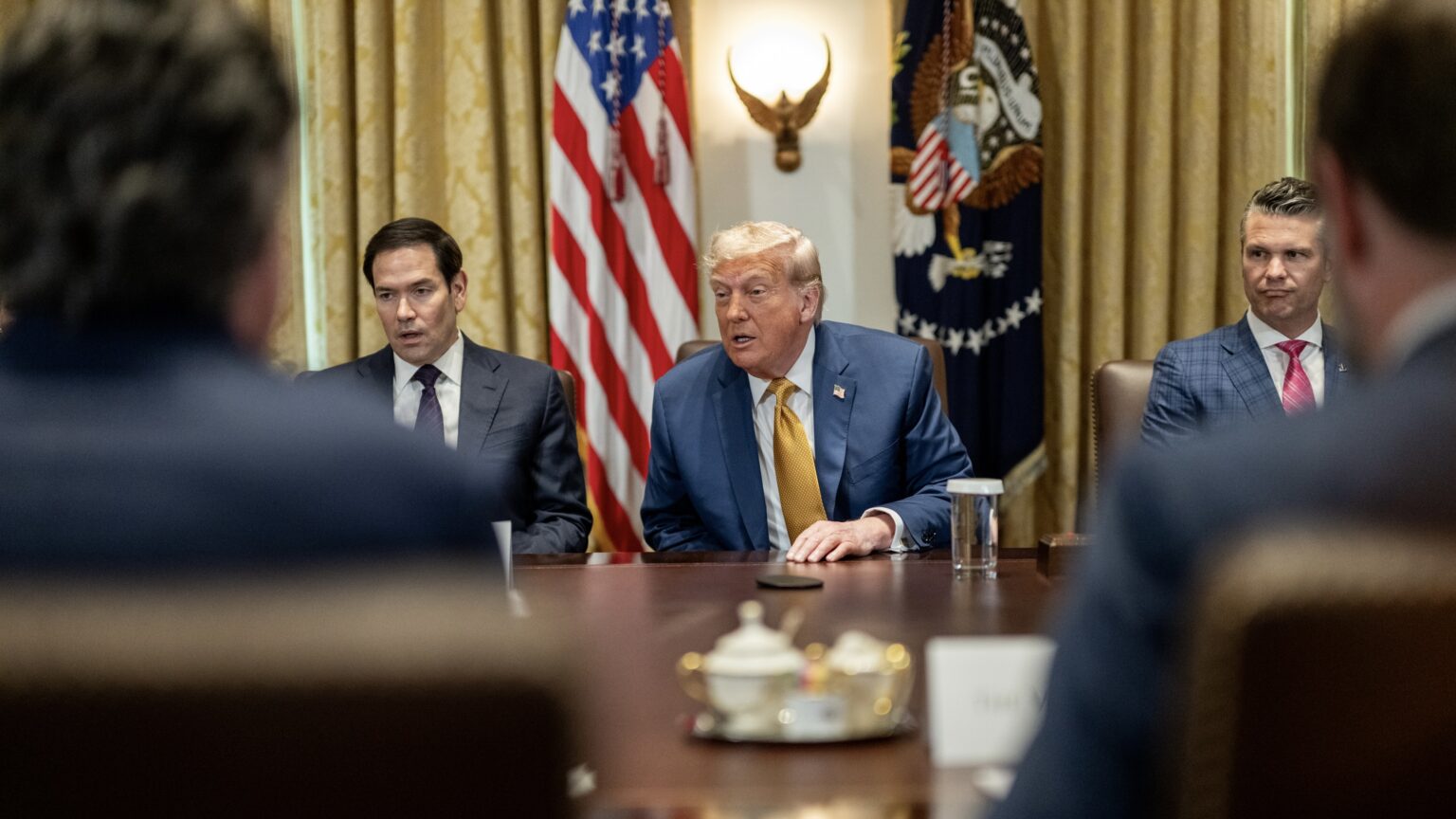
US Secretary of State Marco Rubio, US President Donald Trump, and US Secretary of Defense Pete Hegseth in a Cabinet Meeting. Photo: White House

The billionaire president claimed that trade relations with Brazil are unfair to the US. Lula has called a meeting to discuss a response.

US President Donald Trump has announced that products imported from Brazil will be subject to 50% tariffs starting in August. The application of the tariffs was announced in a letter published on Wednesday, July 9, on social media.

Addressed to the President of the Republic, Luiz Inácio Lula da Silva, the message begins with a direct defense of Jair Bolsonaro and criticism of “the way Brazil has been treating the former president”, which he classified as an “international disgrace”.

Referring to the case against Bolsonaro in the Supreme Court (STF), Trump emphasizes: “This trial should not be happening. It is a witch hunt that must end IMMEDIATELY!”

It is worth noting that the US president has no authority over the decisions of the Brazilian judiciary.

In his letter to Lula, he states that the decision on tariffs is based on attacks on free elections and freedom of expression in Brazil.

“(As lately illustrated by the Brazilian Supreme Court, which has issued hundreds of SECRET and UNLAWFUL Censorship Orders to US Social Media platforms, threatening them with Millions of Dollars in Fines and Eviction from the Brazilian Social Media market),” Trump declares.

After the political justification, he adds that trade relations with Brazil are unfair to the United States. However, the trade balance between the two nations has been in surplus for the US for more than ten years.

The percentage announced by Trump for Brazilian products is the highest among those most recently defined by the US government. In the letter, the US president argues that the country should distance itself from its trade relationship with Brazil.

He goes so far as to say that the 50% rate “is far too low” to bring about a level playing field between the two nations. According to Trump, the US Trade Representative’s Office (USTR) will launch an investigation into Brazil under the US Trade Act.

The intention of this type of approach is to determine whether there has been any violation of trade agreements. If irregularities are found, the US may take action through the World Trade Organization (WTO).

In a threatening tone, Trump states that if Brazil decides to take similar measures in response to the new tariff, the US will raise the rate by another 50%. He ends the letter by saying that the decision may be modified upward or downward depending on Brazil’s relationship with the US.

“If you wish to open your heretofore closed Trading Markets to the United States, and eliminate your Tariff, and Non-Tariff, Policies and Trade Barriers, we will, perhaps, consider an adjustment to this letter,” he writes.

Reaction

After the letter was released, President Lula called an emergency meeting to discuss Brazil’s response to Trump. According to information released in the press, Vice President Geraldo Alckmin, also minister of Development, Industry, Trade, and Services, Fernando Haddad (Finance), Mauro Vieira (International Relations), and Rui Costa (Chief of Staff) are participating in the meeting.

On social media, Workers’ Party senator and leader of the Senate, Jaques Wagner called for respect for Brazil and criticized the measure, which he attributed to a “request from the Bolsonaro family”.

“At the request of the Bolsonaro family, Donald Trump has announced a 50% tax on all Brazilian products, in an authoritarian and unilateral manner. The US president is confusing who he is addressing. Brazil will not be anyone’s backyard. We are the ones who decide our own lives. Let this be clear: Brazil belongs to Brazilians, not to lackeys!” he posted.

This was first published in Portuguese at Brasil de Fato.

Original article by Brasil de Fato republished from peoples dispatch under a Creative Commons Attribution-ShareAlike 4.0 (CC BY-SA) license.
Continue ReadingTrump announces 50% tariff on Brazilian goods in letter attacking the Supreme Court and defending Bolsonaro

Massive Expansion of Trump’s Deportation Machine Passes With Little Press Notice

Spread the love

Original article by Belén Fernández republished from FAIR under a Creative Commons Attribution-NonCommercial-NoDerivs 3.0 Unported License.

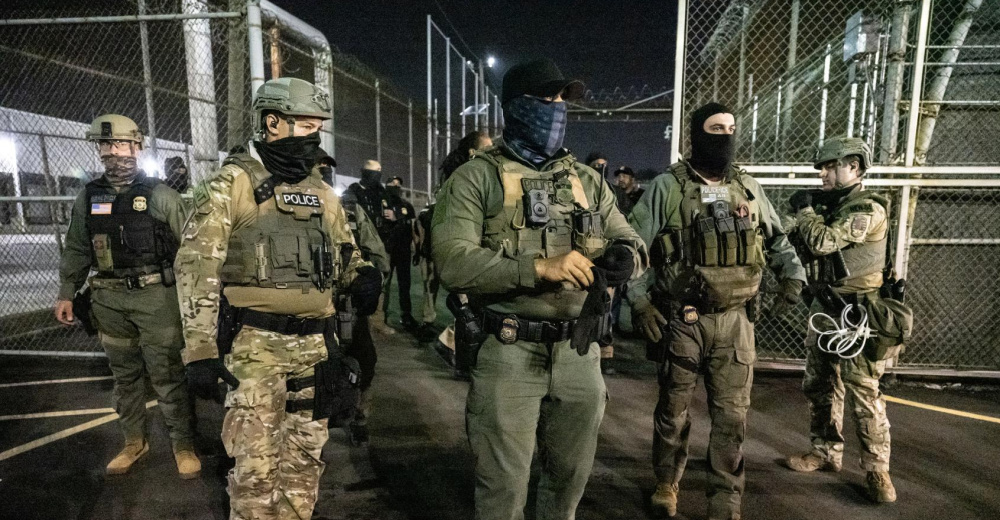
Masked ICE agents, depicted in Salon (photo: Stephanie Keith/Getty Images)

Salon: ICE’s $175 billion windfall: Trump’s mass deportation force set to receive military-level funding

Salon (7/3/25): “The funds going towards deportation would…be enough to fully fund the program to end world hunger for four years.”

And so it has come to pass: US President Donald Trump’s “big, beautiful bill” has set the stage for tax cuts for the rich, slashed services for the poor, and a host of other things that qualify as “beautiful” in the present dystopia. Some cuts, like those to Medicaid, have been heavily covered by the corporate media. But one key piece of the bill has gotten much less media scrutiny: The preposterous sum of $175 billion has been allocated to fund Trump’s signature mass deportation campaign, which, as a Salon article (7/3/25) points out, exceeds the military budget for every single country in the world aside from the US and China.

Approximately $30 billion of that is destined directly for US Immigration and Customs Enforcement (ICE), the goons who have recently made a name for themselves by going around in masks and kidnapping people. This constitutes a threefold increase over ICE’s previous budget, and propels the outfit to the position of the largest US federal law enforcement agency in history. $45 billion will go toward building new ICE detention centers, including family detention centers.

Prior to the signing into law of the sweeping bill on July 4, US Vice President JD Vance took to X to highlight what really mattered in the legislation:

Everything else—the CBO [Congressional Budget Office] score, the proper baseline, the minutiae of the Medicaid policy—is immaterial compared to the ICE money and immigration enforcement provisions.

Scant attention to ICE expansion

NPR: 9 Questions About the Republican Megabill, Answered

“What happens if we spend more than the military budget of Russia on deportation?” was not a question the New York Times (7/3/25) thought needed answering.

And yet many US corporate media outlets have paid scant attention to this aspect of the bill and refrained from delving too deeply into the matter of what exactly this massive ramping up of ICE portends for American society. According to a search of the Nexis news database, while half (50%) of newspaper articles and news transcripts mentioning the reconciliation bill from its first passage in the House (May 20) to its signing into law (July 4) also mentioned Medicaid, less than 6% named Immigration and Customs Enforcement or ICE.

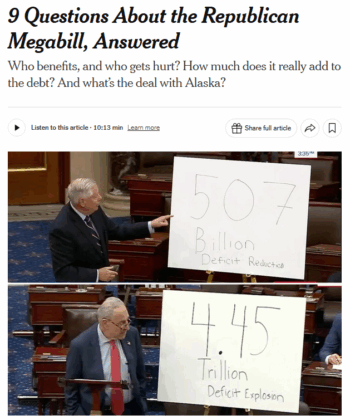
Even many of those that did mention ICE barely gave it any attention. On July 3, for example, the New York Times presented readers with “Nine Questions About the Republican Megabill, Answered,” which in response to the first question—“Why is it being called a megabill?”—did manage to mention “a 150% boost to the Immigration and Customs Enforcement budget over the next five years.” However, there was no further discussion in the article’s remaining 1,500-plus words of potential ramifications of this boost—although there was a section devoted to the “tax break for Native Alaskan subsistence whaling captains.”

That was more than CNN’s intervention managed, also published on July 3, and headlined “Here’s Who Stands to Gain From the ‘Big, Beautiful Bill.’ And Who May Struggle.” The article aced a couple of no-brainers, including that “corporate America” would be “better off” thanks to the bill, while “low-income Americans” would be “worse off.” But there was not a single reference to the ICE budget—or who might “struggle” because of it.

‘Detention blitz’

WaPo: ICE prepares detention blitz with historic $45 billion in funding

Washington Post (7/4/25): “Immigrant rights advocates are imploring the government not to award more contracts to…companies they say have failed to provide safe accommodations and adequate medical care to detainees.”

This is not to imply, of course, that there are no articles detailing what ICE has been up to in terms of persecuting refuge seekers, visa holders, legal US residents and even US citizens—who supposedly have greater protections under the law—and how all of this stands to get worse, in accordance with the impending deluge of anti-immigration funds.

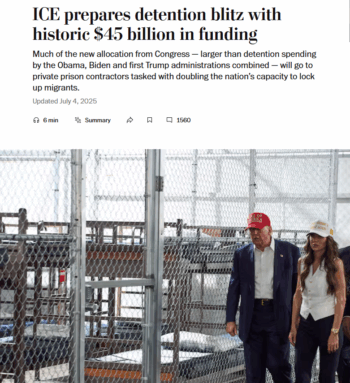
In its report on ICE’s looming “detention blitz,” the Washington Post (7/4/25) noted that “at least 10 immigrants died while in ICE’s custody during the first half of this year,” and cited the finding that ICE is “now arresting people with no criminal charges at a higher rate than people charged with crimes.”

The Post article also contained sufficiently thought-provoking details to enable the conscientious reader to draw their own conclusions regarding the ultimate purpose of manic detention schemes. (Hint: it’s not to keep America “safe.”) For instance, we learn that the share prices of GEO Group and CoreCivic—the two largest detention companies contracted by ICE, which have notorious reputations for detainee mistreatment—“each rose about 3%… as investors cheered the passage of congressional funding likely to result in a flurry of new contracts.”

Lest there remain any doubt as to the centrality of profit flows to the immigration crackdown, the article specifies that GEO Group and CoreCivic “each gave $500,000 to President Donald Trump’s inauguration, according to Federal Election Commission data.”

This article, however, came after the legislation was passed.

Post opinion piece (6/30/25), meanwhile, put a human face on some of ICE’s victims, such as Jermaine Thomas, born to a US soldier on a military base in Germany. Following an incident of “suspected trespassing” in Texas, Thomas was deported by ICE to Jamaica, a country he had never set foot in. Other victims spotlighted by the Post include 64-year-old Iranian immigrant Madonna Kashanian, nabbed while gardening at her house in New Orleans, and a six-year-old Honduran boy with leukemia who was arrested at an immigration court in California while pursuing his asylum case with his family.

It was also possible, if one sought it out, to find reporting on what the cash infusion entails from a logistical perspective: more agents, more arrests, more racial profilingincreased detention capacity, and a deportation system that runs “like Amazon, trying to get your product delivered in 24 hours,” as ICE’s acting director Todd Lyons charmingly put it.

‘Police state first’

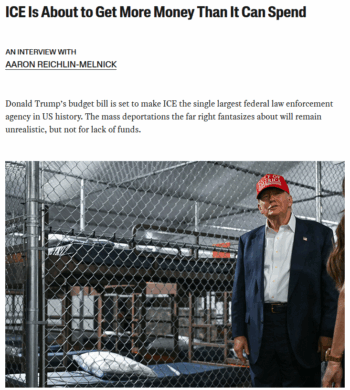
Jacobin: ICE Is About to Get More Money Than It Can Spend

Aaron Reichlin-Melnick (Jacobin7/3/25): “Mass deportation wouldn’t only reshape American society and cause the economy to go into a tailspin. It would also lead to a very different relationship between the US populace and law enforcement.”

Gutting Medicaid is certainly an angle on the reconciliation bill that deserved the media attention it got, and will devastate millions in this country. But the massive infusion of money and power to ICE will likewise devastate millions with a ballooning police state that unleashes terror, rips apart families and creates a network of concentration camps across the country. Given ICE’s contemporary track record and de facto exemption from the constraints of due process, the public desperately needs a media that will connect the dots in order to convey a bigger-picture look of what America is up against.

In an interview with Jacobin magazine (7/3/25) on how “ICE Is About to Get More Money Than It Can Spend,” Aaron Reichlin-Melnick—a senior fellow at the American Immigration Council—made the crucial observation: “You don’t build the mass deportation machine without building the police state first.”

This is precisely the analysis that is missing from corporate media coverage of the bill. Beyond making life hell for the undocumented workers on whose very labor the US economy depends, ICE has become a tool for political repression as well—as evidenced by a slew of recent episodes involving the abduction and disappearance of international scholars whose political opinions did not coincide with those of the commander in chief of our, um, democracy.

Take the case of 30-year-old Rümeysa Öztürk, a Turkish doctoral student and Fulbright scholar studying childhood development at Tufts University in Massachusetts. While walking to an iftar dinner in March, Öztürk was accosted by six plainclothes officers, some of them masked, and forced into an unmarked van, after which she was flown halfway across the country to an ICE detention center in Louisiana. Her crime, apparently, was to have co-written an opinion piece last year for the Tufts Daily (3/26/24), in which she and her co-authors encouraged the university to accede to demands by the Tufts Community Union Senate by recognizing the Israeli genocide in the Gaza Strip and divesting from companies with ties to Israel.

Öztürk’s case is hardly an isolated one. There’s Badar Khan Suri, a postdoctoral researcher at Georgetown University who was seized by masked agents outside his Virginia home and swept off to an ICE facility in Texas. There’s Momodou Taal, a British-Gambian former PhD student at Cornell who sued the Trump administration over the crackdown on Palestine solidarity and then self-deported, explaining that he had “lost faith [he] could walk the streets without being abducted.” And the list goes on (Al Jazeera5/15/25).

‘Homegrowns are next’

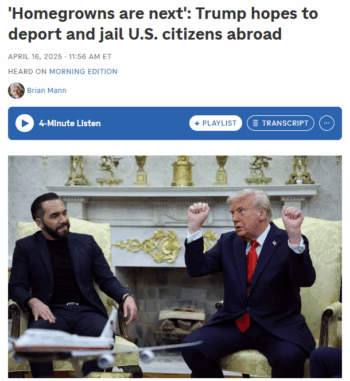
NPR: 'Homegrowns are next': Trump hopes to deport and jail U.S. citizens abroad

Supreme Court Justice Sonia Sotomayor (NPR4/15/25): The Trump administration believes it “could deport and incarcerate any person, including US citizens, without legal consequence, so long as it does so before a court can intervene.”

In the twisted view of the US government, of course, opposing the US-backed genocide of Palestinians equals support for “terrorism”—and in Trump’s view, basically anything that goes against his own thinking and policies potentially constitutes a criminal offense. It follows that Öztürk-style politically motivated kidnappings by the state are presumably merely the top of a very slippery slope that US citizens, too, will soon find themselves careening down—especially as Trump has already exhibited enthusiasm at the prospect of outsourcing the incarceration of US citizens to El Salvador: “The homegrowns are next,” he told Salvadoran autocrat Nayib Bukele.

The line between citizens and residents has been intentionally blurred, with the Trump Justice Department announcing it was “Prioritizing Denaturalization”—that is, stripping citizenship from foreign-born citizens. This draconian punishment has been proposed for Trump’s political enemies, from New York mayoral candidate Zohran Mamdani to former BFF Elon Musk. Trump has also taken aim at the constitutional right of birthright citizenship, potentially turning millions of other Americans into ICE targets.

Somehow, the elite media have not deemed it necessary to dwell even superficially on the implications of super-funding a rogue agency that has essentially been given carte blanche to indiscriminately round people up—be they undocumented workers, political dissidents, or just somebody who “looks like somebody we are looking for.” As for CNN’s write-up on “who stands to gain from the ‘big, beautiful bill,’” it’s definitely not all the folks currently living in a permanent state of fear, deprived of basic freedoms like movement, speech and thought.

Original article by Belén Fernández republished from FAIR under a Creative Commons Attribution-NonCommercial-NoDerivs 3.0 Unported License.

Donald Fuhrump says that Amerikkka doesn't bother with crimes or charges anymore, not being 100% Amerikkkan and opposing his real estate intentions is enough.
Donald Fuhrump says that Amerikkka doesn’t bother with crimes or charges anymore, not being 100% Amerikkkan and opposing his real estate intentions is enough.
Continue ReadingMassive Expansion of Trump’s Deportation Machine Passes With Little Press Notice

Shetland Schoolchildren Study in Classrooms Sponsored by Norwegian Oil Giant

Spread the love

Original article by Ellen Ormesher republished from DeSmog.

A mobile “Newton Room” classroom operating in Scotland. Credit: Scott O’Hara

Critics fear that Equinor’s latest UK education deal is aimed at quelling opposition to North Sea drilling.

This story was published in partnership with Norway’s E24.

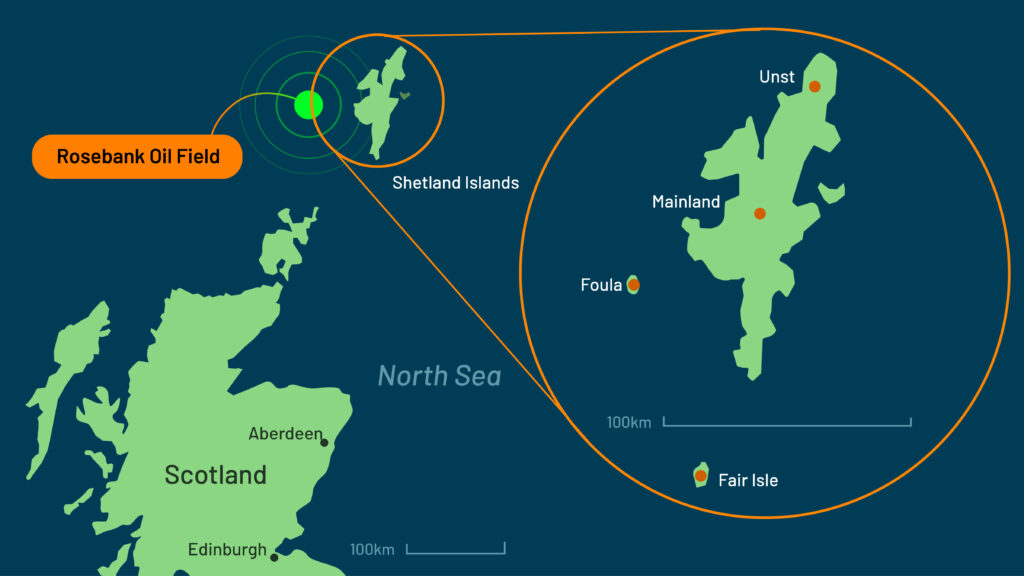
Norwegian oil company Equinor is spending more than £200,000 to sponsor science classrooms in the Shetland Islands, as it seeks approval for plans to develop the vast Rosebank oilfield 80 miles off the coast.

Opponents of Rosebank — the largest new oil and gas field in the North Sea — have accused Equinor of using its deep pockets to dilute concerns over further drilling. Developing the project would result the release of millions of tonnes of planet-heating carbon dioxide (CO2) emissions when the oil it pumps is burned.

Ariane Burgess, a Scottish Green Member of the Scottish Parliament, said Equinor’s backing for the classrooms was “concerning.”

“The timing and location of these investments raise questions about the motives behind them, particularly in light of Equinor’s broader strategy to secure social license to operate in sensitive areas,” said Burgess, one of seven Scottish Green law-makers in the 129-seat assembly in Edinburgh.

The pop-up classroom — known as a “Newton Room” — launched in March and aims to reach 1,000 children aged 10 to 14 across the archipelago of 20,000 people over the next two years, said Highlands and Islands Enterprise, a Scottish agency partnering on the project.

The classroom will be set up in community centres near primary and secondary schools on several of Shetland’s 16 inhabited islands, taking in the Shetland mainland, Unst, Foula, Yell and Fair Isle.

Equinor, which is majority-owned by the Norwegian state, said the project would deliver “pioneering, face-to-face” programmes to develop science, technology, engineering and mathematics skills. The decision to fund the initiative had “no link” to Equinor’s plan to develop Rosebank, and it had declined an opportunity to include its corporate logo, the company said.

“We are proud to support the first Shetland mobile Newton Room and to assist its core operations in the Highlands and Islands,” said Alice Baxter, Equinor’s UK spokesperson. “We look forward to seeing how the mobile Newton Room benefits the wider Shetland community and are delighted to be a key partner in this great programme for the region.”

Credit: Sabrina Bedford

‘Brainwash Children’

Equinor spent a total of $82.7 million on sponsorships between 2020 and 2024, with science, education and research as the main focus, according to a government response to a parliamentary question submitted by Lars Haltbrekken, an MP for the Socialist Left Party, on June 16.

Haltbrekken, a long-time critic of Equinor’s 30-year history of sponsoring education in Norway, had submitted the question in response to reports in Norwegian media detailing the company’s backing for a computer game aimed at UK schoolchildren. The game, called EnergyTown, was developed in partnership with London-based marketing agency We Are Futures and the Association for Science Education, a professional teachers’ body.

Climate campaigners said the game crossed the line between education and promoting fossil fuels because it portrayed renewable energy as “less reliable.”

EnergyTown was part of a two-year-old science education initiative called Wonderverse which has reached over 80,000 schoolchildren in the UK, according to Equinor’s website. Website copy that has since been deleted described Wonderverse as designed to “build future talent pipelines and secure permission to operate at a time of sensitivity around fossil fuels, particularly in light of approval for the Rosebank development.” We Are Futures did not respond to a request for comment.

“[Equinor] is trying to brainwash children into thinking it has the solution to the climate crisis, when in reality, fossil fuels are the reason we are struggling with the climate crisis today,” Haltbrekken told DeSmog. 

Equinor, formerly known as Statoil, was the founding partner of the Newton Rooms mobile classroom programme developed by the nonprofit FIRST Scandinavia in Norway in 2003.

“It’s interesting to see how Equinor has developed a playbook for influencing children in Norway and then copy-pasted it to other countries like Scotland,” said Julie Forchhammer, co-founder of Norwegian climate advocacy group Klimakultur. 

In Scotland, Equinor’s current education partnerships include a deal with the Aberdeen Science Centre, a museum near the Norwegian company’s UK headquarters in Aberdeen, and another with the city’s TechFest annual science festival.

Equinor committed £208,500 for the Shetland Islands mobile classroom project as part of a total package of £385,000 to support the Science Skills Academy education initiative run by Highlands and Islands Enterprise, said Morven Fancey, the agency’s head of housing, skills and population.

“Our core content and supporting educational materials for Newton Room activities were developed at the beginning of the Highland operation and are branded by [Science Skills Academy] independently of any industry involvement,” Fancey said.

Island Opinion Divided

The sponsorship deal with Highlands and Islands Enterprise was agreed in 2023, Fancey said. That was the same year that Equinor won approval for Rosebank from the UK’s former Conservative government, sparking outcry among climate campaigners.

Equinor is now seeking re-approval for Rosebank after Scotland’s highest court dealt a blow to the project in January by ruling the original decision unlawful because it had failed to consider the environmental impacts of burning the fossil fuels extracted from the oilfield.

Opening any new oil and gas fields in the North Sea is incompatible with achieving 2015 Paris Agreement goals of avoiding catastrophic climate change by limiting global warming to 1.5°C, according to a June report by academics at University College London. Burning Rosebank’s oil and gas would produce up to 200 million tonnes of CO2 over the project’s lifetime, which is more than the combined annual emissions of 28-low income countries, wrote one of the report’s authors in an article for The Conversation. 

Opinion over Equinor’s role in sponsoring the classrooms is divided on the Shetland Islands, which have historically benefitted from oil and gas money.

“In Shetland, the fact that our kids have amazing leisure facilities, the roads have no potholes, and the care homes are good is all because of fossil fuels,” said Margaret Goddard, a doctor who lives on the islands of Burra, and who has daughters aged 11 and 14.

But she expressed concerns over the climate crisis, and Equinor’s motives, acknowledging, “These things are very difficult.”

Alex Armitage, a Scottish Green councillor for Shetland Islands Council said he found Equinor’s role “quite dystopian.”

“An oil company that’s making very little effort to reduce carbon emissions and is greenwashing all of its operations is seeking to show that it’s trying to help the next generation,” Armitage said. “Everything it’s doing goes against that.”

Like other oil companies, Equinor has rowed back on its climate commitments in the past year, having announced in February that it would slash planned investment in renewables and low-carbon solutions by around 50 percent between 2024 and 2027. By 2026, Equinor plans to maintain over 95 percent of its energy production from fossil fuels, according to analysis by the environmental law nonprofit ClientEarth.

Equinor holds an 80 percent stake in Rosebank in a joint venture with Ithaca Energy, which is owned by Israel’s Delek Group. In 2023, Delek Group appeared on a UN list of 97 companies whose activities in the West Bank “raised particular human rights concerns.”

‘Extensive Influence’

Oil companies view educational and cultural sponsorships as crucial tools for deflecting pressure from climate activists, influencing legislation, and portraying themselves as gatekeepers to climate solutions, according to a previous DeSmog review of internal industry documents subpoenaed by the U.S Congress as part of an investigation into oil industry disinformation that concluded last year.  

Equinor was not a direct target of the investigation, which focused on the U.S. businesses of ExxonMobil , Chevron, Shell USA Inc. and BP America. The Norwegian company is, however, a member of the American Petroleum Institute lobby group, which described sponsored community groups as among the “best and most influential voices with targeted policymakers on industry issues,” according to a subpoenaed document from October 2017. 

The findings built on previous research showing how the fossil fuel industry has spent nearly a century using educational sponsorships to shape public opinion about energy and the environment. As early as 1928, Standard Oil of California (which became Chevron) was sponsoring educational radio broadcasts that reached millions of American students over decades. Recent programmes include BP’s Science Explorers, a series of free online resources that now reaches over half of UK secondary schools.

In the latest sign of the oil and gas industry seeking to influence young people, DeSmog reported on June 30 that a group of six Canadian fossil fuel companies known as Pathways Alliance had been sponsoring science fairs for children. The finding followed a report issued by the Canadian Association of Physicians for the Environment earlier this year that documented the sector’s “extensive influence on climate education for elementary and secondary school students.”

‘Cynical Tactic’

Equinor has been a sponsor of the Aberdeen Science Centre since 2019, funding the facility and supporting its partnership with Norway’s Vitenfabrikken (The Science Factory), a children’s science museum in the city of Bergen. The two institutions are linked via an initiative called the North Sea Collaboration Project, which develops science and technology activities aimed at children, focused on “carbon emissions reduction solutions” and climate awareness, according to the Aberdeen Science Centre’s website.

Aberdeen Science Centre did not respond to a request for comment.

The TechFest event, which Equinor sponsors alongside BP and Shell, includes Equinor branding in its 2025 programme directory next to listings for workshops aimed at children as young as four. TechFest did not respond to a request for comment.

Through its Hywind floating wind project, Equinor provided £60,000 to transform a disused classroom at Peterhead Academy into what the school called an “ultra-modern” renewables space, complete with screens, break-out areas and turbine models, which opened in 2018, according to trade publication Energy Voice.

Peterhead is also the site of a planned Equinor carbon capture and storage project, which is facing questions over its likely economic viability and climate impact. DeSmog revealed in June that UK Chancellor Rachel Reeves had told Equinor last year that the industry would receive a “quid pro quo” in return for higher taxes on its windfall profits in the form of carbon capture subsidies.

Such programmes reflect a broader oil industry strategy to preserve its reputation among future generations, said Klimakultur’s Forchhammer. “It’s a cynical tactic, but they wouldn’t do it if it wasn’t working.”

Additional reporting by Daniel Shailer, Shetland Times

Original article by Ellen Ormesher republished from DeSmog.

Continue ReadingShetland Schoolchildren Study in Classrooms Sponsored by Norwegian Oil Giant