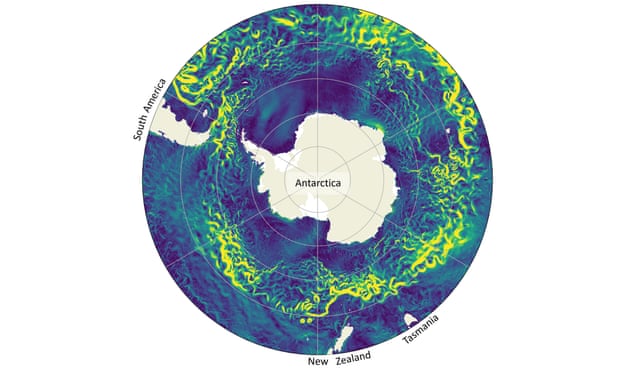
Antarctic Circumpolar Current (in yellow). Climate models show the current could slow down 20% by 2050. Illustration: Dr Taimoor Sohail
Melting Antarctic ice is releasing cold, fresh water into the ocean, which is projected to cause the slowdown
In a high emissions future, the world’s strongest ocean current could slow down by 20% by 2050, further accelerating Antarctic ice sheet melting and sea level rise, an Australian-led study has found.
The Antarctic Circumpolar Current – a clockwise current more than four times stronger than the Gulf Stream that links the Atlantic, Pacific and Indian oceans – plays a critical role in the climate system by influencing the uptake of heat and carbon dioxide in the ocean and preventing warmer waters from reaching Antarctica.
Using Australia’s fastest supercomputer and climate simulator, Gadi, located at Access National Research Infrastructure in Canberra, the researchers used climate models to analyse the impact of changing temperature, ice melting and wind conditions on the Antarctic Circumpolar Current.
The results, published in Environmental Research Letters, revealed a clear link between meltwater from Antarctic ice shelves and circumpolar current slowdown, and comes less than a week after another paper anticipated a weakening in vital Atlantic Ocean currents.
What they found suggested a “substantial reconfiguration of Southern Ocean dynamics”, with “far-reaching impacts on global climate patterns, oceanic heat distribution, and marine ecosystems”.
Co-author Assoc Prof Bishakhdatta Gayen, from the University of Melbourne, described the result as “quite alarming”.
He explained that as melting Antarctic ice released cold, fresh water into the ocean, this sank and spread towards the equator. That flow of fresh water changed the density variation in the ocean, a key driver of movement, causing the slowdown.
“The ocean is extremely complex and finely balanced. If this current ‘engine’ breaks down, there could be severe consequences, including more climate variability, with greater extremes in certain regions, and accelerated global warming due to a reduction in the ocean’s capacity to act as a carbon sink,” Gayen said.
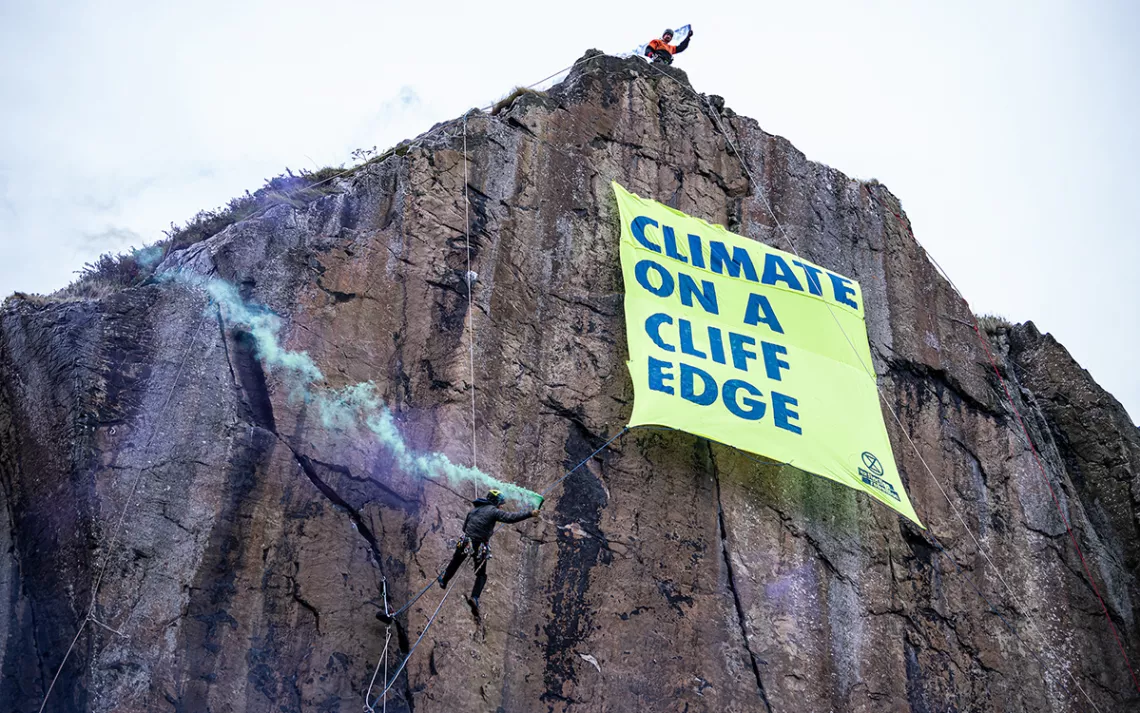
Experienced climbers scale a rock face near the historic Dumbarton castle in Glasgow, releasing a banner that reads “Climate on a Cliff Edge.” One activist, dressed as a globe, symbolically looms near the edge, while another plays the bagpipes on the shores below. | Photo courtesy of Extinction Rebellion and Mark RichardsNeo-Fascist Climate Science Denier Donald Trump says Burn, Baby, Burn.
U.S. Energy Secretary Chris Wright speaking at the 2025 Alliance for Responsible Citizenship conference. Credit: ARC / YouTube
The Trump appointee and fossil fuel executive called the transition to renewable energy “lunacy” at an event packed with climate science deniers.
Donald Trump’s new energy secretary has today vowed to “get out of the way” of coal, oil and gas, and called the UK’s 2050 net zero target “a sinister goal” that would “impoverish” people.
Chris Wright, an oil and gas industry executive appointed by U.S. President Trump, was speaking via video link at the Alliance for Responsible Citizenship (ARC) conference in London, a right-wing forum run by fierce opponents of climate policies.
He also downplayed the threat from extreme weather, and suggested that climate action is part of a plot to “grow government power” and “shrink human freedom”.
The ARC conference, taking place this week at the ExCel centre in east London, includes speeches by Conservative Party leader Kemi Badenoch, Republican Party Speaker of the House Mike Johnson, Reform UK leader Nigel Farage, and Canadian psychologist and ARC founder Jordan Peterson.
As DeSmog revealed on Monday, a leaked guest list for the event includes executives from oil and gas giants, including BP, Koch Inc., Valero Energy, and Energy Transfer.
Until his appointment, Wright was the CEO of the fracking services company Liberty Energy. According to its 2023 tax filing, Wright was also a director of the Western Energy Alliance (WEA), a trade group representing more than 300 companies in the oil and gas industry. WEA has historically lobbied against oil and gas industry restrictions.
In a video posted to LinkedIn in January 2023, Wright said, “There is no climate crisis”.
‘Sinister Agenda’
Wright told the ARC audience today that he wanted to “increase the supply of affordable, reliable energy” by lifting the pause on natural gas and scrapping regulations on nuclear energy.
When asked about coal, oil and gas, he said: “Oh absolutely. The world today runs on coal oil and gas, and it’s been a tremendous success. I should have said number one [of his plan] is get out of the way of the production, export and enhancement of our volumes of coal, oil and gas.”
The energy secretary also attacked the UK’s legally-binding target of cutting emissions to net zero by 2050.
“Net zero 2050 is a sinister goal”, he said. “It’s a terrible goal. It’s both unachievable by any practical means, but the aggressive pursuit of it – and you’re sitting in a country that has aggressively pursued this goal – has not delivered any benefits, but it’s delivered tremendous cost.”
He added: “This is not energy transition, this is lunacy. This is impoverishing your own citizens in a delusion that this is somehow gonna make the world a better place. It’s not.”
The world’s foremost climate science body, the UN’s Intergovernmental Panel on Climate Change (IPCC), has stated that – without achieving net zero by 2050 and limiting warming to 1.5C – the world will struggle to contain the worst effects of climate change. These include droughts, flooding, poverty, and mass displacement.
Wright went on to claim that “We’re scaring children all the time with stories of extreme weather” when “deaths from extreme weather have plummeted for 100 years”.
Better forecasting and preparation have cut extreme weather deaths over this period, but the number and intensity of extreme weather events have increased, and they continue to be disproportionately fatal in the least developed countries.
The energy secretary also claimed that “climate-obsessed people […] know very little about the climate data”, before alluding to the conspiracy theory that climate change is being used to impose a green tyranny.
“I think the agenda might be different here than climate change”, he said. “It’s certainly been a powerful tool used to grow government power, top down control, and shrink human freedom. This is sinister.”
Oil and Gas at ARC
Senior representatives from several major fossil fuel producers will be at the ARC event, according to a leaked list of attendees viewed by DeSmog.
Billed as an effort to “re-lay the foundations of civilization,” the conference will feature panels about energy and environment that are filled with prominent deniers of the climate crisis.
That includes Vivek Ramaswamy, a former contender for the U.S. Republican presidential nomination, who has referred to the “climate agenda” as a “hoax,” as well as Nigel Farage, who has called for the UK’s 2050 net zero emissions policies to be “scrapped” entirely.
They will be joined by representatives of prominent climate denial organizations including the CO2 Coalition, and libertarian anti-climate think tanks such as the Cato Institute.
“I had a chance to sit down one-on-one with Chris in 2022 in his Denver office,” claimed Gregory Wrightstone, executive director of the CO2 Coalition, in a newsletter in late 2024.
Wrightstone “was impressed with his [Wright’s] knowledge and views on energy philosophy, which aligned closely with those of the CO2 Coalition.”
“The key takeaway is that he’s a big supporter of the continuing use of fossil fuels, including coal, oil, and natural gas,” Wrightstone said.
ARC is backed by the UAE-based investment firm Legatum Group and British hedge fund millionaire Paul Marshall, who together own the right-wing broadcaster GB News. Marshall provided £1 million in funding to ARC in 2023, which is run by Conservative peer and UK government advisor Baroness Philippa Stroud.
Speaking to the Financial Times ahead of the conference, Marshall claimed that Britain is “going bust” in its pursuit of net zero. As revealed by DeSmog, Paul Marshall’s hedge fund held £1.8 million worth of shares in fossil fuel companies – including in oil and gas giants Chevron, Shell, and Equinor – as of June 2023. One of Marshall Wace’s biggest investors, U.S. private equity firm KKR, also has a large fossil fuel portfolio, including 188 assets in oil, gas, and coal.
Neo-Fascist Climate Science Denier Donald Trump says Burn, Baby, Burn.Experienced climbers scale a rock face near the historic Dumbarton castle in Glasgow, releasing a banner that reads “Climate on a Cliff Edge.” One activist, dressed as a globe, symbolically looms near the edge, while another plays the bagpipes on the shores below. | Photo courtesy of Extinction Rebellion and Mark Richards
Burned trees from the Palisades Fire and dust blown by winds seen from Will Rogers State Park in the Pacific Palisades neighborhood in Los Angeles, California on Jan. 15, 2025. Apu Gomes / Getty Images
Our planet’s plants and soils reached the peak of their ability to absorb carbon dioxide in 2008, and their sequestration rate has been falling ever since, according to a new analysis by a father-and-son team in the United Kingdom.
At first, the added carbon led to warmer temperatures, vegetation growth and a longer growing season. Once a tipping point was reached, however, the combination of heat stress, wildfires, drought, flooding, storms and the spread of new diseases and pests led to a reduction in the amount of carbon plants can soak up.
“The rate of natural sequestration of CO2 from the atmosphere by the terrestrial biosphere peaked in 2008. Atmospheric concentrations will rise more rapidly than previously, in proportion to annual CO2 emissions, as natural sequestration is now declining by 0.25% per year,” the authors of the study wrote. “This effect will accelerate climate change and emphasises the close connection between the climate and nature emergencies. Effort is urgently required to rebuild global biodiversity and to recover its ecosystem services, including natural sequestration.”
Once the tipping point was reached, the chances of unchecked climate breakdown became more likely, reported The Guardian.
Former Chief Executive of the Scottish Environment Protection Agency James Curran, with help from his son Sam, took a detailed look at the world’s changing carbon concentration levels. Their analysis revealed that, since 2008, plants have been absorbing an average of 0.25 percent less carbon dioxide each year.
“The findings are very stark. Emissions now need to fall by 0.3% per year, just to stand still. That’s a tall order since they typically increase by 1.2% per year,” James Curran said, as The Guardian reported.
Experienced climbers scale a rock face near the historic Dumbarton castle in Glasgow, releasing a banner that reads “Climate on a Cliff Edge.” One activist, dressed as a globe, symbolically looms near the edge, while another plays the bagpipes on the shores below. | Photo courtesy of Extinction Rebellion and Mark RichardsNeo-Fascist Climate Science Denier Donald Trump says Burn, Baby, Burn.
Ater a disastrous press conference, it may be Trump, not Zelenskyy, who needs to watch his back | Andrew Harnik/Getty Images
From blowing up at Zelenskyy to fast-tracking Executive Orders, what can we learn from Trump’s recent behaviour?
Donald Trump’s presidency has barely entered its second month, and the change he has brought about has already been so significant and so rapid that it is hard to imagine how his administration will evolve in the long term.
The substantial changes are, in part, due to the extensive planning done in anticipation of his winning a second term. The 900-page Project 2025 put together by the Heritage Foundation has provided a blueprint for Trump’s far-right conservatism that, combined with the decision to act very fast, has allowed him to already issue more than sixty Executive Orders – catching opponents off-guard.
Looking to the future may be better helped by understanding both Trump’s behaviour and his overall outlook on life, with two recent examples pointing the way. Some commentators see the president as an unpredictable figurehead who is hardly able to direct affairs, but that doesn’t face up to his being the locus of power for now and, in any case, he has plenty of determined advisers who have been waiting years for his second presidency.
The first example of Trump’s behaviour was shown by his reaction to a tragedy that happened just after his inauguration, when an American Airlines flight and a US Army helicopter collided and crashed into the Potomac River close to Ronald Reagan National Airport in Washington, DC. All 67 people on board the two aircraft were killed.
While the cause of the crash is still under investigation, within hours Trump had blamed the diversity-linked hiring policies of previous Democrat administrations, claiming they had lowered personnel standards in air traffic control. A tragedy became an occasion for immediate political point scoring.
More recently, we have seen Trump use social media to promote the new ‘Trump Gaza’. The president shared a bizarre AI-generated video in which the area had been ethnically cleansed of its Palestinian population and transformed into “the Riviera of the Middle East”. Perhaps most telling is the full-colour representation of the main street, which Trump envisages as being dominated by a 60-foot high golden statue of himself.
Together, these instances point to someone who is comprehensively self-obsessed. He might be seen as an egotist or narcissist but certainly has an element of the solipsist in his make-up as well. He is, in other words, beyond egocentric.
But Trump’s impact on the world stage has to reckon with how the world is already changing, especially the rise of the global oligarchy, with vast power concentrated in the hands of a few hundred super-rich individuals. It’s clear that the president views these people as the true exemplars of success – he has formed a singularly powerful group of them around him.
Most notable among Trump’s circle of favoured oligarchs is Elon Musk, who supported his 2024 election campaign to the tune of $277m and has since been given an unofficial role in government and attended Cabinet meetings and Oval Office press conferences.
The wealth of Musk and two other oligarchs close to Trump, Jeff Bezos and Mark Zuckerberg, extends to $905bn, as US Senator Bernie Sanders reminded us last month. Writing in the Guardian, Sanders pointed out that this is “more wealth than the bottom half of American society – 170 million people”, adding that “since Trump’s election their wealth has grown by $217bn”.
This is in line with the findings in Oxfam’s 2025 Davos Report, which last week reported that while the number of people in poverty has remained near stagnant for the past 35 years, extreme wealth is surging. Four more people become billionaires each week, and the world is now on course to have five trillionaires and well over four thousand billionaires within the next decade.
The rising global oligarchy is not easily mapped with precision. Some members of the super-rich stay well out of the public eye, a few become patrons of the arts and philanthropists, but many others are heavily involved in the use of political power.
Though a degree of oligarchic power is evident in many countries worldwide, there are particular concentrations in a handful of nations, particularly Russia, China, India and the US – where Mark Twain’s quip about having “the best government money can buy” still stands.
Between Trump’s personality and his billionaire associates, the best guide to the next four years is to simply assume that ‘self’ and ‘wealth’ will be the president’s constant driving forces. It is not a happy prospect and will require persistent opposition, combined with repeated expressions of more positive ways forward. But is there anything that might limit him as he works to remake the US?
The first answer might just be his very associates. Many incredibly wealthy people are used to getting their own way, which could easily lead to disagreements sufficient to unbalance the administration. That will be much to the dislike and anger of Trump, who may well end up causing great disruption as he finds and disposes of the scapegoats who can keep the blame well away from him.
Then there is internal opposition stemming from numerous legal challenges that are already being mounted, many of them in recognition of the mass use of executive orders, which may undermine the authority of Article II of the US constitution.
Trump is also likely to run into problems due to the huge and vast array of experience and knowledge that will have been lost as a result of his administration’s decision to fire many thousands of federal employees from the Internal Revenue Service, Department of Energy, the Department of Agriculture, the Forestry Service, National Parks, US AID and elsewhere. This is eventually likely to lead to numerous mistakes and delays right across government.
Then there is the matter of US foreign policy, where the ‘Trump Gaza’ fiasco is the clearest possible indicator that Trump just does not have a clue how many people feel. Beyond that, though, is the question of Trump’s view of Vladimir Putin. It is becoming uncomfortably clear that either the Russian president has some kind of hold over Trump or else Trump really does see him as simply another very powerful and hugely rich person just like himself – a kindred spirit in a new oligarchic world of disorder.
This leads to one other question: how long will Trump even be in the White House? A clue may come from Friday’s notorious press conference with Ukrainian president Volodymyr Zelenskyy. People across the world will have seen clips of Zelenskyy being hung out to dry by Trump and his vice-president, JD Vance, but watching the entire 45-minute video, not just the blow-up, reveals a rather different element.
The conference was largely good-natured for the first 35 minutes, with Zelenskyy comfortably holding his own and Trump even praising Ukraine while doing his usual trick of claiming to be the greatest American since George Washington. It is only at the end that Vance moves in aggressively on Zelensky in a manner seemingly designed to get Trump to lose his cool.
Perhaps it is Trump, not Zelensky, who should be worried when reflecting on the experience – and who should watch his back. It may have been on the last day of February but Vance’s behaviour was not too far from the Ides of March.
Calling the bill a “failure of process and policy,” an MLI paper advocating for abolishment states that it has had a “dramatic silencing effect” on many nationwide businesses and associations that want to communicate their environmental goals. It also says the amendment’s wording exposes companies to frivolous lawsuits.
Canada’s Parliament adopted the omnibus Bill C-59, officially known as the Fall Economic Statement Implementation Act, 2023, in June 2024. The bill included anti-greenwashing amendments to the Competition Act, which came about as a result of public meetings held in the spring of 2023.
The bill says that companies found deliberately misleading the public with false environmental claims could be fined up to $10 million.
While Canada’s oil industry argued that the new anti-greenwashing regulations necessitated the removal of advocating for carbon capture efforts as much as their Net-Zero goals, other major Canadian corporations did not have a similar reaction. In addition, major tar sands producers and Pathways Alliance partners, such as Cenovus and Canadian Natural Resources Ltd., blamed the regulations when they delayed environmental, social, and governance (ESG) reporting to investors.
Critics argue CCS is an ineffective climate change mitigation technology because it habitually underperforms at capturing carbon dioxide emissions. It’s also historically been used to extend the lifespans of otherwise derelict oil wells, and – irrespective of emissions captured during production – produces fossil fuels that create new emissions when combusted for energy or electricity. Because of these reasons, critics argue CCS’s only purpose is to provide the appearance of social acceptability while continuing fossil fuel production.
Carbon capture has been widely promoted by the Pathways Alliance, which is seeking to develop a massive carbon capture project in Alberta that would link 13 tar sands facilities with 400 kilometers of carbon dioxide pipelines to a centralized carbon capture hub. CCS projects have historically underperformed in Canada; a 2020 report by Global Witness found that Shell Canada’s Quest hydrogen facility — which uses carbon capture — was actually emitting more carbon than it captured.
Recent research from the Institute for Energy Economics and Financial Analysis (IEEFA) reveals that the Pathways project is not financially viable, and is likely to be subsidy-dependent with limited revenue potential. The IEEFA also notes that Canada’s carbon capture projects have struggled to keep up with projected capture rates.
On the Offensive
Though Bill C-59 is designed to protect Canadian consumers from fraudulent advertising, just as other industries do, fossil fuel advocates — from conservative Canadian newspapers to Koch Brothers-affiliated Canadian think tanks and conservative Alberta politicians — immediately went on the offensive shortly after the bill became law in June 2024.
Alberta Premier Danielle Smith described the new requirements as “draconian legislation that will irreparably harm Canadians’ ability to hear the truth about the energy industry and Alberta’s successes in reducing global emissions.” She also stated that the new law was “absurd authoritarian censorship.”
“Freedom for people to express themselves is crucial to a democracy,” said Emilia Belliveau, program manager, Energy Transition, Environmental Defence. “But giving businesses a free pass to spread disinformation and greenwashing isn’t.”
“Bill C-59 builds on the longstanding work of the Competition Bureau to protect fair business practices and ensure the public isn’t being lied to,” Belliveau said in a statement to DeSmog.
“People have a right to know the truth — whether it’s about a product, a service, or the companies behind them. That’s why it’s imperative that our democracy has rules in place to stop ultra-wealthy CEOs and multi-billion-dollar corporations from spreading misinformation and manipulating the public for their own profits,” she added.
The MLI paper contains its own inaccurate and misleading statements, including an assertion that there was no opportunity for discussions. Despite making this statement several times, and including it as a key talking point in the paper’s executive summary, the paper’s authors conceded that a consultation process did take place roughly a year earlier. They said greenwashing was addressed, but still argued that a last-minute amendment is much broader and therefore deserved its own, separate consultation process.
Efforts to contact Charlie Angus, the NDP MP who sponsored the bill, were unsuccessful, as were DeSmog’s efforts at contacting MLI for comment.
Chief among MLI’s concerns are that the wording of the amended competition law puts the onus of proof on the person or company making a representation (such as an oil company claiming carbon capture is a viable climate change mitigation technology). With the C-59 amendment, companies and individuals now have to demonstrate their claims based on an internationally recognized standard. The MLI paper further argues that this exposes companies — such as multi-billion-dollar oil and gas companies — to frivolous lawsuits. MLI also claims that the new regulations open the door to too many potential complainants, such as environmental activists and climate advocacy groups.
“Should companies be allowed to exaggerate, cherry-pick, or straight out lie to us in their advertising? No,” said Melissa Lem, family physician and president of the Canadian Association of Physicians for the Environment (CAPE) in a statement to DeSmog. “But this is exactly what companies have been doing with their environmental claims for too long.”
“This has had real impacts on our health due to unchecked pollution and escalating climate disasters,” she added.
“At its core, Bill C-59 is about truth in advertising — which ultimately protects us from corporate harm.”
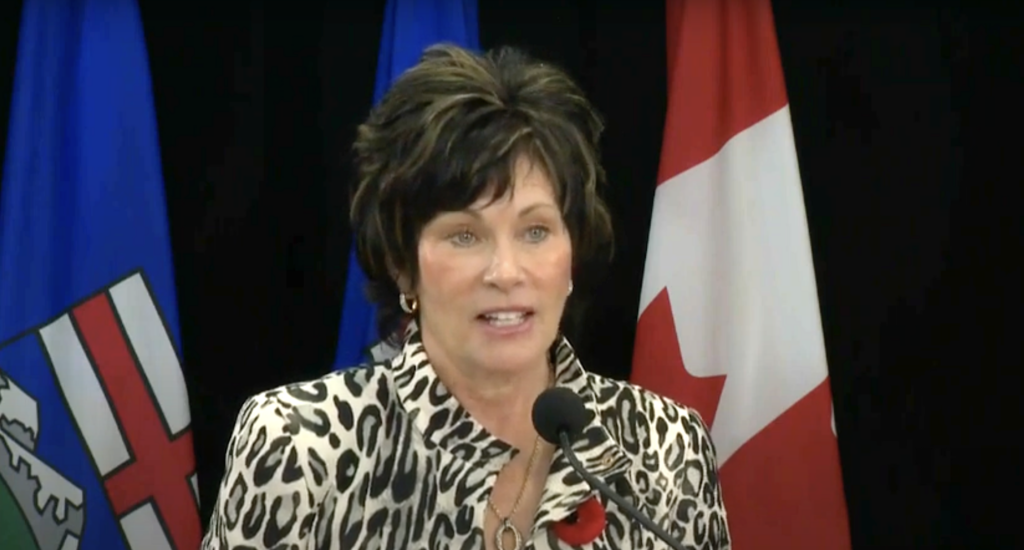
Former Alberta energy minister Sonya Savage has said bill C-59 will result in ‘green hushing.’ Credit: CPAC / YouTube
The MLI paper’s authors are former Alberta energy minister Sonya Savage and Heather Exner-Pirot, the institute’s director of Energy, Natural Resources and Environment.
DeSmog previously reported on Savage’s public statements about her belief that the anti-greenwashing law was “silencing” Canada’s oil and gas sector. Savage was formerly a senior executive with the Canadian Association of Petroleum Producers (CAPP), as well as Enbridge, a multinational pipeline company. Exner-Pirot is well-known for her fossil fuel advocacy as much as for her campaigns on behalf of the MLI against everything from an emissions cap to electric vehicles.
Both Savage and Exner-Pirot have made misleading statements in the past concerning various legislative efforts to control carbon emissions. For example, Exner-Pirot published op-eds criticizing the federal government’s electric vehicle (EV) mandate and characterized it as a quota, among several inaccurate statements about EVs in general. Savage has described C-59 as part of a global effort to silence Canada’s energy sector and that the regulations constituted an indirect ban on fossil fuel advertising, neither of which are true.
The Macdonald-Laurier Institute presents itself as a non-partisan and independent think tank, but is, in fact, part of the Atlas Network. Like Atlas, it has received funding from the Koch Brothers, and generally opposes government regulations — particularly on environmental issues or as they relate to the energy sector. MLI counts among its donors CAPP, Imperial Oil, Canadian Energy Pipeline Association and the Canadian Fuels Association, among others.
MLI has considerable access to mainstream Canadian media and routinely criticizes the environmental movement, attacking efforts to curb emissions as responding to climate change “alarmism.”