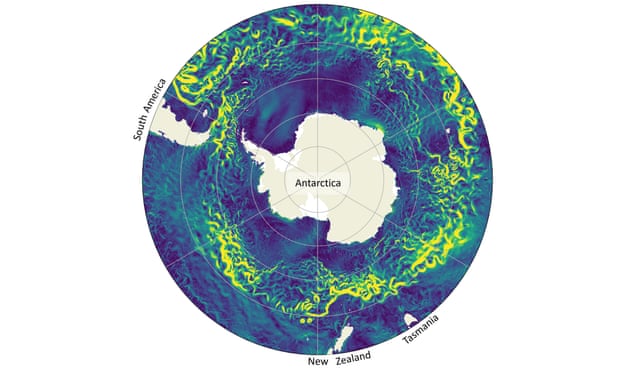
Melting Antarctic ice is releasing cold, fresh water into the ocean, which is projected to cause the slowdown
In a high emissions future, the world’s strongest ocean current could slow down by 20% by 2050, further accelerating Antarctic ice sheet melting and sea level rise, an Australian-led study has found.
The Antarctic Circumpolar Current – a clockwise current more than four times stronger than the Gulf Stream that links the Atlantic, Pacific and Indian oceans – plays a critical role in the climate system by influencing the uptake of heat and carbon dioxide in the ocean and preventing warmer waters from reaching Antarctica.
Using Australia’s fastest supercomputer and climate simulator, Gadi, located at Access National Research Infrastructure in Canberra, the researchers used climate models to analyse the impact of changing temperature, ice melting and wind conditions on the Antarctic Circumpolar Current.
The results, published in Environmental Research Letters, revealed a clear link between meltwater from Antarctic ice shelves and circumpolar current slowdown, and comes less than a week after another paper anticipated a weakening in vital Atlantic Ocean currents.
What they found suggested a “substantial reconfiguration of Southern Ocean dynamics”, with “far-reaching impacts on global climate patterns, oceanic heat distribution, and marine ecosystems”.
Co-author Assoc Prof Bishakhdatta Gayen, from the University of Melbourne, described the result as “quite alarming”.
He explained that as melting Antarctic ice released cold, fresh water into the ocean, this sank and spread towards the equator. That flow of fresh water changed the density variation in the ocean, a key driver of movement, causing the slowdown.
“The ocean is extremely complex and finely balanced. If this current ‘engine’ breaks down, there could be severe consequences, including more climate variability, with greater extremes in certain regions, and accelerated global warming due to a reduction in the ocean’s capacity to act as a carbon sink,” Gayen said.
…
See the original article at https://www.theguardian.com/environment/2025/mar/03/antarctic-circumpolar-current-slow-down-ice-melting-climate

Leave a Reply