Year: 2025
Humanity’s Chance to Reverse Amazon’s Slide Toward Tipping Point Is ‘Shrinking’
Original article by Eloise Goldsmith republished from Common Dreams under Creative Commons (CC BY-NC-ND 3.0).

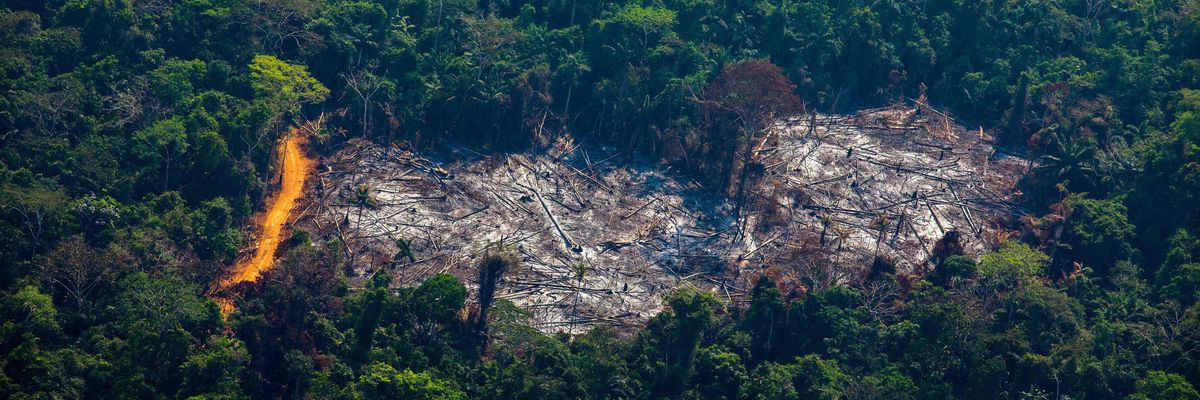
This aerial view shows Amazon forest degradation in the Menkragnoti Indigenous Territory in Altamira, Pará state, Brazil, on August 28, 2019. (Photo: Joao Laet/AFP/Getty Images) The world’s largest rainforest showed “ominous indicators,” including wildfires and extreme drought, in 2024.
The Amazon, sometimes called the “lungs of the planet,” this year showed signs of further inching toward a much-feared tipping point, threatening the very existence of the world’s largest rainforest.
Rampant wildfires and extreme drought ravaged large parts of the Amazon in 2024. The fires and dry conditions were fueled by deforestation and the El Niño weather pattern, and also made worse by climate change, according to the World Economic Forum. “The number of fires reached its highest level in 14 years this September,” the group reported in October.
Drought has also impacted the Amazon River, causing one of the river’s main tributaries to drop to its lowest level ever recorded, according to October reporting from The Associated Press. The drop in the river has negatively impacted local economies and food supplies.
Andrew Miller, advocacy director at Amazon Watch, told the AP last week that the fires and droughts experienced across the Amazon in 2024 “could be ominous indicators that we are reaching the long-feared ecological tipping point.”
“Humanity’s window of opportunity to reverse this trend is shrinking, but still open,” he said.
The Amazon plays a vital role in keeping the planet healthy. 150-200 billion tons of carbon are stored in the Amazon, and it also carries 20% of the earth’s fresh water to sea.
According to the World Economic Forum, if the Amazon tipping point is reached, “it will release billions of tonnes of CO2 into the atmosphere through fires and plants dying off. This would further exacerbate climate change and make the 1.5°C goal impossible to achieve. It would also alter weather patterns, which would impact agricultural productivity and global food supplies.”
A paper published in the journal Nature in February indicates that up to half of the rainforest could hit a tipping point by the middle of the century. “We estimate that by 2050, 10% to 47% of Amazonian forests will be exposed to compounding disturbances that may trigger unexpected ecosystem transitions and potentially exacerbate regional climate change,” explained the researchers behind the paper.
However, it wasn’t all bad news out of the Amazon in 2024. According to the AP, the amount of deforestation in Brazil and Colombia declined in this year. In Brazil, which houses the largest chunk of the Amazon, forest loss dropped 30.6% compared to the year prior, bringing it to the lowest level of destruction in nearly a decade.
The improvement is an about-face from a couple of years ago, when the country registered 15-year high of deforestation during the leadership of former far-right President Jair Bolsonaro. Brazil is now led by the left-wing President Luiz Inácio Lula da Silva, who—despite presiding over this drop in deforestation—has also come under scrutiny, as AP noted, by environmentalist for backing projects that they argue could harm the environment.
Original article by Eloise Goldsmith republished from Common Dreams under Creative Commons (CC BY-NC-ND 3.0).
Sanders Lays Out Plan to Fight Oligarchy as Wealth of Top Billionaires Passes $10 Trillion
Original article by Jake Johnson republished from Common Dreams under Creative Commons (CC BY-NC-ND 3.0).

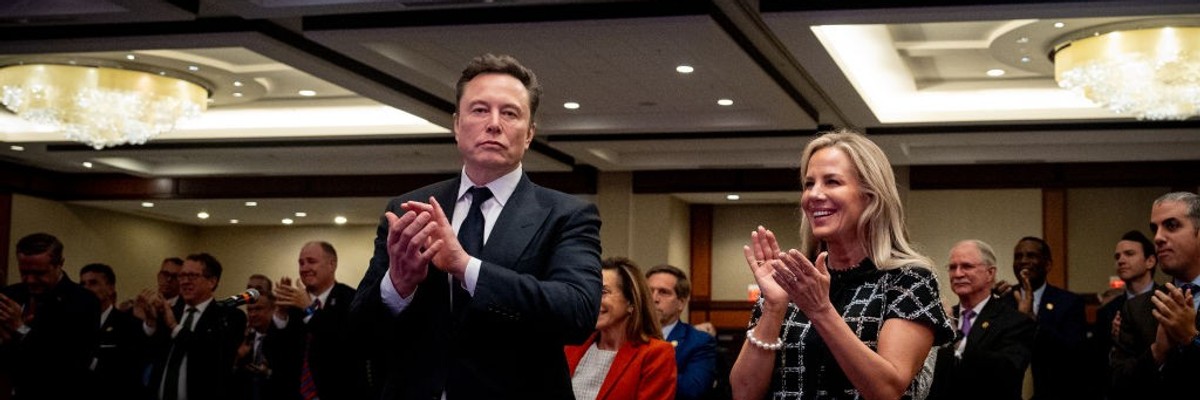
Elon Musk and the wife of House Speaker Mike Johnson (R-La.) applaud during a House Republican Conference meeting on November 13, 2024 in Washington, D.C. (Photo: Andrew Harnik/Getty Images) “If there was ever a moment when progressives needed to communicate our vision to the people of our country, this is that time,” wrote Sen. Bernie Sanders. “Despair is not an option.”
A Bloomberg analysis of billionaire wealth published Tuesday found that the combined fortunes of the 500 richest people on the planet surpassed $10 trillion this year, a finding that came shortly after U.S. Sen. Bernie Sanders issued an urgent call to action to prevent the emergence of “an oligarchic and authoritarian society.”
The new analysis notes that the world’s top 500 billionaires “got vastly richer” this year with the help of “an indomitable rally in U.S. technology stocks.”
Just eight billionaires—Elon Musk, Mark Zuckerberg, Jensen Huang, Larry Ellison, Jeff Bezos, Michael Dell, Larry Page, and Sergey Brin—added more than $600 billion to their collective wealth in 2024 and accounted for 43% of the $1.5 trillion increase in net worth among the world’s 500 richest people, according to Bloomberg.
“But it was Musk—the so-called ‘first buddy’ of President-elect Donald Trump after unprecedented support for his reelection campaign—who dominated the world’s wealthiest in 2024,” Bloomberg observed, adding that Trump himself also saw his fortune surge to a record high this year, “boosted by the performance of his majority stake in Trump Media & Technology Group Corp.”
Musk’s use of his enormous fortune to influence the U.S. political system—including via his purchase of one of the world’s largest social media platforms and donations to Trump’s 2024 campaign—amplified existing concerns about the corrosive impact of massive wealth concentration on democracy.
And wealth inequality in the U.S. could soon get worse, with Trump and the incoming Republican-controlled Congress set to pursue another round of tax cuts for the ultra-rich and large corporations.
“They do not believe in democracy—the right of ordinary people to control their own futures. They firmly believe that the rich and powerful should determine the future.”
In an email to supporters on Monday, Sanders (I-Vt.) called the rapid shift toward oligarchy in the U.S. “the defining issue of our time,” warning that billionaires have come to increasingly dominate not only “our economic life, but the information we consume and our politics as well.”
“A manifestation of the current moment is the rise of Elon Musk, and all that he stands for,” Sanders wrote, pointing to Musk’s outsize influence on the 2024 election and his key role in shaping Trump’s billionaire-dominated Cabinet.
“But it’s not just Musk. Billionaire owners of two major newspapers overrode their editorial boards’ decisions to endorse Kamala Harris, while many others are kissing Trump’s ring by making large donations to his inauguration committee slush fund,” the senator continued. “They do not believe in democracy—the right of ordinary people to control their own futures. They firmly believe that the rich and powerful should determine the future.”
Progressives, Sanders wrote, have a “radically different vision,” one that prioritizes “an economic system based on the principles of justice,” “a vibrant democracy based on one person, one vote,” and making “healthcare a human right.”
“Even though we are not going to succeed in achieving that vision in the immediate future with Trump as president and Republicans controlling Congress, it is important that vision be maintained and we continue to fight for it,” wrote Sanders.
Since Trump’s victory in the 2024 election, Sanders has focused heavily on the need to organize the working class to combat the threat posed by Musk and other far-right billionaires who have amassed obscene wealth and political power.
In his email on Monday, the senator said he intends to “travel, organize, hold events, and create content that reaches people where they are” in the coming weeks as part of the “struggle to determine where we go from here.”
“Will this effort be easy?” asked Sanders. “No, of course it will not. Can it be done? We have no choice. If there was ever a moment when progressives needed to communicate our vision to the people of our country, this is that time. Despair is not an option. We are fighting not only for ourselves. We are fighting for our kids and future generations, and for the well-being of the planet.”
Original article by Jake Johnson republished from Common Dreams under Creative Commons (CC BY-NC-ND 3.0).
As it fights Israel’s war in Jenin, can the Palestinian Authority be saved?

Palestinian Authority (PA) security forces use tear gas to disperse a protest against their security operation, in Jenin in the Israel-occupied West Bank, on December 16, 2024 [JAAFAR ASHTIYEH/AFP via Getty Images] The latest news about the Palestinian Authority’s so-called “Protecting the Homeland” operation in the Jenin refugee camp paints a grim picture. Nine Palestinians have been killed in the ongoing crackdown which began on 5 December, including a young journalist, Shatha Al-Sabbagh.
The campaign, as reported by the Israeli newspaper Haaretz, has, not surpisingly, received a stamp of approval from the Israeli occupation army, which seems content with the PA’s performance. Meanwhile, Israel’s Channel 14 confirmed that the occupation regime has issued a clear deadline for the PA to finish the task of effectively eradicating what remains of legitimate resistance in Jenin, in the name of ending “lawlessness” and apprehending “outlaws”.
It is an irony that has become all too familiar: the Palestinian entity that was supposed to represent the will of the people and lead them towards freedom has become complicit in crushing resistance in one of the most marginalised and impoverished areas of the Israeli-occupied West Bank, all while serving the interests of the occupation state. This is the heart of the Palestinian paradox in the West Bank.
For years, the PA has demanded unflinching obedience from the Palestinian people in the name of preparing Palestine for sovereignty and statehood. Yet, as the years have passed, this pledge has slipped further and further away. In its place, the PA has become complicit in the expansion of Israel’s territorial control and the erosion of Palestinian rights. This might be a difficult conclusion to digest, but the killing of innocent Palestinians in Jenin at the hands of Palestinian security forces, while Israel and its settlers are cracking down on Palestinians elsewhere in the West Bank, should be all the proof needed to support such a conclusion.
READ: Rights groups urge Palestinian Authority to end campaign in Jenin
Moreover, the PA’s strategy of appeasing Israel through “security coordination” has done little to hinder Israel’s systematic land grab and the continued construction of illegal settlements. On the contrary, such “coordination” has emboldened Israel and its lawless settlers.
The PA has become a tool of the Israeli occupation
What is perhaps more damning is the fact that the PA has often become an active participant in the Israeli oppression of Palestinians, as is happening in Jenin today. In its role as an enforcer of Israeli policies, the PA has become a tool of the Israeli occupation, tasked with quelling political dissent and silencing critics.
The latest operation in Jenin is a clear manifestation of how Israel uses the PA to do its dirty work. The Jenin refugee camp, an area of less than half a square kilometre, has always been a symbol of Palestinian resistance. According to the Palestinian Ministry of Health, Israel has raided Jenin 80 times in the past year alone, killing at least 220 Palestinians and wounding hundreds more. Yet, Jenin remains unbowed. To now see the PA working in concert with the Israeli army to break the will of Jenin’s 23,000 inhabitants is a deeply painful reality for most Palestinians.
What complicates this crisis even further is the silence of many Palestinian intellectuals, both in the West Bank and the diaspora, who have failed to confront the PA with the same vigour with which they criticise the Israeli occupation. Why have so many prominent voices, intellectuals and political analysts remained mute on the issue of the PA’s betrayal of the Palestinian struggle?
The answer lies in a complex mixture of fear, political pragmatism and historical inertia. For decades, the PA has maintained a stranglehold on the political landscape of Palestinian life. It controls the levers of power, and anyone who dares to challenge its authority risks being silenced, through arrests, imprisonment, torture or worse. Palestinian intellectuals, particularly those in the West Bank, are all too aware of this reality.
OPINION: For the first time, Palestinians abroad publicly criticise the Palestinian Authority
Moreover, there is a deep sense of paralysis within the Palestinian intellectual community in the occupied West Bank, in part due to their leadership’s failure to confront Israel over the ongoing genocide in Gaza. But there is more to this ongoing paralysis.
For years, the PA has framed itself as the “sole legitimate representative” of the Palestinian people. Many intellectuals who would normally criticise Israel’s occupation are unwilling to take on the PA for fear of further fragmenting the Palestinians. There is a deep-seated belief among some that a public confrontation with the PA would lead to greater disunity, which could play into Israel’s hands.
This political pragmatism comes at a heavy cost. While many Palestinian intellectuals hesitate to criticise the PA, they are forced into a position of complicity with its actions. The PA’s betrayal of the Palestinian cause is no longer a matter of debate, it is a fact. Yet, by failing to confront this betrayal head-on, intellectuals and activists alike risk forfeiting their moral credibility.
The betrayal of the PA has been laid bare for all to see
In the face of Israel’s genocidal war on Gaza and unprecedentedly-violent crackdowns on Palestinians in the West Bank, the betrayal of the PA has been laid bare for all to see. Its willingness to assist in the subjugation of Palestinians in the West Bank, while pretending to represent them, has exposed the institution like never before.
Can the PA be saved? The answer may not even matter. What matters is whether the Palestinian people, with their collective will and resistance, can liberate themselves from Israel’s settler colonialism and the moral corruption of their self-proclaimed leadership. The events of the coming weeks and months will be decisive.
OPINION: Palestine and the power of the boycott movement
The views expressed in this article belong to the author and do not necessarily reflect the editorial policy of Middle East Monitor.
This work by Middle East Monitor is licensed under a Creative Commons Attribution-NonCommercial-ShareAlike 4.0 International License.
Palestinian Authority security forces kill female journalist in Jenin
Original article republished from peoples dispatch under a Creative Commons Attribution-ShareAlike 4.0 (CC BY-SA) license.

Shatha al-Sabbagh. Photo: Social media Shatha al-Sabbagh was shot in the head by a sniper a day after interviewing victims of the Palestinian Authority’s security campaign in the Jenin refugee camp.
A sniper from the Palestinian Authority’s security forces killed female journalist Shatha al-Sabbagh in Jenin refugee camp on Saturday, December 28. Shatha (22) was on her way to a grocery shop close to her house along with her two little nephews, her mother, and a sister-in-law, when the sniper shot her in the head, according to Shatha’s mother, who witnessed the incident.
The bereaved mother held the Palestinian Authority’s security forces fully accountable for murdering her daughter. She also considered the incident a targeted assassination as a barrage of bullets was fired by the security forces at people in the street, who tried to rescue Shatha, including her mother.
Shatha’s mother believes that her daughter was killed deliberately because the day before her death, she had interviewed families in Jenin refugee camp as part of a report. Among the people she interviewed was the family of a child who was killed by the PA’s security forces, and a family whose house was set on fire by the forces during its ongoing campaign against the camp.
Shatha’s father also said during an interview with the local news platform Falasteen Post that the street where they live and where Shatha was killed, has been under full control of the PA’s security forces for over 26 days, and that no resistance fighters have been present there during that entire period. Her father’s testimony refuted the claims of the PA’s security forces, who claimed that Shatha was killed by one of the fighters affiliated with Jenin Brigade.
Shatha’s brother-in-law, Suhaib Merei, whose two little children, his sister, and his mother-in-law (Shatha’s mother) were with Shatha when she was shot, reiterated the same circumstances about the killing incident. Merei added that the sniper was only 20 meters away from where Shatha and the rest of family were standing.
He added that unlike the rest of the camp, where the electricity has been cut off by the PA for around one month, the street lights were working because the street has remained under the control of the PA’s security forces since the campaign began. Therefore, the sniper was able to distinguish that those walking were three women with two babies.
For his part, the spokesperson of the PA security forces, Anwar Rajab, condemned the killing of Shatha and accused “outlaws” of being responsible for the crime, a claim which has been refuted by Shatha’s family.
On Monday, December 30, Rajab refused to have a discussion with Shatha’s mother on Al Jazeera Mubasher. Once he saw her on the air, he withdrew from the interview. Rajab justified his withdrawal and refusal to confront Shatha’s mother by saying that he was not informed that she would be part of the interview. The Palestinian security official accused Al Jazeera of being unprofessional, and further explained that he was unwilling to discuss anything about the incident with Shatha’s mother considering her current emotional condition.
PA’s siege of Jenin refugee camp
The PA began a large-scale security campaign in Jenin refugee camp in early December, which explicitly aims at prosecuting what the PA calls “outlaws”. Though, according to analysts and Palestinian grassroots, the campaign seeks to crush resistance groups within the camp in collaboration with the United States and Israel.
Residents of Jenin refugee camp have accused the PA’s security forces of killing six Palestinian citizens in the camp since the beginning of their campaign. The murdered citizens include Mohammad al-Amer (12), Majd Zeidan (16), Ribhi Shalabi (19), Shatha Sbaagh (22), Mohammad Abu Libdeh (25), and Yazeed Jaysah (28).
Residents have also reported that as part of their campaign PA’s security forces have shut off water and electricity in several areas. Some have reported that houses have been targeted by rocket-propelled grenades (RPGs) and set on fire by the forces. People in the camp labeled the stifling siege imposed on them as a “collective punishment”.
It is worth mentioning that the PA has reportedly prohibited foreign media outlets from entering the camp and that all reports coming out from there are being posted online by activists, journalists, and residents, including the families of the victims, or via local media outlets.
Meanwhile, the PA mourned five personnel of its security forces stating that they were killed in clashes with “outlaws” during the campaign carried out in Jenin refugee camp.
In an attempt to cover up the crimes committed in the camp, the PA’s government institutions have allegedly called their staff to participate in demonstrations to show support for the security campaign against Jenin refugee camp. In addition, videos attributed to some Palestinian security personnel were posted online, showing them bragging about verbally and physically abusing Palestinian citizens, who reportedly criticized the PA’s campaign in Jenin on social media networks.
Despite the fact that Israel has violated all peace treaties signed with the PA, including the Oslo Accords for decades, the PA has continued to submit to Israel’s endeavors in the West Bank. The ongoing campaign in the Jenin camp, seemingly on behalf of the Israeli Occupation Forces which are simultaneously carrying out the genocide in Gaza, has further eroded the PA’s legitimacy among the Palestinian people as a body advocating for the Palestinian people and their liberation.
Original article republished from peoples dispatch under a Creative Commons Attribution-ShareAlike 4.0 (CC BY-SA) license.